Free country: means your dreams can come true here. Right?
Not exactly an accurate reflection of the country in which we currently live. And if anyone tries to tell you that politics don’t belong in theatre and you believe them? I’ve got some oceanfront property in Nebraska to sell you. Once belonged to Abraham Lincoln too. It’s a fiery, unprecedented world in which we currently live and Laurel Mill Playhouse is stepping up to the plate with their current production of Stephen Sondeheim’s Assassins, as co-directed by Phillip Wong and Michael Hartsfield, with musical direction by Mimi McGinniss.
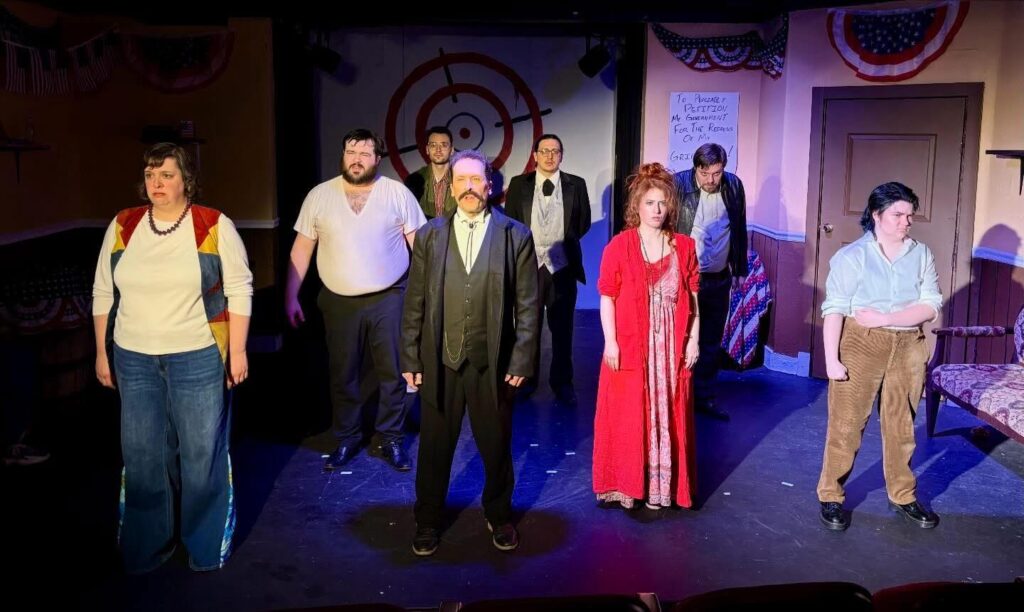
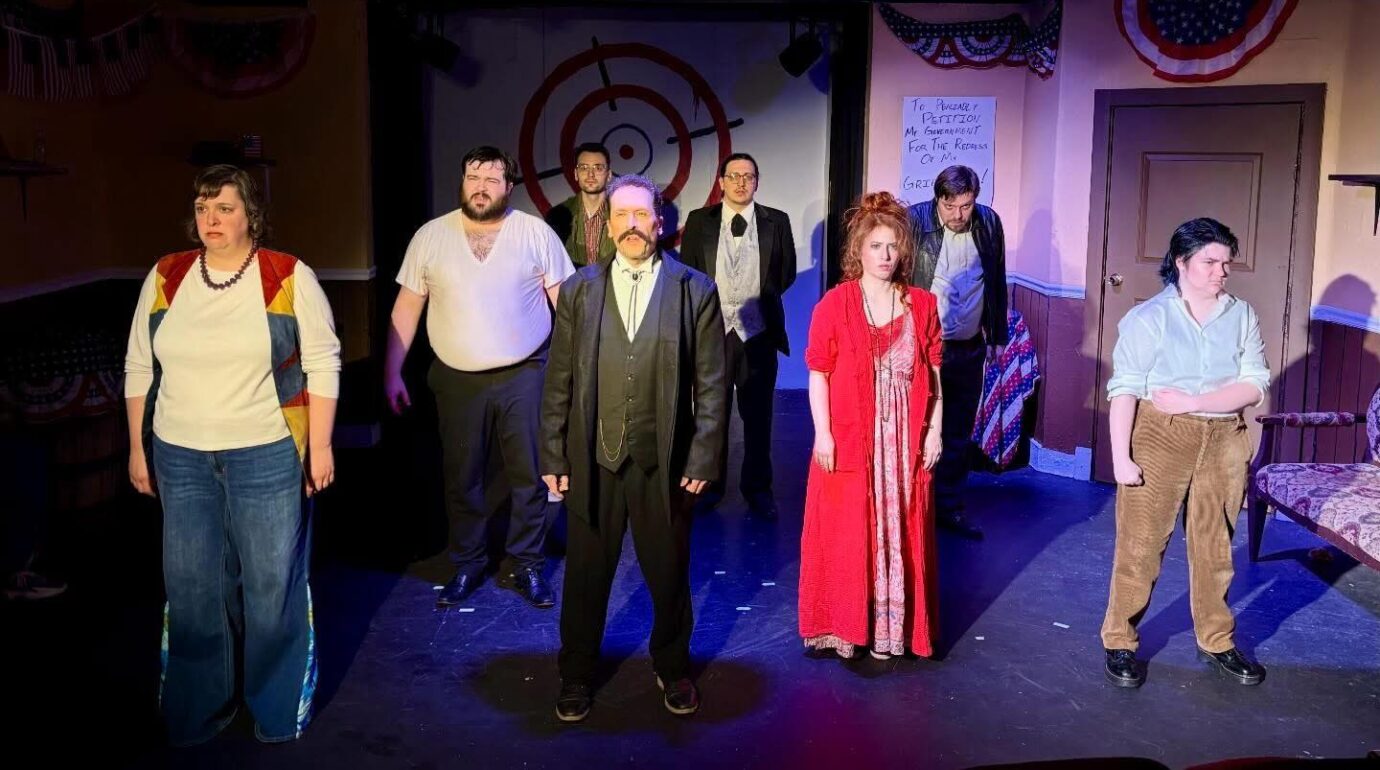
I’ve seen Assassins a good half-dozen times and I’ve seen a lot of different theatre companies do a lot of different things with it, and while for the most part, the LMP production is pretty textbook (with the exception of the Neil Patrick Harris-standard of doubling up The Balladeer and Lee Harvey Oswald) what they do for the staging of the final number— “Everybody’s Got the Right (Reprise)”— is bone-chilling in a deeply unsettling way. I don’t want to talk about it with any real detail because it would spoil the effect— but this conceptualization and how Phillip Wong and Michael Hartsfield handle the blocking and what exactly happens in that moment, particularly the final moment, is striking and really, really powerful. It speaks volumes about the world in which we live and is a horrifically accurate reflection of how people are finding themselves in situations that they never could have imagined. (If you really want to know— and it is both tastefully handled and smoothly executed— you need to see the show!) It really hits home with Glennyce Lynn, the housewife character, and one other character in particular and their exchange.
The production isn’t without some questionable choices, in particularly Marge McGugan and Nicole Johnson’s costumes, which feel a little uneven. While its implied that the ‘ensemble’ is meant to be ‘through the ages’ what pieces do get fitted upon this group of seven are a bit of a hod-podge, with some looking too modern beyond their timestamp and others having the right feel but wrong era too them. This is a minor detail and is really only noticeable because of the intimate staging at the playhouse. Co-director Phillip Wong doubles up as the show’s set designer (with a community theatre village helping on build, paint, and decoration) and it’s a serviceable set. The inside of a DAR-Hall or Town Hall or any other place where stars-and-stripes bunting and banners hang with pride. What makes it special is the wall shelves that flank either side of its contained space. Because all of the trinkets of their stories— the Assassins— are there or end up there…like the Czolgosz’ bottle, Moore’s KFC bucket, the radio in Oswald’s book depository. It’s a really clever nod to this museum-like notion that these artifacts shaped history. Wong and Hartsfield are also responsible for the show’s lighting design, which is used to great emotional effect throughout the performance, though the yellow-jaundice light that hits Booth towards the end of “The Ballad of Booth” looks more sickly than perhaps the cowardice-bath that was intended.
But limited production-value missteps aside, Musical Director Mimi McGinniss and Co-Directors Phillip Wong and Michael Hartsfield bring together a strong team of both live musicians in the pit (concealed backstage and pretty-well balanced— except for that hot clarinet mic— featuring: McGinniss on keys, Ralph Burrows on trumpet, Adria Boss on woodwind, Jonathan Gibson on percussion, Andre Cutair on guitar/bass) and live performers on stage. The ensemble (featuring Taylor Cusack, Leonard Dinerman, Kira Judish, Katherine Lang, Glennyce Lynn, Patrick Pase, John Umali) create a lively musical atmosphere for numbers like “How I Saved Roosevelt” though their true shining moment is their feature number, “Something Just Broke.” Standouts from the ensemble include Leonard Dinerman as the various presidents (the paper masks were good choices, though for consistency’s sake they should have used one for Gerald Ford. I understand the intention was for Squeaky and Sarah Jane to ‘not recognize him’ but it felt odd to have the other presidents in paper-mask but him not) and also Kira Judish when she plays Sarah Jane’s child. The tantrum over the Bubbalo Bill ice cream is a totally praiseworthy scene-stealing moment. Glennyce Lynn, as previously mentioned, shares the most powerful moment of the production with the Oswald character at the very end of the show but she also doubles up as Emma Goldman and her speaking interactions with Czolgosz feel fiery and well-delivered.
In this production, The Proprietor (David Jackson) feels as if he serves less of a purpose than in other incarnations, though whether this was intentional or not is unclear. Jackson’s opening bid during “Everybody’s Got The Right” feels sublimely carnival-huckster with that ready-to-roll verve of snake-oil salesman, particularly as he’s handing out period-appropriate (ish…and shout out to Wong, Hartsfield, Nicole Johnson, and Marge McGugan on prop-replicas here) looking guns to the various assassins. But the ever-present puppet-master component of Jackson’s character sort of vanishes after that opening number and while he does reappear from time to time, there’s just a strong wish for the actor and the character to have been utilized more.
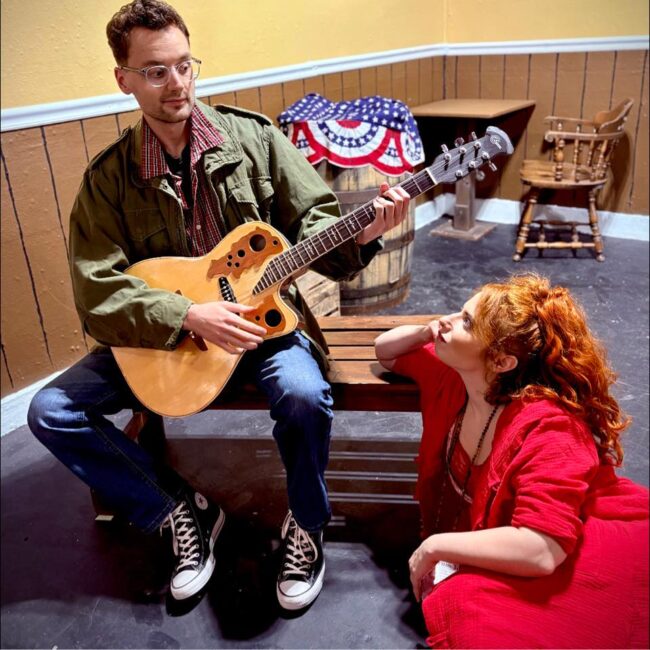
The Balladeer (Nick Yarnevich) is a fascinating character, though in this production, not having him dual-split as Lee Harvey Oswald is a curious choice. (It may be that this particular licensed version doesn’t call for that or it may be a Wong-Hartsfield choice, which it is, remains to be seen.) Yarnevich has a strong voice and a very emotionally expressive face. Watching his journey trajectory as the character grows more and more disheartened is a really satisfying experience though you feel cheated out of the reward when he doesn’t then become Lee Harvey Oswald. (That in no way, shape, or form should be a reflection on Yarnevich’s performance he does a fine job in the role and really engages with the audience, particularly during “Another National Anthem” and you can see him emotionally losing the struggle-fight between hope and despair; it’s intense!) Connor Wright, as the aforementioned, LHO, isn’t give a solo musical number (write to the estate of Sondheim or librettist John Weidman for complaints on that one) but his intensive acting work in that book-depository scene is really unsettling. The facial expressions that Wright portrays creates an angsty turmoil with which the audience engages and you find yourself sitting on a very prickly cactus of discomfort watching the weight of that moment weigh heavily upon him as the others coax and convince him.
If you’re looking for the two performers who read most closely to their historical counterparts, you’ll find them at LMP in Melanie Kurstin’s portrayal of ‘Squeaky’ Fromme and Thomas Digby’s John Hinckley Jr. Though they couldn’t be more opposite in their presentation, with Kurstin making Squeaky this off-the-rails cult-obsessee and Digby making Hinckley this deeply-troubled, albeit internalized, incel, they get foisted together in a duet-apart for “Unworthy of Your Love” with Digby’s character singing about Jodie Foster and Kurstin’s character singing about Charles Manson. While you don’t see much of Digby’s character outside of that one big solo, everything he portrays is subtly nuanced, making him feel that much more dangerous and yet simultaneously worthy of sympathy and empathy. It’s a fascinating blend.
Kurstin, on the other hand, is a vibrant breed of feral, popping up in scenes alongside Jenny Gleason as Sara Jane Moore. While Moore delivers a much more level-headed portrayal, the pair wins comedy-moment-of-the-show with their gun-standoff, aimed at each other. There’s something earnest about the way Gleason plays her character, wholesome, almost like a midwestern mom, and something a little haphazard too. It, like Digby’s Hinckley, is a unique and intriguing blend to watch in action, especially when she’s trying to react and respond to some of the off-the-wall cult-based nonsense flying out of Kurstin’s character’s mouth. Kurstin has a sublime sense of stage presence, oozing in and out of her handful of scenes like beachy driftwood, totally vibing to that ‘mellow cults are the only way’ feeling.
Declan McGinniss, as Zangara, and Mytheos Holt, as Czolgosz, do respectable jobs of holding their respective characters’ accents. McGinniss has a burning passion that comes out with vocal fortitude during “How I Saved Roosevelt”, attached to this blasé existence once he’s seated in the chair. He’s also great at working the stomach-pains of his character into his physicality. Holt, as the bottle-making immigrant, has a striking voice that really gives light and vivacious fury to both his leading segment of “The Gun Song” (a traditional trio alongside Booth and Guiteau, though at this performance Sarah Jane Moore is added to make it a quartet) and in his handful of lines sprinkled into “The Ballad of Czolgosz.” If there’s a head-tilting questionability to Holt’s character choice it’s the intentional wheeze he layers into the character. (It’s not present when he sings or speaks.) It’s very clearly meant to represent the side-effects of laboring in the hot bottles factory, but it’s overdone, to the point of distraction in certain scenes (and it may be that it’s only noticeable if you’re in the first few rows but it’s discomforting and not in a theatrical way.)
With spunk and calamity, Anthony Case takes up the role of Charles Guiteau and really does have the audience agreeing with Garfield when the president calls him a mad man. There’s an award oiliness to Case’s approach with Guiteau, really hitting on the “I want to sell my book” as reasons for doing what he’s doing. Case has a smooth voice, and handles the tempo and style changes of “The Ballad of Guiteau” with an air of ease. He also really gets that zany mentality moving behind the more up-tempo moments in that number. In a shadowy sense, he’s almost like a foil to Booth (John Rose) who serves as the more down-to-earth, wholly driven an focused assassin among the bunch. Rose’s Booth, who one could arguably say in this performance is more of a puppet-master and narrative figure than either The Balladeer or The Proprietor (the Balladeer in this production seems to serve as more of a “voice of justice, reason, democracy”, which sets up sublimely that ‘action’ at the end of the show.) While Rose’s voice blends solid amongst the other three performers in “The Gun Song” it’s his speaking interactions, both in his eponymous ballad and when he’s engaging with Oswald that are truly riveting.
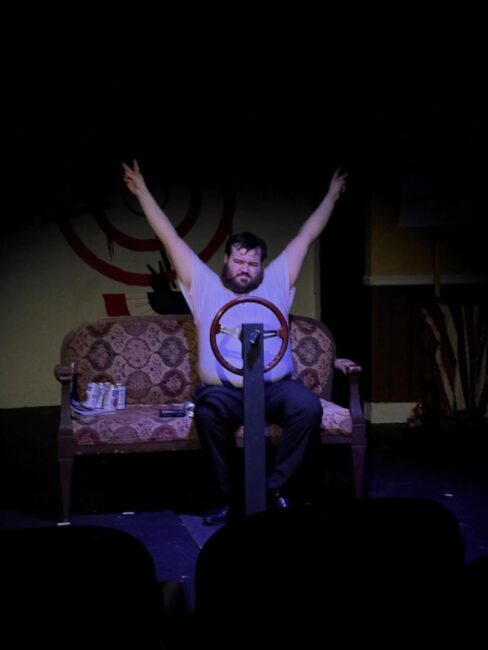
Hands down the standout of the production here is Robert Howard as Sam Byck. And while the Samuel Byck character isn’t given a solo song— but rather two epic monologues— you can hear Howard’ voice superbly during “Another National Anthem” and it’s an enriching vocal feature for that very harrowing song. Howard understands the nuance of the Sam Byck character, and really delves into the beats of the text, delivering this two monologues to theatrical perfection, navigating the ups and downs, the frenetic build of energy, emotion, and volume with seasoned experience. When the character explodes, it’s frightening in Howard’s hands. There’s a nervousness, blended with an ire, mixed with a despair, mingling with chaos in his portrayal of these two monologues and it’s stunning and evocative to watch. It’s never just starting at angry and exploding a little angrier; it’s a whole track and ride with Howard’s Byck and it steals the show.
All you have to do is move your little finger…by tapping it on the ticket link here at the bottom of this review… to get yourself tickets to see Assassins. (Please note below some weekend nights during the run of the production do not have actual performances, read the dates carefully.)
Running Time: 2 hours with NO intermission
Assassins plays through May 3rd 2026 (with no performances on Sun 4/5, Fri 4/17, Sat 4/18, Sun 4/19, and Sun 4/26) at Laurel Mill Playhouse— in the heart of historic Laurel at 508 Main Street in Laurel, MD. Tickets should be purchased in advance (though walk-ins are welcome!) and are available by calling the box office at 301-617-9906 or in advance online.