We are here to discover what no one has ever seen.
And The Maryland Ensemble Theatre’s penultimate mainstage production of 2025/2026— Arthur Miller’s The Crucible— is unlike any Crucible you’ve ever seen before. It’s a disquietingly innovative hot-take on the production that universally presents it as an everyman tale, wholly investing the ensemble in the story’s narrative burden whilst simultaneously reflecting the harsh reality of the present-day world in which we live— but subtly, with a tour-du-force of theatrical engagement, and a soundscape that creeps into the bones and rings you until you leave.

You will discover what no one has ever seen before with this harrowing and disturbingly beautiful performance that can most-accurately be described as ‘Not-Your-Daddy’s Crucible. Directed by Julie Herber— jiminy, all one can say is buckle-up, you’re in for the a theatrical roller coaster ride that twists and spins and snaps from start to finish in a raw and refreshing manner.
The brilliance of this production comes from the movement-based brainchild of Director Julie Herber. It’s not just in the signature dance-infused-movement stamps that Herber places on the piece (of which there’s exactly the right amount, sprinkled liberally and evenly at exacting moments all throughout the performance) but her overall conceptualization and deconstructed-reconstruction of Arthur Miller’s work. It isn’t quite a dizzying chaos of ‘script-in-a-blender’ as it still follows Miller’s initial linearity but my gosh do you feel like you’re watching a gorgeously disjointed Frankenstein’s monster recreation of the text. Watching a well-known play reanimate with such brilliant, revitalizing intent is life-affirming, even if it’s harrowing and disquieting and wholly uncomfortable to do so.
Herber transforms the story by universally redistributing the weight of the narrative to all twelve performers, really driving home the notion that this is everyone’s story— be them active participant, innocent bystander, or somewhere trapped in the primordial purgatory in-between. And she does so with sensational results. Multiple actors— even those with more ‘featured-identified’ roles— deliver lines of minor characters, there’s an entire scene where everyone except John Proctor becomes the voice of Reverend Hale and it’s such an intensely suspenseful setup and delivery (defies proper description because it’s this intense effort of Herber’s blocking and overall conceptualization, Kaydin Hamby’s Sound Design and Doug Grove’s Lighting Design all amalgamating into one sublime scenic experience) that it could arguably be the defining moment of the show. There’s another moment when the walking stick of Giles Corey makes its way from one end of the dozen performers to the other— every performer lays hands on that stick signifying that every single one of them could be, was, and is Giles Corey. It’s deeply profound and strikingly effective. And the show is blanketed and moments like that.
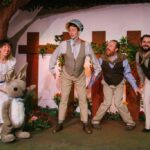
There’s also the aforementioned movement component, another indescribable phenomenon because there’s so much happening with it— like the drive-run between John and Elizabeth late in the second act with various performers acting as physical barriers impeding their progress or the dizzying way they chase one another around the central pole as they have one of their initial argumentative disagreements— you really ought to see the show twice, or even thrice, just to try and wholly experience it all. The cast is perpetually in motion— even in moments of stillness and that’s breathtaking in its own right— and they’re almost exclusively always on stage, even if they’re tucked away in the shadows of the woodworking of Cody James’ scenic design. Don’t be fooled by the rustic simplicity of James’ set; it’s both purposeful and loaded with intention of making this show exist everywhere in time.
The design team for this production broke the mold, knocked it out of the park, pick-a-phrase-of-praise-and-insert-it-here— because the synergy flowing between lights, sound, set, props, and costumes is unprecedented. Salem Witch Trials may be the textual timestamp but non-descript semi-countryside, partial dark academia with nods to colonial New England and yet still hints of modernity are what define Logan Benson’s costume design. Drab earth tones, nothing bright, nothing significant to differentiate one character from the next (that’s left to little components like the Giles Corey walking stick or a character’s physical affectation) so that that unifying thread of ‘everyone’s story’ weaves wholly through the show’s aesthetic. Lori Boyd follows suit with her two noteworthy props being the poppets and those Jacob’s ladder-style hanging signs that all say ‘John’ on them. Doug Grove’s lighting is eerie and unsettling, which matches step for step the intent behind this production. And while all of the design elements are extraordinary in this show, if one had to be selected to be ruler of ‘production creativity’ it’s Kaydin Hamby’s sound design. Crafted in a cinematic fashion, so that it’s underscoring practically every moment of the performance, Hamby fabricates an unearthly aural landscape that paints unredeemable dystopian vibes into your mind. Hamby’s work blends divinely with the vocalizations happening from the cast as well— be it chanting in tongues, whimpers, wuthering wind sounds, or the unmistakable nightmare-fuel yelps created by Jennifer Pagano— and in the few moments where Hamby’s work is silenced, the effect is jarring.
Nuance and subtlety and clarity of vision is what sets this production a step above, in addition to having a dozen superbly talented performers acting as an ensemble in this production of The Crucible. Julie Herber’s understanding of the space, her articulation of her vision and her ability to mirror reality in the work without didactically smacking the audience in the face with the intention behind it is stellar. Blocking John and Elizabeth Proctor at the front of the playing space, apart and facing only out to the audience as they speak a very intense and intimate conversation with one another is genius. Having the ‘young girls’ swirl about various characters in certain moments as if they are the spirits themselves is haunting. The repetitive and collective whisper of ‘lies’ strikes a cord that shakes into the soul as you witness and hear it. There are often cacophonous moments of sound and movement that rise, vibrating the action to a gut-clenching crescendo— it’s like living in an immersive horror-thriller. And Herber takes care that certain lines land just so— not too forcibly but not glossed over— to really drive home how very relevant this play is to today’s society. A personal favorite, and delivered so delicately, is the line “…a person is either with the court or must be counted against it.”
Unified as the ensemble— Lucy Campbell, Candace Clagett, Karli Cole, Victoria Davidson, Bill Dennison, Shea-Mikal Green, Katie Martin, Jeremy Myers, Jennifer Pagano, Reiner Prochaska, Jean Rosolino, Joe Waeyaert— are frenetic on their on-stage existence, both in moving and in stillness, in vocalizations, words, and silence. It’s feral and yet realistic and visceral watching certain moments pop. There’s a thread of dark humor that glides beneath it all— almost invisible but glimmering in a moment or two here or there just so that you don’t get crushed under the unyielding gravity that this show now exudes. It’s an earnest struggle to describe the sheer brilliance of the experience without doing a play-by-play (and if Herber and her superior Stage Management Team of Eli Bendel-Simso (SM) and Olivia Pietanza (ASM) can draw this production to a tight two-and-twenty including an intermission, I’m going to attempt the same courtesy) of every blessed thing happening on stage.
One of the most effecting and haunting scenes are the ‘girls’— Lucy Campbell (as Betty Parris), Karli Cole (as Mercy Lewis), Jennifer Pagano (as Susanna Walcott), Victoria Davidson (as Abigail Williams), and Candace Clagett (as Mary Warren) in the courtroom scene in the second act. The vocalizations, textual delivery, and overall engagement and movement of this bunch in that scene will pull you to the edge of your seat and have you holding your breath until it’s finally over. Pagano should be noted for her vocalizations in other scenes, which will be haunting like nightmare fuel if you linger on them too long, and Cole for her animated facial and bodily expression. Campbell, who spends a lengthy portion of the opening scene stiller than stone is unsettling to watch in that moment because of how she sustains that immobility. Williams, as this really disquieting figure has a moment with John Proctor (shout out to intimacy consultant Mallory Shear) that is both beautiful and disturbing. And Clagett’s Mary Warren is versatile in both her back-talk to John Proctor and the way she crumbles in the court-room; the panic attack meltdown she’s exhibiting is all put physically palpable.
There’s a lot to be said for Katie Martin (primarily Tituba/Hawthorne) and Jean Rosolino (primarily Rebecca Nurse) as well. Watching Martin all but combust when being set upon by the voices of authority (initially Reverend Hale) is so unsettling that the urge to jump up and save her from the madness is overwhelming. This is a full uno-reverse when you get to her character in the jail cell in the second act because the level of eerie-becalmed that she has become will put your teeth on edge. Rosolino has moments of hope bright in her voice and also gets a line or two here and there (though not as Rebecca Nurse) that dare you to chuckle (a much needed, carefully articulated mechanism in this production.)
While all members of the ensemble voice a whole host of characters, Jeremy Myers (as Rev. Parris), Bill Dennison (as Rev. Hale), Reiner Prochaska (as Danforth), Shea-Mikal Green (as Elizabeth Proctor) and Joe Waeyaert (as John Proctor) have the most consistent commitments to their assigned characters. Watching Jeremy Myers progress through the three defining stages of Rev. Parris is a micro-cinematic experience all its own. You could rewatch the entire production and focus solely on his stage presence and feel like you were getting a whole show on its own. The dread and anxiety that cripples his physicality, facial expressions, and overall body language and textual delivery in those opening scenes— fearful of scandal, worried for optics— could not be more opposite to his smug, prosecutorial approach to Reverend Parris as John Proctor comes to court. There is a sanctimonious sense of achievement when things appear to be going in his favor— predominantly expressed in this unholy grin that Meyers has perfected. And this goes as much against his opening bid as a character as it does the way you find Reverend Parris near the end; desperate, unspooled from hope and faith, resigned; it’s a real ride and a half to watch.
Dennison, as the good Reverend Hale, waddles down a bendy rabbit hole all his own, starting off on the surface as ‘on the side of what’s right’ until the blindfold of righteous is stripped away. The thing that is most notably enjoyable about Dennison’s portrayal of this character is the minutia that he imbues— a nervous drumming finger-tap that is perpetual in multiple scenes, a slight droop in the shoulders that pulls the character figuratively and physically inward, the tendency to play him meager and ‘smaller’ rather than parading him around as a grand figure— which ultimately makes him a fascinating watch and experience. You get similar, but again uno-reverse style, traits from Reiner Prochaska when he embodies Danforth. Though like everyone, Prochaska takes up others, particularly before Danforth is introduced in the second act, he spends most of his time hovering over the other characters like an ending storm cloud of piety and legality; masquerading loudly as the Danforth-version of justice. It’s intense.
What’s most fascinating to me about this production is that Elizabeth Proctor (Shea-Mikal Green) and John Proctor (Joe Waeyaert) almost become background players in their own story. The myopic historical lens of ‘looking at Arthur Miller’s The Crucible’ would have us believe gospel that John Proctor is the tragic-hero-protagonist and Elizabeth his supporting sidekick. Julie Herber keeps them simultaneously in the foreground and the background of this story and the experience is sublime. Green has these moments where her lively eyes betray a world of text that her lips are never permitted to speak. Waeyaert has the exact opposite happening, where he’s almost got this deadpan face, void of expression and emotion and yet his words are fully charged— yet another accurate reflection (cleverly layered into the work as a whole) on the way our country ranks the power of men versus women. The cacophonous crescendo that Waeyaert achieves in those final moments, shouting about his name is soul-spiking. Watching Green struggle in that moment where she’s not allowed to address or see John Proctor while being viciously questioned by Danforth (again the creativity behind the blocking there is feral and I’m her for it) is painfully intense.
The popping-pulsation scene (once you see it, you’ll know) is one of my favorite pieces of movement in the production; on the whole, as theatre show, it’s the most stellar reimagining of a classic to hit the stage in quite some time whilst still staying strikingly true to the source text. Evocative, theatrical excellence incarnate, The Crucible will strike differently when you see it at The Maryland Ensemble Theatre this spring.
Running Time: 2 hours and 20 minutes including one intermission
The Crucible plays through April 26th 2026 on the Main Stage of the Maryland Ensemble Theatre in the Historic FSK Hotel building— 31 W. Patrick street in downtown historic Frederick, MD. For tickets call the box office at (301) 694-4744 or purchase them online.