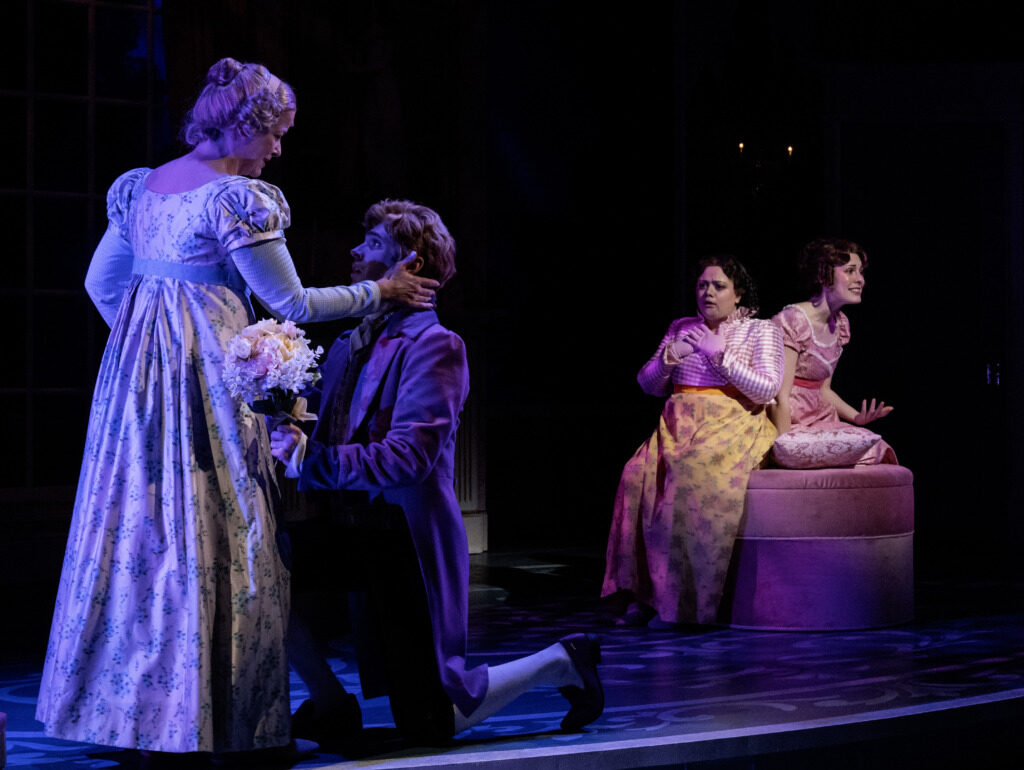
You can’t control everything, Emma! But isn’t it fun to watch her try!? Yes! Yes it is! And far more than fun— it’s practically a divertissement of the most jubilant nature; it’s a rather uproarious, madcap enjoyment! Emma, the Jane Austen classic— as recently adapted by Kate Hamill for maximum rom-com tomfoolery— is situating itself onto the Everyman Theatre main stage as the final production of the 2025/2026 season. Directed by Laura Kepley, this zinging delight of a reimagined rom-com is a perfect burst of giggles set in the adored Regency realm and will give you a heartfelt splendid evening of humorous theatrical endeavors.
We see you, Kate Hamill! Out here, having that meta-self-awareness, bringing live-time comedy, misquotes a plenty, and all that jazz right up into the midst of one of Jane Austen’s most beloved Regency novels of the time. Hamill transforms Emma into something wholly humorous, thoroughly enjoyable for those who love the source material, those who love to laugh, and those who have perhaps never been exposed to Jane Austen. The way she reconstructs the novel into a digestible hilarity, complete with zany moments of madcap modernity that hint just enough at the present day without ever truly wrecking out of the Regency era setting is sublime. Hamill also has that one moment of deep sincerity when everything falls apart, allowing the audience to dwell in the melancholic beauty of earnest pathos before zipping back to the shenanigans for which her adaptations are so heartily known.
Color the creative team coordinated because they’ve got matchy-matchy themes and approaches going on in spades all across the various design elements of the production. Lighting Designer Juan M. Juarez, Costume Designer David Burdick, and Scenic Designer Daniel Ettinger are all on the same proverbial page when it comes to color schemes, period themes, and this sense of elegance through aesthetic beauty. And the sliding pink parlor wall, which effortlessly matches Emma’s primary dress, is both functional and funny; Ettinger has ensured that it gives you that sense of perky interior whilst simultaneously creating humor when Emma literally has to shove it out of the way to change the scene.
David Burdick utilizes a color scheme in his sartorial selections that matches personalities; the garish sun-bright yellow is perfectly suited for the equally loud Harriet Smith while that icy blue affair featured on the seemingly frigid Jane Fairfax is a perfect fit for the character. There’s a regal and almost cheeky shade to the purple seen on Frank Churchill, and of course the aforementioned pepto-pink that bathes both Emma and the parlor is sentimental, passionate, confounding, and everything that defines the titular character at her very core. And Burdick shows an adept understanding of the Regency era fashions, not only with all the empire waistlines but with those glorious spencers that are showcased once we all go berry-picking with Knightley.
You get a lot of lovely accents from Juan M. Juarez’ lighting design but the most stunning example coming readily to mind is the teal wash for that striking moment where both Emma and George are put into their respective places. Yes, the show is high-octane comedy and non-stop shenanigans, but there is one scene, quite late in the second act, that forces an emotional reckoning to the surface and Juarez’ teal-bath approach to that moment is truly sublime. And speaking of sublime, Jane Shaw’s sound design rips the show right out of the early 1800s and drops it into the 1980s, at least musically. And it’s an excellent choice. The party vibes— particularly the dancing— really sends the audience into fits and peels of laughter and giggles and you even get some of those iconic party dance moves, compliments of choreographer Shalyce Hemby. It’s a racy and vivacious choice that is perfectly suited for this production.
Director Laura Kepley drives a pace that would put the Epsom Derby to shame, keeping the scenes meticulously mobile and fluidly rolling along, which only aids in augmenting Kate Hamill’s humorous approach. Kepley, working with Dialect Coach Gary Logan, Dramaturg Robyn Quick, and Fight-Intimacy Coach Lewis Shaw, delivers a resplendently balanced production that is well-saturated in comedy, be it physical or witty. Kepley makes exquisite use of callbacks, plays up (but carefully and truthfully) the self-awareness of the play, and allows the actors to work their magic with both text and physical interactions with one another, the scenery, and the overall riding vibe of the production. It’s most enjoyable— particularly when it comes to “Mother”…the uncredited character, Mother of Miss Bates (who at various points in the performance is played by…whichever actor isn’t currently engaged in scene or about to be); the acute humors worked into that bit are simply smashing. As is the ‘hat-hovering-person-holding’ for Mr. Elton whenever that actor is otherwise engaged. Kepley understands the farcical nature of the show and works it for all its worth, and might I add to exceptional success.
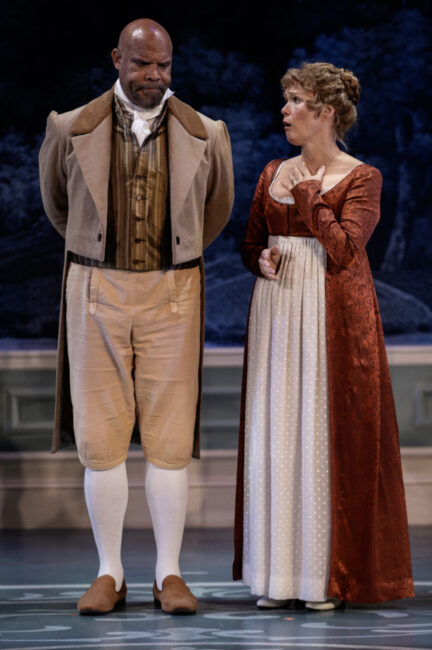
With an octet of performers, half of whom are pulling double+ duty in their roles, you certainly get a great many opportunities to laugh and enjoy all of the antics which surround Emma, both play and person. Jefferson A. Russell, who serves as both Mr. Weston and Mr. Woodhouse, delivers a striking physical differential between the two characters, and although his upright subtleties are none-too-subtle when it comes to presenting his son, Frank Churchill, it’s the grousing grumpiness over the gru-el when he plays Mr. Woodhouse that you’ll remember most fondly. (Shoutout again to dialect coach Gary Logan for that specificity!) Hobbling around the stage in a manner most befitting of an elderly character, Russell hardly need say the word ‘gruel’ before the on-stage players and half the audience is groaning amidst their laughter.
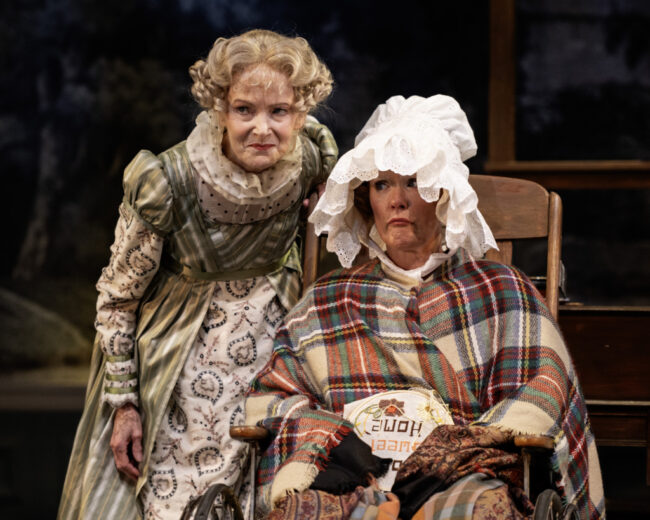
The Miss Bates (Helen Hedman) character does her fair share of fussing, though in a gloriously admirable fashion over Jane Fairfax… JANE FAIRFAX! *harrumph* Hedman’s triumphs in the role are well-witnessed whenever she’s interacting with “Mother” (who spends a great deal of time— no matter which actor is in the chair— mutteringly hilarious incoherent vocalizations and rattling limbs about) though the moment she absorbs all of Emma’s verbal abuses is truly harrowing and watching her just stand and drink it all in does tug admirably at the heartstrings. Of course it’s balanced on the other side with the parrot-squawk routine that Hedman shares with the Harriet character. When they’re all in the sitting room singing Jane’s praises in Emma’s general direction, she starts the repetitious clucking of “Jane, Jane, Jane…” sounding much like a deranged fowl, which causes the actor playing Harriet Smith to follow suit, resulting in hysterical laughter from the audience, much to the consternation of furious Emma.
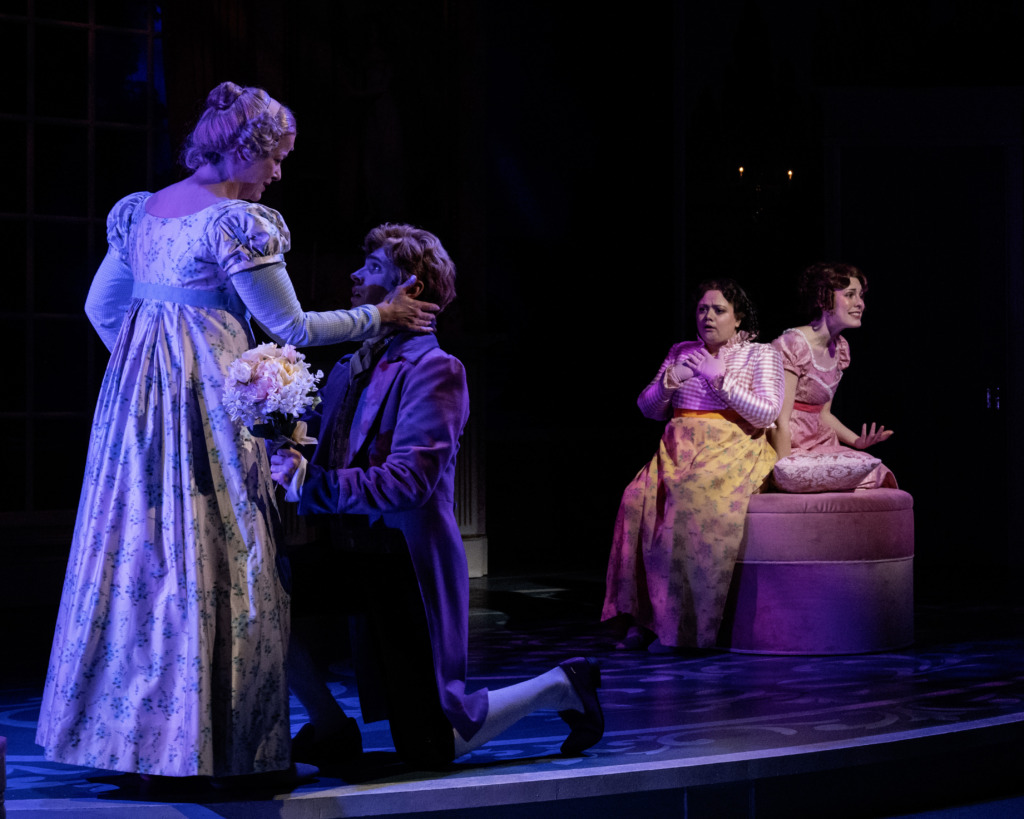
Mrs. Weston (Beth Hylton) might be considered the catalyst character in Emma or perhaps the Deux ex Machina or some beautiful hybrid of both as the character is the starting point for Emma’s deluded notions in believing she’s an exquisite match-maker and also ends up serving as the ‘fixer’ come the show’s conclusion. (It’s an Austen novel so HEA is essentially guaranteed if not wholly implied.) Hylton, particularly when she’s dancing with Mr. Weston, knows how to cut a rug. Her comedic delivery, especially when making zippy little comments about the situationship that is George and Emma, is perfection. And in her moment of reckoning clarity, Hylton delivers some of the most sage advice in the whole piece. The play is all fun and games with lots of witty one-liners, clap-backs, callbacks, and high wordplay, double entendre, and roaring nonsense, but when Hylton hits that moment, which her character spearheads amidst the George-Emma cutdown, it’s stunning.
If you want to talk flibbertigibbet-flavored fun, that’s all Nia Zagami and her approach to Harriet Smith. And the irony of her not being the brightest bulb in the set whilst being bedecked in blinding shades of sunshine and buttercup is lost on no one. There’s something utterly hysterical about the way Zagami takes to the character, really amplifying the nonsense that accompanies this simple woman. And when her character and Emma start engaging in secrets (even though it’s painstakingly obvious to the audience that they’re each talking about separate men and the obliviousness of Emma in that moment is driving the farcical humors) swapping their banters readily, there’s just this infectious bubbly energy that exudes from Zagami in the most effervescent fashion imaginable. That same energy morphs into comedic woes when Zagami’s flopped down on the cushion in the parlor, wallowing miserably about when things don’t go according to Emma’s plans and the whole notion that someone can be so blue but still be so brightly engaged is just extraordinary.
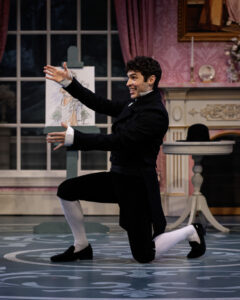
Tripling up as all the ‘young, eligible menfolk’ Zack Powell has his work cut out for him and my does he ever succeed in creating three distinctively loveable and simultaneously loathable bachelors. The audience Elton, he’s got the audience barrel-rolling with laughter, particularly once he gets to ‘making-out’ with Mrs. Elton (the incomparable queen of comedic chaos, Megan Anderson, though we’ll get to the second-hardest working woman in the show momentarily!) And while his overt advances in a certain misguided direction are high hilarity, it’s the way he swaggers with confidence when playing Frank Churchill that really captivates the eyes of the masses. Powell speaks with a sophisticated refinement when playing the Frank Churchill character, which serves as a nice contrast to the way he spouts purple pose and poetry, all flowery and melodramatic when playing Mr. Elton. The way he drifts through scenes, particularly as Churchill, is just glorious to behold.
Megan Anderson is the hardest working woman on stage, second only to Katie Kleiger as Emma. Tackling the role of the maid, frosty Jane Fairfax, Mrs. Elton, and at one point (possibly more than one point) ‘Mother’, Anderson is delivering a whirlwind of vastly unique characters all rolled up in one human being and she’s doing so phenomenally. There’s a scene— berry picking party, perhaps? Where Anderson is dashing about like a fool, playing Mrs. Elton, squealing and giggling like Olive Oyl met Fran Drescher at a candy convention, physically racing all around the stage, only to dive off-stage into the house left corner and hit the perfect freeze-frame stillness as Jane Fairfax, as if she’d never been more than a delicate wallflower, cooler than a cucumber in early April. It’s uproarious and earns Anderson a thorough ovation from the audience. The dramatically drastic shifts in energy— at least in the way they’re outwardly presented— are astonishing and keep you both mesmerized, in utter awe of her versatility, and wholly amused each time she shifts from one to the next. And while Mrs. Elton may be her most over-the-top ridiculous, she lends something delicate and soft to Jane Fairfax that makes you truly feel for her in that role. And her dive into ‘Mother’ near the end is equal parts high-comedy as anything she’s doing as Mrs. Elton.
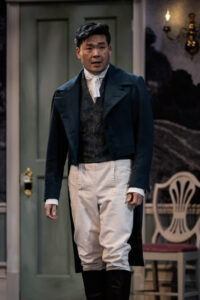
George (Tony K. Nam) and Emma (Katie Kleiger) are the epitome of spoiled childhood brats, perpetually picking on one another, playing not-nice with one another, teasing one another; it’s so flipping obvious they’re in love that everyone can see it but them! Right from the opening bid, where Kleiger is doing this sensational job of attempting to warm herself up to the audience as this narrative-soliloquizing fourth-wall-obliterating mistress of matchmaking (the OG-UK Dolly Levi, if you will, because believe me, Emma’s putting her hand in everywhere…except maybe into George’s berries…though that’s a discussion for another matter!) you get their bristling, burbling, volatile dynamic and it’s the baited hook that keeps you engaged. They barb, spar, and all but come to physical blows with one another at a perpetual rate all throughout the production and the chemistry between Nam and Kleiger is fierce. It’s also unique in that it reads simultaneously as frenemies, enemies-to-lovers, and fussy-siblings. The way they metaphorically dance all around each other’s affections is the perfect rocket fuel to jettison this play into rom-com orbit and it really sells the production.
Nam delivers— no question— when it comes to trying to keep Emma tied down to earth and also when it comes to pushing her buttons. But his funniest moments are perhaps his pantomimed violence of ways he’s going to go after Frank Churchill. And his infuriated outcry of said name is on the same bombastic and explosive level as Jane’s outcries whenever the name ‘Jane Fairfax’ crosses her lips. It makes for great laughter in the house. The play is not called ‘Knightley’ (a direct quote from Emma) but to be sure, Nam absolutely makes his mark on the performance. They have all these smaller moments earlier on in that “neener-neener-neener/raspberries” vein that just augment their passions toward one another, regardless of how respectively blind they are to it.
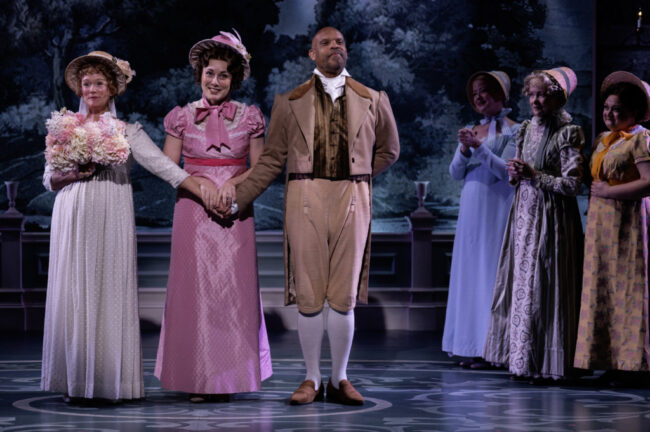
As the narrative presence, Kleiger is really doing wonders slipping in and out of the asides to the audience and the activated scene work wherein Emma must exist. She’s funny, cheeky, determined, wholly present, and essentially a little sparking ball of electrical static that just keeps accumulating jolts as the performance progresses. Everyone in the production has exceptionally well-delivered physicality and spatial awareness, though none more than Kleiger (though Anderson is definitely giving her a run for her money.) Vigorously aggressive, Kleiger’s Emma is everything the character could have been had Austen penned her with modern day sense and sensibility. But she’s also balanced. There’s a gravitational pull to make this character go too-far in the over-the-top vein and Kleiger toes that line, flirting shamelessly with it, but always maintains this side of realistic when it comes to being Emma, even when she’s yucking it up or yelling at the audience. It’s an extraordinary balance to behold in action.
A mind must have occupation or it will come to mischief. That’s true. Though why not both things? Occupy your mind with the delicious mischief of Everyman Theatre’s Emma and you’ll soon discover that not only does love have its own agenda but that love often knows best. And you’ll have fun and laughter every step of the discovery.
Running Time: 2 hours and 30 minutes with one intermission
Emma plays through June 14th 2026 at Everyman Theatre— 315 W. Fayette Street in the Bromo Arts District of Baltimore, MD. For tickets call the box office at (410) 752-2208 or purchase them online.