Lifting as we climb, onward and upward we go! The rallying cry of Suffs— women on the march! Women on the move! And these women will show you who they are as they march for justice, for freedom, for equality! And they’re bringing that march right through the heart of Charm City— to Baltimore’s Hippodrome Theatre! The First National Tour of Suffs plays a limited week-long engagement at The Hippodrome and it’s playing in one of the most crucial moments in history. Whoever thought that in 2026 we’d be pedaling backwards in a terrifying landslide of rights being rolled back, illegally stripped away, and on the brink of history attempting to repeat itself. But if Suffs proves nothing else— it proves that you never give up the fight. That hope shines eternal and the cause is worth fighting for! Onward! Upward!
This Tony Award-winning musical (directed by Leigh Silverman), with music, book, and lyrics by Shaina Taub, is fierce, fiery, and feminine to the max! And its got a lot of glorious heart, inferno-blazing soul, and the message is loud and clear— the time is now, now is the time, and women are done waiting their turn!
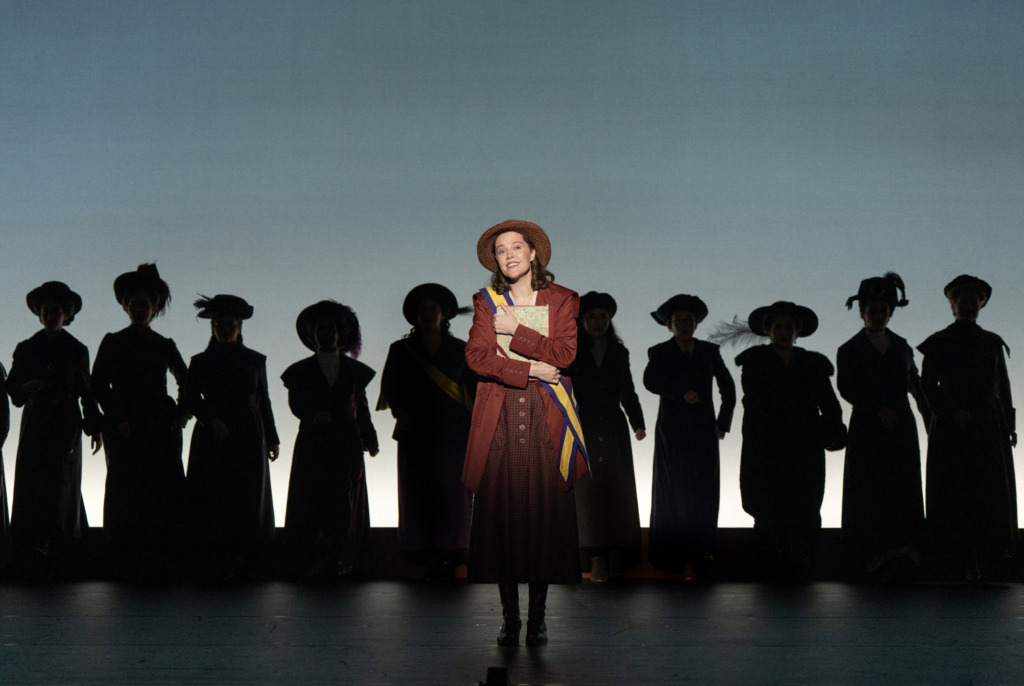
One of the most striking visual components of this production is the use of shadow and silhouette play (often created through backlight, tightly focused spotlight, and the overall use of live actors on stage out of the light as a whole) by way of Lighting Designer Lap Chi Chu. It’s both visually stunning and metaphorically excellent; showing how women are often forced to exist and be seen only in the shadows or as figures of the background. You get to see that technique first during “Finish the Fight” but often enough throughout the production that it settles into the aesthetic sublimely. Chu also deserves praises for the ‘fire’ light during “Fire and Tea.” It’s as emotionally evocative and progressively building as the women singin during that number.
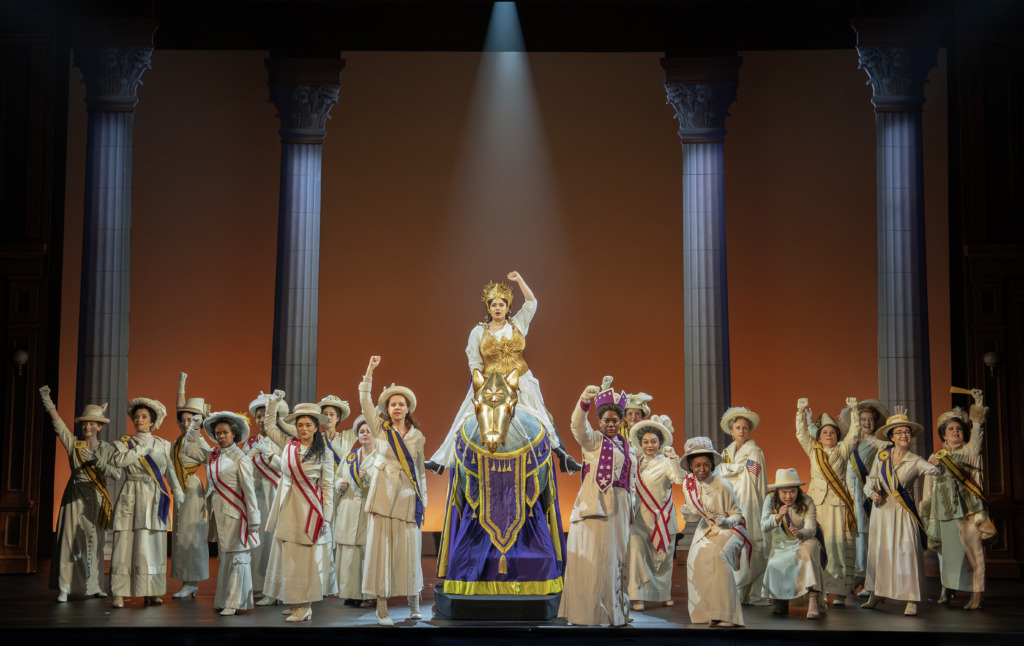
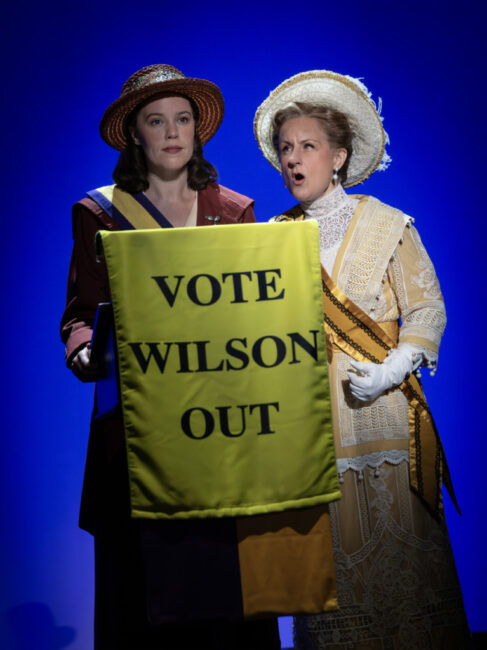
Capturing the sartorial vibe of the 1910s, Costume Designer Paul Tazewell gives an array of outfits— everything from the opulent furs and patterns featured on Alva Belmont and that warrior-riding-into-battle affair seen on Inez Milholland during “The March (We Demand Equality)” to the more ‘traditional’ garments of the Suffragists and their movement. The gold and purple sashes are an iconic touch and you get all of the period appropriate hats and footwear from Tazewell as well, firmly settling the show in that era’s time stamp.
From a scenic standpoint, Christine Peters (touring scenic design, working with the concepts from the original Broadway scenic design of Riccardo Hernández) is adding elegance to the show’s look and also allowing for that Broadway caliber feel when scenery naturally flies and glides in and out (as opposed to being manually manipulated.) The platforms— be they the overhang in congressional Tennessee or the railway station stairs where Inez Milholland makes one of her grandest moments— are the perfect fixtures to both physically and metaphorically elevate these women. The scenery, though beautiful, is simple and that best serves the show’s overall narrative.
While one could never accuse Suffs of being a ‘dance-heavy’ or ‘dancing-spalsher’ of a musical, choreographer Mayte Natalio has left her mark on the production without question. There is a great deal of intentional marching, often with strife-based gestures that accompany these determined movements in song. The physicality and overall dance-based movement in this production is as rigorous as the uphill battle that the women are fighting in its plot. Watching the interpretive ‘torture ballet’ featuring the leading Suffs during “The Report” is beautifully grotesque and accurately reflects the pathos of that very intense moment.
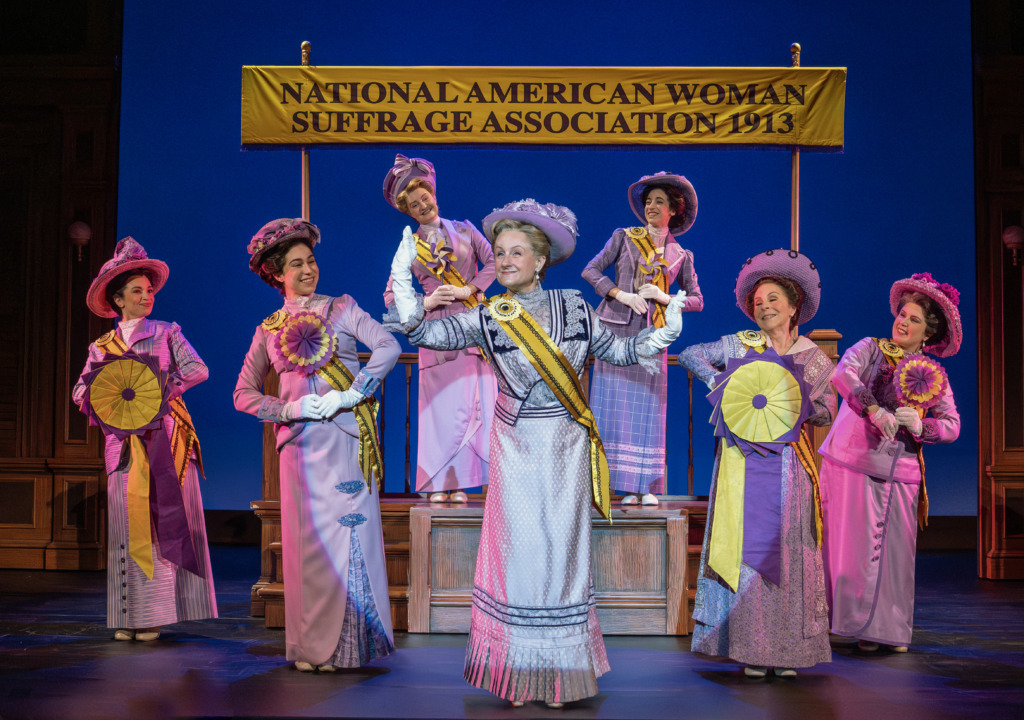
Shaina Taub’s work is stellar. There’s no better word for it. Evocative, gripping, moving— all of those, and even ‘stellar’ to a degree, feels like it falls short of the mark when one is trying to describe the sensation of experiencing Suffs. It is very much the historical sensation with cleverness in the lyrics, smartness in the musical composition, and all of those utterly impressive nuanced details that clearly earned Taube two Tony awards. Historical brilliance incarnate, telling HERstory in a way that never should have been swept under the rug as the textbooks have done for centuries; that is what Suffs is. And the hard-working company of 17 lets you know it every step of the journey. There are only four women credited as true ‘ensemble’ (Anna Bakun who also plays Speaker of the House, Marissa Hecker who also plays Dr. White/Mailman, {at this performance} Aquila Sol who also plays Major Sylvester/Senator Burn, and Gretchen Shope who also plays Mrs. Herndon) but you feel them in their moments. Sol does a superb job of turning a reflective moment of response into a pivotal zenith when playing Senator Burn reading over that telegram and Hecker has a moment of compassionate, albeit silent, understanding when she’s playing Dr. White in the prison scene. All 17 woman share one passion-driven spirit and it’s glorious.
Though Mollie Hay (Tami Dahbura) doesn’t have a number of her own, per say, you get that really beautiful ‘unspoken’ dynamic, which very, very briefly becomes spoken at the end of “If We Were Married (Reprise)” a duet that gets shared with Dudley and Doris, between Dahbura’s Mollie and the Carrie Chapman Catt character. You see her flanking the CCC-character a fair bit throughout and although a lot of her interactions are simple one-line responses, you feel the weight of them, whether they’re humorous or deep.
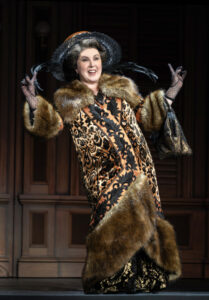
In a dueling princess track, Laura Stracko appears first as Ava Belmont and then as Phoebe Burn where her first appearance shows up brassy and hilarious, getting the NWP underway with her charitable donations. Stracko drops a cheeky one-liner here and there in this role— including “some of us not so young” at the top of Act II. But her true moment of radiant glory is the real game changer, playing Phoebe Burn. “A Letter From Harry’s Mother” is delivered with such purity of heart, such intentional gusto, and such unwavering pride of being a woman and deserving so much more than what the country has decided to give; it fires up the belly to tears and shouts. And in Stracko’s capable hands, it’s pure heart-fire.
If there’s a slick-talking, antagonist (not to be confused with the glorious agitators that are the Suffs themselves) it’s the Woodrow Wilson character, as played to perfection by Jenny Ashman. She’s smarmy, condescending, and yet charming in that you need a shower after interacting with the character sort of fashion. Ashman affects a physicality and vocality that just irritates and settles right into the skin of the Presidential figure. With an easy voice, Ashman almost wins the audience over with “Ladies” until you actually let the lyrics sink in; she does a divine job of razzle-dazzling, obfuscating and shillyshallying all around the important bits. And when she gets to ‘narrate-sing’ through “The Report” its purely villainous. There’s also something hilarious about the way she approaches the character.
Standing alongside the President, Dudley Malone (Brandi Porter) is the epitome of office-lackey for the mid-1910s. Porter has a very physicalized way of moving and it’s uproarious. And when the meet-cute occurs in the bar between Porter’s Dudley and the Doris character, it has the audience in stitches. They sing brilliantly together for “If We Were Married” and its reprise but it’s solo, “Respectfully Yours, Dudley Malone” that really showcases Porter’s skillset and dedication to the role.
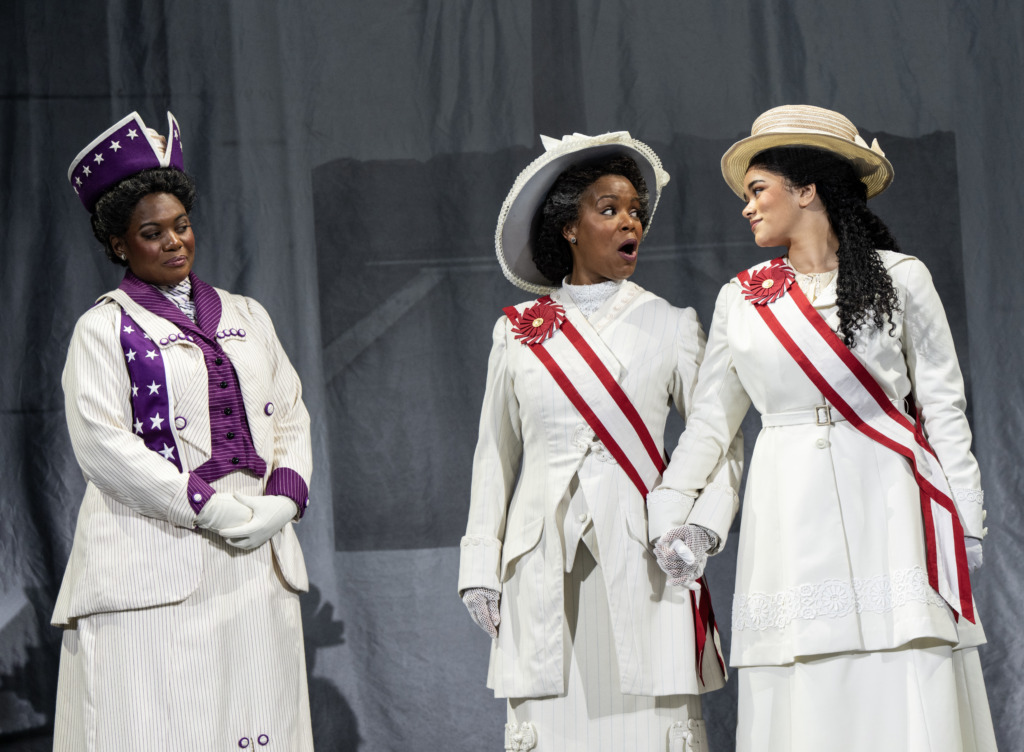
Mary Church Terrell (Trisha Jeffrey), daughter Phyllis (Victoria Pekel, who doubles up in the final-scene as that newcomer to the feminist movement, Robin) and Ida B. Wells (Danyel Fulton) have some of the most moving moments in the production. Jeffrey, whose character longs to play it safer than the agitating Wells, finds herself acting as the beacon of vocal hope during “Terrel’s Theme”, a song which she sings at Pekel’s character before encouraging her to sing along; it becomes an anthem and its brilliant. Jeffrey and Fulton have a really heated ‘show-down’ during “The Convention” and they harmonize sublimely. Fulton, as the iconic Ida B. Wells strides into the scene at the tail-end of “Find a Way” as if a narrative takeover were about to occur and she does so with such poised confidence and grace you’d absolutely follow her into revolution. There is an unmitigated intensity and a blast-melting powerhouse belt unleashed from Fulton when she blazes her way through “Wait My Turn” and you hear that again in spades, essentially every time she sings, like an indefatigable flame that flickers indefinitely as the show marches on.
You have this ragtag quartet of Suffs who form the primary corps of Feminine Fighters, all handpicked/decided upon by Alice Paul, their ferocious and unhinged leader. Ruza Wenclawska (Joyce Meimei Zheng), Doris Stevens (Livvy Marcus), Inez Milholland (Monica Tulia Ramirez) and her best friend from university, Lucy Burns (Gwynne Wood.) This quartet of sensational women are forces to be reckoned with, powerhouse beltresses, superior actors, and all-round sensations to behold in their respective roles. Marcus’ Doris bounces into he fray, almost by accident. She’s sweet, adorably naïve, but not without skill and pluck to contribute. There’s a dulcet nerdiness to her characterization and it’s that much more adorable once her character falls in with the Dudley character. You hear her sing-out best during her duets with Dudley, “If We Were Married” and her feature verse during “G.A.B.”
Receiving the assignation of the show’s lone-F-bomb is somewhat of an honor and that gets slapped squarely on the shoulders of Zheng’s Ruza and she owns it. With volcanic lava for fire in her belly, Zheng is not only fierce but funny and really understands the concept of deadpan comedic timing. With a superb hold on the Polish accent, Zheng gets a lot of ripe and poignant one-liners fired off throughout the performance and you’ll find yourself laughing in equal measure as you will clapping or gasping along with what she says. Vocally she’s a perfect blend for the harmonies during “Find a Way” and “Fire & Tea.” As Belmont says, she absolutely puts the ‘rage’ in Suffrage!
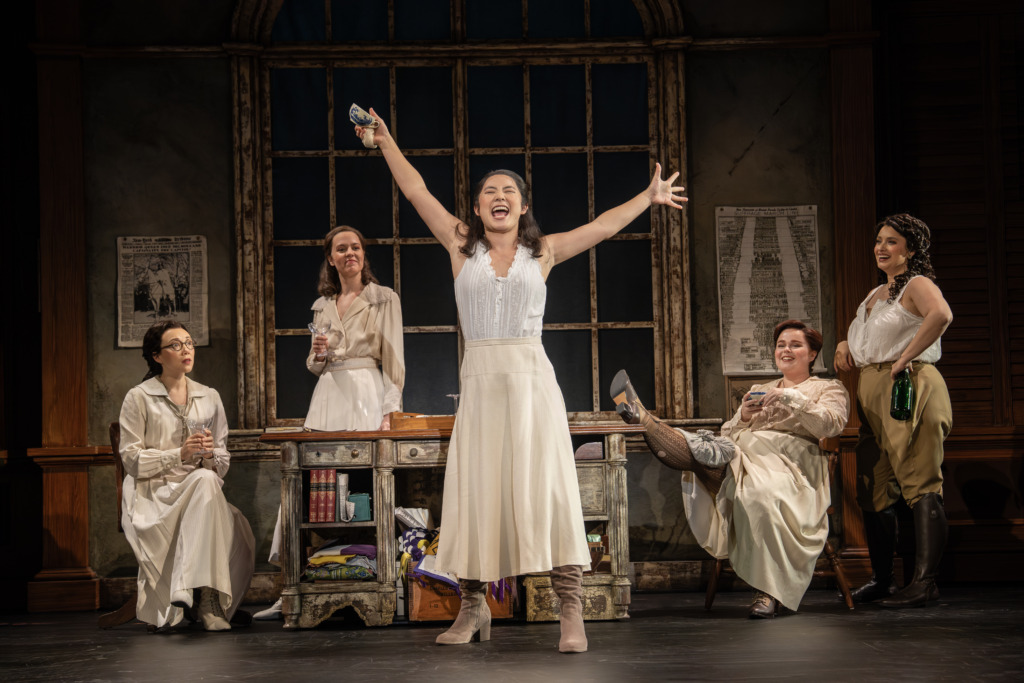
Bubbly and filling out the role of ‘supportive best friend’, Wood’s Lucy is that delightful supporting and necessary lift to keep Alice Paul on track. From the moment she flies into “Find a Way” with her little ‘don’t’ say two’ when asking how many of them are there through to when she takes off with her beautifully positive swan song “Lucy’s Song” you just get this convivial sense of sincerity and real camaraderie between her character and Alice. And she’ hysterical for her verse in “G.A.B.” sweet little protests to the ‘featured word’ and all.
A law onto her own, Monica Tulia Ramirez slays in the role of Inez Milholland. There’s a smoldering sass that drives her, a burning panache that guides her, and she creates this larger than life character that sucks up all the oxygen on the stage but in the most impressive way imaginable. There is an unwavering intensity that she brings to the character, even in that moment when you feel like she’s giving up and giving in during “Show Them Who You Are”, where Alice does most of the singing at her, you get this feeling that she’s exuding the eternal flame of the movement right from the very center of her heart and soul. And my goodness can she sing. You hear her voice ringing out loudly, proudly, and definitely with some spirit for “G.A.B.” and in every other feature, though the most harrowing is when she’s singing during “The Campaign” and again during that stunning reprise of “Show Them Who You Are” where she turns the tables back on Alice.
While Carrie Chapman Catt (Marya Grandy) feels like the enemy, she’s just a slightly different face of the same coin upon which Alice Paul (Maya Keleher) is fighting. But my God if Grandy doesn’t make it a glorious knock-down, drag-out, extremely civilized fight. Grandy gets the opening bid— a most important moment to grab the audience by the horns and pull them along with you— and she nails it, no question. There’s humor, a little resentment, but above all, a gloriously even, smooth, and bright sound ringing out for “Let Mother Vote.” But if you want to talk blazing battle-axes, it’s “This Girl” that puts her on the vocal and emotional warpath and she does it magnificently. The constant volatile, albeit civilly exercised, dust-ups between her character and Alice Paul are wildly feral and wholly captivating. You get the remnant echo of those feelings in the back-half of Act II during “She and I” where Grandy vocally holds her own against Keleher’s Alice.
Intense. Astonishing. Conflagrational. That third one might not even fully be a word, but she’s absolutely blazing up a conflagration that’s cause for alarm, this Maya Keleher in the role of Alice Paul. Shaina Taub may have originated the role but Keleher is putting her mark on the character and its not one that history is likely to forget. She’s spunky, with a hint of impetuousness, a sprinkle of madness, a whole lot of guts, gusto, and enthusiasm, and an undeniable talent that could crumble the patriarchy in a single belted blast. And she’s versatile as hell, traversing the incredible score that Shaina Taub has composed, giving a myriad of unchecked emotions every step of the way, engaging her body, facial expressions, and voice as immortal tools in her arsenal; it’s extraordinary. Keleher hardly ever leaves the stage so its nearly impossible to pick out her finest moments, though “Insane” and all of the powerhouse vocals, raw, unbridled, brutal emotions that come roaring out of her in that moment are pretty much the moment that makes the show. Her working dynamic with literally every other character on stage is authentic, feels grounded, and purposeful. And she carries perfect pitch, sublime tonal control, and full-force emotions every time she sings, whether it’s a solo number like the aforementioned “Insane” or “Finish the Fight” or when she’s blending with the others in literally almost every other number. Maya Keleher is servicing history tenfold in this role of Alice Paul and the world will know she’s creating something extraordinary.
So, women of the century, how long must we wait? Suffs won’t wait. This evocative, explosive powder keg of truth is a must-see. But it marches on— and it marches right on out of Baltimore on Sunday May 31st 2026. So don’t you wait to get your tickets!
Suffs plays through May 31st 2026 at The Hippodrome Theatre inside The France-Merrick Performing Arts Center— 12 N. Eutaw Street in Baltimore’s Bromo Arts District. Tickets are available by calling the box office at 410-837-7400 or purchasing them in advance online.
To read the interview with Maya Keleher on playing Alice Paul, click here.
RUSH tickets are available for all performances— $39 at the box office starting 2 hours before curtain. Limit two per person and tickets are only available for the performance the day you go to the box office for RUSH.