
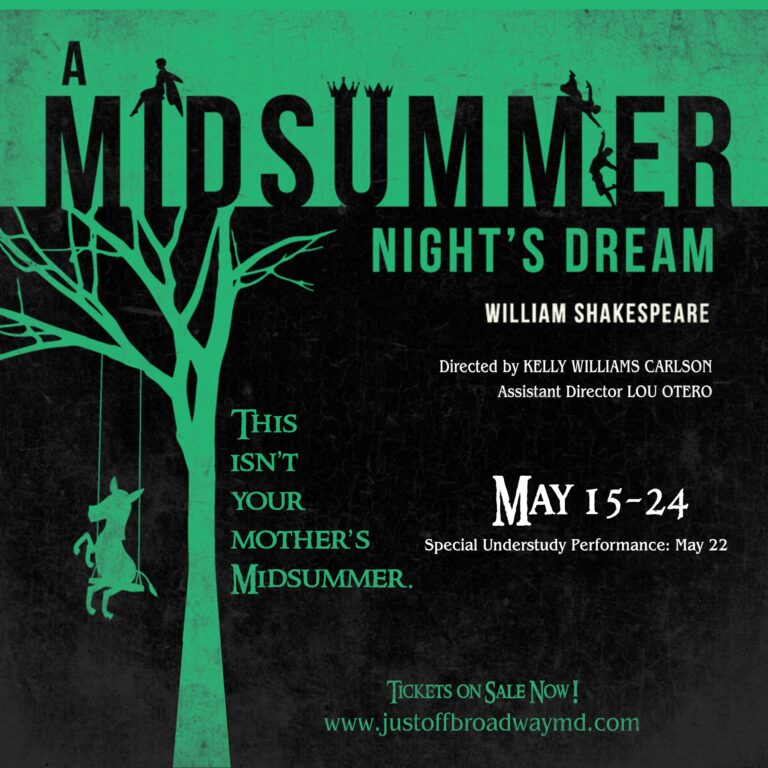
How now, summer spirit? Have you brought us hot ice and wondrous strange snow? Or a mess of Athenian lovers, a Faerie Brawl, and some Rude Mechanicals all dusted up in one moonlit spell? All of that, says you? Then you must be alluding to A Midsummer Night’s Dream at Just Off Broadway! The first of the Bard’s ilk to tread the boards at JoB and it’s a sensational production under the keen and goodly direction of Mistress Kelly Williams Carlson, a masterminder of Shakespeare’s works. Fully expressive, immersive, and engaging, this wondrous strange comedy belonging to The Bard will mesmerize you with its brilliance from star to finish.
Kelly Williams Carlson has a masterful understanding of not only Shakespeare but how to make it accessible and immersive to the audience at hand. Truthfully upon spying the initial setup, I was wholly skeptical; the costumes appeared to be spanning a series of timestamps that felt a teensy bit incongruous with one another and the set— half on the stage half on the floor— wasn’t helping to settle that. But after just ten minutes into the production I found myself hanging at the edge of my seat, rapt attention focused on the production and all of its intricately and brilliantly executed nuances. Banking the audience in a semi-oval around the framework of a centralized aisle and the stage was a clever concept, one that well-served Carlson’s approach to the show.
Set Designer Theresa Bonvegna has done a superb job of both simplicity and detailed work in actualizing Carlson’s vision; there is this glorious, eye-catching newspaper-mod-podged moon up on stage that is not only enormous but constructed in such a way that actors can make entrances and exits from between its ‘face’ creating the illusion of stepping out of the moon. Bonvegna has also constructed these extraordinary flora-stems (made from green rubber gloves!) that are so whimsical and wondrous strange that they fit the bill 100% for the curiously strange motifs that populate the Midsummer text.
Lighting Designer Andrew Vida should be praised tenfold for those whimsical, ethereal lanterns that float up and down over the main portion of the stage; they are just the perfect touch to round out all of the fairytale components of this production— and they change color. There’s actually a great deal of color used— both in the highlighted play spaces and behind the audience— throughout the performance to signify different emotional pulses or significant moments during the production. These often align in tandem with the sound design (Kelly Williams Carlson and Kevin Carlson) which creates a unique aural landscape of unearthly experiences. The Rude Mechanicals in particular have this almost steampunk sound that accompanies their scenes, and the forest-y sounds are fantasy incarnate. Carlson, Carlson, and Vida deserve even higher praises for their storm-fury effects. But the crowning jewel in the light-sound-show design is the eerie red and accompanying noises that signal ‘Bottom’s Transformation.’
It’s Angie Rupper’s Costumes that (at first felt disjointed but then quickly became glorious) really make the production an aesthetically pleasing wonderland. She’s approached the play like Carlson has done— three separate ‘plays’ wherein the Faeries have an array of outfits— women in flowers, men in feathers and my absolute favorite costume is Peaseblossom’s corset-and-flow-tails affair— and the Athenians have their own series of costumes, which actually read like the could represent the 50s, 60s, 70s, and 80s with Lysander looking like something out of a punk band from the early 80s with his guy-liner and grunge, Helena looking like a coven witch of the 70s in her flowy dress, Hermia in her swing-style floral dress of the 60s, and Demetrius in his crisp, poised blue suit circa the mid 50s. And then Rupper sets the Rude Mechanicals to look like their various trades (she herself plays Snout and has a whole Rosie the Riveter vibe going on in her personal sartorial selection.) And the Faerie King & Queen (doubled as Theseus and Hippolyta, a common casting choice for this show) maintain their regal Elizabethan couture only with stunning sylvan and nemorous accoutrements that slide easily into place for their respective transformations.
What makes Carlson’s approach to the production so exquisite is the level of play that she encourages amongst the cast. While she certainly has a talented bunch of performers in this cast, who all clearly demonstrate their consummate capabilities with both Shakespearean language and understanding (in such a way that has even the most novice of audient feeling their understanding), it’s the levels that she layers into their play that really sets this production ahead of other approaches to Shakespeare. Puck is master of ceremonies; the Rude Mechanicals are a law onto their own; there is a subtly secretive past-time relationship that pre-exists the start of the play between Demetrius and Helena; it’s all very nuanced. As Carlson also serves as the show’s Intimacy Director, you get these exquisite moments of familiarity— particularly when Helena and Demetrius have that kiss before the Faeries start up with their shenanigans— and it reads divinely.
Carlson, as mentioned, encourages ‘play’ and you see it all throughout the production. When Lysander and Demetrius are on the forest-floor playing rock-paper-scissors over Helena while the girls verbally spar it out, when the Fairies are dancing (movement-dances of the Fae choreographed and coordinated by Lizzie Detar) in their mysterious revels, when Snout is playing ‘wall’ during the play-within-the-play and purposefully almost takes out the entranceway with her curtain-rod-wall-costume, moments like these and dozens more ferociously set the tone for this show, allowing for giddiness to thrive in the atmosphere whilst also perpetuating that sense of ‘wondrous strange’ for both players and audiences. Carlson also has her actors moving at perfect speed; not too rushed, not too languid, moments landing as and when they should, with perfect approaches to their deliveries. (I’ve seen this particular Shakespeare over a dozen times and it’s the very first time I’ve ever heard Lysander call Hermia and Acorn when he’s spellbound to insult her and I almost died for laughing!) The concept itself sticks to The Bard’s basics whilst flawlessly interweaving both timelessness and this overriding concept of ‘play’ into the material; it takes a understanding most masterful to make that an effective production and Carlson clearly demonstrates that here with Midsummer.
The Fairy Court— Peaseblossom (Samantha Monk), Cobweb (Kyleigh Eccard), Moth (Gianna Shaikh), Mustardseed (Kate Crosby), Thistledown (Latrese Riley), Ardenfern (Starla De’sra Riley), and Fairynameless (Lizzie Detar)— are their own mystifying wonders to behold. They attend Titania, certainly, but they also swoon over Puck, though in a “ooh— our friend the storyteller— sort of the way The Lost boys hang on Wendy’s every word when she comes to Neverland to tell them stories. It’s delightfully amusing to watch them abhor being called upon by Bottom once that whole affair gets underway. And when they all ‘shift’ (to be members of the royal court for the Duke’s wedding in the final scene…and shoutout, however oddly, to the Changeling Pup…Fargo…) you can still catch the subtlest hints of their fae-like tendencies in their Athenian embodiments.
As Thesus and Hippolyta, you wouldn’t give Ross Merlin and Caroline Pogust a second glance; they’re that haughty ruler-rich couple who’s wedding planning gets interrupted by the petty squabbles of some over-puffed dude and his outrageous desire to have his daughter marry well, or at least marry as he sees fit. (Patriarchy. Woof.) But as the Faerie King and Queen, with Merlin as Oberon and Pogust as Titania, they are spectacular marvels to wonder over, or wondrous spectacles over which to marvel; take your pick, both are true. Merlin is an exquisite actor, with devious eyes, intense facial expressions, and a full-on bro-code handshake-slap-around with Puck that’s just hilarious. He bites nasty and hard at Pogust’s Titania, but she bites back twice as nasty and thrice as hard; the pair really look like they could bring about the end of days in their circle-off snapping at one another. They share the burden of driving that scene together and it’s extremely well-excuted. Pogust has an immeasurable command of Shakespeare’s language, painting scenes into existence with tone and timber, cadence and patois, delicacy and emotion, all slapping around in that scene where she and Oberon go verbal-sparring. They’re a wonder, the pair of them— whether they’re sniping at each other, or Titania finds herself fawning and falling wild over Bottom on that roller-bed (shoutout to Bonvegna, and the design/construction team) or Oberon in his barking orders at Puck.
Withdraw from the Faerie Court for a moment and draw the focus to the bumbling buffoons that are The Rude Mechanicals. Petra Quince (Diane Colburn), Francis Flute (Travis Roth), Snout (Angie Rupper), Snug (Jim Morgan), Starveling (Marianne Sohn), and mercy-help-us Nick Bottom (B. Thomas Rinaldi.) Rinaldi goes into a king-goose category all his own, but golly gosh are these goofballs the greatest. Carlson has set them up in a way to be true to their monikers (both enacting the labors of their trade in the togs that Rupper has designed and in the way the speak and stumble about), making them infinitely more humorous than one might expect. Morgan, as the Lion in rehearsal for and during the play-within-the-play stands out especially because he’s so preciously a mess to watch and it’s delightful. And you’ll catch Rupper having “had it up to here” with Bottom’s antics; that girl is throwing face, shade, and a flip-off and it’s epic. Roth also deserves a hearty clap of praise for his mid-air vaudeville-style prat-leap when he fleas the scene in terror after Bottom’s “transformation.”
Thomas Rinaldi is like Dogberry meets Nick Bottom meets Benny Hill and the three of them spawned a clown camp pyramid scheme that just rolled itself through time with Doc Brown’s Delorean and somehow ended up in the forest of Athens. He’s over the top, hilariously engaging, and when he’s a-bellowing about, the audience is torn between rolling their eyes and groaning the way one might at a most groan-worthy pun or busting a gut for laughing at his antics. His ‘death’ scene during the play-within-a-play is the epitome of farcical nonsense and he just holds your attention like nobody’s business; absolutely 10 out of 10 perfect casting for the role.
Slipping back to the Athenian love-Quad: Demetrius (Owen Roughton), Lysander (Joshua Torrence), Hermia (Kai Mellarkey), and Helena (Monica Crain), they’ve got their work cut out for them, but this quartet of deliciously seasoned performers really keeps the audience engaged. You have great lengths of text to get through with these four before the ‘juicy-fun’ begins (when the gals start brawling and the boys get all tangled up in the mess, trying to keep them apart whilst also trying to court Helena.) And with these four, you find yourself deeply invested in their experiences. Their command of language and delivery— particularly Mellarkey as Hermia— is of a professional caliber; their ability to romance the scene and all of its ins and outs— especially when Roughton and Torrence start trying to one up each other for Helena’s attention— is superb. Their overall approach to these characters is ripe with both grounded presence of mind and a refreshing knowledge of the story as a whole. You don’t get the sense that they know how they’re going to end up, but you feel that they are keenly aware of the fact that they’re on a journey whose roots are not wholly earthed in human-mortal reality and that’s a truly fascinating concept to behold. The group dynamic shared between them, particularly their physicality in the “who gets to be with who” scene late in the play, is Shakespearean perfection.
And that’s the lot. Save our dear Egeus (J.R. Hontz) who gets featured like a bookend to the play at top and tail of the show; and the rare but beautifully conceptualized into existence Changeling Child (Aiden Rupper), who appears near the very end of the performance, betwixt Oberon and Titania. Surely I couldn’t be missing anyone…certainly not that fleet-footed, nimble-witted, delightfully terrifying free spirit, Robin Goodfellow. Or perhaps better known as:
PUCK (Meagan Jenkins) who arrives amidst the moon, departs through it, and juggles a mini moon too. Be cautious wary of that pesky Puck who may a-mingle herself amid the masses seated in the house and you may find her making mischief right upon your countenance without warning! Truly a clever incarnation, Meagan Jenkins is this rebelliously delightful spirit who is almost like a twin— or better yet, a shadow— to Oberon. There is a sense of the text-based subservience, but it’s more like a split of personality, if Oberon is the Fairy King, then Puck in this instance, is his raunchy, silly, teenaged-mentaly-id. She is certainly her own venerable creation that captivates the audience every time she appears. And her physicality is top-notch extraordinary magic, no question. Floor-sliding like some sort of manic-pixie version of Bo Duke, you’d almost believe she is a real fairy just based on the way she moves. Jenkins moves with the fluidity of a fever dream and it’s phenomenal to watch. There’s also this fantastical moment when it is realized by Puck and Oberon that Puck has in fact magicked the wrong mortal boy. And in this delightfully childish, rebellious style, Jenkins lets this notion of taking ZERO RESPONSIBILITY for her actions roll right through her facial expressions, vocal decries, and body language. And then she utilizes malicious compliance and weaponized ignorance in one blow to agitate her way through and out of that scene. It is unhinged. It is hilarious. It is pretty epic.
There are all sorts of complex beauties in the simplification of this production; an extraordinary first look at Shakespeare at Just Off Broadway. For the short and the long is, their play is preferred!
Running Time: 2 hours and 35 minutes with one intermission
A Midsummer Night’s Dream plays through May 24th 2026 with Just Off Broadway at Epiphany Lutheran Church— 4301 Raspe Avenue in Baltimore, MD. Tickets can be purchased at the door or in advance online.