
Just sit right back and you’ll hear a tale, a tale of a Duke o’er-thrown
That ended him and his daughter dear, on an island all alone.
Though not so alone as they thought they were— among spirits of earth and air
And then a conjured-magic sea-spun storm that brought their en’mies there.
The plot then thickens there, my friend, and there’s so much more to say
About the entities and denizens that populate this play
Magic. Revenge. Redemption. And some mercy in-between.
All wound up in The Tempest at Chesapeake Shakespeare Company. At Chesapeake Shakespeare Company.
While you won’t find the slap-happy skipper (though Trinculo and Stephano get darn close to giving Gilligan a run for his money) on this enchanted island, you will find a goodly treasure in the cast that’s been bundled together around Artistic Director Ian Gallanar’s approach to The Tempest. Widely considered to Shakespeare’s last solo-written play, this finale production of the 2025/2026 indoor mainstage season at CSC* has hints of whimsy and wonder, if a little disjointed in its overall approach. And it bears forth the deeper intended meanings of the text, highlighting the paternal love of Prospero for Miranda. There are also puppets a plenty.
Visually the show is quite striking; Shartoya R. Jn. Baptiste has taken a simplistic yet stunning approach to the scenery. It’s almost like a three-story gazebo that’s been warped to the ways of the island itself, stacked upstage center and dominating the play space but in a fashion most majestic. There’s also ruins marked on the balcony overhangs and support beams of the upper-deck seating structure which creates this metaphoric spill-over into the audience that encourages drawing theatergoers into the theatrical experience. The backing scrim is projected onto with shadowy goblins and gremlins of the island (compliments of Mark Williams’ projection design) and this is oft accompanied by the wondrous strange sound effects designed by Sarah O’Halloran. Katie McCreary’s lighting design is equally effective in augmenting some of the more curious moments on the isle, particularly when it comes to the magic-induced time stops or the presence and arrival of various spirits.
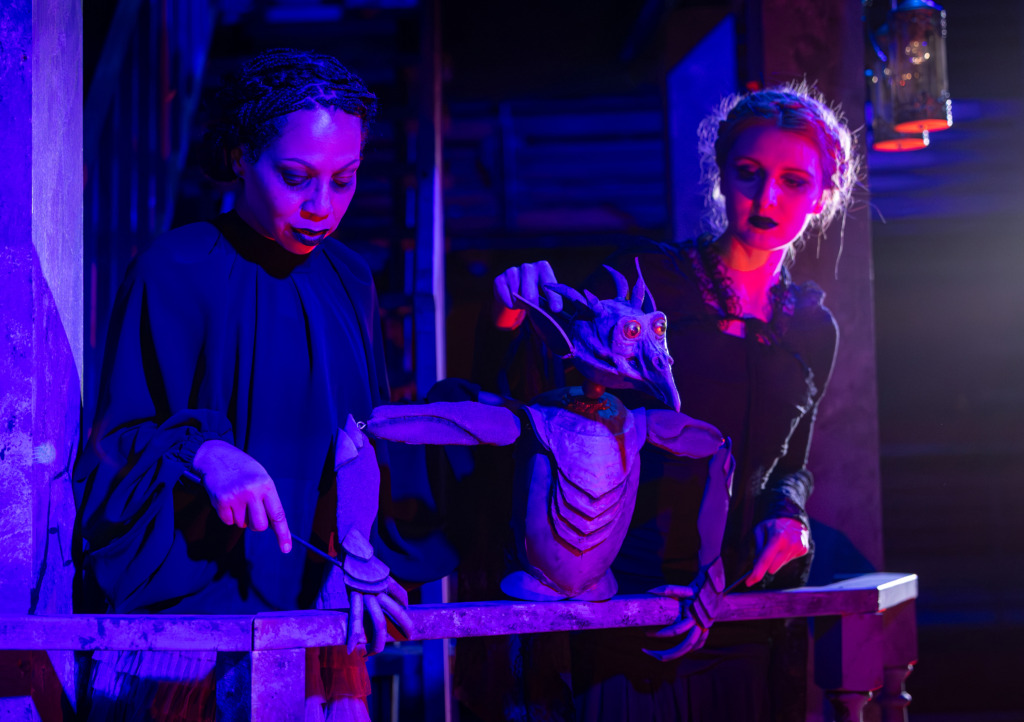
The show’s wardrobe deserves a lengthy analysis in “where does Kristina Lambdin get these fantastical ideas from and more importantly how does she fabricate them into existence with what appears to be a simple swish of some magical staff” but we’ve got to side-step the wonders of the superb sartorial selection for just a moment and talk about Chris Reuther’s puppets.
While I am admittedly questioning their purpose and general existence (because director Ian Gallanar has them there, clearly as ‘other entities’ to the island they pull focus in places because they’re so extraordinary and fun to watch and otherwise seem slightly distraction-causing without otherwise serving a purpose) it has to hands down be said that they are extraordinary wonders, the stuff from which dreams are made. Puppeted by the four spirits of the compass and/or winds (Aura Gallanar as North, Dorienne Hoven as East, Christina Krawec as South, Mari Andrea Travis as South) this inhuman creatures are marvels of curiosity and creativity. Reuther’s finest creation is arguably the one that feels wholly thought-through, though briefly included in a ‘non-scene’ re-intro from the intermission. For lack of knowing its name, we’ll refer to it as Skeledeer, the sweetly innocent yet very hungry entity that soodles its way over to where Caliban sits in the vom-stair ducts that lead down into the house. And there’s this very endearing interplay between Caliban and the creature, which humanizes Caliban in a truly heartfelt way; it’s also cute and draws forth many chuckles from the audience. While the puppets are extraordinary, fun to watch, and ultimately feel inclusive to the overall experience, they feel a little like a whimsical layer of distraction that got tossed on top of the production as ‘magic-puppet-icing-because-we-could.’
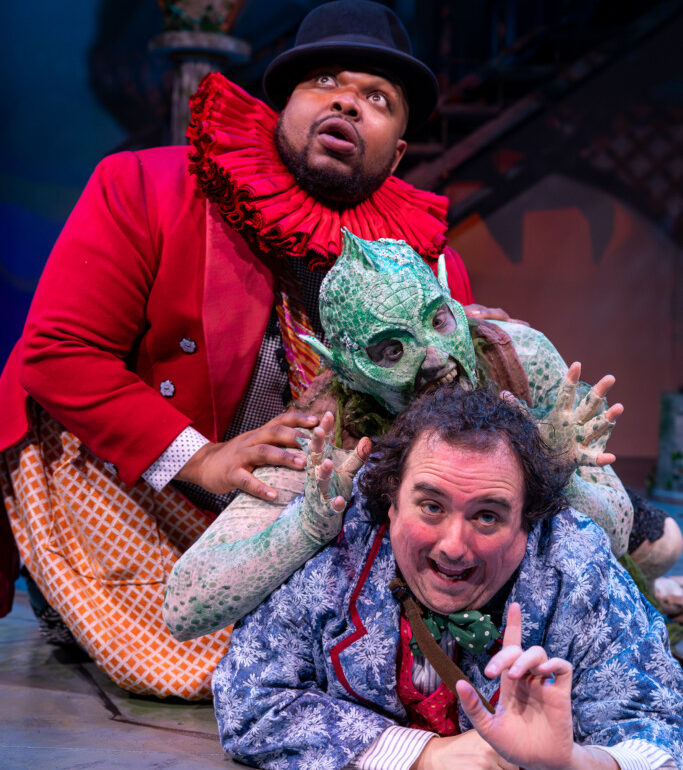
Back to Lambdin’s wardrobe, which is augmented and accompanied by the brilliance of Hannah Brill on wig and makeup design. It’s easy to point out the shimmering scales and nautical-aquarian hybrid look used on Caliban (and it is remarkably breathtaking and impressively transformative) but my personal favorite are the wings on Ariel. They create a dueling sense of both majesty and foreboding. Like Plutonian shore raven wings of indescribable proportions; it’s a theatrical wonder to behold. The rich and vibrant colors featured on the Shipwrecked court is a nice nod to wealth and affluence while the togs reserved for Prospero and Miranda still manifest glints of that life lost. And keep your eyes out for those jewel-tone, overly saturated shoes on Stephano and the ruff on Trinculo, it essentially makes the show from a costumes-chosen standpoint.
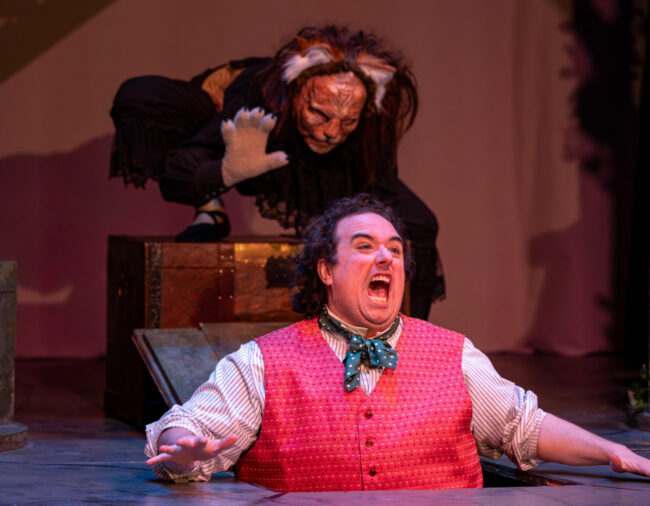
Ian Gallanar lets this production of The Tempest crash ashore in its own right. (There were, at least on opening night, some major issues with various actors projecting all through the first act, which is a rare experience to have at CSC, and this seemed to happen during more of the intimately connected moments between Prospero and Miranda, though also with the members of the Shipwrecked Court.) The overriding malice that oft accompanies Prospero in his rage is lacking but this feels like a refreshing change of pace for this ‘late play.’ There also appear to be a few missed opportunities in Gallanar’s approach. He goes to the trouble to create the four Spirits of the Compass Winds (the aforementioned North, East, South, and West) and even double-utilizes them as creatures of the island (the most hilarious and well-executed being with the Jungle-Kitty as played by Dorienne Hoven when she goes after Stephano.) But then there are also moments when the limited pieces of stage-furniture— crates and what have you— are being cleared from the scene…by tech/run crew in stage-blacks. Why not have your Wind Spirits whirl them away? It just feels like an overlooked chance to further incorporate these creations into the scene work. And while these Wind Sprite/Compass Spirits do get plenty of on-stage time (mostly as puppeteers with the aforementioned whimsy creations) it would feel more cohesive to weave them into the intrinsic movement of the mechanics of the play. Aura Gallanar (Spirit of the North) also lends her beautiful and haunting vocals to a lot of the wind-chanting and singing that happens in the performance and it’s a gloriously stirring and evocative sound.
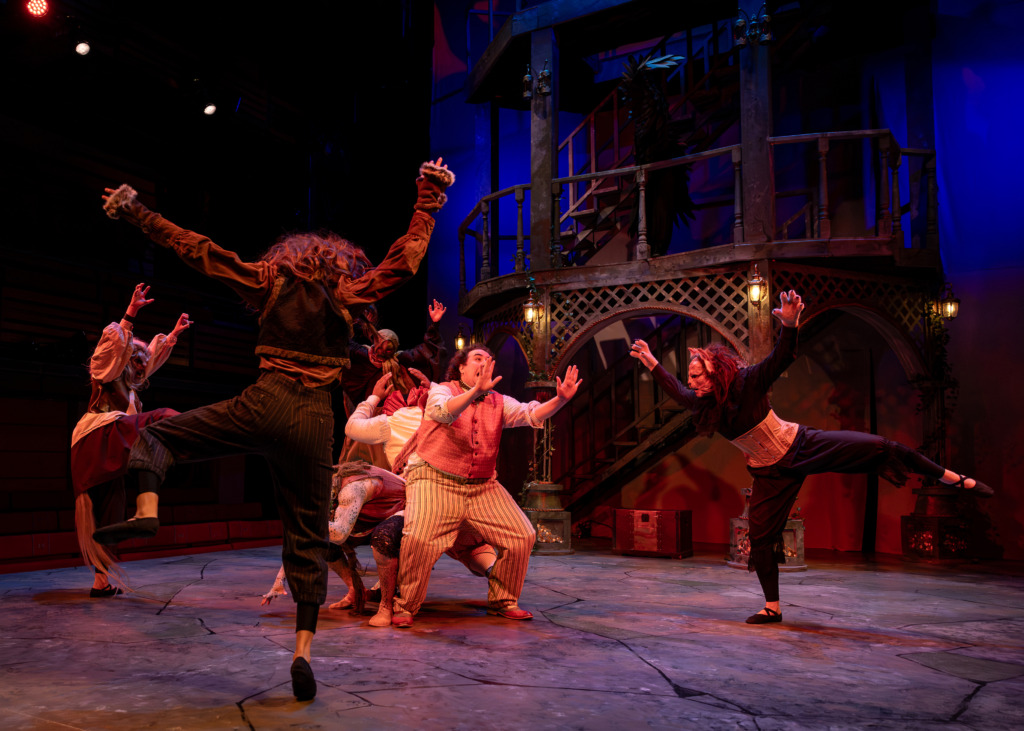
The Shipwrecked Quarter of Court— Alonso (Dawn Thomas Reidy), Antonio (Lesley Malin), Sebastian (Garbriel Alejandro), and Gonzalo (Gregory Burgess)— oft appear like chess pieces, gently being manipulated by Prospero and the spirits of the island and it creates a good visual. One of their most striking moments is when Prospero finally tells to Miranda the tale of how they came to the island; Gallanar makes superb use of the second tier of Baptiste’s set, mingled with McCreary’s lighting, by appearing to ‘conjure’ the characters as if they were apparitions of the past (You see Burgess’ Gonzalo and Malin’s Antonio featured heavily here.) Reidy’s Alonso is the most stoic of the bunch, rigid and detached, awash in her own grief and guilt and it never wavers. Burgess’ sincerity and kindness radiates through his physicality and while his speeches are simple, they are heartfelt.
It wouldn’t be a true Shakespeare if there wasn’t some young, dumb couple having a meet-cute and falling wildly and inappropriately in love much too quickly. Enter Ferdinand (Drew Sharpe) and Miranda (Selah Kreeger.) The innocent naivete on Kreeger’s Miranda is exactly as you’d expect it to be, which makes her attempts at dabbling in the flirting pool with Sharpe’s Ferdinand just darling. Sharpe delivers a striking flexibility in his physicality, bending to almost inhuman angles and positions when ‘caught’ under Prospero’s enchantments, and his facial expressions are lively and animated. He is filled with a youthfulness that surpasses the situation of his character and a hope that is tempered by reality though never quite fades from his energies as a whole. Selah’s Miranda has quite a few interactions with Prospero that captivate the heart, their familial bond feels authentic and strong. (Though it’s perhaps most amusing to watch Prospero pacing on the third tier deck of the set while they’re making their ‘maybe we get married’ plans and all of his facial expressions, jarring bodily pauses, and the general antics that are happening, unbeknownst to the lovers below.)
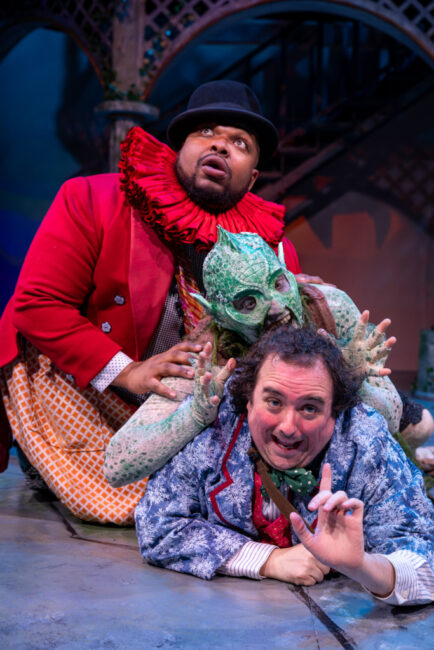
Frick, Frack, and Fantastic— also known as Trinculo (Shakill Jamal), Stephano (Matt Harris), and Caliban (Vince Eisenson) feel a little like they were plopped down in the middle of The Tempest from another production entirely, and while generally this would bristle and create an uneasy friction within the confines of the narrative plot, Gallanar’s approach to using them in this well works pretty well. Jamal and Harris are giving Abbott & Costello vibes with some pant0-farce energy and play off one another sublimely, though they’re introduced separately and have a lot of brilliant and zinging solo moments. Jamal’s Trinculo is particularly bombastic and almost modern (much like Eisenson’s Caliban feels a little like it was dropped in from either Chicago or Jersey) and this works as an excellent foil to the nervous energy and ultimate hilarity that Harris is bringing to his Stephano. The way this pair physically flops about— and when Harris flees out into the audience, making that callback of pausing to squeeze between the pillars when he could clearly just go around— is comedic gold. Harris also has that moment with Hoven’s ‘Spirit of the East guised as kitty cat of the chaos, and it’s an uproarious roll-with-laughter kind of moment. Harris is nailing it with facial expressions, Jamal is nailing it with body language, and Eisenson is winning in all categories.
There is something cheeky about Eisenson’s Calliban. Not quite the nefarious trapped devil that the creature is often seen to be, but more of a ‘I think I was a newspaper salesman in Chicago once and I don’t know how I got here but here I am’ verve about him. The most impressive thing about Eisenson’s performance in this role isn’t his casual approach to the text, which allows for a real access to his character’s experience, but his exquisite movement. Watch him hop out of the hole like some spry creature whose youthful moments are preserved eternal, the way he crouches and slink-skitters around the stage, it’s an evocative character study in shifting physical energy to present an inhuman entity and its sublime. Also he’s really funny and matches in his own right the comedic charms and skillset of Harris’ Stephano and Jamal’s Trinculo.
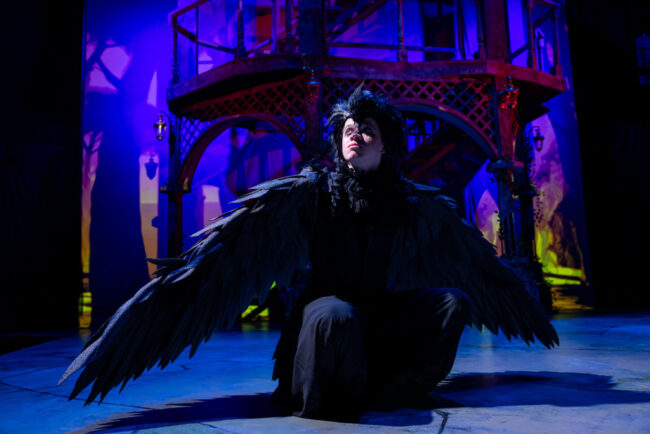
And if you’re mesmerized by Eisenson’s movements, you’ll be hypnotized by that of Noah Haren’s Ariel. There is this superbly striking moment at the very end when Haren is posed in this subservient crouching position, a hunched-over and internalized manifestation of servitude reserved for whenever the character of Ariel is receiving command from Prospero, and Haren is gently shifting in place only to recoil slightly at Prospero’s approach as he does. Then there’s an extraordinary moment of touch-magic and it hits the heart with astonishing sincerity. Haren encapsulates the epitome of majesty and yet also has this ‘Puck-Sprite’ quality to the portrayal that makes Ariel rich with layered depth and more than just a wind-bringing. There’s a humorous component to Haren’s incarnation of the Air Spirit and a sincere one too; wholly fascinating to observe.
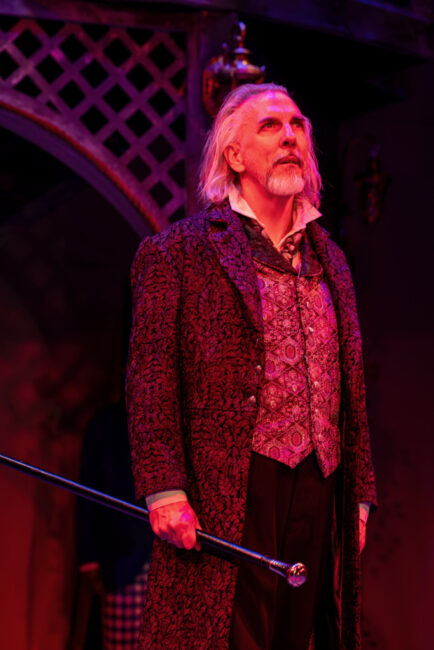
As the master of the island, Prospero (Christopher Marino) is far less the puppet-master/manipulator that most productions make him out to be. In reality, despite having the magical control of staff, spell, and air, Marino’s Prospero is really just a wizened father, desperate to keep his true treasure safe. Not the books, not the island where he’s been condemned, but his daughter. And there are great sweeping moments of paternal love and care that radiate through his performance. (And when he’s observing Ferdinand and Miranda from on high it’s actually really hilarious to watch his facial expressions.) Marino has a fine handle on the daunting text that Shakespeare has laid thick over Prospero’s character, and delivers raw emotion and energy that is not o’er-ruled by any one dominating feeling, like rage or revenge. Instead you get a flurry of feelings flickered into every moment, all orbiting around this central conceit that everything he’s done, doing, will do, has said, says, and will say, is for Miranda and the care he so greatly feels for her. It’s a bright and refreshing approach to the character, if not a wholly unexpected one.
What goodly creatures are contained within this production of The Tempest? Certainly some 15-upright human actors, and wonders strange that will pique the curiosity of whimsy and fantasy as they appear. Running through mid-May, this final indoor production of CSC’s mainstage 2025/2026 season is the stuff of dreams.
Running Time: Approximately 2 hours and 40 minutes with one intermission
The Tempest plays through May 17th 2026 at Chesapeake Shakespeare Company— 7 S. Calvert Street in Baltimore, MD. Tickets are available by calling the box office at 410-244-8570 or purchasing them in advance online.
To read the interview with Christopher Marino on being Prospero, click here.
*The Tale of Cymbeline will appear at CSC’s outdoor summer home, The PFI in Ellicott City beginning in June!