author: Ryan J. Bordenski
Love is in the air, but so is deceit, mockery, adultery, the withholding of information, lies, and…uh…dental procedures? But don’t worry; this is a comedy so everything will be funny and fine in the end, right?! Of course, I am talking about Return Engagements at Bowie Community Theatre. This farcical and comedic play by Bernard Slade tells the story of four unique and awkward couples who have separate chance encounters and trysts, yet somehow all manage to be connected to one another as time passes. Directed by Lorraine Brooks, with Assistant Director and Stage Manager Shiesha McNeil, and produced by Alan and Penni Barnett, Return Engagements shows us what it’s like to meet someone and fall in love in the moment, and determining what it means for your relationship in the years to come.
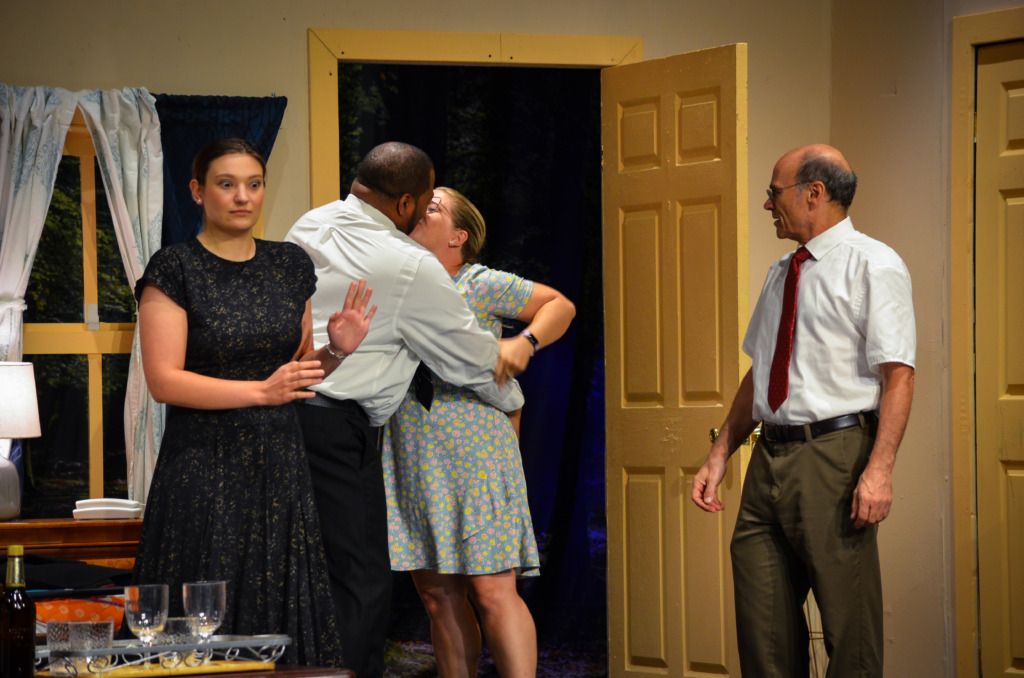
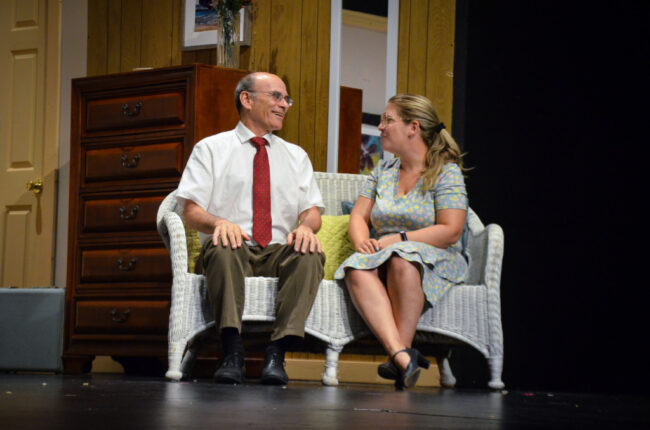
There were a lot of great directorial choices made, and I thought the staging of the show made sense. Actors would utilize the scene that was provided to them and interact with its elements, whether they were laying in bed, sitting on said bed, sitting on the couch, sitting in individual chairs, or standing. The actors also moved quite naturally. There were moments in the show, however, where some actors appeared unsure of themselves and where to go, or misremembered blocking, which in some cases pulled audiences out of the story; luckily these were only minor stumbles. Director Lorraine Brooks does a great job with getting each of the couples to try to understand one another and their motivations, though I would have liked to have seen more “drive” from some of them. If the characters were to ask each other what their “end goal” would be, what would they tell them? That being said, the staging was great for the space, and I liked the variety of choice in characters sitting down, standing up, or laying on the bed.
Set Designer Dan Lavanga provides us with a great depiction of our scene for the entirety of the play, which is the small room in a guest house located somewhere in Stratford, Ontario, Canada. You get pictures on the walls, dressers, nightstands, chairs, a loveseat, etc. which is just enough to build the setting without it feeling crowded; the set then extends slightly to include a powder room, front door, and operable window. The actors were able to maneuver the space nicely, and aesthetically it looked clean. One thing that was a bit distracting, however, was the set design seemed to stop abruptly at the topmost part of the set piece that was a wall, so the top portion where extra wallpaper or paint should’ve been was just a plain black wall to match the black box theatre, so it was a bit distracting and didn’t look super realistic; however, it was a very cute set. (There is also clever use of the space from Act 1 to Act 2 by changing the curtains, bedspread, and all but one picture on the wall to show we had moved through time (15-20 years depending upon which couple’s storyline we were focused on). Those were really smart touches!
There were some strong moments in the play, which I will get into later, but a lot of the qualms I had with this production lie mainly within the technical aspects. While the show did not have many lighting and sound cues to begin with, almost every cue needed was either missed, delayed, or done early (a phone ringing at the incorrect time, not ringing the phone after the actor gave the cue line, fading the lights out as soon as the scene ended, etc). Sometimes I know it is hard to hear actors and listen for the cues in some spaces, but this space allowed great vocal projection (to a point of no one using microphones), so those technical mishaps were rather disappointing.
Additionally, I was expecting the scene changes to occur a lot faster since there was only the moving and changing of props and not actual set pieces during each transition, but some changes took a very long time, and again, disrupted the pacing of the play. The lighting for this show also did not change at all throughout, unless the lights were fading in and out, or a single spotlight was being used, which was honestly only utilized twice. It would be cool to see some lighting variation used to really emphasize the dramatic tone of some scenes. Lastly, the lighting cues for starting and ending scenes felt delayed or dragged out, which made it a bit uncomfortable for the audience members waiting, and the actors who use that cue to determine their next move. Overall, if those technical aspects can get more succinct, fixed, or polished, it would improve the pace and quality of the production immensely. Even so, shoutout to Lighting Designer Pete Dursin and the Bowie Playhouse Staff for their good work at keeping the actors well-lit for some rather lengthy scenes.
Costumer Marge McCugan understood the assignment of dressing the actors in garb that fit the time period. While none of the costumes stood out or wowed me per se, they were appropriate and elegant, and worked well for each of the characters. The most bold outfits came from Dawn Hammond (portrayed by Jessie Dugan), and those were holy moly pops of neon orange and pink colors, in the best way!
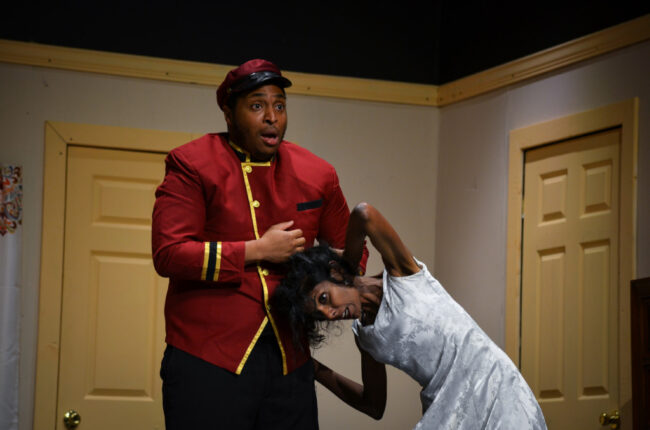
Tatum Moss and Sarah Luckadoo as the Intimacy Coordinators for this production deserve high praises because there is so much lip-locking, cuddling, and caressing that takes place in this play. I think this is the most intimacy I have personally seen happen in a play, but the co-coordinators handle it so well, especially when falling onto the bed or the floor to continue those fiery bursts of passion. It is not easy coordinating actors to be intimate with one another, but it is such an important role that need not be overlooked, (especially when some characters end up half-naked in bed with one another).
When it comes to the stage production itself, what impressed me the most was how each scene was only 2-3 characters together at a time to tell the story in small pieces. In the play, there are only 8 characters total, split up by “coupling.” What is also clever in the way the play is written is that each couple’s storyline has a designated name. Daisy and Raymond are Chemistry, Joe and Miranda are Genes, and Oliver and Fern are Passing Fancies, with the fourth couple, Henry and Dawn, maneuvering their way through each of the couples’ short vignettes. Daisy and Raymond are the inaugural couple to have their chance encounter, where they have a one-night-stand, upon which Daisy finds out the next morning she just slept with the bellhop at the guest house/hotel. As we progress through each scene, and later heading into Act 2, we see each couples’ stories get a revisit, only this time there is an 18-20 year time jump. (The show is way more fun if you don’t know how every individual couple is connected to one another and the information you learn by the end, so I am going to keep it as vague as possible, to ensure the optimal viewing experience).
Aparna Sri does a phenomenal job portraying down-on-her-luck actress Daisy Lawrence, and I was really impressed with her line delivery, physicality of her acting (especially in a shocking Act 2 moment!), and her overall chemistry with Mathhew J. Murray, who plays bellhop-lover Raymond Mackay. Murray and Sri compliment each other well, and the sexual as well as romantic tension they build is very believable. I would have to say Aparna Sri was one of the strongest actors with her portrayal of Daisy Lawrence, next to Melvin Smith as Oliver Edwards.
Carly Brownstein is superb as Miranda Jablonski/Miranda Nagorski, particularly in Act 1 when she delivers an effortless Polish accent. Her mannerisms, humor, and choices made as Miranda were excellent, and I liked her approach at being funny yet poised. Andrew Rappa as Joe Bristol is lovable and awkward and a sweetheart, and you really get to know Joe in Act 2 (and I found Rappa’s performance to be stronger in Act 2 versus Act 1 personally).
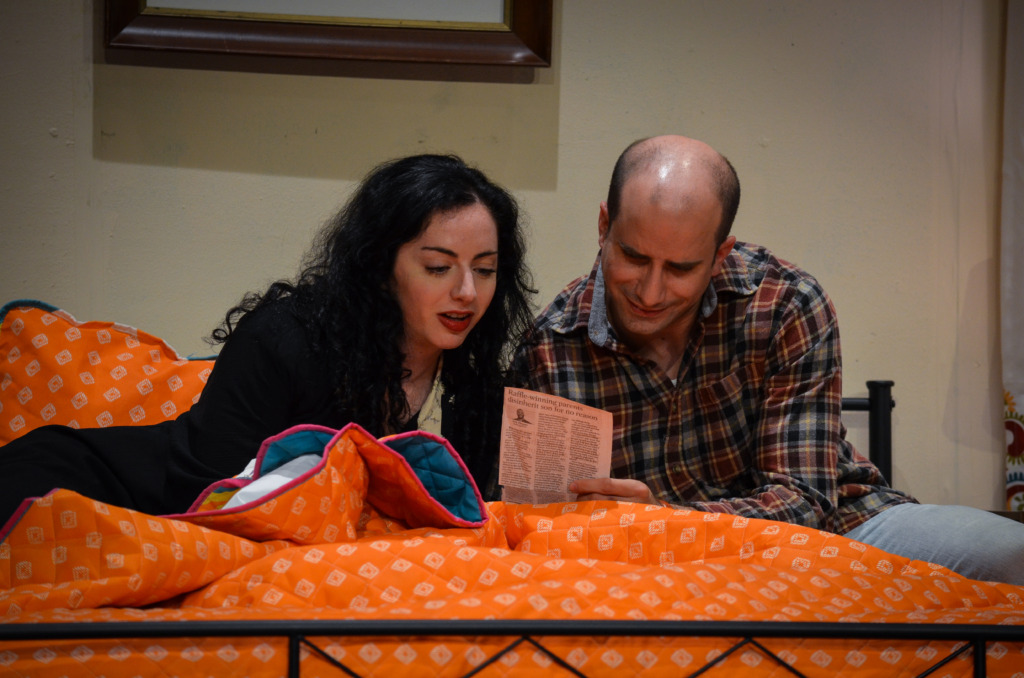
The super silly and super quirky duo of Henry Metcalf and Dawn Hammond (portrayed by Producer Alan Barnett and Jessie Duggan) will have you cracking up, as neither of them seem to have much clue of what’s going on in each of the storylines. I am not sure if this is a characterization or actor choice, but these characters definitely filled the role of comedic relief; they are silly and are not meant to be taken seriously, but also come in, meddle, and make some crazy things happen by the end of the play. Duggan makes Dawn into a party girl with a heart, while Barnett approaches Henry in a more subdued fashion, and the juxtaposition of the two is very silly.
Sara Worley plays sassy-and-ready-to-be-a-divorcee Fern Edwards, alongside her hilarious and boisterous husband-soon-to-be-ex-husband Oliver Edwards (played by Melvin Smith). Worley provides so much sass and sarcasm in her Fern, and it is very cool to see her and Melvin Smith interact with one another; they keep things exciting and engaging, and are adorable with their witty banter! Smith’s Oliver Edwards is beyond entertaining and his character easily has the most hilarious belly-laughing lines of the show. His delivery of them is poignant, and he has his comedic timing down to a science!
So… what is the fate of these couples? Do each of the couples end up together in the end, or does time play its cruel hand and separate them for good? And how does Brownstein play two different characters at the same time? Is there a happy ending? Why is the play called Return Engagements? All these questions will be answered, but the only way to find them out is to go and enjoy an evening of farcical comedy with Return Engagements.
Running Time: Approximately 2 hours and 45 minutes with one 15-minute intermission.
Recommended for Ages 14 with themes of romance, marriage infidelity, divorce, and sexual situations.
Return Engagements plays through August 9, 2026 at The Bowie Playhouse with Bowie Community Theatre— 16500 White Marsh Park Drive, Bowie, MD 20715. Tickets can be purchased by calling the box office at 301-805-0219 or in advance online.