
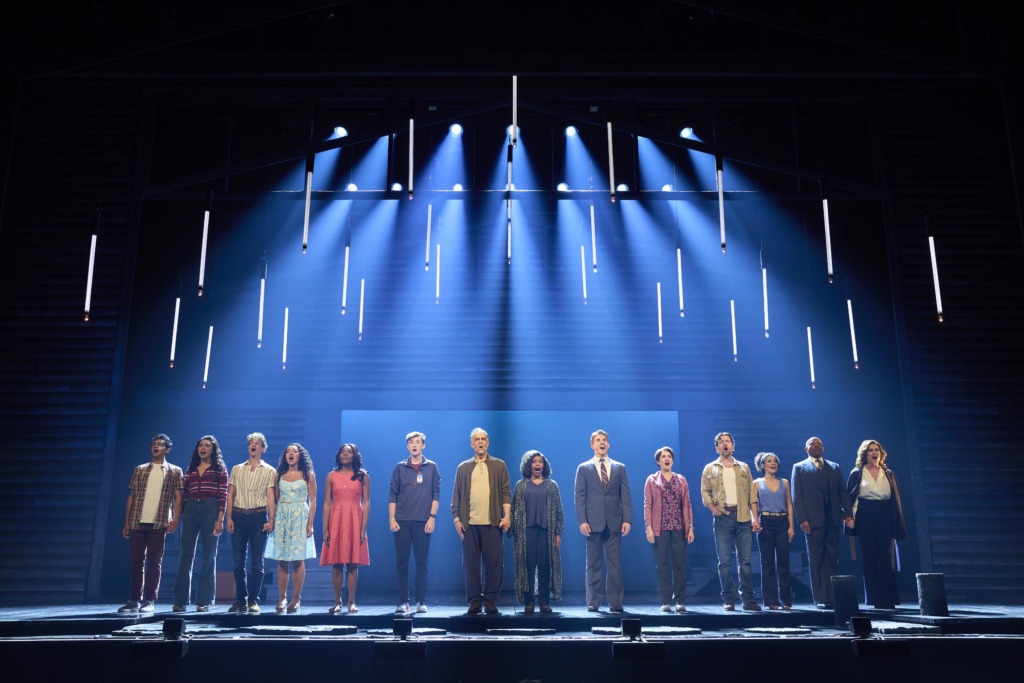
Inside the sadness there is joy; a powerful and universally true statement, no matter what your situation may be. And The Notebook is steeped deeply in both sadness and joy. Now touring Broadway at The National in Washington DC through the end of August, this tragically beautiful story— with music and lyrics by Ingrid Michaelson and book by Bekah Brunstetter, based on the novel by Nicolas Sparks— has a lot of really exquisite moments woven throughout and features some incredibly talented performers to narrate that tale.
It’s difficult to pick a touring apart when the talent is so exquisite. You want them to succeed; you want people to experience their powerhouse vocals, their expressions, their abilities to tell these stories. And it’s even more difficult to do that when most of the technical design components of the show are of such a high caliber. The problem therein with The Notebook is the show itself. Bekah Brunstetter’s libretto is sloppy at best, a jumble of doing too much, not enough, trying to be too symbolic, not trusting the narrative enough, and overall just a mess. And Ingred Michaelson’s music and lyrics, though truly beautiful, feel disjointed and completely unmemorable. There isn’t a single tune in the show that can be hummed or sung or even really recalled upon leaving it, and while the music is evocative in places, it feels a lot like “song selections from an audition book” rather than a cohesive series of numbers that derive from the same show.
While the show itself is based on Nicholas Sparks’ novel, I’d be willing to take Kalshi-style odds to say that more people, particularly of the theatergoing variety, have a pop-cultural familiarity with the 2004 film adaptation. And while the novel sets you up from jump-street to know that The elderly couple you’re seeing are Allie and Noah at ‘end of days’ as it were, that Allie has dementia or Alzheimer’s (that’s not made clear in the stage adaptation as to which but as both diseases carry such similarities, it’s not a necessary discernment) and that it’s their story Noah is reading to her, in a desperate attempt to bring her back to him, to give her those lucid moments. The movie lets that land much later in its narrative structure, and while I’m never one to compare cinema to stage craft, particularly as stagecraft— living, breathing theatre— is definitively the superior art form, this is one instance where sticking to the structure of the movie would have proved wiser.
Because of the way Bekah Brunstetter has structured the libretto for the stage, it’s created ample opportunities for Directors Michael Greif and Schele Williams to really ‘play’ on memory. And the problem therein lies that it’s too much and not enough at the same time. You get all of these really intensely crafted moments— several of which are inconsistent with one another and incongruous with the reality that they’ve attempted to establish. You have three sets of couples— Older, Middle, and Younger Noah & Allie— and at times you have all three of them drifting around on stage together. The intention is to move like swirls of memory, which works well in some moments— particularly when Older Noah sees his younger selves. But then in other moments, that appear to be happening in present time or perhaps in the ‘mind-space’ of time (though who’s is often unclear) the younger versions make direct eye contact and recognizance of their older selves, which just feels weird. And it doesn’t land with the clearly established dynamic of them existing as living memory.
And a lot of the show’s physical motion— choreographed by Katie Spelman— does move in that tangled mess that memory can be described as, particularly when memory fails us in a situation like Alzheimer’s or dementia— but it feels forced and sometimes trite, as if Spelman, Greif, and Williams are desperately trying to signal the symbolism of ‘memory loss’ and ‘confusion’ through movement. The intention is there, the symbolism is there; it’s being pushed into a ‘done-to-death’ and over-the-top vein that makes it almost unpalatable. And the overall lack of linearity doesn’t help matters. While I understand this is true to the novel, where they jump around in time a lot, because this production frequently features all three couples on stage— sometimes in their own little pockets of time, sometimes interacting directly with one another— it creates an unnecessary layer of vague confusion, which again smacks of “look at how jumbled these memories are; look at his distorted recollection can be.” And it’s unnecessary. Maybe if the songs were stronger, the music more memorable, this approach would have landed better.
All of this to say that the reality of living with Alzheimer’s and/or Dementia— and not just the patient but those in care of and loved ones— is brutal. And given the intensity and reality of live theatrical performance, the show just becomes an in-your-face, repeating smack of “this is sadness, this is Alzheimer’s, this is what life looks and feels like when your memory fails.” It’s not subtle, it’s too much in a great many places, and feels wholly like an overkilled agenda.
The show also suffers from poor staging choices— not just the dizzying movement— but the overall use of the space. The Notebook would be far better served in a more intimate play space, and while it’s understandable that most touring venues have vastly cavernous prosceniums, there’s no need to stretch the show out into every inch of that space. This is particularly noticeable and fails spectacularly with the ‘sliding room’ of Older Allie at the facility. It’s tucked way upstage, which wouldn’t generally be an issue, except often times Older Allie and Older Noah are present in that segment of scenery, still attempting to passively engage with the scene that’s happening before them and at that point it just becomes a distraction. Greif and Willliams also overutilize that tactic of having Older Allie and Older Noah present and responsive when watching certain ‘scenes of memory’ unfold. And it’s a hot-cold point of contention for me because watching these two actors (at this performance Yassmin Alers and Beau Gravitte, respectively) and the way they respond is striking, deeply emotional, and wholly engaging, but it creates a divide. Have that be an initial springboard so you can watch them for a few moments, then draw them away (or at least take the lights off of them) so that the attention can be given to their ‘memory-selves’ and the rest of the play as it unfolds.
Ingrid Michaelson’s music is also unbalanced. While she does have some really beautiful numbers in the collection for this show, most of them are heavy ballads, slowly drifting along without any sense of urgency or intensity. It felt a little like her attempt to pay homage to someone who truly understands blisteringly beautiful slow ballads like Jason Robert Brown. That’s not to say that Michaelson’s lyrics aren’t crafted cleverly— there are absolutely moments where the audience is busting out with much needed laughter, like during the opening bid of “Kiss Me” with young Allie and Noah— but the cleverness of her lyrics is not in direct proportion to variety of style or placement of timing in her overall song selection.
All of that said, the production values— both craft and creation— are impressive. And everyone is waiting for that moment— the iconic scene from the movie (the poster-scene if memory serves)— and when it lands— the rainfall, the lightning, the kiss— with actual pouring-down rainwater on stage, the audience goes nuts for it. It’s executed flawlessly. Scenic Designers David Zinn and Brett J. Banakis does a lot with a little. There are hints of scenery— porch railings to allude to Young Allie’s whole vacation home, barren drop-in walls for the care home and hospital scenes. All of this is augmented to perfection by Lighting Designer Ben Stanton, who again does a stellar job with the effects for that pinnacle ‘in-the-rain’ moment. Though Stanton’s ‘memory light’ gets ill-used to that redundant effect by the directors, constantly putting that liquidy gold swirling effects on the stage and on the cast whenever they’re trying to make sure the audience knows it’s memory, same too with the way Older Allie & Noah are often lit, attempting to force-create a differential that is simply unnecessary. And while the Costumes weren’t anything spectacular to write home about (and graciously not something that needed lambasting for poor attention to detail or period inaccuracies) designer Paloma Young has done a decent enough job of keeping those shades of blue— a thematic component— on Allie in all three of her phases. Mia Neal, of Hair & Wig Design, deserves a shoutout for all of the differing wigs and hairstyles, which really do serve a solid purpose in creating character distinguishments, particularly with Allie’s Mother and Nurse Lori, played by the same actress, though you’d never know it for her hair.
The ensemble structure is curious; it’s a small-cast show and there’s nothing wrong with that, though the level of doubling and tripling is actually one of the most intriguing components in play for this show. Having Jerome Harmann-Hardeman play both Young Allie’s reserved and judgmental Father as well as Older Allie’s adult son is really an impressive statement and showcases, however briefly, a true versatility in performance. The same can be said for Ann Tolpegin, playing Young Allie’s stringent and strident Mother and also present-day Nurse Lori. Their character similarities have the same heartstring at their core but are executed very differently and it’s marvelous to watch Tolpegin succeed in both roles. You also get given a taste of Tolpegin’s vocality, which is sweet and well-toned, as the Mother character is perpetually singing “Don’t You Worry” at her daughter. If there is one thing to be said about the stunning musicality of this show it’s the acapella verse of a song merely labeled “Coda” where the entire company of 14 performers are standing on stage, in perfect harmony, unaccompanied, singing their hearts out. That moment sticks.
They all but exclude the Lon (Jesse Corbin) character from the narrative, not giving the audience much of a chance to experience Middle Allie’s turmoil in her life-altering decision. And the characters of Georgie (Grace Ohwensadeyo Rundberg) and Fin (Jordi Bertrán Ramírez) are fun and you get them featured a bit in the early-early scenes, particularly during “Dance With Me” but again the way that Bekah Brunstetter has adapted this feels a little like she grabbed characters from the novel because she thought they’d be needed but forgot to give them a purpose. The character of Johnny (Connor Richardson) feels like he’s from out of left field and yet everyone loves him, myself included. He’s that peppy, perky, super-still-in-love-with-his-health-care job type who is just quirky and adorable and creates beautifully comedic, bristling friction with Older Noah. Richardson is this delightful cameo character that actually provides some much needed laughter and relief in this production and his responses, particularly once he gets ahold of ‘the story’ are hilarious and genuinely enjoyable.
The six leads— Older Noah (Beau Gravitte), Middle Noah (Ken Wulf Clark), Younger Noah (Kyle Mangold), Older Allie (Yassmin Alers), Middle Allie (Alysha Deslorieux), and Younger Allie (Makena Jackson)— are superbly talented, and all six of them, especially Makena Jackson, will go places even if this musical does not. Jackson and Alysha Deslorieux are given multiple opportunities to showcase their stupendous vocal capabilities, really enhancing these half-formed love-torch-ballad numbers into something emotionally reverent and spectacular. And the extraordinary chemistry that each of the couples cultivates in their respective pairing is sublime. Kyle Mangold’s Younger Noah is all spunky and fiery, and although his character has been cursed with the ‘let’s make every young tenor Orpheus in that high-striking tenor-falsetto range’ existence, he sails through that with glorious vocality. Mangold and Jackson play exquisitely off one another, particularly in their meet-cute and her stubbornness, a trait which follows through all of the performers playing the varying stages of Allie.
It’s a coin-toss between Beau Gravitte’s Older Noah and Ken Wulf Clark’s Middle Noah as to ‘which Noah is my favorite.’ (Kyle Mangold is excellent but the character is constructed in such a way that you love him because Young Noah is young, stupid, and head-over-heels in love, not because the character necessarily possesses depth or dynamism, and that has nothing to do with Mangold’s superb performance.) Clark is that rugged-handsome character who has a tortured soul, beautiful intentions, electric chemistry with Deslorieux’ Middle Allie, and a voice that could readily win over any person in the house. And he proves it with “It’s Not Easy.” Gravitte’s character only gets one true solo song— “Iron in the Fridge” and he shares it with his character’s two younger selves, but Gravitte’s character isn’t designed to be a singing character (he does so with great aplomb in any case.) Gravitte is bringing those truly reactive and responsive moments— catching himself when interacting with Alers’ Older Allie— you can see him shaking on the edge of breaking down into tears, forcing a smile, because it’s tearing him up inside but he can’t let her see that he’s falling apart because she’s already fallen apart. Their dynamic is the most tragic and simultaneously beautiful to observe. And Alers’ is really bringing the waterworks out in the audience because she is the epitome of confused, lost, and trapped in her misfiring mind. It’s devastating to watch— and the lack of linear structure in this show makes it that much more brutal and in-your-face, which is its own trial. But she is stunning, there is no question about that.
You want to support these performers, the way they are succeeding even with this jumbled mess of a libretto and song selection. You want to feel the way they tell the story and see them succeed. Take a deep breath, accept the fact that Michaelson, Brunstetter, Greif, and Williams didn’t live up to their potential but these 14 performers are making it special, making it worth taking in; in a time when we’re all struggling, particularly the arts— this is the moment to stand for good performers, and there are 14 of them giving real emotion in the heart of DC for the next two weeks.
Running Time: Approximately 2 hours and 15 minutes with one intermission
The Notebook plays through August 30th 2026 with Broadway at The National— 1321 Pennsylvania Ave NW, Washington, DC 20004. For tickets call the box office at (202) 628-6161 or purchase them online.