
Everything must end eventually. Now I’m asking you to trust me. When I say go see Maybe Happy Ending, I mean do it. The Tony Award-winning musical (six wins including Best Musical, with book & music by Will Aronson and book & lyrics by Hue Park) launches its National Tour debut from Baltimore’s Hippodrome Theatre and is playing through September 19th, 2026. Heartfelt, evocative, gripping, and gorgeous, this striking new musical, directed by Michael Arden, shows us the raw reality of what living amidst humanity is like, while reminding us how important it is to embrace the impermanence of human existence. It’s loaded with laughter, pulsating with heart and truth, and will bring about gut-punches, exquisite heartbreak, and the most cathartic series of tears since Ceilidh played next door in the M&T Exchange last fall.
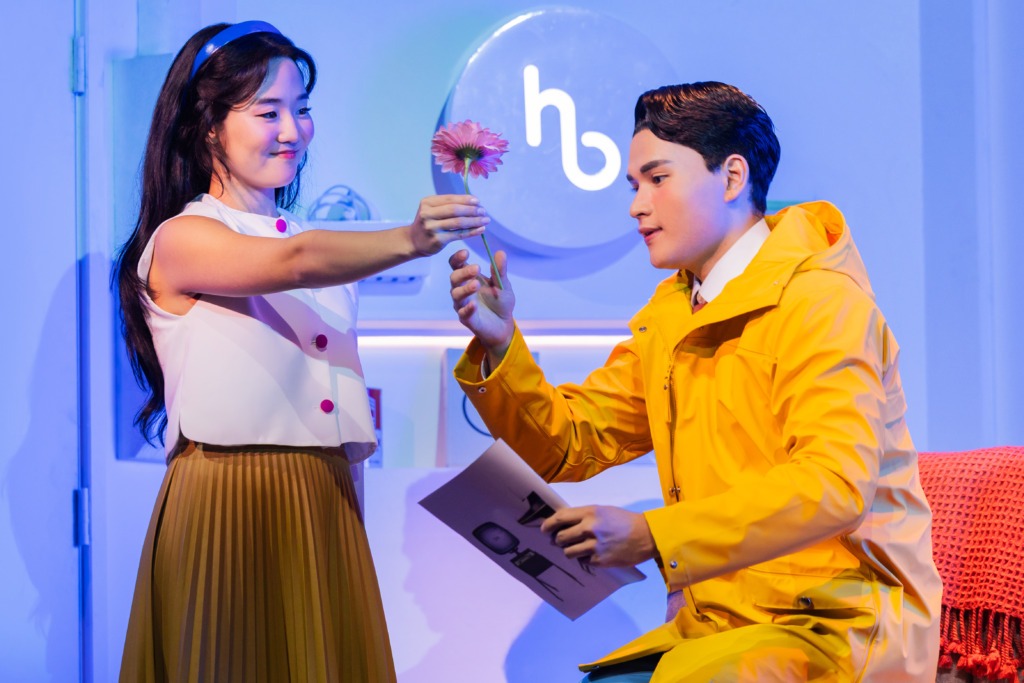
From a technical standpoint the show is stunning. Opening night brought about some of the most flawlessly synchronized technical components that one could hope for from a show where humorous punchlines and heartfelt pathos depend upon synchronicity of audio effects, lighting cues, and moving scenery to all align in perfect syzygy. Scenic Designer Dane Laffrey, working in tandem with Lighting Designer Ben Stanton and Video Designer George Reeve, has crafted an entire retro-futuristic world on stage with two sliding box-contained apartments and a whole lot of illumination and exacting video projection. There is this undeniably futuristic verve to the show’s scenery and overall setting— “The Helperbot Yards outside of Seoul, Korea in the near future” – which hints at a time that could be just around the corner but also possesses this nostalgic aura, maybe sprinkles of the Big Band era and a little dash of the late 1940s/early 1950s. The mail-chute in Oliver’s apartment is a personal favorite, and the hints of personal touches, which differentiate the two spaces, lends itself to the otherwise intentionally sterile minimalistic approach of this future world. The way the two apartments glide effortlessly on and off, accentuated in frame by neon tube lighting— blue for Oliver, pink for Claire— generates this cinematic sensation, as if you’re sliding in and out of separate scenes whilst wholly understanding they’re part of the same unit.
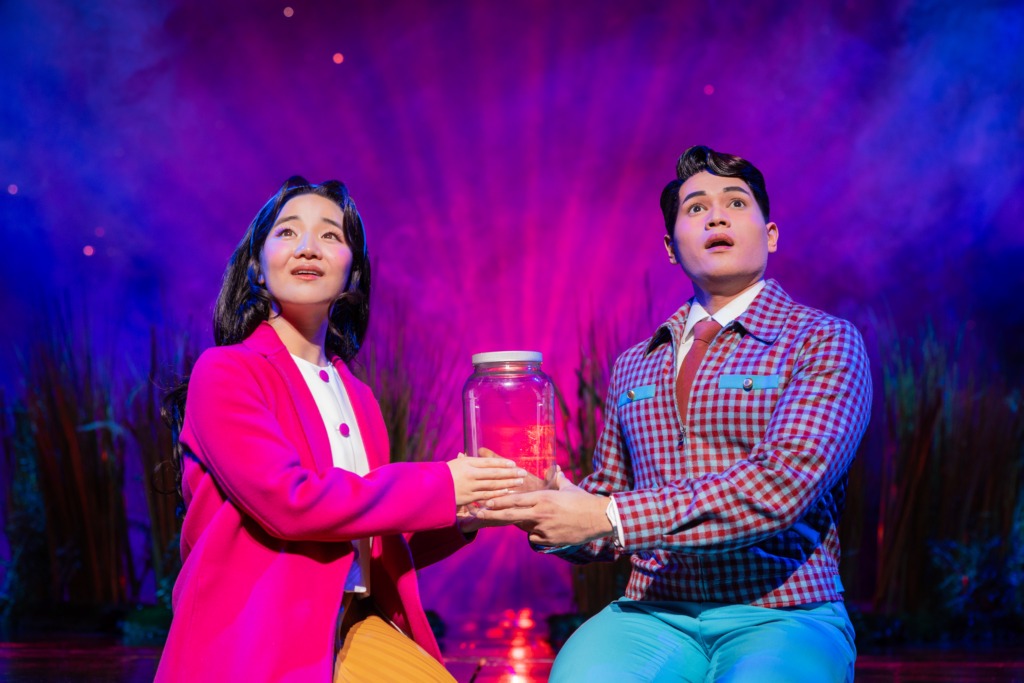
Reeve (who uses additional video design work crafted by Laffrey) is one of the most critical components for the show’s striking and dramatic plot-driven moments. As the show’s videographer, he captures the epitome of futuristic technology with some of this videographic-projection work, particularly when Suhan (Young Mazino) is played in a memory with Claire, making the audience question if the actor is actually standing on stage engaging with her. The way Reeve’s work seamlessly wends itself into the overall structure of the scenery, carefully balanced against Stanton’s lighting design, is extraordinary. The scene in the forest on Jeju Island is breathtaking with all of Stanton and Reeve’s effects playing out in tandem.
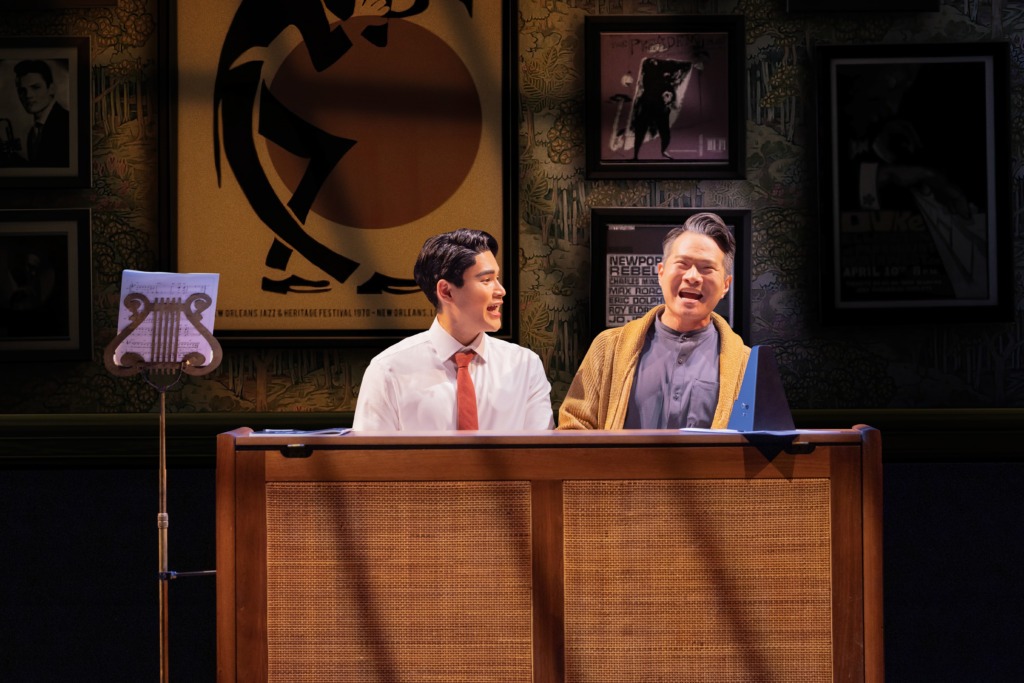
The Sound Design, conceptualized by Peter Hylenski, is extraordinary. There are multiple moments built into the performance where old-world effects, such as dial-tones and traditional phone rings, are synched up with actor motions to layer in humorous jokes and effects and this happens superbly and consistently throughout the performance. The orchestra-to-microphone ration (shoutout to Production Sound Team Pil Lojo and Simon Matthews) is beautifully balanced, particularly during “Chasing Fireflies”, an instrumental where members of the orchestra appear on stage as a part of the surreal and glorious experience on Jeju Island.
And while the show’s sartorial selection is mostly minimal, Costume Designer Clint Ramos (in tandem with Hair & Wig Designer Craig Miller and Makeup Design Artist Suki Tsujimoto) gives the two main characters bright pops of wonder in their clothing. Claire, in her basic goldenrod skirt has this fabulous pink traveling jacket, not unlike Oliver’s shiny yellow rain coat, and Oliver’s overall outfit is that electric bright shade of cornflower-teal. Of course, the costume that wins best in show, is the briefly-witnessed red-velvet luster suit, fitted for a crooner, that’s seen on the Gil Brentley (Francisco Javier González) character.
The show has a quirkiness to it that is undeniably charming. But it’s so much deeper and more stirring, gripping, heartbreakingly-evocative than just a humorous take on two characters who are so close to being human that at times you forget that they are robots, “Helperbots.” The sheer brilliance behind Will Aronson and Hue Park’s book gives not only a deep appreciation but a hope that original ideas can and do not only survive but thrive on stage in the modern era of everything-gets-adapted-into-a-musical. The humor is relatable, particularly the jibes and breakdown differentials between the Model-3, Oliver, and the Model-5, Claire, not dissimilar to any technological product that has enmeshed itself into daily human life in reality. The world that Aronson and Park has created is a gift; by not being fully human, it asks the audience to embrace our own humanity to explore it and truly appreciate the wonders— both joyous and mournful— of the fleeting existence that is our lives. It brings about heavy deluges of cathartic tears, particularly when the genuine hopeful vibes, intricately woven predominantly into Oliver’s limerence of what will happen when he begins his adventure, are exposed and reality seeps back in. The show is stunning, sensationally heartfelt, and will teach you a powerful, emotional lesson about living life fully, loving each moment— the happy and the sad— and embracing things even when you don’t fully understand the because that is simply the way of human life.
Hybrid medium performances can be risky in live stage ventures, but the technology interspersed into Maybe Happy Ending has proven to be near flawless, if not wholly perfect (and we’re going to credit every human involved here, because no robot could make the experience that good!) The video actors— Arden Cho as Jiyeon, Young Mazino as Suhan, and momentarily Jim Kaplan as Young Junseo— feel almost real because of the way their ‘scene work’ infiltrates the theatrical experience. There is a moment, previously described in the praises of the tech team, where it’s almost impossible to tell if Mazino’s character is a true hologram-style projection or if an actor has actually walked on stage and the lighting effects make him appear translucent. It’s stunning.
While the show itself is primarily a two-hander, it would be remiss of me (not to mention rude) to overlook the two supporting characters. Francisco Javier González plays Gil Brentley, the iconic, albeit fictional, jazz crooner meant to represent any jazz-band-leader-crooner of the time— think Glen Miller meets Sinatra meets Nat King Cole and Mel Tormé— and his crooning voice is otherworldly. “Why Love”, which kickstarts the show, feels like it could be from your old favorite jazz album and is sung with such passion and confidence, you’d swear that you’d heard it somewhere else in your memory. (None of the songs featured in Maybe Happy Ending have pre-existing life prior to being created for the show.) González drifts in and out of the scenery in those moments where his character is called upon to sing a tune, the aforementioned opener, “Jenny” and “A Sentimental Person” being the primary three where his vocal talents are put on proud display.
While the character of James (James Seol) has only one number in which he sings— “Where You Belong”, a duet with Oliver, is such an emotionally powerful song that you’ll feel the tears starting then. It’s the quintessence of limerence-living and hope, the stardust that humans are made, which has metaphorically been absorbed into the programing of these HelperBots; it’s a blindsiding moment that lands simply when you hear it and resonates throughout the entirety of the performance, only you won’t realize it until after you’ve heard it. Seol, who plays both James and his son Junseo, also plays the funniest bit-part-style ‘NPC’ in the performance— the ‘Motel Sexx’ desk-clerk and it’s a hilarious scream.
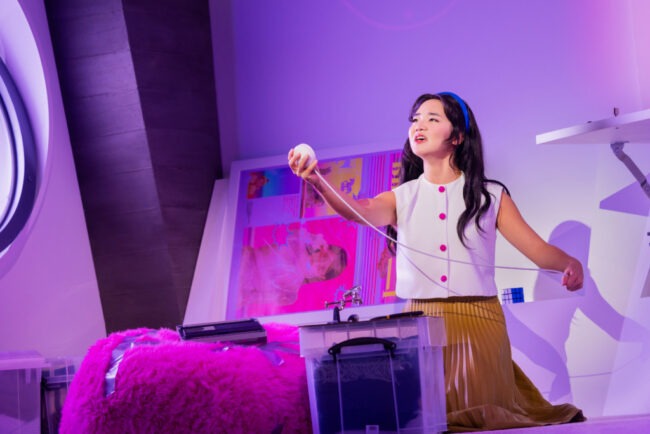
Claire (Claire Kwon) and Oliver (Steven Huynh) are our two protagonists, whose journey and existence intertwine early on; the audience is invested in their tale from the moment Kwon’s character is introduced. The way they play off of one another, the slight bickering and good-natured teasing, the careful interactions, as if they were trying to capture the true essence of human engaging with one another for the first time, but missing just this tiny component of truly being human; it’s fascinating. And when they sing together— particularly during “Hitting the Road” (all three of its parts) and “Goodbye, My Room” you get this sense that their voices were just made to blend together. The pièce de résistance of their duetting is “The Rainy Day We Met”, which is a glorious improvised rekindling of their human backstory and its sung sublimely by the pair of them.
Kwon, whose HelperBot is a model five, has a much higher intensity in her overall body language, energetic expression, and physical portrayal. She speaks with a more natural human cadence, which flawlessly insinuates her streamlined programing as an ‘upgraded model’ by comparison to Huynh’s model, which has more pronounced robotic features. There’s an undeniable personality to Kwon’s characterizations that is intentionally absent from Huynh and yet both actors make their characters feel so gloriously realistic, you’re wholly immersed in this world where HelperBots are true companions and exist alongside human beings as if they always have. Kwon’s voice is stellar, particularly when she sings the heartbreaking solo “What I Learned from People.” And when she alights on “How Not to be Alone” there’s something so soul-stirringly genuine that you’ll find yourself ready to tear up all over again.
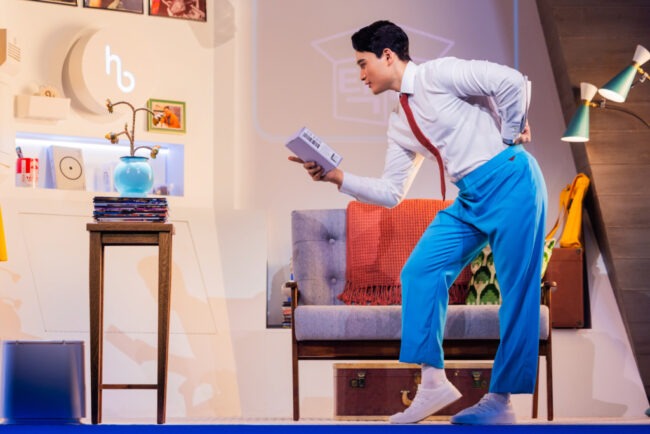
Huynh, as a model three, has more rigid movements, but not so stiff that they appear to be lampooning robotic gestures. Watching Huynh is like observing a character study in how to look as human as possible; it’s watching a sentient mechanical being imitate and nearly flawlessly mimic human life, movement, and existence. Initially his character startles easily and its hilarious to watch his body react accordingly. There is something peacefully innocent and naïve about the Oliver character as well, which is all the more heartbreaking as the situation grows somewhat more obvious to the audience. Gifted with a graceful voice that’s the perfect match to Kwon’s Claire, Huynh has this bright and unyielding joy for “World Within My Room”, the show’s true opening number, which already stirs your heart, making you both envy and appreciate his simplicity. The way Huynh and Kwon build their relationship dynamic is truly wonderful; it feels authentic, true to humanity, even if their characters are not truly human.
Maybe Happy Ending is a life lesson. To appreciate the heartache with the joy, to embrace the impermanence of existence. Who says endings must be sad? Who says goodbyes are not just routine? Are they— and on the whole, is not life— simply what we make it? Words to encapsulate such a stellar theatrical experience, one that can truly uplift and shatter the heart in well-under two hours, seem impossible to find. Robots are lucky, yes. They have the choice when it comes to remembering their experience, but humans are luckier. They have the full option of the experience whenever the memory strikes them; that is a true gift of existence. Don’t let Maybe Happy Ending say goodbye before you get to experience it, commit it to memory, and let it move and change your heart this fall.
Running Time: Approximately 100 minutes with no intermission
Maybe Happy Ending plays through September 19th 2026 at The Hippodrome Theatre inside The France-Merrick Performing Arts Center— 12 N. Eutaw Street in Baltimore’s Bromo Arts District. Tickets are available by calling the box office at 410-837-7400 or purchasing them in advance online.