author: Steven Kirkpatrick & Charles Boyington
Dirty Dancing—The Musical, now playing at The National Theatre, is a visually rich, energetic dance showcase built around the beloved 1980s film’s signature elements: the Catskills setting; the romance between Frances “Baby” Houseman (Annalese Starzec, who resembles Jennifer Grey) and dance instructor Johnny Castle (a muscular Blake Zelesnikar channeling Patrick Swayze); the famous lifts; and, of course, the climactic declaration that “no one puts Baby in a corner.”
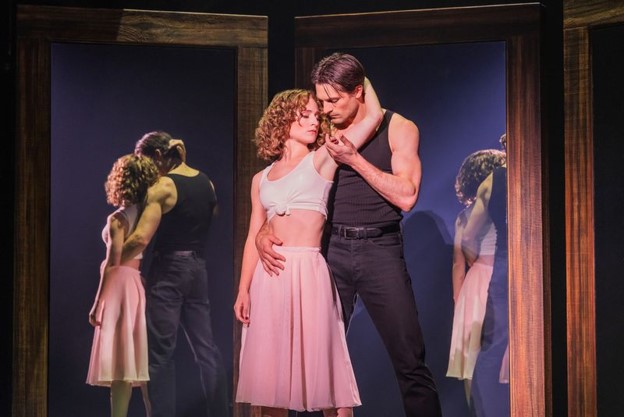
The audience was thrilled and the production is certainly worth seeing, though not without a few caveats. Rather than a conventional musical, it is a play punctuated by familiar songs and extensive dance sequences. Eleanor Bergstein’s story was a tad slender even on film; onstage, it often functions as a framework for recognizable scenes instead of a fully absorbing work of musical theater. Visually, it delivers–if emotionally, it cheats.
Adapted by Bergstein from her original screenplay, the stage version follows the film’s plot closely. Baby arrives at Kellerman’s resort expecting a dull family vacation, but her summer becomes a coming-of-age journey when she enters the private world of the resort’s dance staff. As in the film, the production considers class prejudice, romantic and sexual awakenings, loyalty, and youthful independence. Although these themes remain visible, the staging rarely gives them sufficient dramatic force, substituting fluid visuals and stage movement for depth.
Although the cast faithfully reproduces several iconic scenes, the performances vary. The leads are visually effective, and excellent dancers, but Baby and Johnny’s relationship does not always develop with the urgency the story demands. Blake Zelesnikar seems most charismatic primarily when he is dancing, and the genuine attraction between Johnny and Baby seems predetermined rather than surprisingly discovered in the moment. The material’s familiarity poses an understandable challenge, but it also makes nuanced dialogue and heightened emotional stakes essential.
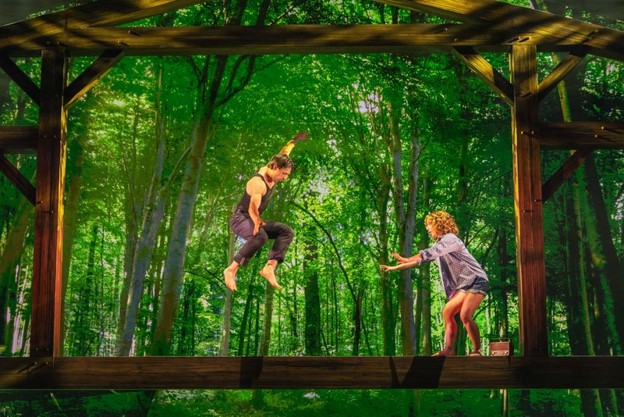
Directed by Lonny Price (who played Neil, the grandson of resort owner Max Kellerman in the movie Dirty Dancing) the show moves quickly. There is a fluid dance feel to every moment, from the spectacular light show to every scene change. The production, set design and projections all feel wonderfully cohesive and beautifully staged as if the entire theatre is a member of the dance company.
Two performances provide the evening’s strongest musical moments. Ethan Peterson as Billy, the cousin of Johnny Castle, and Ashley Lalonde as Elizabeth sing with power and distinct personality. Peterson leads Eric Carmen’s “Hungry Eyes” and joins Lalonde for “(I’ve Had) The Time of My Life,” the duet made famous by Bill Medley and Jennifer Warnes. Their vocal energy briefly lifts a production that otherwise struggles to generate dramatic momentum. The best dancer of the night was Olivia Cece playing Penny Johnson, the professional dancer who inadvertently sets all the other characters down the paths that they must follow. Her moves are pure poetry, and she manages to score emotionally throughout her scenes.
Most of the humor in the show is brought to us by the secondary characters, usually Baby’s family and other guests at the resort. Bryan Fenkart, playing Baby’s father, takes on his own emotional journey where being good isn’t the same as being right. Gina Lamparella may be slightly wasted in the small role of Baby’s mother, but with each look and verbal phrase she is perfection. Often the best laughs came from Jonas Cohen playing guest Mr. Schumacher. The audience began to giggle each time he came on stage expecting something outlandish. Also noteworthy is Lilly Kren as Baby’s sister Lisa, who just wants attention, and Sarah Ellis who plays Bungalow Bunny Vivian. Both ladies scored both physical comedy moments and one-line zingers.
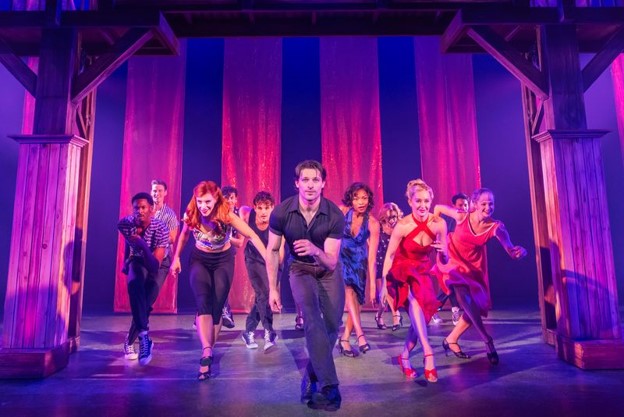
Darrell Grand Moultrie’s choreography supplies much of the evening’s momentum. Dance is the production’s central language, tracing Baby’s growing confidence and her connection with Johnny across class lines. The ensemble sequences combine athletic movement with vivid stage pictures, though greater complexity and unpredictability would make them more compelling.
On opening night, the audience’s enthusiasm peaked during the long-awaited finale. In those closing minutes, the production finally delivers the exhilaration it has promised all evening. Nostalgia carries much of the show, but when the familiar music swells and the dancing take over, the audience’s shared excitement becomes part of the appeal.
Dirty Dancing-The Musical is worth seeing and you will have a great time: yet the production ultimately asks whether its journey can match the impact of its destination. For much of the evening, it cannot. Yet when the finale arrives, its combination of familiar music, vigorous dancing, and collective nostalgia makes clear why audiences remain eager to take the trip.
Running Time: Approximately 2 hours and 30 minutes with one intermission
Dirty Dancing-The Musical plays through October 4th 2026 with Broadway at The National— 1321 Pennsylvania Ave NW, Washington, DC 20004. For tickets call the box office at (202) 628-6161 or purchase them online.