
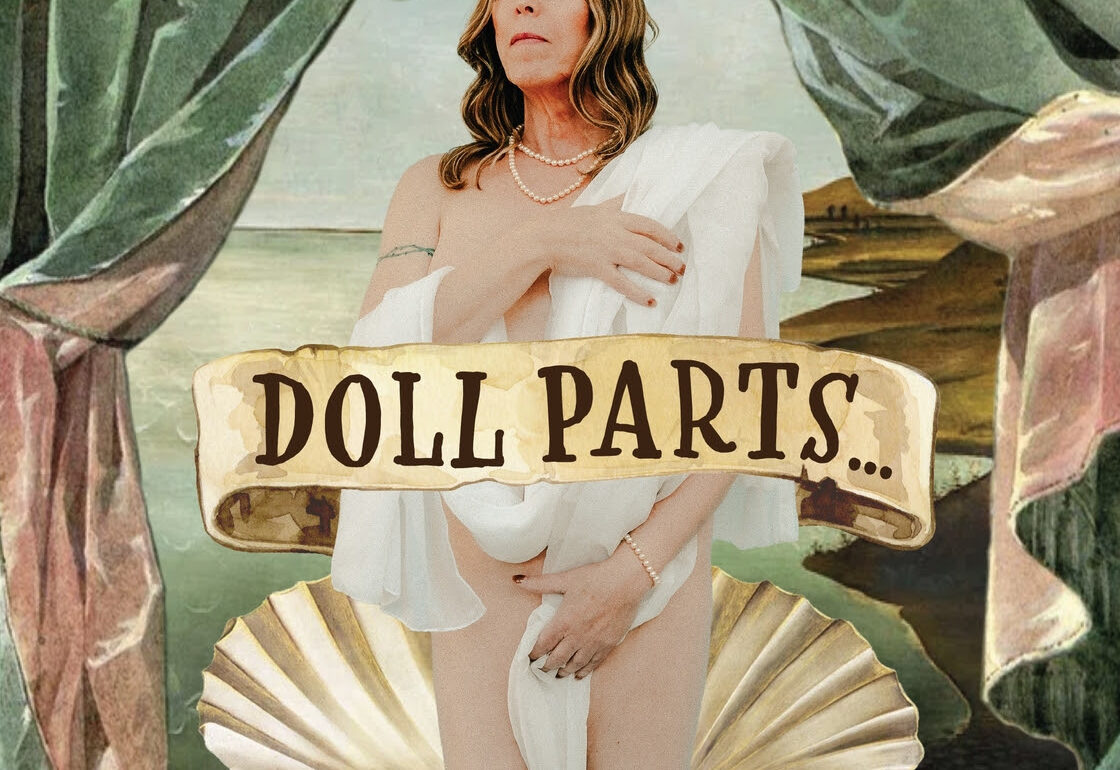
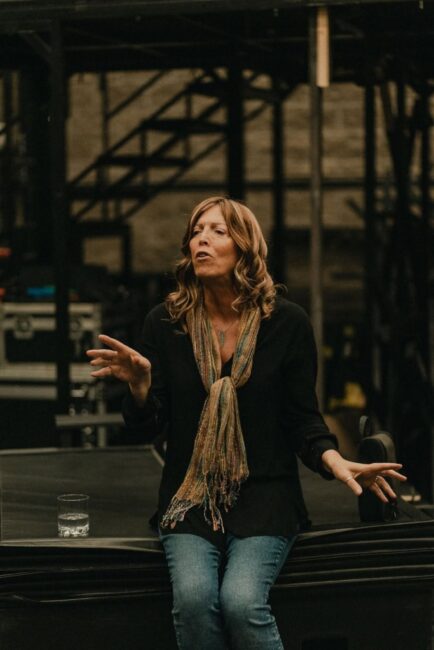
A one-[trans]-woman show about memory, becoming, and transitioning gender in later life. If that sounds like a show that has piqued your interests, then Doll Parts… appearing at The Voxel in Baltimore from July 21st through July 25th 2026 is the show for you. Written and performed by Nikki Ann Hartman (Founding Artistic Director of The People’s Repertory Theatre Company) this new work will debut as a part of the summer residency program offered at The Voxel. And in a TheatreBloom sit-down exclusive interview, we’ve gotten a sneak-peek at the whole process.
Thank you for sitting with us, Nikki. We’re really excited to be with you. So now the readers get to know— you’re Nikki Hartman, writer and performer of Doll Parts… which is being directed by Grace Shepperd, so tell us, how did this journey with Doll Parts… start? What was the impetus?
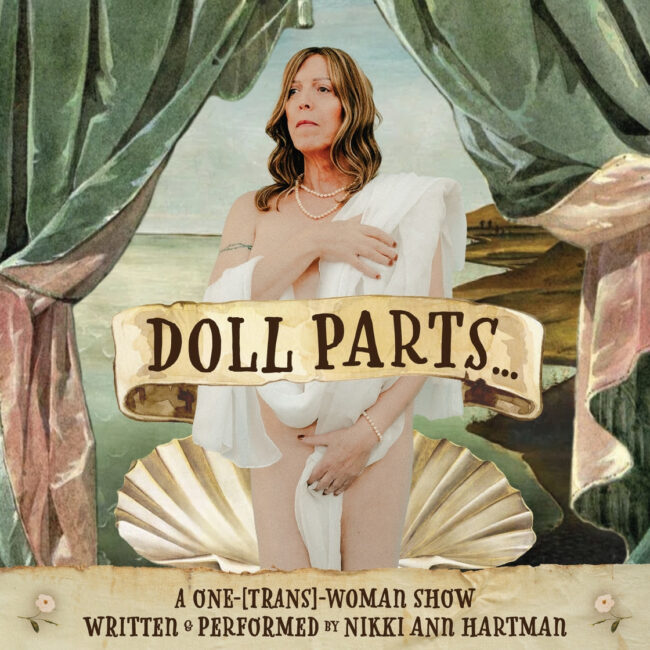
Nikki Ann Hartman: I’m a trans-woman in the midst of my transition. When I went from living publicly as a woman to medically transitioning, a good friend of mine said, “Nikki, you should write about this.” And we sat over dinners, laughing and making fun of the journey of transitioning and being a woman. And we came up with a lot of schemes. That was really the start, I really needed to talk about the absurdity of what this is like. And there’s so much that’s absurd. And so much also that is very serious and very heavy. But some absurd and funny too. That was the start. Maybe I should write about it.
So I began writing about it. Then Eve Muson, the chair of the department of theatre at UMBC where I work, knew that I had been writing and she asked if I wanted to do some pieces and test them as part of a show that the department was doing called Shout. It was a queer theatre project and it was this idea of “what are the voices in theatre that represent the queer community.” She was also serving as a dramaturg for me at the time. And she said, “Okay, Nikki, now that you’re writing and it’s good, don’t stop writing, keep going, let’s just keep doing it.” That’s kind of where the impetus came from.
And kind of better said? I was really looking for a piece of theatre to kind of give voice to the things I was experiencing. I was reading plays to see what would get at it if I were to direct it. There really wasn’t anything that spoke to me of me in that particular journey. And I thought the only thing I’m going to be able to find to get at— because I work through things theatrically as my art— and the only way to get at it was by finding a piece to work on. When I didn’t really find one, I knew it was time to write one that stresses the things we need to.
I love that. What was the timeline on this?
Nikki: Oh gosh! I began medically transitioning in 2021. I had been living as a woman in public…privately… since 2019. And then in 2021 I felt ready, and there was counseling and things involved, and then by 2022/2023 I began writing.
Would you say you were ‘in-process’ when the writing process started?
Nikki: Yes, I was in process before the writing got started, a couple years really. Three or four years in process before I actually sat down and said “let’s write.” There were small pieces and things that I did create here and there but it wasn’t really until then that things got started.
You’ve been a writer all your life?
Nikki: I have been a multidisciplinary theatre artist all my life. I began writing personal narrative performance art early on, like when I was 17. And I began doing that particular work. And through periods of when there wasn’t something, I would write something. In the 80s I did a series of pieces about what it was like to be living in that time period, which was very similar in some regard to the conservativism that we are experiencing now. The 90s was also a really big period of shift. It was just a big shift as a culture in the way that we began to view the world. I was writing about that, living as a father, and what that does to your heart. I’ve been a writer all my life but I don’t call myself a playwright. I took playwrighting classes but I didn’t study that. I studied theatre making and my theatre company, The People’s Repertory Theatre Company, wrote those pieces as a starting point. They were very much in the vein of the artists who greatly influenced my work.
Doll Parts… is this new work, this self-narrative that shares your journey. What might people expect when they come out to see Doll Parts…?
Nikki: That’s a great question, Mandy! This is the iteration that it is now. Doll Parts… is a series of monologues that is probably three times larger than what people will see here when they come out to see it because it was a lot of writing and a lot of the journey. And when we went to put it here, we asked, “What is the story that we’re telling?” And I think what people will see here is the journey of what it has been like for me as a trans-woman to encounter my first confrontation with people with transitioning out in public. They will likely see some issues that trans-people deal with, or at least that I dealt with. There are some memory things too. You look back at your life and go, “Oh my God! This was then!” and it was 20 years ago. It’s kind of a journey through memory and becoming and the process of transitioning. The joys, the challenges— and it’s always been about the light for me.
It’s always been about ‘God’ and seeking the higher self. My whole life has been about that. God is kind of a weird word for many people. But where is the light? Where is the positivity? The journey is about growth of the self, growth of the soul, while here. The play is really about that journey of growth of my soul and coming to terms with where am I, where did I get to, where did I get lost on the way?
It’s also funny. It’s moving. And it’s a little dirty. Just a little bit. Interestingly, unlike my real life, I only curse one-time in the show! It was surprising to me to suddenly realize that. You know, can I write a show without the cursing? Because there’s so much negative going on in the world if you’re a trans-person, and what’s happening with the legislation that’s coming in, the Project2025 that’s being enacted, and all of those things that are going on— the descent into darkness that seems to be happening. I think I realized about halfway through that I only had one piece in the work that used the ‘F-word.’ And we cut that piece out because most of the political things didn’t make it into the show. Because we’re all living the political things. So to bring them into the show and be living through them seemed very heavy, very dark. And there’s far too much joy for that. I suddenly realized “Oh my God, if I take that out then I don’t say it at all— I don’t curse at all.”
What a fun discovery and challenge to make!
Nikki: We looked at what we had. We looked at what is being presented and what does that turn out to be and it’s really, I want to say it’s a very optimistic view on working through what it means to be living as a person of conscience, a trans-person, a human being at this time in our lives.
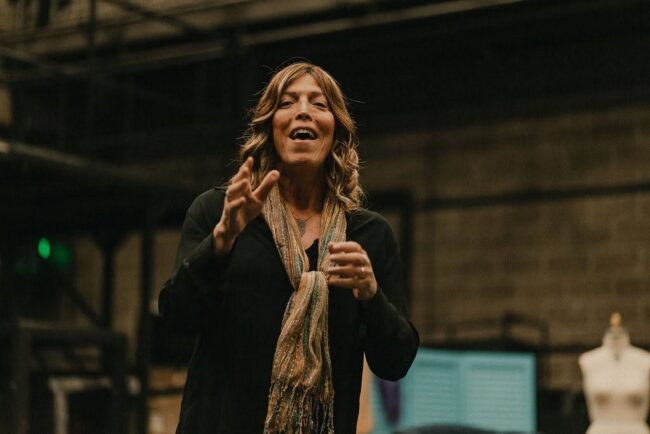
That’s really beautiful. Now, please forgive me for saying, but you are a woman of a certain age…you have a little bit of seasoning on your trail and you look stunning, but you have some decades that you can say you have lived through. How has that colored your experience here?
Nikki: Thank you and yes I have decades— I’m 66, so this is a great question! I do have decades! I was raised in the decades of coming out of the 50s and the repression into the 60s where everything was open. Then I came into my teenage years in the 70s, pre-HIV, pre-AIDS, where what had carried through in the 60s and matured into the 70s was this very open not-sexually repressed era. Then I lived through into the conservativism of the 80s and then the political conservativism of the 90s. And here I am now, years and years later, I’ve lived an entire life, 66 years of it.
I remember wanting to transition when I was 17 in the 70s. I had this opportunity and I didn’t think I would be safe, that I could do it, like there was too much expectation on me. Though I had a really wonderful opportunity, it was one of a series of events that were possible for me. I waited to do it until I felt it was safe. In the mid-teens, the early teens of 2000s, so many of my students were coming up through adolescence as trans and living as transgender. And I had this feeling, “obviously it’s safe now, Nikki, you can transition.” So I did that. And then of course, Trump came in and the world turned upside down.
I think Doll Parts… touches on that. This was a moment, this is a moment that happened in my own journey that came to light when I finally sat down and said I think I’m ready to do this. I think I’m able to do it. But then to suddenly be confronted with, “actually, you’re no longer able to do that” and you’re now considered— not an enemy of the state, a domestic terrorist. I think they’re saying now that the terminology, as a trans-woman is that I’m a domestic terrorist.
That is absolutely not okay.
Nikki: I know. I’m even receiving emails about how wrong I am for doing a show about it. It’s really a thing. But there is so much joy in this show, I need to keep saying that.
It sounds like you have not lost sight of hope or light or optimism in the face of all of this adversity.
Nikki: I have to say that that’s not necessarily true. But I’ve come out the other side of it, into a space of optimism, amidst all the adversity. In the journey, especially post-election— 2016, when I was giving it consideration— and the same thing is true with 2024— when that happened, that was a dark four or five months of packing my bags, having a go-bag ready, preparing to flee. I was investigating surgeries in other countries, planning to actually leave the country.
I did all of those things in the midst of getting ready, and at a certain point it becomes difficult to navigate all of that. And while this bit isn’t in the play, I reached that point where the choice was either, “I stay and I continue my transition” or “I get out and maybe I don’t ever transition.” And the dilemma about staying, which is what I chose to too, is that I can’t get out now. Or get back if I’m able to get out. That was the dilemma for me. I just couldn’t walk around carrying that anymore. I just have to assume that I’ll know when I need to go. And I don’t know if this was right or not, but I removed a lot of the darker pieces from the show about what that turmoil was really like. We touch on it, but we don’t really go the whole way.
That’s a deeply personal decision in where you feel comfortable or not comfortable exposing yourself and your journey in this format. Because at the end of the day, while you have every right to express yourself in a way that best represents your true self, unfortunately, there is now a societal narrative where you have to think about your safety in addition to your expression. At the end of the day, are you going to be able to safely leave the theatre, go back to your home and not be overwhelmed with worry about whether or not you make it home?
Nikki: You bring up a really good point there and I want to say— it’s always been that for me. It’s always been having to balance my personal safety with what I believe as an artist or as a human being. My entire life, since I was young-young, all the way to now. But it’s also one of the reasons why there is only a little bit of the political turmoil in the show, because everyone is living it. I don’t really have to push too far on everyone’s button for them to recall or know or feel what’s happening. It’s in all of our bodies, it’s the way we’re all addressing the world with so much caution. It’s difficult for an audience to be in that space. So how do you present it and then allow them their own journey and not bury them in it? That personal safety thing? That’s always been a weighted thing. Culturally, faith-based— being raised Jewish, I always had to worry about that. Same thing with being gender queer, from young all the way through to now, it’s always been heavy.
What would you say has been the biggest personal challenge, taking this project on either as a writer or as a performer or just as a human being, a trans-woman who is trying to stay safe but also stay expressive and be true to yourself?
Nikki: That has been the biggest challenge, Mandy!
I answered my own question!
Nikki: You literally did! It really has been the biggest challenge. How do I stay true to what it is and keep myself safe? There have been multiple incidences— even today— where my safety at work or being and living my authentic life have been threatened. That’s the hard part. For a while I was really at that point of, “That’s it, I’m not going out, I’m not going anywhere.”
But then what kind of life is that?
Nikki: That’s why the work is so important. It has to be put out there. I was done, I couldn’t but I thought “Where’s my line? Where’s the line that I flee the country?” And the line for me was the moment they started collecting people like they did in Nazi Germany. At that point I knew I could no longer sit back. I need to have a voice and I need to say something, even if my safety is threatened. There were times when I had to remove my imprint out in the world for a couple of months while ICE was actually in Columbia and going door to door. Even at work. They came and ripped off my Pride Flags and my Trans Flags and I had to be really careful about moving around on campus. This is a balancing act. But I can’t stay quiet.
I wrote a really great, long, big piece— a couple of them— but one that we didn’t record, which was called “Bad Math” was a piece about the numbers of people and comparing the timeline of Trump’s administration with the timeline of Hitler’s administration and what were the numbers of people that are being effected immediately in that timeline. And Trump’s were astronomically larger. That piece we went to film and put up— but it became too risky. I was told ‘don’t put that up, it’s not a good time right now.’ And I’m sorry we didn’t but at the same time, who knows what might have happened. The atrocities that I think the Trump administration have been doing have been happening so quickly, so fast that you can’t keep up with them. So my piece, though potent, the examples are already out of date. He’s made worse things since then and it really becomes a whole ordeal that way.
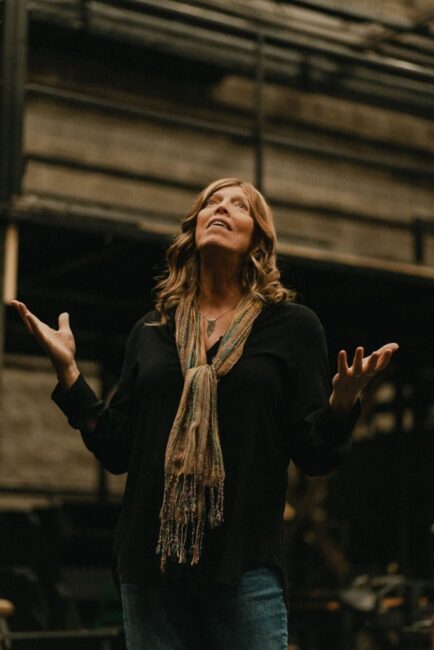
That’s in the piece— this 28-minute piece in the show became one sentence. Because what could I say? I can’t keep up. And neither can the Daily shows, they can’t keep up. No one can keep up. He’s moving faster than the Nazi party and Hitler’s regime; it’s been horrifying. As a person, in real life, I don’t watch much news, it’s just too difficult. It’s always been too difficult. I’m aware of what’s going on, but I can’t have it come in and interrupt because it’ll overtake. And that’s why there’s so much humor in the show.
And when I say humor, I’m talking about the way in which I walk through the world, and that’s rather like self-effacing. And I try to find the most joy that I can amongst the difficult.
You absolutely must find the joy otherwise all that’s left is the despair and where do you go from there? What would you say is the moment— of what made the final cut into Doll Parts… — that speaks to you the most?
Nikki: Oooh, wow! You ask such good questions! That’s really a great question, what speaks to me the most, that’s what you asked? The construct of the show is through jumping in time. Each of the pieces are a particular time. Some are elongated and become a whole period. So what speaks the most to me? I can’t even answer that because we just talked about escaping— and there’s a whole piece on that and that speaks really very hard to me, really strongly to me— but I think I’m finding an answer here. There’s a piece called “Planetary Alignment” which marries the opening of the show with my relationship to the gods back into my relationship with the universe. And what is that relationship and why are we here. There’s this aspect of the metaphysical that’s involved in any journey, and in this particular journey, the constant has always been the connection to the metaphysical. “Planetary Alignment” ties the bows, ties the knots, and for me, that is one that speaks really well to me.
There’s also “In The Midst” and that one is possibly the most theatrical of them but it’s just looking at the things we do in life as a metaphor for the sheer joy that life holds for us, even if things go wrong. I would say that one. And there’s an ‘attempting-to-date’ scene, which is really lovely. Dating is hard. It’s just hard! It’s a difficult thing, especially if you’re trans and you’re mid-process, and in the show that’s where I am, mid-process. What is that like and who are you supposed to be connecting with?
And you’re an artist, and a woman of a certain age, you’ve got all the boxes!
Nikki: All the boxes and they are all checked off! Isn’t the lesson then the person you’re supposed to date is you? Isn’t the life you’re supposed to make with someone supposed to be the life you make with yourself? You’re looking for your true love? Well she’s you— you are your true love. I think, all things considered, I think that’s really part of the journey. In the show, it’s really clear that I’m single, humorously so. But then wait, it’s not so funny. But I really think for me and my own journey, there’s been great beauty, and also the lesson of “maybe I need to stop seeking outside.” Happy with yourself but so much more, just being present. And allowing. This society doesn’t give anyone that time. They want you on TikTok and they want you absorbed, but I want that sense of peace by being present. I think that comes from being over 50.
What has been the most fun thing about getting to work on this project?
Nikki: Oh my god, well first of all, there are many but one of the most fun things of the whole thing? That’s been the collaborating. From the get-go! Collaborating with my writing guides— the self-collaboration that goes on in the process. Here’s this idea and then suddenly all these ideas come forward and that collaboration was dynamic. Then the collaborators who work with me as writers, I have a colleague who works at Tulane University and that collaboration. Then the dinners with friends I was talking about early on, which got the spark, those collaborations were great. And all the artists that came and joined the process, like Grace Shepperd the Director. When she found out I was writing a play, she said she was a solo artist as well and she wanted to read it. And I told her if she was going to read it I was going to need her to edit it. So she read it and said “okay, let’s go.” It was really evident that we absolutely clicked; we have a similar aesthetic, we have a similar sense of humor. That collaboration has been dynamic and wonderful.
The collaboration with Eve has been wonderful. All of the artists that you’re seeing— our stage managers in the show Mady and Jaydn, (the stage manager Mady Sims and assistant stage manager Jaydn Fleming) they have created such a supportive, safe space in the rehearsal room. That collaboration has been great. They’re in the show— they’re gods in the play. It’s a solo performance but because they’re doing work and its present, it’s fitting that they’re gods. That’s how we’ve created them.
So the collaboration all around has been great. The support from all over that has been so present in the work from friends, from granting organizations, and The Voxel Theatre.
How did we end up here at The Voxel?
Nikki: I know! I think that too! They offer a summer residency and I applied for the summer residency. They had 70 artists apply. I was one of seven who received that residency. I applied, they held my hand during the process, they really worked with me. They thought the project was really a good fitting project for The Voxel. And if you don’t know, The Voxel is a state-of-the-art theatre laboratory along with the fact that they invite artists of all different disciplines to do work in their space. We account for the heavens and the metaphysical world in the play, most all my plays do, but this one really does. And the technology that we have here, to see that happen? We couldn’t produce that elsewhere and that’s been really exciting.
The collaborating, the support, and how re-enforced the need for this work is. How much the voices that do this kind of work are truly needed, re-enforcing that need has been really great. And the last thing that’s been really great even though it’s not the last, is that I transitioned when I began writing the work, but I’ve also transitioned my work. I went from being mostly behind the scenes, after the last 20-30 years, from being a director to being in front of the lights, on the stage, and being the performer. That process of stepping into the light, into my own next step of the work has really been super exciting. It’s about time.
What would 66-year-old Nikki say to 17-year-old you?
Nikki: GIRL… DO IT! Girl, you could have done it! Girl, do it! Really, seriously, that’s what I said to myself at 60. 66-year-old Nikki, would tell 17-year-old Nikki “Fuck it! Go for it! Live your life! Seek your joy! You never know where it’s going to take you?” Who knew I would get here? Here, though theatrically is here and that’s a great thing, it’s also here spiritually in the way that I work and live in the metaphysical world and the ether. How do I manifest, how do I live my life? So yeah, I would have told her “Go for it, go for it!” I would have told her that at 13. But I couldn’t do it. Society wasn’t ready for it. I can remember living in New York City and running down the street so I wouldn’t get beat up.
I’m so sorry.
Nikki: You don’t have to apologize. That’s just how it was. And that’s what is so weird and awful about having to worry here and now again because at the time I was living in New York City it was really a worry for my well-being. I could have ended up dead several times. It was good that I didn’t. I mean not die, but that I didn’t transition then because I don’t know that I would have survived any of it. And now, it’s back; I have to worry about that again. We are in some times indeed.
What is it that you are hoping audiences members are going to come out and take away from this experience?
Nikki: Just the sheer joy of being alive. The fun of life. It’s a question I ask in the play but what are those moments that really change what your life is? When you overcome your fears and ask yourself “what if it goes better than you could ever imagine?” And if you take the chances to overcome your fear, which I couldn’t do at 17, the world opens for you! There are so many things that happen for you when you step into ‘what’s supposed to happen for you in the world.’ I hope they take away the sense of “I can, it worked out here, it can work out for me, I can have that courage, I can have that strength.” I hope they take that and the joy.
I hope they do too. What has this project taught you, what has been your biggest learning lesson about you?
Nikki: That so much of my life has been spent trying to appease others. You’re only good, only happy, when you make choices that fill your heart and the needs of your heart. It taught me to overcome my fears. Being on stage is fuck fearful. I stopped doing it because it was just so much anxiety. And now, I’m like “okay, if you overcome your fears what could happen?” Only amazing things can happen if you do it!
That is beautiful and true. Why do you want people to come out and spend an evening here at The Voxel with you and Doll Parts…?
Nikki: First of all, it’s fun. It’s an absolutely fun show, it’s really delightful. It’s a really enjoyable evening. It’s smart. It’s smart-funny. And it’s a really beautiful show. That’s why they should come. Their lives will be changed when they’re done. For the better. Transformative theatre!
We love transformative theatre. Anything else you’d like to touch on before we wrap this up?
Nikki: Come have fun. The Voxel does so many really good things, so many amazing, cutting-edge performances are done here. I would say come and see what the theatrical community, the performative community is doing, come see some of these new works that are going on here at The Voxel. I’m just one of the many shows that are doing it. (For more information on upcoming programing at The Voxel, click here.)
If you had to sum up your experience in working on Doll Parts… up to this point in the journey, using just one word, which word would you use?
Nikki: Bliss.
Doll Parts… plays July 21st through July 25th 2026 at The Voxel— 9 W. 25th Street in Baltimore, MD. Tickets ca be purchased at the door or in advance online.
Related posts:
 Doll Parts… at The Voxel
 Livin’ It Up On Top: The Graduating Seniors of 2026 from Children’s Playhouse of Maryland Chat About Their Final Show- Hadestown
 When You’re An Addams: A Full-Disclosure Interview with The Addams Family (and some Beinekes) at Beth Tfiloh Community Theatre
 Speak Low If You Speak Love: A Round-Robin Interview with Ardeo Theatre Company’s Much Ado About Nothing Folk