Of these two things I am certain; all else is confusion:
- Cockpit in Court puts up five shows a year in their summerstock season; two main stage shows, two shows in the cabaret, and a junior show for youth performers over in the admin building.
- Deathtrap is arguably the best show they’ve produced up in the cabaret space this side of the pandemic.
It’s thrilleritis-malignus at its finest! Directed by Eric J. Potter, this Ira Levin theatrical chestnut is chasing you with its dark comedy and suspenseful vibes from the moment the metaphorical curtain goes up. It’s staged in-the-round in the black box cabaret space upstairs so you’ll have to imagine the curtain, but it’s a powerfully executed production that is practically perfect in every sense.
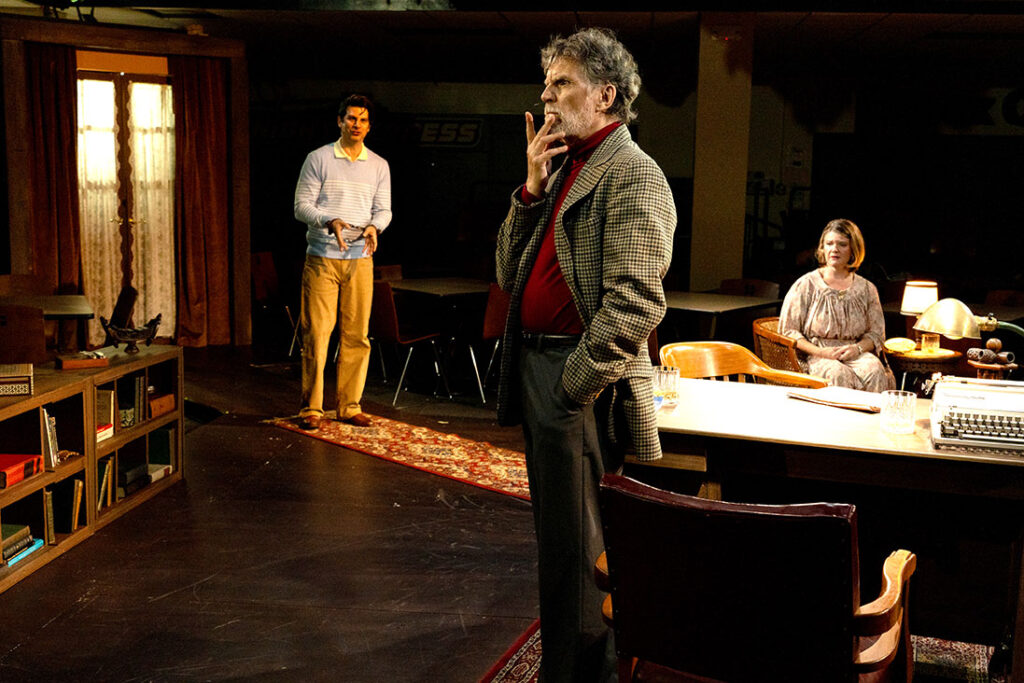
Scenic Designer and Artist Michael Rasinki does a splendid job with the layout, the furnishings, the décor. Deathtrap has very specific design elements written into the script, like the wall of weaponry and the Window Cards (not to be confused with stage posters) and the desk. If one wants to be nit-picky, the desk, which sits central to the stage’s play space, isn’t a true partner’s desk (come the second act) and although they make it work, it’s difficult to tell from any one spot that it’s meant to be a nicer/newer addition once the actions of the first half of the show have taken place. And because of the intimate viewing optics in the play space, the fact that the second typewriter is not a black Smith-Corona (or even black at all) the way it gets referenced and joked about in the script is the tiniest bit unsettling. (It’s understandable that budgets are factors but given the amount of times this production has been done in the community and all around the area over the last decade…) But this minor observations aside, both Rasinki and Cathy Kratovil (on props) do a fine job in creating a realistic and suspenseful atmosphere.
The show’s sonic soundscape is spectacular and aligns pretty flawlessly with the show’s lighting design. Phil Vannoorbeeck serves as master design for both technical components and they are well-received in the production. There are moments when Vannoorbeeck’s lighting is intentionally trying to draw attention to the more ‘meta’ and ‘meta-hyped-thriller’ moments by focusing tightly on the characters and action in those instances— from a personal standpoint it’s a heavy-handed approach? But that said it, it read beautifully and one must bear in mind that virtually no one in that audience will have seen Deathtrap nearly a dozen times (excepting myself and maybe one other local area theatre director.) Vannoorbeeck’s work with lights and sound are high caliber; the storm effect is exquisite. Though when the crossbow fires its sound effect is virtually indistinguishable from that of the gunshot, which is just a tiny bit disappointing. And I’ll say in earnest that if the only true ‘problems’ one is having with their production is a mismatched sound effect and an off-color typewriter, you’re leaps and bounds ahead of the game.
Wil Crowther’s costumes are so seamlessly lined into the mid-late 1970s timestamp that they’re hardly noticeable. That’s not to say they aren’t worth praising because they are it’s just that it’s not the type of show where you’re expecting sequins or hard-to-timeline couture. Crowther takes a more subtle approach to the Helga Ten Dorp sartorial selection but even this fits the overall verve of this production. She is loony psychic, no? Of course one might expect outrageous colors and patterns. Crowther’s approach is more befitting of the character’s age and in trusting the actress who brings the ‘over-the-top’ characterization with her acting. Of course the most praiseworthy thing about Crowther’s costume design is the thing I can’t talk directly about, suffice it to say the ‘distress’ featured on a certain costume at the end of the first act is morbidly delightful and ticks all the boxes!
As a director, Eric J. Potter demonstrates a tremendous knowledge of the play itself, the play space, how to direct in the round, and how to drive tension into those heightened scenes where the edgy thriller nature desperately craves to be felt by the audience. The show moves effectively (shoutout to Lisa L. Boeren, the stage manager, and her run crew) and you find yourself readily enthralled in the drama as it unfolds. The aforementioned Phil Vannoorbeeck’s sound design lends a hand in this department as well for the shifts between scenes. You get spikes of suspenseful music, all orchestral, all very cinematic, and it augments the experience in those ‘dark-outs.’
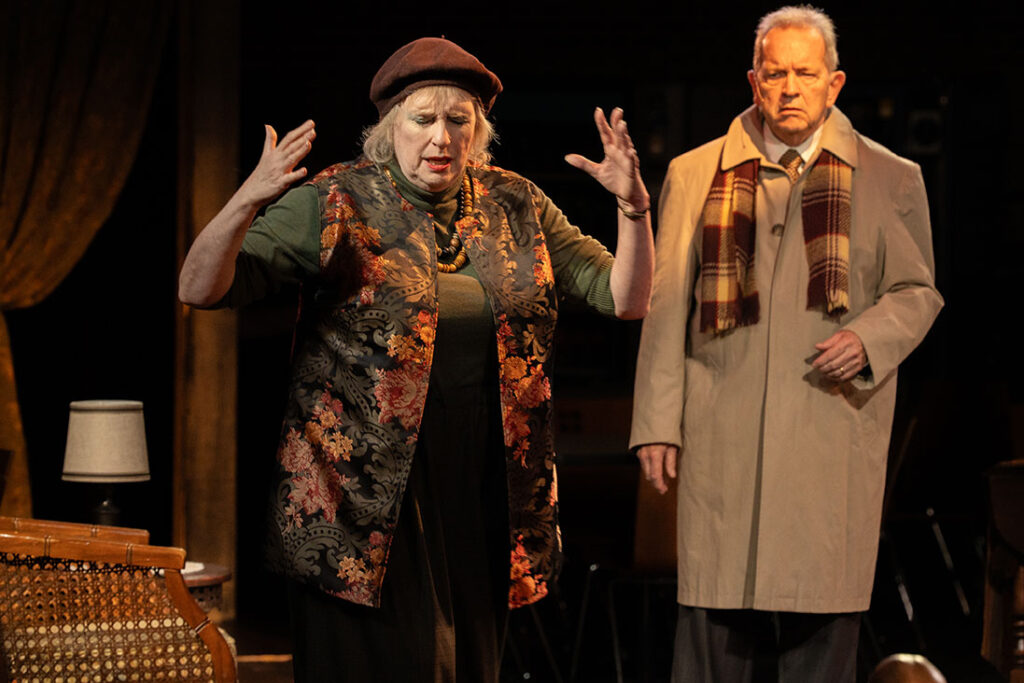
It’s a five-character show, and even the drop-in character of Porter Milgrim (John Dignam) feels wholly entrenched in the group dynamic even if he only appears for two brief moments in the second act. Dignam’s arrival coincides with two major plot points that I won’t divulge here because if— unlike me— you haven’t seen this play more than a handful of times or even at all— I don’t want a Bruhl murder-weapon aimed my way for spoiling things. But you get this rather somber characterization, outside of the pithy little family-solicitor type jokes scripted in for Porter and Dignam makes a palpable effort to strike the balance between ‘OG-dad-joke’ style humor and the more stoic nature of his visit. And much like the Porter Milgrim character, Helga Ten Dorp (Cathy Herlinger) is a drop-in feature of the play. Herlinger adapts a caricature-style accents suited for the way the character is written and adds a larger-than-life comedic flavor to the production. Though she too has those moments of seriousness that she juxtaposes well against her more quirky nature. Both Dignam and Herlinger work their characters realistically. It feels very authentic.
And that’s true across the board; the feeling of authenticity thrives in this cast. You don’t feel as if you’re watching actors putting on a play, you get the sense that they’re living this drama and thriller in live-time. As Myra, Stephanie Ranno facilitates this exact notion in both her on-stage energy and the character’s overall dynamic arch. It’s easy for the character of Myra to remain somewhat one-dimensional, particularly as she’s only featured in the first act but Ranno surpasses that potential plateau by starting the character’s energy at a much more warmly effervescent level. You can see a tenderness between Myra and Sidney, gently nudged into place by Ranno’s spatial relation and overall comforting touches. Watch Ranno’s facial expressions; they’re simply fascinating and will speak volumes of her character’s experience, particularly as it shifts from doting wife to chaotic panic. The deft shift in trying to maintain a becalmed façade whilst experiencing sheer terror is handled with extraordinary grace in Ranno’s capable hands.
Clifford Anderson (Matthew Payne) and Sidney Bruhl (Phil Gallagher) are the play’s sparring figures. And you’re getting stage brilliance from both of them. There’s delectable brooding sarcasm that drips from Gallagher’s mouth early on, particularly when discussing and debating the situation at present with Myra. And Payne gives you a full-flip-switch when it comes to playing up the character of Clifford. In his initial bid, Payne presents a fawning, eagerly enthusiastic student with a nervously wary composition to his character. That’s quickly dispelled by the time certain actions occur and you get this smooth, unrufflable confident creature who balances the upper hand as well as his steady textual delivery.
The way Payne and Gallagher interact is wholly exhilarating. Their pacing and delivery and the dynamic shifts from the way their character’s respond to one another sends theatrical shivers up the spine. Even if you know the show as well as these two (or people like myself) you never feel like they’re chasing a foregone conclusion; the shocks and surprises and true thrills sneak up on Gallagher and Payne as earnestly as they do the audience. And when all of the various ‘fights’ start cropping up, it’s deliciously authentic fight choreography that you’re treated to in this production. There are also little moments when Payne’s character mock-parrots Gallagher’s character, putting on an accent and affected vocality and it earns some much-deserved humor, which is the perfect distraction from all of those really intense moments. The par spar— not just physically— but mentally and with words as their weapons— and they understand each other as well as each other’s characters making for one intensely engaging theatrical experience. There’s a drive that both Gallagher and Payne possess as they push their way through the scenes in the second act— a smugness on Payne’s Cliff, an exasperation on Gallagher’s Sidney, the combination is intoxicating, you could punch-drunk on their banter, which makes it that much more titillating once things shift. One of the most striking moments shared between them is that ‘up-in-each-other’s-faces’ instance at the fireplace in the second act; it’s dangerous and you could cut the tension that permeates out of the pair of them with a cleaver.
Much like its downstairs counterpart, Footloose, this show is hot. And selling quickly. And in all likelihood will sell out. Do not miss your chance to experience the sensational stage thriller that is Deathtrap this summer at Cockpit in Court.
Running Time: Approximately 2 hours and 20 minutes with one intermission
Deathtrap plays through August 2nd 2026 with Cockpit in Court in the upstairs Cabaret Space of The Robert and Eleanor Romadka College Center at the Community College of Baltimore County Essex Campus— 7201 Rossville Boulevard, Essex MD. For tickets call the box office at (443) 840-2787 or purchase them online.