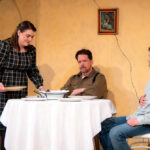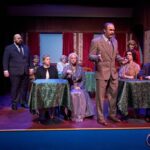
Just what kind of community do you want to live in? Ask yourself that the next time you think about running for town council or stepping up to attend a city hall meeting. It’s a valid question. What kind of community do you want to live in? It’s a surface level question that could have a surface level answer. It could also be a fathomless question with a bottomless answer that really gut-checks reality for you. Find out which specifically Tracy Letts is addressing in the DC-premiere of his visceral play The Minutes now appearing live on-stage at The Keegan Theatre for the penultimate mainstage production of their 29th season. Directed by Susan Marie Rhea, this stunning and evocative dramady explores the cankerous truths nestled deep in the darkness of small-town politics and is a mind-blowing theatrical experience well-worth seeing.
The play itself could honestly be pitched as a political comedy; a cross-section into smalltown life by lens of the town-hall/council meeting. All the little gripes and grievances, humors and whatnot are ripe for the plucking but playwright Tracy Letts dives so much deeper and it’s a lovely little laughing event right up until it isn’t. And once it isn’t— it hits. And it doesn’t just hit— it deep-bomb devastates and really exposes some ugly truths that rankle with both the characters and the audiences. It’s a riveting and compelling piece of theatre that is ingeniously switched on in both its methodology and its exacting approach to weighing out the balance of human nature.
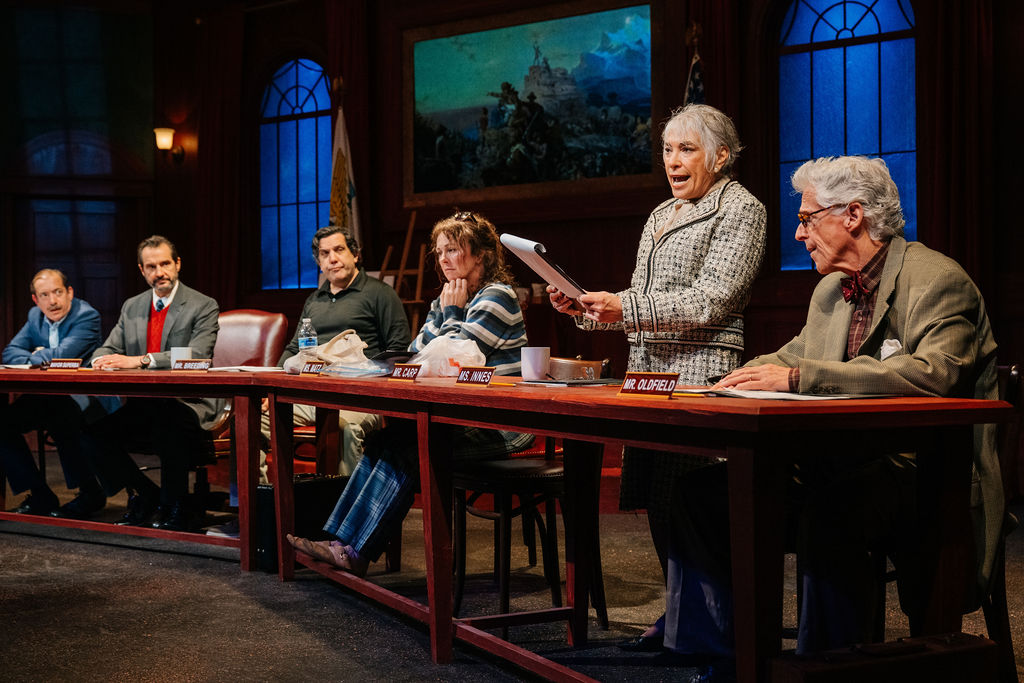
When you slip into Keegan’s main stage space, you automatically get this feeling that you’re like a member of the small town of Big Cherry (the fictious town setting for The Minutes) attending their weekly council meeting. Right up until the script announces that it’s a closed meeting; then you feel just that twinge of discomfort— like maybe you ought not to be there watching what’s unfolding? And yet it’s so compelling. And you’re drawn into the full-blown spectacle of it all, firstly by Scenic Designer (and technical director) Josh Sticklin. Working with Properties & Set Dressing Designer Cindy Landrum Jacobs, Sticklin immerses you into this small-town council chamber; the details are intricate, the space exists with reverence yet simplicity, it’s a powerful dynamic carefully crafted into the walls and overall structure.
Complimenting the play space is the superb lighting and sound work of Dominic DeSalvio (lights) and Tony Angelini (sound.) There’s a storm happening on the night that the play is set; it’s subtle but ominous, the perfect parallel for the build of dramatic and dynamic tension from within the script. DeSalvio’s use of the flickering lights, accompanied by that power-surging sizzle fro Angelini’s soundscape at intervals adds the sublime element of foreboding to the experience. What’s truly sensational about their combined design work is how flawlessly they execute a ‘power-outage/blackout’ which serves as a temporal shift. You go from live-time to recall and back with a series of flawlessly and meticulously plotted cues that are really striking and breathtaking, especially once you realize it’s not just the storm but a brief time-hop.
High praises are also owed to Fight Director Sierra Young (no spoilers herein but the choreography looks intentional, naturally, and really authentic) and to scenic director Brodie Steele, though truthfully I’m not sure if that’s credit for specific scene-work (perhaps the final scene with the movement-based actions?) or the transitions of scenes, but it goes in the category of ‘this show is extremely impressive so therefore’. Director Susan Marie Rhea also manages to effortlessly capture the intent behind Tracy Letts’ writing, giving each of these characters their moment to exist in their essence and in relation to one another. The dynamic tension that is cultivated throughout is exhilarating and really pulls you to the edge of your seat. The pacing is perfect, the breaths and beats between moments where such things need to occur naturally are so natural you forget you’re watching a play an not an actual townhall council meeting.
Princess Track is often a term reserved for musicals— a character who waltzes in briefly, drastically alters the course of the plot, and waltzes out. I’ve never seen a more perfect incarnation of a ‘princess track’ (and certainly not outside the realm of musical theatre) than with the character of Mr. Carp (Michael McGovern) here. McGovern’s character spends most of the play in absentia— if it were written with an intermission, in two acts, you could easily say he doesn’t show up until late in the second act. But when he does it is jaw-dropping, intensely powerful, and wholly engaging. Without wanting to spoil anything— as part of what makes this play so gripping is the blindsiding nature of what comes at you when the balls start to drop— it can be said that McGovern’s performance, most notably a ‘reading’ of a historical account, is sensational. And it’s harrowing. It’s also nearly impossible to stay wholly focused on him as he speaks and reads during this moment because of what he’s saying and you so desperately find yourself flickering eyes about to see how his words are landing with the other nine characters on stage in that moment. It could readily and easily be argued that he delivers the most sensational moment of the performance (in both senses of the word) and those praises will have to suffice for fear of ruining the shock.
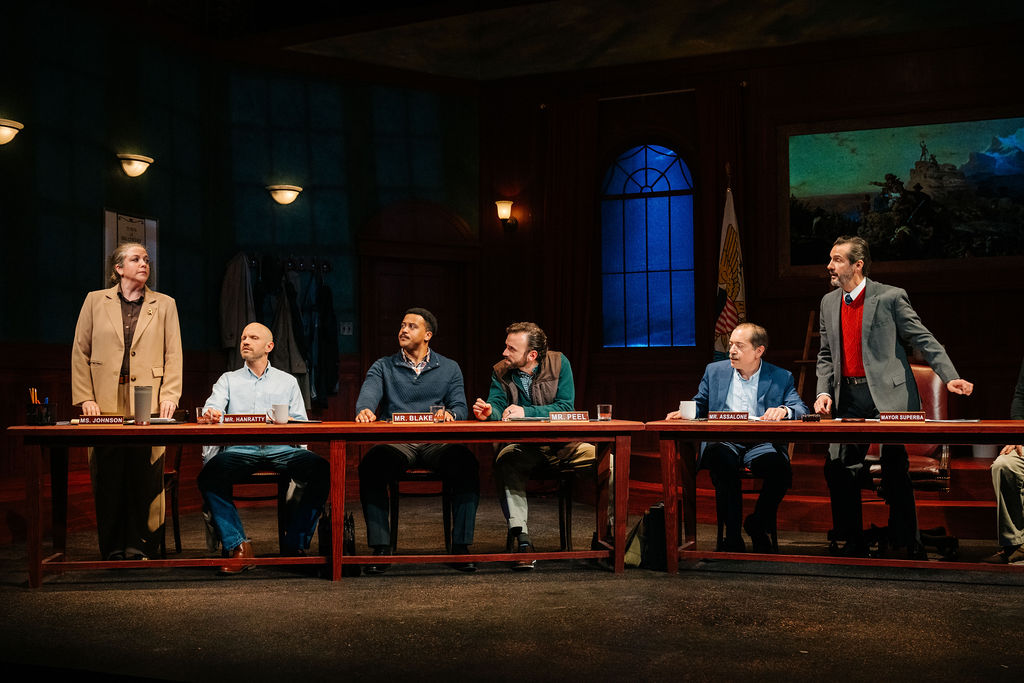
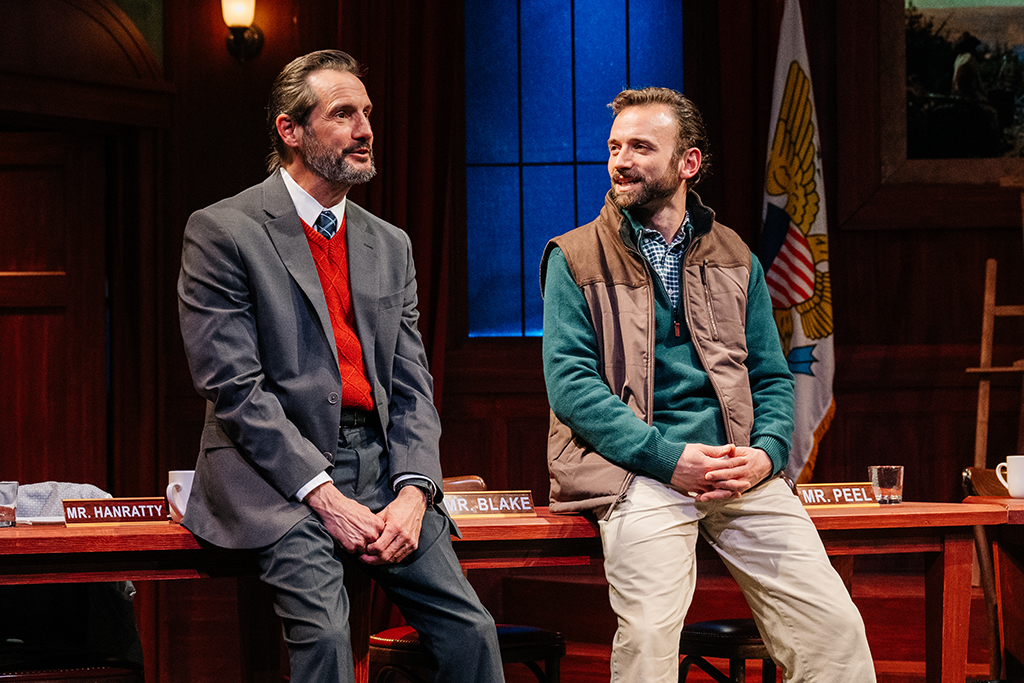
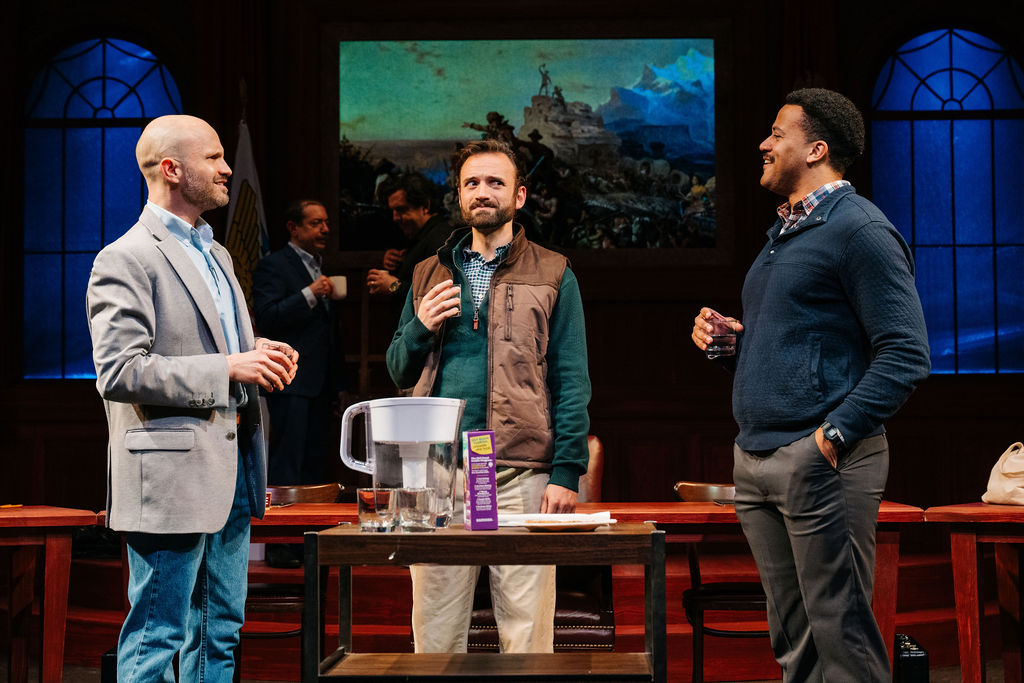
The dynamic among the town council— ten players on stage at any one time in ‘full quorum’— is fascinating. Because while they each exist on their own, with their quirks and uniqueness, there is this unifying thread of co-existence that binds them to one another, with the exception being Stephen Russell Murray as Mr. Peel. You learn from the beginning that not only is the Peel character new to the town council but he was not present at the previous week’s meeting, wherein a significant occurrence took place. Murray is a vibrant entity in this production; frenetically existing just outside the ‘inclusivity’ bubble of this otherwise ‘like-minded’ group of people and the interactions that he brings to each of the characters is really intriguing on a series of levels. There’s an edginess to Murray’s performance as well, but not like he’s got something to prove? Rather like he is who he is and he isn’t going to change who he is just because it might be expected of him to do so; there’s real depth being explored with Murray in this portrayal.
There’s real beauty in the way Tracy Letts has crafted some of these characters as they could read like stereotypes bordering on caricatures if not handled correctly. Immediately coming to mind are the two ‘older’ characters, Mr. Oldfield (Timothy H. Lynch) and Ms. Innes (Barbara Klein.) The text indicates that they’re the longest seated members on the council, one being there 35 years and the other closer to 40 and both readily navigate the comedic flavors that are attached to said stereotypes, with Lynch really leaning into the character’s more curmudgeonly approach to existing. Klein and Lynch have hilarious moments (made even more hysterical by characters like Mr. Assalone who have these ‘bored-to-death’ stares and eyerolls whenever they’re piping up with commentary.) And while both Klein’s character and Lynch’s character serve as this zinging comic relief of sorts, they have their more gravitationally focused moments as well and they handle those with matched clarity and the same intensity with which they deliver their plucky laugh lines.
Katie McManus is also a riotous lynchpin in the show’s comedic components. Dazed, spaced, possibly on too many medications, it’s really difficult to tell what exactly her character’s dysfunction is, but the Ms. Matz’ character is consistently in mental absentia despite being physically seated at the table. Half-a-step and a full answer behind, McManus keeps the audience tittering at whatever it is that the character does or does not have going on, right up until the show hits a bombastic tonal shift, and then she— like everyone else— hits that hard heavy wall of severity.
Valerie Adams Rigsbee, as the council clerk/secretary/recorder of the minutes, delivers my favorite line of the play: “…I have a little girl now and I don’t have the luxury of these ideas. We live here. This is where we live.” It’s such a simple line and yet it speaks voluminous mountains of what it’s like to have privilege of choice. Rigsbee’s initial characterization is actually quite humorous, the opening bid of the play has her flitting around the room, attempting to be efficient and get things set for the meeting all whilst attempting to dodge the incessant small-talk-nonsense coming from Murray’s Peel. And she’s got some really engaging facial expressions and body language that helps with the humor of those opening moments. And although all Rigsbee appears to do is take roll, take counts on various votes, and read things, watching her silent and reactionary responses— especially when they are subtle— is deeply thrilling because she’s like a silent barometer. And when she hits that aforementioned line, it’s tragically beautiful.
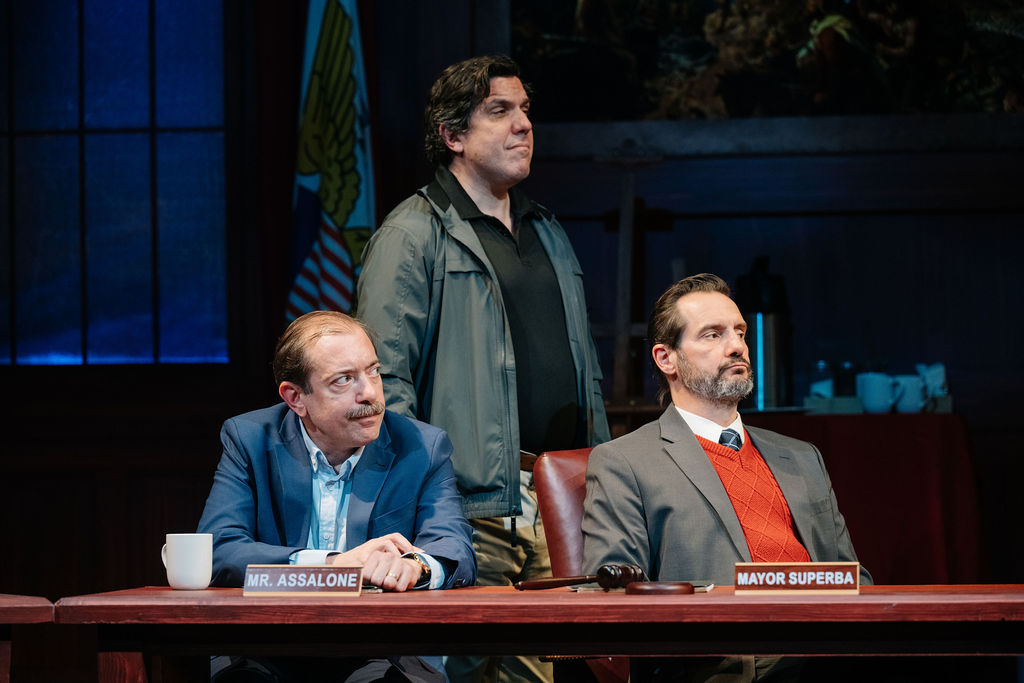
There’s this strange grouping of the remaining five performers as they fill their respective roles— Ray Ficca as Mayor Superba, Brett Earnest as Mr. Hanratty, Dominique Gray as Mr. Blake, Zach Brewster-Geisz as Mr. Assalone, and Theo Hadjimichael as Mr. Breeding— where they all exist as one and yet they don’t quite; it’s difficult to describe but watching they dynamic they create on stage and the interplay that results is truly evocative and extraordinary. Gray, as Mr. Blake, and Earnest, as Mr. Hanratty, seem to be the odd men out— with Earnest’s character pushing perpetually for an agenda that’s fueled by his personal relationship with his disabled sister, and Gray’s Mr. Blake serving as the only person of color appearing on the council. Both give compelling performances when it’s their turn to present their points, with Earnest’s Hanratty being a little more expasperative, a little more strung-out, and Gray’s Blake maintaining a calmer approach to things until, like the narrative’s sharp and unexpected twist, his character has an explosive moment.
Hadimichael’s Mr. Breeding is that unabashed product of his time with the backwards mentality of what is what at the forefront of his textual delivery while Brewster-Geisz’ Mr. Assalone has more of that seedy, concealed political corruption about his portrayal. There really is some high humors to be had every time one of the other characters mispronounces Brewster-Geisz’ character’s last name, the facial expressions and the contempt in his voice generate good, hearty chuckles from the audience. Seating these two characters on either side of Ray Ficca’s Mayor Superba is visual powerhouse, really showing you what ideology leads the room when it comes down to it. Ficca’s mayoral character seems collected, appears level-headed and turns a phrase sublimely. And once the plot shifts, so too does Ficca’s approach to his character; it’s equally difficult to watch because the seeds of it are right in front of you the whole time just cleverly and carefully tucked away right up until they aren’t. His whole ‘talk-down’ speech at Murray’s Mr. Peel near the end of the performance is deeply unsettling and delivered with such conviction it makes you want to flee the room in a similar fashion to Mr. Peel.
The ending of the show, led by Ficca’s Mayor Superba, is disturbing on a most unsettlingly visceral level; it defies description and must be seen to be experienced and believed. It’s a really, really intense ending. The whole play, particularly once it unfolds through to the end, turns out to be one big avalanching snowball, masquerading as a political comedy about small-town, backroom politics, right up until it isn’t; right up until the universality of it and its overall impact on the world in which we live is presented in this astonishing and simultaneously grotesque, raw truth. It’s infuriating to not be able to speak on it more fully (but so much of the thrill and the dawning realization is making the discovery of the plot in live-time with these performers as they approach it; they are all tremendously, sensationally successful in their respective roles) but it really is a moving piece of theatre. Not to be missed by any stretch of the imagination if it can be helped, but it’s one of those: “warning— this play is not what it seems, buckle up” style shows, for sure.
Running Time: Approximately 95 minutes with no intermission
The Minutes plays through May 3rd 2026 at The Keegan Theatre— 1742 Church St. NW in the Dupont Circle neighborhood of Washington, DC. Tickets are available by calling the box office at 202-265-3767 or by purchasing them in advance online.