

O’ wonder! How many goodly creatures are there here! How beauteous mankind is! And it takes just one goodly creature, in this case, an actor, to sit down with us and chat all about Chesapeake Shakespeare Company’s upcoming production of The Tempest. In a TheatreBloom sit-down exclusive, we’re talking to Christopher Marino, currently playing Prospero in The Tempest, which opens on April 24th as the final show (on the indoor mainstage) of the 2025/2026 season.
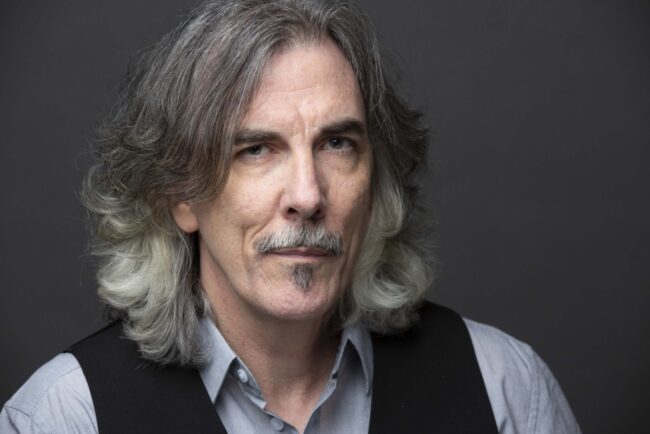
This is such an exciting opportunity and thank you so much for sitting down with me! You are Christopher Marino, and you are playing Prospero in The Tempest here at Chesapeake Shakespeare Company. Was that a ‘hey, Prospero is a dream-role/bucket-list role for me’ or how did this come to be?
Christopher Marino: That role was actually never on my radar!
Really?
Christopher: Yeah because I don’t perceive what age range I’m in for casting. When Ian (CSC’s Artistic Director Ian Gallaner, currently directing The Tempest) asked would I be interested in doing Prospero, I said, “Oh yeah…I’m a little young for…” and then I had that realization of “Oh, crap, I’m not too young for it.” I’m at that age. I’m the age of that guy. I’ve been in the show before. I’ve played Sebastian before. When you play Sebastian or Antonio or people in the court, you don’t end up interacting with Prospero much. You have Act V and you’re mostly just standing there.
So my perception was that I had no clue what the lift was in terms of the role. And even once I signed on for it, I was still not fully aware. I teach Shakespeare all the time but I don’t necessarily teach Tempest much because it’s a particularly difficult and challenging play.
What do you think makes it so difficult and challenging, at least from a teaching perspective?
Christopher: From a teaching perspective, it’s because it’s a late play. If you’re trying to get students to understand rhythm and meter, this is where the rules start to get bent. I liken it to art; you wouldn’t start with three-dimensional perspective if people are just learning how to paint. It’s the same thing, you would start with plays that are more structurally sound, pretty firmly on the iambic.
In terms of the role, it is way more challenging than I thought!
Oh? How so?
Christopher: The language is quite tricky just syntax-wise. I think some people would think of it as dense. And then he talks a lot! Prospero talks a lot! That’s the big challenge, trying to make sense of that and still come off as a living, breathing human being. It remains to be seen what I end up doing up here. But if it does work, I think it will have been an advantage because it’s not a role where I had been thinking about it for a long time and already have these preconceived notions about it. I read it the same way that I would encounter a play that I just didn’t spend a lot of time on. At this point in my life there are things in the play that resonate more strongly than if I had played this role 15 years ago.
What things are those that are resonating with you now that maybe wouldn’t have a decade and a half ago?
Christopher: Particularly, I’m a girl Dad. I have two daughters. I have a 16-year-old and she’s very much like a Miranda. I have that experience. When I read the text, the first thing I came on was that connection. I know how it’s normally done— it’s not that I’m going to try not to do that, but I’m going to look at it for just face value of what’s on the page. The first thing he says is that ‘I’ve done but in care of thee— of thee, my dear one, thee, my daughter.” He’s doing everything for her. That’s interesting because I think sometimes the play tips towards this idea that it’s vengeance.
It’s easy to think that it could be from a vengeance standpoint because of the familial dysfunction between Prospero and his brother.
Christopher: Absolutely. But I think, if it goes that route, you’re missing a dimension. And we’ve cut some text, so we don’t necessarily have this as a story point, but for that 12 years on the island he’s done nothing but tutor his daughter and bring her up. If we’re talking about magical stuff? She, Miranda the daughter, is his best manifestation of magic. In the sense that he’s created somebody who is purely virtuous and has no cynicism. She is just open. That’s his best. That’s the best thing he’s ever created. In that sense, the play gets complicated because I think he very quickly realizes, “oh no. when somebody is that open and has that open of a heart, that leads them toward people taking advantage of them or bad thing happening.”
Enter Caliban.
Christopher: Absolutely. Caliban tries to— and to use my intimacy terminology here— Caliban tries to have a non-consensual relationship with her and is unapologetic about that. I think Prospero very quickly realizes, “Oh no, I have to protect her.” And really, a big part of his thoughts are, “If something happens to me on this island I can’t protect her. Who’s going to be there. She is an open vessel that has no defenses.” Which is why he has to put Ferdinand through all the trials. In terms of Elizabethan culture, Miranda, as the object of the affections of a rather rich boy, would need to put up a strong resistance to that and not give him any indication that she likes him.
We see that with Juliet (Romeo & Juliet) right? She gets really freaked out, ‘oh no, he heard me and he knows I like him.” We see that with Cressida too in Troilus and Cressida. But here in the Tempest, Prospero has to do that for her because she doesn’t know how to do it. That’s part of the reason why he puts Ferdinand through the trials. The other reason is that Ferdinand is essentially Alonso’s son. How much in that thinking is Ferdinand? For me, it’s a much more human and deeper story than I initially thought. And it’s not that I would never think of Shakespeare as deep. But it feels like when people describe Prospero, they describe him as bitter or vengeful or like a stage manager. He’s making everything happen. Yes, to a certain extent, but this is about him giving up control.
That’s a fascinating take— say more.
Christopher: The sequence of events in the play lead him to giving up control, not controlling. He does try to control but I think by the end he realizes that there are no levels of control that are going to make human beings change essentially who they are. So why am I compromising being present to attempt to do something that is essentially— it’s not even impossible— but he askes himself, ‘should I be doing it?’

I really like this refreshing take you’re presenting with Prospero. How do you find yourself bringing you, Chris, to Prospero, and what is he bringing to you?
Christopher: I’ve been with the text for a few months now. I guess what I would bring to Prospero is that understanding of wanting to protect my daughter. That is of paramount importance to me. How does Prospero want to be manifested? And that’s yet to be determined but I think, essentially, by the end of the play— and this is something I was saying to Abe (Dramaturg & Text Coach Abraham Stoll) who’s working on dramaturgy, I think one of the things that came up when I was working on the text was this phrase, “The strongest form of magic is to give up magic.” And that’s essentially what he’s doing. He’s actually going to a higher form of magic by giving up this earthbound magic. It’s interesting, because he has nothing good to say about Sycorax and he talks about this earthy and abhorrent magic that she has. But he’s doing the same thing. All of his rough magic is all sort of earthbound. Ariel is a spirit of the air, an air-elemental, so in that sense, Ariel is sort of a higher-formed being for him. But I think by the end, he realizes the biggest magic he can work is to give up magic. And to become whole.
I love that. What has been your biggest personal challenge that you’ve encountered so far in tackling this role?
Christopher: Right now, a lot of it is just the overwhelming amount of text and the density of it. His syntax is frequently reversed or will have a thought that’s like six verse-lines long and he’ll put the verb in the sixth verse-line. You have to be really aware at first of how to make those shifts. And then the next step is, ‘how do I now disappear into it and not have to steer it?’ And that’s going to be the next step. There are very intricate syntax things that I have to hit otherwise the audience doesn’t have a hope of understanding.
And the big challenge also is that Act I scene ii, in our script, and bear in mind Prospero is not talking the whole time, but that scene is 18 pages. I don’t know what the running time of that scene is, but it’s easily 20 if not 25 minutes of pure talking. It’s getting that to have real human want and need in it, rather than ‘I’m telling the story so that the play can move forward.’
Absolutely. You want your audience to engage with what’s happening and not just feel like they’re getting a play-reading. And I wouldn’t say that Tempest is a lesser recognized story, but it’s not Much Ado or R&J. You want people to invest in what’s happening but also not have them feel like they’re spending 17 hours getting lost in everything you just talked about.
Christopher: Yes. It’s a lot of listening! If nothing is happening, then why not just have the audience pull up a chair and I’ll read the text. Or you just cut it to ribbons and get to the story points and get off of it. But I think that front end is really about the human cost that Prospero has suffered. The fact that this is the first time that he’s verbalizing that cost— it happened to him but who was he going to tell?
I’ve never thought about it like that. Obviously he wouldn’t tell the daughter who he’s trying to protect and keep virtuous and open. And he’s alone on the island, other than the air spirit that he keeps and Caliban, who I don’t think he wants to tell Caliban anything.
Christopher: I think Caliban is interesting because— at least with what the text indicates— their relationship, Prospero and Caliban, was quite loving. It’s really on this event with Caliban and what he attempts with Miranda that makes Prospero lock him up and treat him like a slave. Because there’s no text that says “Oh, I’ve been your slave for this amount of time” or “you were always making me do this.” It felt that it was very much— I think to him, Caliban was like another child. He was probably very close in age to Miranda and he raised both of them.
But Caliban has to be controlled. After he’s called out about it, Caliban unapologetically says ‘well, I would do it, I want to people the island with more Calibans.’ So he’s not saying, ‘hey, I’m not going to do it’ or saying ‘hey, I’m sorry, I understand the error of my ways.’ He’s going, ‘no, if you give me opportunity, I’m going to do it.’ And I’m over here thinking. “Well, what father wouldn’t lock that guy up?” In that sense, I think what sort of clouds the reading of it is that post-colonial thinking, and I totally see that as being there, but there’s more nuance and levels to it. Because inevitably it’s about Miranda and it’s about the fact that he loved Caliban. He says late in the play, ‘basically I treated him with humane care but it’s all lost.’ In that sense, if it was just purely, ‘you know what, I came in, I took over, and I turned him into my slave’ there would be no text about it. Even very early in the play, in my first interaction with him, I say, “I use thee, filth as thou art, with human care, and logged thee in my cell.” I let him live me. I taught him everything. This is the second person who he has considered family or extended family who has now betrayed him.
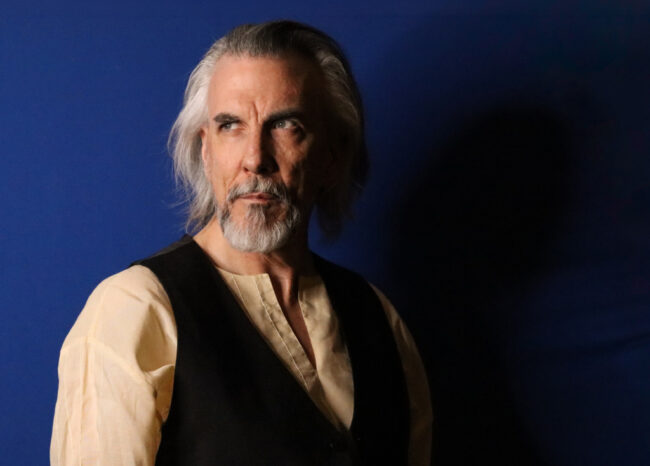
That makes for a rough life for Prospero. How is this production of The Tempest, with Ian at the wheel, different than perhaps any other production of Tempest that we may have encountered out there outside of CSC?
Christopher: I think what’s nice is that it’s really taking on board more of what’s in the text rather than trying to shape it around an idea. And I understand the post-colonial idea. I’ve been in productions and seen productions that have done that. But I think it’s nice to see what’s really on the page, what is really happening. These are inevitably living, breathing human beings. If we can get the audience to connect with it on that level then we’ve done a real great service to the play. As long as Prospero doesn’t become this weird wizard guy who just rolls out every now and again. And it’s not about thinking “oh, because it’s always done that way I have to make a left turn” it’s just— you know, after a while, you read it and you think, “Maybe I’m doubting myself here because I’m not seeing what all these other productions are doing.” It will be interesting to see what will happen with this one because we are exposing more of what’s in the actual text.
I am interested, for sure! I know you said you’ve done Tempest before, and obviously you’re doing it now, but if you could step outside that one and write your own ticket— regardless of age, gender, capability, etc.— who would you play in the canon?
Christopher: That changes all the time. I used to really want to play Richard III. Now I’m not as interested. He does a lot of hobbling. It’s also an early play so from an audience standpoint, it’s like joining Game of Thrones but in season four. It’s really the fourth part of War of the Roses. Everything that they reference, they reference about stuff that happened between them in the three plays before. Regardless of age? I think at this point in time, something like Leontes (The Winter’s Tale) would be really exciting. Or Richard II. Richard II is exciting because it’s a lot of very beautiful verse. Leontes is great because it has everything. It’s somebody going through something really gritty and hardcore. The language is wonderfully complicated but in a really organic way, so that could be really fun.
And you direct, I believe? So if you could direct any of Shakespeare’s 37, whether or not you’ve already directed it, which one would you direct?
Christopher: The play that I’ve directed the most is Twelfth Night. I’ve done that one three times. I directed it here in Baltimore too— for Baltimore Shakespeare Festival back in 1999. And that was a pretty cool, magical production. Then I directed it again in New York and then the third time I directed in Wilmington (North Carolina) as a part of the professional company that I’ve put together. And I brought people from both productions back. My Olivia was from the 2002/2003 production, my Malvolio was from that production, my Maria was from the 1999 production. It was really nice to bring people together to re-experience that.
What would I love to direct? I’m trying to think of things that I haven’t had the opportunity to. I love Romeo & Juliet, I’ll always come back to that. It’s a teen comedy up until somebody dies. Same thing with Hamlet, that’s a complicated, angsty teen comedy— well not a comedy but it’s got that vibe— but then once Polonius dies, it all goes wrong. Same thing with Romeo & Juliet, first half is all Romeo’s play and the second half is Juliet but then you have to make sure it’s still interesting after Mercutio dies, which can be hard to do. Those are the ones that come to mind.
I just directed Measure For Measure, the Riot Grrrls version; it was all women. That was wonderful. When I direct Shakespeare, it’s always live music. The Romeo & Juliet that I just did— and I think the Rachel Ziegler one did the same thing, and I didn’t know at the time— but he falls in love with her because Juliet is singing this song. It’s sort like a version of “Fade Into You” by Mazzy Star and Paris had his own song when he was trying to woo her and it was really awkward and quite horrible. In that one I cut Lord Capulet. I didn’t really have men that could play that age and I was interested in seeing what it would happen if it was just a mom. That created an interesting dynamic. I will always have time for Twelfth Night, I think it is the most perfect of the comedies.
Who would you play if you could be in Twelfth Night?
Christopher: Malvolio.
What is it that you are hoping that people who come out to this production of The Tempest here at CSC are going to take away from the experience?
Christopher: I would hope that they would feel it as a human experience. That they can observe real human behavior on stage and see some aspect of themselves in the play rather than something that they feel distanced from. I don’t want them to feel like it’s “Ye Olde Shakespeare.” Again, I don’t think you have to reinvent the wheel to achieve that. What I endeavor to do, when I’m directing or acting, is to link it back to these characters being human beings. They are not an idea of something that’s 400 years old. And that in 400 years people have not changed. It’s the same stuff— they want what they want. They want a place to live, they want food, they want to be with the person that they want to be with, and then there’s some people in the mix who want that more and they have more control and power.

That’s a beautiful observation and when you render it down to that beautiful basic level, it really is eye-opening to see that we have not changed all that much in 400 years. What has taking on this particular acting challenge taught you about yourself at the end of the day?
Christopher: I’ve always endeavored to continue to grow in whatever process that I’m working on. This one is a little bit different for me in the sense that I’m going about text slightly differently than I have before. And that’s always scary because it’s sort of an unknown. If it works, it will be an interesting new way to look at it. I’m teaching my students to do it right now. It’s about connecting to text through a little bit more an emotional value rather than an intellectual value. I think getting Shakespeare out of the intellectual brain is super important.
I think you’re right. While it is a rich intellectual text that does shape our theatrical history, I think you’re 100% on the nose about taking the intellect somewhat out of it to make it more human.
Christopher: It has to be visceral. It has to be embodied. What I always say to my students— we do this weird magic trick, right? Somebody hands us a piece of paper, and there are these weird little squiggles on it, and we interpret these squiggles into a living, breathing human being. It’s a magic trick. And if done right, it’s a mind-blowing magic trick. And ‘right’ is the wrong word, done…in a more embodied way. That’s what I endeavor to do. Do I always get there? I don’t know. But I do try. That’s what I’m hoping to do with this. I want it to feel lived in. I want it to feel organic.
Anything you want to say about returning to Baltimore after all these years?
Christopher: It’s great! It’s so lovely for CSC to have me here. It’s so lovely getting paid to do something you love. That, especially in this day and age, is sadly in short supply. This is a gorgeous space. Who wouldn’t want to work in here? Generally I’ll come in here like on Fridays and Saturdays, after rehearsals and I’ll just work in here alone. It’s very haunted.
It is absolutely beautiful and haunted. A friend of mine who was in a show earlier this season sent me a picture of himself lying on the stage, staring up at that gorgeous ceiling and it was just so stunning and picturesque.
Christopher: Oh yeah. It’s beautiful. And haunted. I’d be working in here alone, I would look to my left and I’d see a little face peer around and then pop back. And no one else was here.
All good theatres have at least one spirit. Now, if your Prospero could bring thing— anything from any era— with him, just one thing, to the island, what’s he bringing?
Christopher: Oh— what would he bring? It would be on brand for Prospero to bring…it would have to be a magical implement. My guess is it would be some sort of divination tool like a scrying mirror. Even though he probably already has one on the island…he fashioned it out of sea glass or something.
Oh totally. Now, if you foresaw in that scrying mirror, that you— Chris— were about to be shipped off to a desert island, what is the one thing you’re bringing with you?
Christopher: What would I want? The practical part of me is like ‘something that makes fire easy.’ But the philosophical part of me wants— probably something that doesn’t exist but is unbreakable, it never runs out of battery, and it plays music, so that there would always be music.
That’s valid. Speaking of music— if you could only bring one CD…wait, to people still listen to CDs? One album— what one album are you taking to the island?
Christopher: I don’t know. It’s probably going to be… this day and age it’s probably going to be something like Loveless or My Bloody Valentine.
Why do you want people to come out and see this production of The Tempest here at Chesapeake Shakespeare Company?
Christopher: I think it’s about being in a room together, sharing something at the same time— creating community and having a communal experience, which we’re seeing is happening less and less these days. And feeling the energy of something in the space. That’s what’s important. Inevitably, that’s what would be ultimate. This feeling of us being together in this space and celebrating what aspects of ourselves are human. We go to the theatre to reflect and learn about our own humanity. We go to see that. Hopefully that will happen!
If you had to take your total experience of working on The Tempest here at CSC up to this point and describe it using just one word, which word would you use?
Christopher: Probably transformational. That’s the one. It’s in all aspects. Transformational.
The Tempest plays April 24th 2026 through May 17th 2026 at Chesapeake Shakespeare Company— 7 S. Calvert Street in Baltimore, MD. Tickets are available by calling the box office at 410-244-8570 or purchasing them in advance online.
Related posts:
 The Tale of Cymbeline at Chesapeake Shakespeare Company
 Speak Low If You Speak Love: A Round-Robin Interview with Ardeo Theatre Company’s Much Ado About Nothing Folk
 While You Live Tell Truth and Shame The Devil: An Interview with Evan Crump and Aaron Angello {mostly} on Henry IV Pt1 (and also a lil Much Ado)