We all peel labels. The most innocuous, seemingly mundane line to not only land but stick indefinitely from a production that has arguably thousands of lines to choose from or resonate with. Edward Albee and Betty Brevity are not besties (spoiler: neither are she and I!) but there’s a reason his verbose textual structure has garnered him the success and accolades that it has through the decades of his works’ existence. But that one line— “we all peel labels” is the most brutally exacting descriptor for what’s happening in this current production of Who’s Afraid of Virigina Woolf? at Ardeo Theatre Company. It’s a flippant response from one character to another, almost even potentially intended as a one-off, dismissive clapback. And yet it hits; it resonates. Peeling the labels off of one another— this quadrangle of messy humans as they interact with one another. Peeling the labels off of themselves— as they shed layers of personality veneer and delve into dark discoveries of the most disturbing nature. Peeling the labels off of the expectations that accompany any three-hour play, particularly an Albee, with the sharp refocusing of the group dynamic at the forefront of the production.
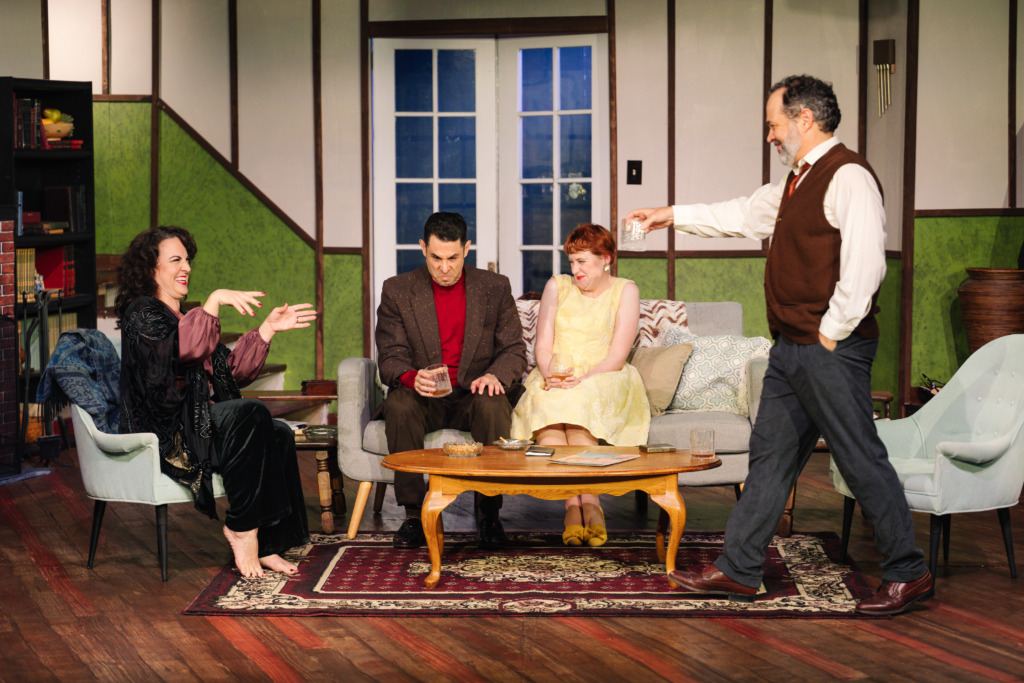
Directed by Suzanne Beal, this visceral roller coaster ride is nothing short of a psychological thriller ripped raw in live-time. Buckle up— because this is a “deep cut” approach to the script as you know it, pulling the group dynamic of Martha, George, Nick, and Honey to the forefront of the experience and unapologetically exploring in remarkable depth the humanity and lack thereof in their relationships. Parlor games turned dark, devious, deceptive, and wholly destructive are the setup, but the unabashed obliteration of heart, soul, mind, and spirit is what’s on the line and it is a harrowing but simultaneously glorious theatrical experience.
Before delving hog-wild into Beal’s approach and the group dynamic that this perfect quartet of actors is bringing to the stage, praises ought be popped in the general vicinity of the creative team and run crew as the show moves almost flawlessly from start to finish. Lighting Designer Rook Bartlett has ordinary interior cues that have two very specific moments— both in the third act of the play— where they are noticeably effective. The first being when Martha launches into her description about the child and the lights dim, focusing more closely on her though all four players are actively in-scene. The second being when all but the focal light on the stairs where George and Martha are seated dim out and fade for that final freeze-frame of the play (bonus third being the purplish dawn lights that reflect in the windows to ‘welcome’ the morning/end the night.) Bartlett’s unnoticeable praises come from the simplicity of the household interior; you see characters having interactions because Barlett’s inobtrusive fixtures have done their jobs accordingly.
Aaron Angello has designed the perfect set, transforming the black box play space into the believable interior of George and Martha’s ‘on-campus-home’ in New Carthage. It smacks of academia and of the time period without feeling like it’s trying too hard. The stairs are appropriately placed— the French doors leading off to the kitchen and bathroom are an elegant and elevated touch of sophistication without going overboard; the set is functional and placed with just enough detail (compliments of Props Designer & Scenic Dresser Olivia Pietanza) to be intriguing without being overwhelming and be substantial without feeling too simplistic.
Pietanza deserves mad props for her two signature pieces: the breakaway booze bottle which has a surprisingly realistic shatter-smash sound once broken and the Brella-Rifle; that is quite a gadget— damn clever! Stage Manager Rebecca Carroll nails light and sound (the door chime and music from the on-stage record player; sound effects crafted by Sam White) from the booth and has called the show in such a fashion that the epitome of Beal’s perfect pacing shines through with ease. Pietanza and Carroll both deserve shout-outs for the amount of fluids stocked on that stage (and double-back cheers to the actors for consuming something like Dylan Thomas proportions of alcohol.)
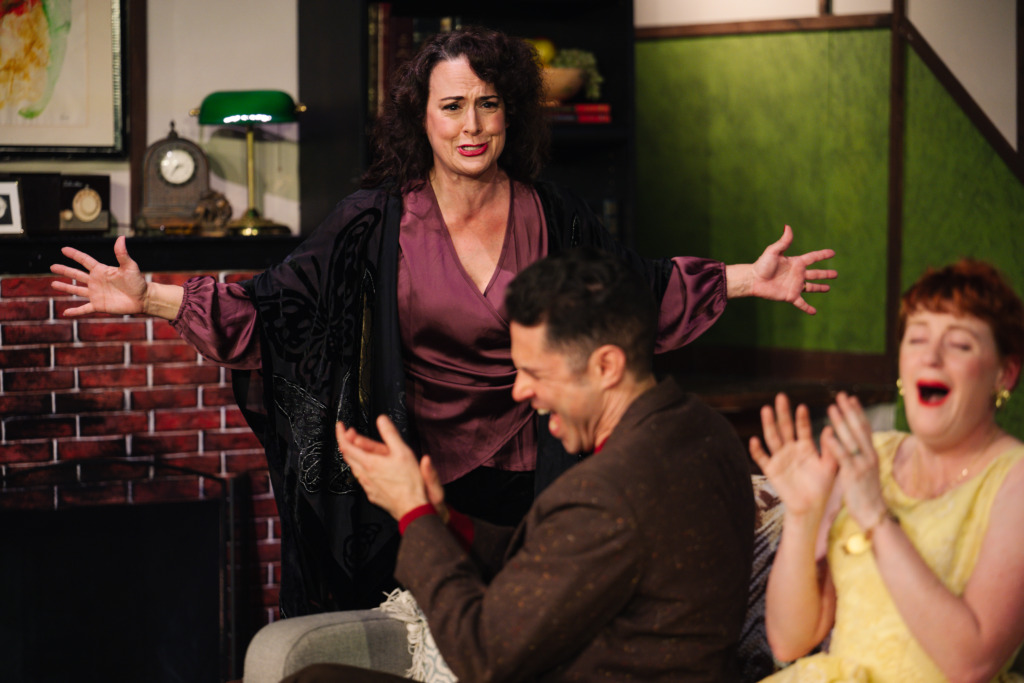
There are five costumes in the production. Every character gets one except Martha. Martha gets two. Maureen O’Neal has effortlessly captured the essence of the early 1960s academic late-night-party world in which Albee’s work nestles itself. The yellow affair— everything from mini-pillbox down to the heels— on Honey screams not only timestamp but accurately reflects the naïve simplicity that saturates the character. That glorious amethyst affair featured on Martha when they come in from the party juxtaposes divinely against the frumpy, dumpy collegiate togs featured on George. And the brown suit and hat saved for Nick not only shows off his quarterback physique but gives him this cheeky dangerous edge that melts superbly into his character.
The play itself is steeped to the eyeballs in intimacy of all sorts, not the least of which is physical— be it romantic or fury-fight-driven— and Intimacy Coordinator Julie Herber has crafted extraordinary moments between these characters. Whether it’s the gentle way Nick finds himself trying to tug down the hem of Honey’s dress for modesty in that final scene or the way George all but breaks Martha’s neck as he flings her back over the chair or the rocket-slam of Nick and Martha into the wall; Herber has a keen understanding of how to make these moments not only look authentic but read with the intensity of reality as they happen in live time.
Director Suzanne Beal’s approach to Who’s Afraid of Virginia Woolf shows not only a keen understanding of the text as written but also an intensely passionate deep delve into dissecting the potential of these four characters as layered, nuanced humans. Cultivating this group dynamic, which becomes the overriding focal lens for the experience, is an exceptionally unique and fascinating way to explore Albee’s work without altering it. All too often the onus of this play in particular is thrust upon the shoulders of Martha— and to be explicitly clear, Gillian Shelly is an extraordinary actor who delivers a stellar caliber of performance, there’s no debate on that front— but in Beal’s approach, there are three other active narrative participants ripping and gripping at the audiences’ attention, the audiences’ psyches, the audiences’ sense of the ridiculous (and sense of humor) which forces the experience into epically thrilling, beautifully torturous, brilliant carnival ride territory. Fun, nauseating, and you desperately need to get off by the time it’s over.
It’s no longer leading-lady Martha, her milquetoast husband George, and that couple who came by for nightcaps-gone-wrong; it’s a powerful and evocative examination of what too much alcohol, too many buried secrets, and the blurred lines between truth and illusion can look like to four different individuals, two different couples, and one group of four deeply flawed and tragically rattled human beings. There’s actually a sense that you’re walking into a theatrical experience, where you the audience, much like Nick and Honey, have become the hostages in a psychological thriller and you just don’t know it yet. Achieving that with this particular script is no small feat and one that Beal should be tremendously proud of for achieving so epically.
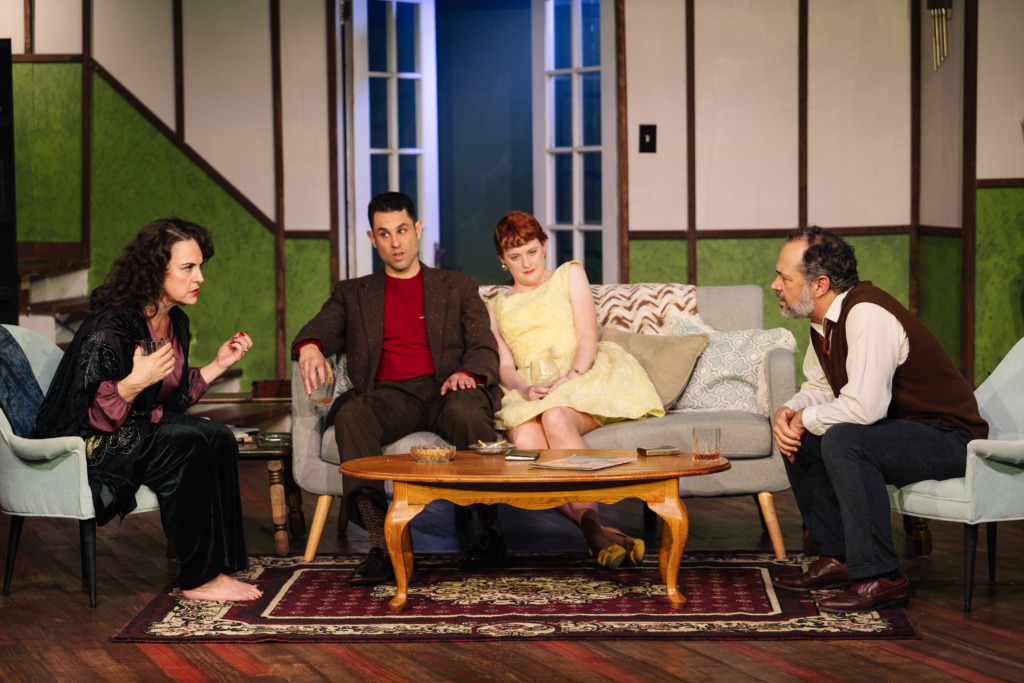
Beal’s pacing of the work and understanding of Albee’s use of language is also remarkable. There is no ‘rush’ to scenes and yet there is this underlying current of urgency; a needling need that ebbs and flows as the dynamics perpetually shift between the four characters and where they are in the evening. Beal allows moments that truly deserve their beat to land and be breathed through to be exactly that; she understands pacing dynamics in relation to the text sublimely. And yet somehow conducts magic so that each act (which for the most part runs just under an hour) feels like the blink of an eye. There is something truly praiseworthy about a director who can take four actors in a ‘one-roomer’ move them through five hours’ play time, across three hours’ stage time (with two intermission) and leave the audience feeling like they’ve blinked and also been trapped in the excruciating and torturously delicious existence of these people for an eternity. Beal manages exactly that; timelessness. It’s astonishing.
There is a palpable sense of trust amongst these four actors— Gillian Shelly (Martha), Aaron Angello (George), Steven Todd Smith (Nick), and Maureen O’Neal (Honey.) The overall dynamic that they’ve set— even and especially when they’re fighting and tearing each other apart— is one that just vibrates frenetically betwixt them; they’re each their own source of individualized emotional complexity, they have pairings, and then they function as a quartet of oneness. They exist at this heightened state of emotional reality, fueled intensely by alcohol, and maintain a level of earnest exposure that feels subtle at the start only to grow exponentially as they traverse this maelstrom of Albee’s script. It’s like raking exposed nerves across a metal grater by the time the show as ended. And it all feels grotesquely authentic— too real, so much so that it crawls under your skin, settles in and unsettles you there.
And they find the humor. Another feather in Director Beal’s cap for allowing these four to pick at the funny threads weaving the darker tragedies into place; this play, though dark and deeply disturbing, has a great many humorous moments and lines liberally splashed about (though far more so in the first and second act) and Beal guides this cast to hone in on them making them part of the tumultuous experience. One will find themselves laughing far more than one might expect for this show. And amidst all the laughter, even if you know the script and know it well, never once do you feel as if you actually know what’s about to happen; there are no senses of ‘foregone conclusion’ and that is a testament to the superb skillset these four actors and director Suzanne Beal are bringing to this experience.
Easily the most glossed-over character in Albee’s masterpiece is Honey (Maureen O’Neal.) But this production activates her (activates all four of the characters equally, truth be told) and keeps her fully present, even when she’s faded out on the couch or passed out, unseen off-stage in the bathroom on the floor. O’Neal manages to create depth in an otherwise vapid bubble of naïve and blissful ignorance. When the other three characters come to fisticuffs and blows, O’Neal is squealing in delight, bouncing up and down, chanting about violence. And arguably there is this horrifically sober moment that happens immediately after said violence is halted but O’Neal is simultaneously throwing a hilarious pouty-face and matching noises of petulant disappointment in the background to disbalance the whole affair which makes the beautiful absurdity of the moment resonate resoundingly.
The way she carries the character, with this initial jovial innocence, showcases a tremendous amount of versatility and dynamism in an otherwise potentially static creation. And there’s something to be said for the way she receives being placated by Steven Todd Smith’s Nick; it’s innocent at first the way he dutifully dotes on his wife, a gentle hand on her thigh or knee or an arm around her shoulder, and she almost lovingly accepts it. But you can see the slight tension in her physicality as if her Honey and his Nick might be strangers to each other’s touch, that all might not be as described in their happy little marriage. (Double-shoutout to Julie Herber, Intimacy Coordinator, for this minutia and how it plays into Nick and Honey’s backstory.) Watching that transition across O’Neal’s physical expressions of the character over the course of the evening is dark but delicious. Especially once her Honey is on the other side of ‘too drunk’ and desperately seeking physical comfort, even if it is from Smith’s Nick.
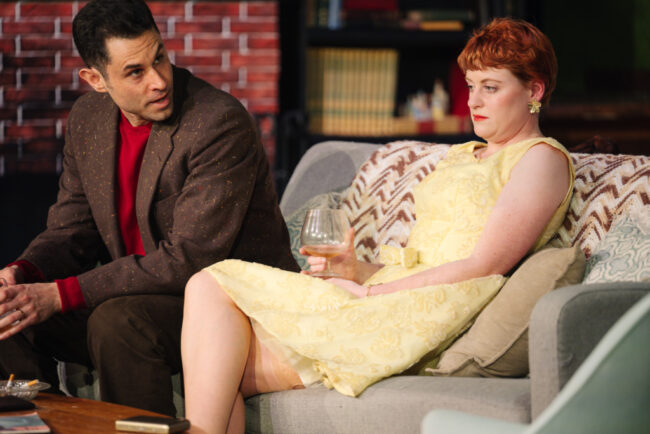
There’s a clearcut trajectory for O’Neal’s Honey during George’s game of “Get the Guests.” The dawning realization, the growth and explosion of “yay fun” to “this isn’t fun anymore” is really riveting to watch. O’Neal also brings a subtlety to the character which is deceptive in its own right. There’s a particular moment near the end of the performance, she’s cradling her peeled-label bottle of brandy close to her breast, and in addition to the deeply symbolic reflection of the ‘peeled label’ being exposed (as is everyone in the room at that point) that deeply disturbing utterance that leaves her mouth (and the reaction from Smith’s Nick— holy heart-stop, batman) hits in tandem with the way she’s holding the bottle and it’s a grade-three devastator that implodes for a moment before attention is ripped away by Martha and George. O’Neal balances Honey perfectly; the syrupy sweet gal-to-gal interactions with Martha, the simmering up-and-downs with Nick, the free and almost wayward dancing once George puts the record on; it’s a stellar performance that creates levels and layers to an otherwise flat character.
While George (Aaron Angello) is no flat character, per say, he is certainly penned to be the mousiest of milquetoast men in the room, a living incarnation of Mr. Cellophane. Right up until he isn’t. And when Angello hits those explosive moments you find yourself jumping in your seat, spine stiff with fear and surprise; it is its own breed of captivating and unsettling. If there’s a micro-fault to be had with this production its that some of the ‘quieter’ moments where Angello’s character is more internalized, or engaging half-heartedly in the dialogue exchanges because the character is flagging in the ‘fight’ he becomes a little hard to hear— cinema-whisper intimacy; but if the lone complaint is a few of George’s lines are too soft, then Angello, the company, and the production are lightyears ahead of the game.
There’s a moment early on, once Honey and Nick arrive, where Honey mentions something to George that Martha mentioned to her and the gobsmacked look of befuddled ‘wait— I couldn’t have possibly heard that right’ while Angello nods along is so intense that you get chills. And there’s an immediate snap; the wheels in Angello’s brain start cranking hard and it radiates into his physicality, all through his facial expressions, and that little powder-keg-catalyst moment continues to fire inside of him, growing like a slow avalanche right through to when Honey and Nick finally leave; it’s intensely epic watching that slow, gravitational growth.
The dynamic between Angello’s George and Gillian Shelly’s Martha its own master-course in theatrical torture in the most beautiful sense of the phrase. The surface levels of what are expected between a George and a Martha are present but serving only as faint outlines to keep these two creations within the confines of Albee’s world. The emotional discovery and exposures that are stripped away one moment at a time are wild. If Martha takes the most drinks in the script, George may be the one that tells the most stories. And the fascinating thing about the way that Angello weaves those moments is with this level of curiously enigmatic wonder; you never quite know if what he’s saying is true and it’s wholly intentional, deeply deceptive, and gives such a depth to this otherwise middling swamp-bog of a man that Albee has written. When Angello and Shelly are on the verge of physical blows— numerous times throughout the performance— there is something wholly frightening about the energy that he’s bringing to his half of the fight, not because Angello, or George by extension, are to be feared but rather because it’s that Frankenstein moment of electricity landing to alight the creature— in this case, his fury— to life. And it happens with such vigor and shock that each time, even though you can feel the fight coming, it jolts you.
The other highly cultivated dynamic for Angello’s George is the constant bull-horn locking with Nick (Steven Todd Smith.) You could watch the pair of them go at it, first in semi-polite but still argumentative discourse and later at full-on n0-mercy verbal blows, all night and never know who you were truly hoping would win. The pair, much like Angello and Shelly, are non-stop. And watching the way that dynamic shifts and mutates— with Smith’s characters really rising to the engagements every time they’re thrown down— creates for compelling theatre. They take turns, Angello and Smith, holding the upper hand, smacking the other back into place; it’s fucking riveting.
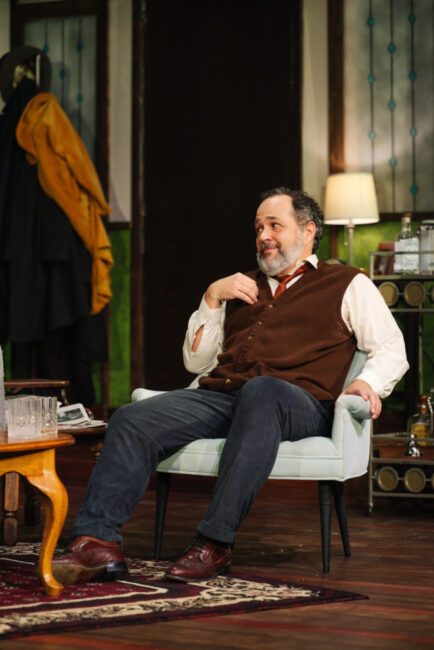
If Angello is the master story-spreader, Smith is the master-receiver and watching the way Smith’s facial expressions shift to absorb all of these moments, the way those feelings land and then disseminate down into his body language and posture, is awe-inspiring. The interplay between the two of them once George mentions ‘games’ and starts telling his mouse-story at the room is a brilliantly beautiful blood-bath. You get Angello who is driving that scene but in this delicate slow, smolder— there’s a hidden urgency to it, rather than a bombastic vindictiveness— and Smith desperately trying to apply brakes, desperately trying to halt this unstoppable avalanche that’s going to bury him in that moment; you need a minute to breathe through it as it’s crashing and then another once it crashes. These men steal the very air from your lungs and do not give it back.
Angello also gets this moment— that one Vesuvian eruption— when he’s on stage alone and its as intense as you could hope for and then some; another one bringing full-on mercurial dynamism to the stage. The introduction of the telegram is the pièce de résistance for Angello’s George though not in the way one might expect. It’s an irrevocable shift that has been slowly building and building and building and once it hits— BOOM. And when you slide that up against what you witnessed and experienced from him in all of those moments leading up to it, and what is experienced from him in the final moments where it’s just George and Martha on the stairs, you’re left shaken.
Steven Todd Smith transforms the character of Nick into something fascinating, that presently defies description, but captivates the attention in a manner which is both alarming and engaging. There are multiple journeys on which Smith is taking Nick over the course of the evening, not the least of which is that of a young lunkhead’s propensity for drink. And this path is one of the most intricately woven trajectories in his journey as you can see the definitive moment where the alcohol settles into the character, takes over the decision making, and where it starts to fade and the sobering reality of the horror show he’s just barely survived starts to creep back in. It’s the finest staged inception of ‘navigating drunk’ that I’ve ever witnessed.
Smith creates a delicate balance between existing in the background during moments when critical things are happening and intentionally shifting the audience’s attention to his character in those moments; it’s a gut-check and it’s brilliant. You feel it most keenly during this final scene when Martha starts talking about the child. That’s a relentless onslaught from both Shelly’s Martha and Angello’s George and the much-needed release of distraction that Smith creates with the simplistic but fascinating gestures and looks he’s giving in that moment are a zenith of theatrical expressivity that land gloriously in both his and the scene’s favor. For all the bravado and machismo and charisma that Smith presents Nick with at times, he does a superb job of creating balance; humbling the character or being readily smacked into being humbled as both occur in equilibrium throughout the performance.
It’s Smith’s facial expressions— particularly the way he responds and absorbs dialogue, especially from Angello’s George— that make him stellar. There are multiple moments early on where you can watch Smith sitting on the couch or pacing over to the fireplace, desperate to escape the scene with civility and temperament still in tact but his face is screaming ‘Jesus Christ, how the fuck do I get out of this?’ and its striking. One of the most heart-stopping moments in the play— and there are a good half-dozen, so be prepared— is the “Houseboy” discourse. (I could write a dissertation on the way Steven Todd Smith, Gillian Shelly, and Aaron Angello take that moment and make it a novel onto itself with fully fleshed backstory and forward trajectory of what could and will happen beyond it.) It’s a personal, intimate moment, ripped viscerally raw and the trifecta of perfection radiating between Smith, Shelly, and Angello in that breath— it stirs the soul with a poisoned swizzle stick that both burns and soothes; it is stunning.
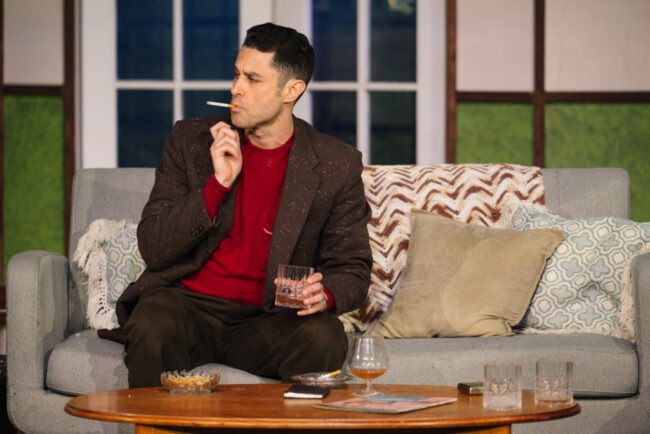
Smith wears this perpetual banner of emotional text on his brow, ever-shifting between moments and scenes. You can readily feel the regret and resentment that weighs heavy on him like a boulder of burden once his Nick shares with Angello’s George how he and Honey came to be. And when Honey makes that harrowing confession— brief though it is— at the end, the abject shock on Smith’s face will break your heart. He takes Nick out of the background in a similar fashion to what O’Neal is doing with Maureen, making them both activated players in the Martha-universe. And getting to watch Smith decompose in various moments— especially as the ‘truth of illusion’ dawns on both him and O’Neal’s Honey in those final moments— as it clicks into place and he’s standing screaming ‘Jesus Christ I think I understand this’ your soul just shatters. There’s a moment— Angello and Shelly are playfully going at it, it’s almost disturbing how cutesy they are, with the flowers up in each other’s faces— and Smith is half-collapsed on the fireplace mantle in the background. The little utterances, greatly overshadowed by his riveting facial expression and body language in that moment wholly portrays the psychological torture of both his character and the audience’s experience; there is no escape and you feel it with every fiber of your being because of the way Smith is expressing it in that moment.
For as many brutalized moments as Smith carries the character through, he also finds those smoldering flirtatious moments, twigging quickly to the undeniable chemistry between his Nick and Shelly’s Martha. And he rolls with the humors of the script divinely; it’s the most enlivened, activated portrayal in a wholly earnest, emotionally evocative encapsulation of a raw, real human being with backstory and hope for a future that I’ve ever experienced in a Nick when it comes to Who’s Afraid of Virginia Woolf.
The give and take of the power struggle in this play is wholly manipulated, if not damn-near ultimately dominated by Gillian Shelly as Martha. A single gesture with a five-word line and she freezes a near physical explosion between Nick and George. And not merely because the script could call for it; there is such commanding power and driven intention behind that moment, it punches. She punches. Gillian Shelly is the KO of this production. Right up until she isn’t and there is something disturbingly gorgeous about that. The focused intention behind all four of these actors and their every calculated maneuver on stage is beyond compare, you just feel it most readily with Shelly’s Martha.
Mercurial doesn’t feel like strong enough of a word choice for the way Shelly is bringing Martha to life, though she is definitely that and then some. Particularly in her dynamic with Angello’s George, she’s this unpredictable live wire that sparks and explodes spontaneously which juxtaposes brilliantly against the low-lit pilot light style flame that is Angello’s George. Shelly doesn’t shy away from the visceral, vicious carnality and total savagery that is ingrained in Martha, she meets it full on, taunting and teasing it to come out and play. And she perfects the look sublimely— everything from her vixen nails and pedicured toes, which match her lipstick and accent her evening wear to the way she saunters through the space as if her character were the only one in existence while simultaneously acknowledging others’ existence in her periphery. Shelly is fire. Not on fire but the fire that smokes, smolders, explodes, and incinerates this production into the fabulous erupting trainwreck of emotional catharsis that it is.
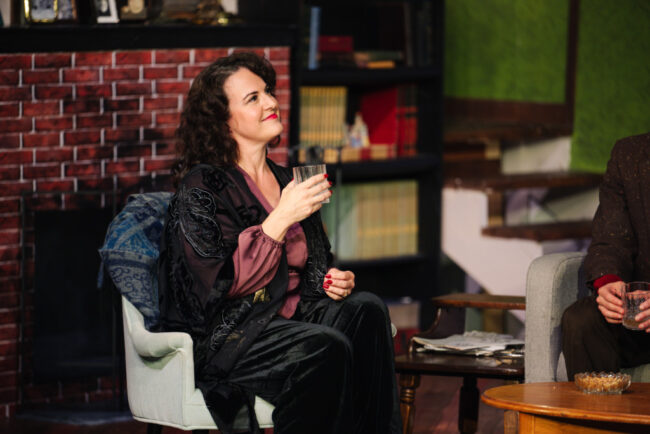
Gillian Shelly hits levels of unfathomable emotional existence, traversing the character’s imbalanced journey like a rogue spirit incarnate. One could spend hours, pages, days, and documents describing her efficacy in the role, how engaging she makes it, how deeply she connects to Martha, and it would still feel seemingly inadequate to the portrayal she’s giving on the stage. Martha is penned to be loud and obnoxisous but Shelly fabricates her into this legendary vulgar, fucking willful, scene-riding dominatrix who also has a broken side that slumps like a ragdoll when defeated. Her performance is mind-blowingly unhinged. And it circulates around the carefully constructed intrapersonal dynamic on stage with each of her three co-stars.
Even though Shelly’s Martha has the least amount of interaction with O’Neal’s Honey, you feel their girly-bond early on; it’s delicate, not unlike Honey’s constitution, and while it’s engaged to a lesser degrees— especially by comparison to the Martha-George and Martha-Nick constructs— its never fully out of sight. And it’s a gut-clutching coin toss about who you want to watch Shelly engage with more: Angello’s George or Smith’s Nick. The palpable, undeniable chemistry between Smith and Shelly is both invigorating and wholly five-alarm-fire. But the deeply dysfunctional destructive volatility between Angello and Shelly is soul-sickening in an addictive fashion. And there are absolutely moments in the performance where your eyes and senses won’t be able to move quickly enough to flip back and forth between the trio as Shelly engages with them both.
For as readily as Shelly engages with Smith in their inferno-driven chemistry is as harshly as she smacks him down during the infamous “Lunkheads/Houseboy” scene; it’s an eviscerating experience and you thrill watching Shelly slam it out and you cringe watching Smith take it in. There’s this moment— all four on stage near the finale where Angello drops a bomb and it incites Shelly to physically fly at him and if not for Smith catch-restraining her you just know the whole of the stage was about to collapse under the gravity of her intense emotional outburst. It’s jaw-dropping pathos smacking so hard in your soul that you’ll leave bruised for weeks.
The true beauty in Gillian Shelly’s performance is her moments of intentional stillness and quiet. Anyone can rage (though no one quite as epically as Shelly does as Martha) but those chosen moments of simplicity are what haunt thoroughly. Very specifically when she is calling quietly for George at the top of the third act, which not only is an eerie moment in and of itself but showcases the character’s insidious nature; the braying fashion in which she cries for him in scene prior is a CHOICE!! And it lands in that moment that she’s constantly galling George just to get a rise out of him because that is their love language: visceral, irreparable soul-destruction. That is how they show love. It’s horrific and marvelous.
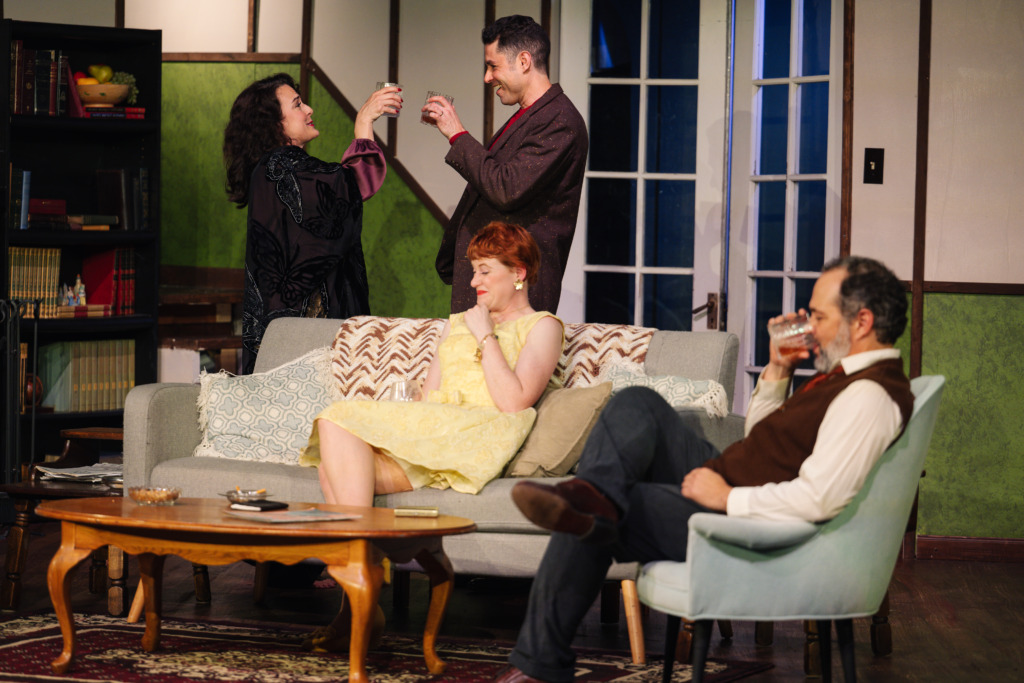
Each of these characters is embodying a frenetic energy in their own way. O’Neal’s Honey is like a wave-pool at an amusement park, little surges, nothing too intense but still part of the game. Angello’s George is more like a geyser, with little moments of potential eruption, mostly dormant, but absolutely still there and under threat of explosion at any moment. Smith’s Nick is this indescribable pressure-cooker whose valve is on the brink of malfunction; the number of times he almost loses it in anger or meltdown is so utterly intense that you ache to watch it. And Shelly’s Martha is a feral raccoon with rabies and sentience who can shapeshift from creature to vixen with a slip of the tongue. You might get bit, you might get kissed, you might die but you’ll love every second of her. And her cackle, good lord, does that pinch the soul and the spirit in ways that one cannot find adequate phrasing for.
The savage fashion in which these four characters destroy one another and themselves is this wholly unfettered torturously beautiful experience. The vulnerability— particularly with Shelly’s Martha near the end and Smith’s Nick in moments of confession— experienced from these four actors is sensational. They have understood the assignment and masterfully concocted this theatrical epic that flays you open and leaves you exposed; it’s beyond what words could ever really do justice. Suzanne Beal and her cast of Gillian Shelly, Aaron Angello, Steven Todd Smith, and Maureen O’Neal are giving you the theatrical ride of a lifetime with their production of Who’s Afraid of Virginia Woolf and it will shake you to your core. Do not miss this exquisite opportunity.
Running Time: Approximately 3 hours and 5 minutes with two intermissions
Who’s Afraid of Virginia Woolf plays through Monday June 1st 2026 as an Ardeo Theatre Company Production currently in residence in the Black Box Theatre of Tatem Arts Center at Hood College— 410 Hood College Drive in Frederick, MD. All performances are Pay-What-You-Can and tickets are available at the door or in advance online. Seating is LIMITED so booking early is highly recommended!