You either shave your legs or you don’t. Radical, albeit limited, that approach to feminism circa the 70’s. And we’d like to think we’ve come so very far from that myopic viewpoint and the circumstances that forced it into existence in the first place. We’d like to think. And there’s plenty to think about— drink in, really— when you catch the penultimate production of the Vagabond Players 110th season— Wendy Wasserstein’s The Heidi Chronicles. Directed by Lee Conderacci, this dramady-chronicle of one woman’s experience with feminism through the ages (specifically the mid-60s to the late-80s) is a little dated and yet the way that Conderacci approaches it shows us just how unfortunately relevant it still is.
Director Lee Conderacci should be congratulated on her impressive approach to Wasserstein’s text; it is a little dated and yet the way Conderacci lets it unfold really does slant a modernity over it so that you feel what of it is still harrowingly and painstakingly relative to the world in which we’re living today. And although she can’t ‘fix’ the ending (the ‘achievement’ that Heidi shows off in the script’s final moment…symbolizing how success for a woman is still measured by obtaining that thing) because it’s fixed in the script, the way she has the actor contemplating in profound silence does make you wonder and feel the present-day vibes dripping their way into the whole theatrical experience.
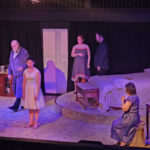
The minimalist set (Conderacci, who also does the show’s musical sound design, intimacy choreography, and dramaturgy) lends itself to the transient nature of the scenes. Although Wasserstein’s work is progressively linear (except for starting both acts in Heidi’s ‘present day of 1989’) there’s a lot that’s meant to change between the years in which each scene unfolds. Having the bare bones set not only keeps the focus on the action but it allows for smooth and well-timed transitions (shout out to Stage Manager NJ Saroff for mobilizing the cast in such a way that keeps the pacing of this show on its toes.)
What makes the scenic shifts from year-to-year standout most is the combination of Projections (Chris Uehlinger) and Music (Conderacci.) There are video montages of relevant women-related events and pop culture that fit the incoming year along with a well-matched popular song of that year every time we move forward in time. “We’ve Got the Beat” is a personal favorite as we approach 1982 in the second act. This, combined with April Forrer’s Costume Design (and Penelope Chan’s wig & makeup design) are the inclusive hallmarks of how the audience knows we’ve progressed into another year (Uehlinger’s projections also feature the year being projected but it’s brief, favoring more of the video montages— and the sapphic imagery for the rolling records during the move into 1974 is perfection!) There’s more to be praised for both Forrer and Chan, though specific favorites include the orange scalloped dress on Jill in 1968, that blingy-eggplant affair on Susan in 1984 and that sign-of-its-time wedding dress on Lisa from 1977. (Shout-out to TJ Lukacsina on lights; sometimes the hallmark of a good lighting designer is to not notice because their work is geared toward natural and ambient interior lighting.)
The text speaks for itself in most cases and Conderacci allows the performers (an impressive bunch of nine, over half of whom play at least two different roles) to delve into the richness of their respective characters’ storytelling. She approaches the work from the human perspective rather than trying to reinvent the wheel to make it relevant. And she allows the script to breathe; pushing the timing of moments for certain comedic effect, letting her actors develop natural camaraderie and connection between them; it’s a very impressive approach to a script that in lesser hands could feel a little stayed and a little fatigued.
Playing more supporting/ensemble roles, the quintet of Maggie Dennis, Danae Nick, Penelope Chan, Nava Rastegar, and Nathan Trexler create the bonds which hold the script together. It’s Heidi’s narrative, with her three principal players but the ins and outs of her timeline are ear-marked and time-stamped by these wonderfully talented individuals. Nathan Trexler plays at least four different roles on stage (and has an ‘Easter Bunny’ credit that never appears on-stage) and gives us great personalities, first as the twist-n-smoke Chris Boxer, all the way through to Ray the anesthesiologist. Penelope Chan is most noted for her chanting at the Women-In-Art protest as the Debbie character while Danae Nick’s most memorable moment is as Jill during the 1970 women’s circle-group meeting. She’s loaded with a spitfire personality in that scene and really has the audience rolling with her edgy, care-free feminist attitude. The way she jettisons her body forward to deliver that one line, “I f**king hate charisma” is so priceless and wholly enjoyable she makes a lasting impression on the audience. (Costumer April Forrer also gives her the most striking outfit of the show when she’s playing Molly in 1977— that fire-engine red-ruched dress is fierce and fabulous!)
Nava Rastegar and Maggie Dennis both have lingering complexities to their characters. While Rastegar starts off briefly as Jill in that aforementioned women’s group and is wholly supportive and sweet in that role, she spends the remainder of the play (from the final scene in act one through her final appearance) as Lisa. The delicate southern drawl, the attempt to hold her own in a world that is clearly dominated by men, it’s all present and Rastegar does a fine job of delivering it within the confines of this character. Dennis, who’s two most notable roles are how she bookends the play— Becky and Denise— shows a great versatility in her portrayals. As the meager and naïve Becky, you desperately want to reach up and hug her before she even reveals her truth, and as the go-getter-career-gal of the 80’s Denise, you have this simultaneous urge to both love and hate her. Dennis has a subtle yet effervescent stage presence, even when Dennis is just lingering on the sidelines, like during the 1982 TV-segment, you can feel her energy quite intensely and it’s impressive.
Watching the Susan Johnston (Aparna Sri) evolve through the decades does make one wonder what a ‘spin-off’ starring that character would look like. A bubbly dip of a squealing, boy-crazy teen, Sri evokes that caricature of Susan in 1965 with such enthusiastic gusto that you’re laughing at her shenanigans despite your spine shuddering at her intentionally shrill vocalizations. (By the time Sri reaches 1984 she’s talking with that lower-ranged, smoothly-LA tone and hearing those sounds so flawlessly come from the same actress in such a short span of time is wild.) The connection that Sri builds with Heidi (Chelsey Megli) fluctuates in peaks and valleys as well; their friendship changes as Heidi’s life does and the changes all generate from Susan. Sri handles this dynamic shifts masterfully— coming full to bat as this defensive guardswoman in the 1977 wedding scene, being inclusively-dismissive of her in the 1984-restaurant scene; it’s a dynamism that shifts, burbles, and grows almost as quickly as the years do in this production.
It’s hard to say which man— Peter (Colin Tillery) or Scoop (William Darden)— has the bigger impact on Heidi’s life. Both Tillery and Darden are exceptional actors, portraying very different characters and thriving in their respective roles. Darden, as the absolute charismatic jerk-face stereotype of ‘wrong guys that women perpetually fall for because even though they know better they let those men define their value’, is really edgy and unhinged. He’s not a villain so much as an antagonist, yo-yoing Heidi along, constantly challenging her sanity with his mind games and antics, playing with her heart because he’s too immature to address his own. Darden is engaging to watch and there’s even a moment when you almost feel a hint of human sympathy toward him; almost. He plays a practically irredeemable character but he’s got great comedic timing, is quite sharp of presence and of line delivery and really makes the story move in regards to how (or whether) Heidi grows a backbone and discovers self-worth.
Tillery, as the not-so-closeted Peter Patrone is the funniest character in the show in the sense that he gets all of the laughs. Though this isn’t to say Tillery’s character doesn’t have some more sober and gravitationally emotional moments— the whole mid-to-end of the 1987 penultimate scene has Tillery delivering the most moving and brutally honest things his character encounters over the course of the play. (Peter Patrone is a gay man, living in the late 1980’s in New York City.) Of course the scene that steals the thunder, back to his flawlessly comical side, is the 1974 art-protest moment. As Tillery’s Peter tries to subtly and then very overtly tell Heidi he’s gay, he keeps getting bulldozed over by her obliviousness and the facial expressions, body language, and subsequent tonal adjustments he makes with every passing attempt is hysterical. He’s also hilariously on fire in the 1982 TV scene (which is wholly cringe to watch because of the way both Scoop and Peter keep plowing over Heidi, though you can’t help but laugh at Tillery’s character’s nonsense in that scene.) There’s this honestly evocative moment between Tillery and Heidi (Megli) at the end of the 1987 scene. It’s touching, sincere, extremely earnest as they exchange their little in-jokes, their deep-bonded friendship and platonic love for one another; it’s one if not the most moving scenes in the play.
Except for maybe Heidi’s (Chelsey Megli) monologue that is the entirety of Act II Scene 4 at The Plaza Hotel in 1984. (That monologue is in ever monologue/audition book known to actors everywhere and it’s a doozy.) If Megli were to be judged on that scene alone, she’d ace the evaluation, hands down; it’s evocative, gripping, mercurial— a true roller coaster of emotional combustion and raw, eviscerating experience. She’s alone on stage, speaking to a fictitious audience (though the real audience gives her the well-deserved ovation when she completes the scene as if we were the audience from her scene) and every single word she speaks has you mesmerized. It’s an impressive feat to be sure. Megli does an superb job of making shifts in the Heidi character without pronouncing them as such. You still see her as this silenced woman, uncertain as to whether or not she should have a spine— particularly when it comes to Scoop— but she lets the character have true moments of growth and real, earnest connections with each of the other characters that she encounters. Watching her decompose at the end of the first act is as tragically haunting as it is frustrating because she deserves better, we all know it, and yet we’ve all been where she’s been in that moment. Watching her bite through and swallow her tongue during the TV-studio scene in 1982 is infuriating and yet, again, relatable. She’s versatile, complex, and when she’s lecturing as the Art Professor at the tops of both acts, she’s so genuinely enthusiastic that you find yourself really intrigued by her lecture topics. It’s an extraordinary performance given by Chelsey Megli in this titular role.
How will you use what you know, Baltimore? Now that you know there’s a good show happening in Fells point this spring? Hopefully you’ll take that knowledge and get a ticket to see The Heidi Chronicles at Vagabond Players before it closes on May 3rd.
Running Time: 2 hours and 35 minutes with one intermission
The Heidi Chronicles plays through May 3rd 2026 at Vagabond Players— located in the heart of Fells Point: 806 S. Broadway in Baltimore, MD. Tickets can be purchased by calling the box office at (410) 563-9135 in advance online.