
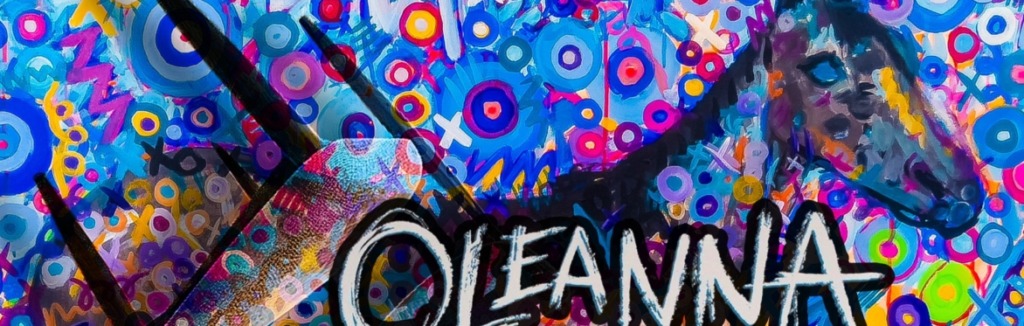
Everybody needs to expose themselves to different points of view. There’s nothing wrong with that. It’s essential. But what happens when the viewpoints are so skewed there’s no good side to take? What happens when no matter whose viewpoint you see a scenario through you’re in the wrong? It’s exactly that type of dialogue that WFB Productions is attempting to encourage with their production of David Mamet’s Oleanna. Referred to as ‘not-your-mama’s’ Oleanna, this presentation turns the play on its ear— in so much as the immutable licensing will allow (sorry, Baltimore, there’s just no getting around that stammer-stacked dialogue that Mamet truly believes is genius)— and really makes you question just what side you’re on. The shocking conclusion? No matter what side you think you’re on— you’re wrong. It’s a harrowing theatrical experience that will generate evocative and visceral conversations for days after the run concludes. Directed by M. Eden Walker, this unsettling piece of theatre certainly discomforts the comfortable and in some lights may portray a sense of comfort to those in need of it.
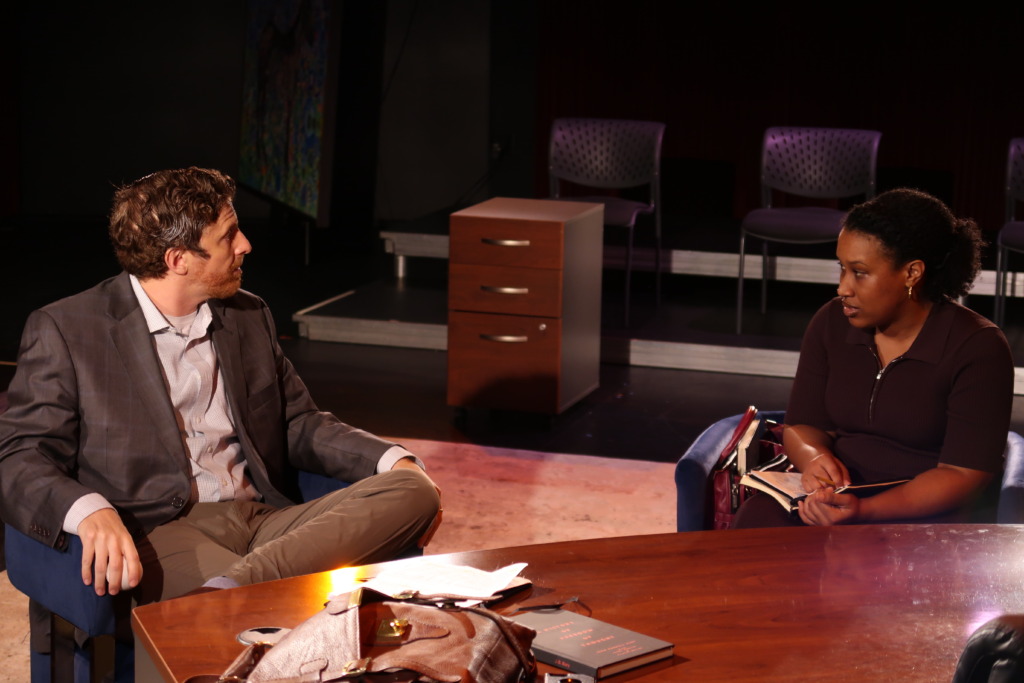
In a successful attempt to create as claustrophobic play space as possible, Director M. Eden Walker and her production team (Teagle Walker- Stage Manger, Paige Mattke- Technical Properties Manager, and a five-person set choreography team: Kai Beauvois-Ransome, Jeanea Blair, Matthew Hazelhurst, Hawkin Mattke, Paige Mattke) set the play in the round inside the black box stage of Baltimore’s own Motor House. With the audience encroaching upon the action, the intensity of that perceived sense of claustrophobia resonates thoroughly throughout the performance. Watching the scenery change— without spoiling the effect or delving into too much detail— as also fascinating and an integral part of Walker’s intention behind the piece. The scenic shifts between the first and second act and again between the second and third, with the furnishings that evolve and devolve, is a significant, symbolic representation, if not a wholly physical reflection of the power dynamic that is shifting and evolving between the two characters in Mamet’s script. It’s worth praising— the giant horse painting, entitled “Horse on Canvas” (by Joseph Scalea) that greets patrons as they enter the space; it’s eclectic in nature, curious to look at, and ultimately primes your mind for questioning, which is exactly what the mind will be doing as the play advances.
Textually, Mamet’s work is a bear. And not the good kind that we’re all choosing in the woods. It’s difficult to listen to— the stammer, tripping-fall words, and gross repetition is intentional. It’s almost like watching the future of AI-Robots glitch out in live time. But that’s Mamet’s style. Not the actors. The actors— Carlo Olivi as John and Azure Grimes as Carol— have impeccable emotional control and impact over the show’s pathos as a whole, in spite of Mamet’s highly stylized dialogues. There are papers and likely dissertations about why he writes this way and what he’s hoping to achieve, other than annoying the audience, but that’s one of those things that bears little holding on the play or its intentions as it stands.
There are moments of intense physicality in the production; Fight Choreographer Paul Reisman makes a lasting impact with his work, creating realistic involvements that frighten and shock the audience whilst balancing the safety of the actors (and the audience as everything and everyone is in very close proximity) against the verisimilitude of the action. There are only a few moments where this type of choreography comes into play but when it does, it’s chilling.
Mamet’s work is troubling. A scenario is presented in the first act— perceived in three lights— the neutral observation of action between two characters, the interaction as perceived by the female character and the interaction as perceived by the male character. The second and third acts subvert and upend these perceptions, causing great consternation not only for the characters but for the audience; they’ve watched exactly what has happened, formulating their own opinions and feelings, and find that those opinions and feelings are thrown into a tempestuous maelstrom as the acts progress. Walker’s intention of presenting these two characters in their respective lights purposefully engages confusion in the narrative. If she’d been less this or he’d been more that— would things have been perceived and extrapolated differently? Wasn’t he just trying to help? Wasn’t she just overreacting. It’s going to hit different for every person watching based on their own personal biases and experiences.
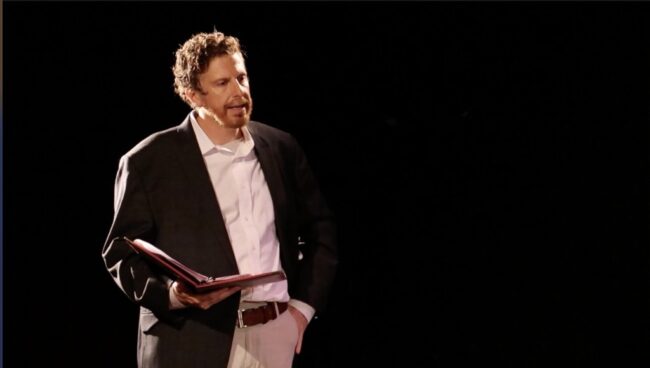
Carlo Olivi, as John, starts off composed, albeit agitated, largely to do with external circumstances and forces in play. You never get to hear the other half of the phone conversation that his character is perpetually having, but Olivi sort of makes you feel like you do, with how engaged he is in those moments. Watching his character physically and emotionally decompose from act to act is an unhinged and feral experience that is both gutting and rewarding, simultaneously revolting and cathartic? The takeaway there is really going to be who’s side you’re on…so long as you remember that it’s the wrong side, no matter what. He’s being kind or he’s being a jerk, or he’s being a human. Either way he’s wrong. And while there are definitely lines crossed when it comes to his character’s physical interactions with Grimes’ Carol, they aren’t as she depicts them and portrays them. She’s being an exploitative opportunist, she’s only playing the victim, she’s blaming him for something that isn’t his fault. Right up until she’s not. It’s a vexing conundrum and an enigma, dipped in a headache, wrapped in theatrical bacon, and rolled up in a three-layer-color-coded-carpet, shoved under a jewel-bright abstract painting of a horse.
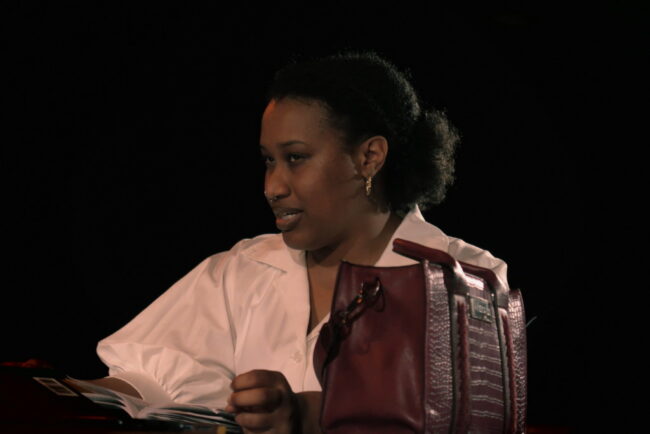
Azure Grimes, as Carol, has fascinating internalizations of her character’s existence, which often manifest themselves in the way her body posture is held. Even when the power dynamic shifts, there is a lot of meager gesturing, pulling into herself, looking down, refusing to make eye contact. It’s a fascinating character study. The pair of them spend a great deal of time fluctuating around the play space as well, not as if they’re floating in the primordial ether of where they’re supposed to be, but rather utilizing physical levels— sitting and standing— to demonstrate positions of power. Watch who’s standing more in the first act, versus when they sit and why they choose to sit in those moments and comparatively bring that in juxtaposition against those same actions in the second and third acts. (Director M. Eden Walker has that down to an exacting science and really drives the component of the ‘shifting power dynamic’ home with those simple gestures. She also shifts the character’s costumes; they progress or digress, depending, as the acts move forward; noteworthy but indescribable for fear of ruining what they potentially symbolize.) One could easily start a dissertation on their ever-shifting dynamic, even if it is somewhat linearly progressive. And the emotions that both Olivi and Grimes pour into these characters are equal parts unsettling and bombastic. While Olivi has a more metered and measured control of his emotions, releasing them at meticulously calculated moments that feel as if they are predicted from within the confines of the text, Grimes has more sporadic outbursts that feel reactionary to the situation. The opposition of these two emotional exposures is part of what makes the play so harrowing to watch and so disquieting.
Just because it’s a difficult concept and hard to watch doesn’t mean it shouldn’t be watched and embraced. It’s a sensational approach to a classic, designed to revolutionize the types of conversations we should be having but are too afraid to have, especially in this day and age. Even if you’ve seen or read Mamet’s Oleanna, you haven’t quite seen it like this. And should explore it as WFB Productions has it presented for their limited-engagement run.
Running Time: 1 hour and 50 minutes with two 10-minute intermissions
Oleanna plays Thursday September 25th, Friday September 26th, and Saturday September 27th 2025 at 7:30pm with WFB Productions at Motor House— 120 W. North Avenue in The Station North Arts District of Baltimore, MD. Tickets are available at the door but advance tickets are strongly encouraged and can be found online.
To read the interview with Teagle & Eden Walker, click here.