
Every moment is a moment when you’re in the woods— again please.
It’s the Vagabond Players’ turn to try their hand at Sondheim’s most beastly bear…Into The Woods, under the co-direction of Audra M. Mullen and Kerry Simons, launches its five-weekend run as the first show of the company’s 109th season. With Musical Direction by Stephen M. Deininger, this challenging Sondheim musical has a few twists, turns, and pleasant surprises in store for audiences who are familiar with the work, and will provide a most agreeable experience for those brand new to this glimmer of a tried-and-true Sondheim classic.

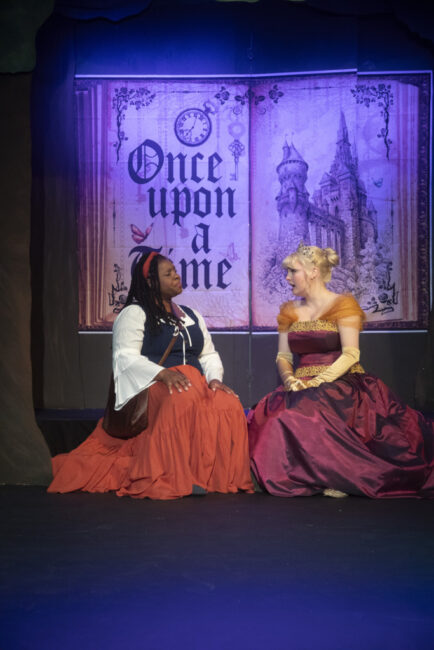
The majestic and mysterious forest, complete with overhead twinkle-lights, grows onto the stage by way of Set Designers Audra M. Mullen, Kerry Simons, and Bruce Kapplin. Scenic Artist Charlies Woods and Set Painters Miles Weeks and Alissa Suser are responsible for the detailed imagery of the seamless-fold-out-beanstalk. Mullins, Simons, and Kapplin keep the set surprisingly simple but honestly it lends itself to the engagement of the imagination amongst the audience, particularly with the ‘storybook-style’ pop-out hatches that serve has homes for the Baker and his wife as well as Cinderella and her ilk. It’s a quaint little set with its own charm— perfectly spaced for the limited staging area that Vagabond Players is working with in their intimate and cozy theatre. What makes the set work in true resplendence is the amount of time Mullen and Simons have the players off of the stage…either coming up and down through the house…standing and singing in the stairway-aisles, parking themselves right at the edge of or down off of the apron…it keeps the stage from feeling overcrowded and also helps to generate the sense that the fairytales contained within the story are coming directly to the audience.
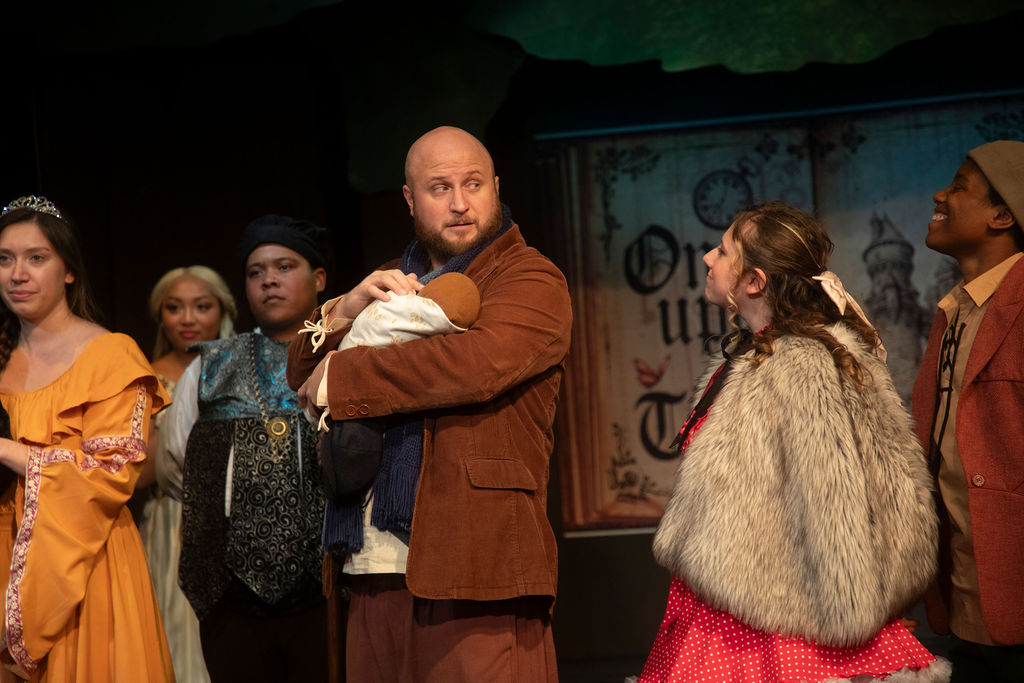
April Forrer’s costumes follow suit, simplicity but with elegance. Very tasteful. Very demure. Cinderella’s peasant clothes have a subtle nod to the Disney brown while her ballgown has a much more vivacious shade of claret and ruby resonating within it. Snow White, Sleeping Beauty, and Rapunzel don’t look anything like their Disney counterparts (and thank goodness for small favors; that always feels like the ‘easy out’ when it comes to gathering up costumes for Into The Woods.) The princes look princely, the witch looks ghastly…until she doesn’t…and that shimmering, glimmering, sparkle-fest of a purple sequin glamour gown is giving all the princess-type characters ‘dress-envy.’ Forrer strikes a balance between more ‘salt of the earth’ styles— like the togs featured on the Baker, his wife, and The Mysterious Man— and something with more fervent grandeur— like all the dresses featured on those in Cinderella’s house.
Mullen and Simons do an expedient job of keeping the show moving. Sondheim can be and often is long at the best of times, and while this particular Sondheim is no exception, Mullen, Simons, and Stage Manager Kaite N. Vaught run a well-paced production. (You’re never going to get around the fact that it comes in shy of three hours but you don’t notice it because they keep the action moving, the scene changes swift, and ultimately keep the audience engaged.)
The principal complaint for the production is sound balance. Musical Director Stephen M. Deininger is backstage with a piano/keyboard making magic, but it’s overblown coming through the speakers/monitors, often at times to the detriment of being able to hear certain soloists. Deininger’s work as the musical director radiates in the nuance of the delivery of the musical numbers, particularly when the company sings as a group, navigating their way through those dizzying, difficult harmonies, rambling recitatives, and overall challenges that every Sondheim score throws at performers. Deininger keeps exceptional pace too— especially during the two pitfall numbers, “Agony” and “Your Fault.” They race along without feeling rushed and they never drag. And the articulation and cadence that comes out of the latter of those two numbers is sublime.
Now for the clever twists. We’re still set in that majestic and mysterious forest and while there isn’t some ‘reinvent the wheel’ concept being thrown over this production like a theatrical cloak, Mullen and Simon have done something unique and rather extraordinary with their vision for the show. It’s not so inconceivable that— as these are ‘children’s fairytales’, however dark— that this whole ‘Into The Woods’ experience could be the narrative existence of a child reading a storybook. And that’s exactly what they’ve done by casting Lillian Jackson (7th grader) as The Narrator. Jackson, who has a striking stage presence in the role, not only narrates the show as the character is written but has several quirky and intriguing interactions with characters from inside these tales— as one might imagine young children do when they’re exploring and experience fairytales for the first time. Without spoiling too much of the magic, it can be noted that Jackson’s primary character of interaction is one that is often a crowd favorite in this particularly moo-sical. Jackson has a solid voice as well and getting to hear her take vocal leading point on “Finale: Children Will Listen” and the imagery created with her, the witch and the storybook at the end is divine.

There are other fantastical devices in play to keep the show intriguing— like the scrim-screen and shadow play for when Little Red Ridinghood finally makes it to grandmother’s house. Lighting Designer Joel Selzer really double and triple checked the setup for that one because the shadows and silhouettes were extremely crisp and effective. And while having a puppeteer be Cinderella’s birds is not uncommon, (and in this case they’re spun around on a lovely carousel-mobile of sorts by Sydney Marks) in the dozen or so different productions of Into The Woods that I’ve seen over the years, I can officially say this is the first time I’ve ever seen an actor play the harp. Sydney Marks (who is also featured momentarily as Sleeping Beauty near the end of the performance, alongside Jess Corso as Snow White) is a human-embodiment of ‘The Harp’ and has hilarious background-chewing engagement moments when Jack’s Mother is busy threatening to go into town and ‘sell the harp.’ It’s wild. Marks, alongside Milky White and Jack make that scene far funnier than it has any right to be!
Speaking of show stealing delights… Matthew Lindsay Payne plays Milky White (yes, the cow) with such enthusiasm and gusto you won’t be able to take your eyes off of him. His facial expressions are hysterical and his body language makes you feel ‘all the feels’, which are quite a lot for a cow, particularly when he’s trying to flee the Baker’s Wife. Also, keep your eyes closely peeled for ‘Cow Incognito’ because that’s as hilarious as Sydney Mark’s Harp having reactions to the notion of being sold.
Other standout performances among the supporting fairytale characters include Shae Henry’s sassy performance as the Steward, who is either tailing along behind Cinderella’s Prince in pursuit of the ‘runaway princess’ or leading ‘the royal family’— Cinderella’s Stepmother (Kallan Allison), Cinderella’s Father (Tim Sayles), and her two wretched stepsisters, Florinda (Sarah Jacobs) and Lucinda (Daisy Hall) through the woods. Allison, Jacobs, and Hall do admirable jobs of being snotty, snooty, and downright mean to poor Cinderella, and their voices blend superbly in all of those spellbinding harmonies that Sondheim puts forth for the big company numbers.

Flamboyance— arrogance— intensity— it’s different for both— you’ve got Geraden Ward and Jonathan Lightner— playing Princes, plus one’s a wolf, don’t you know? Ward and Lightner go head-to-head or toe-toe? Whine-fest-to-whine-fest with one another as Rapunzel’s Prince and Cinderella’s Prince, respectively, dueling their way vocally through “Agony” and its reprise. Ward really takes the ‘one-upmanship’ to extremes during the reprise of this song and the pair have a perfectly timed sigh of resignation at the end of the song as well. Both a fair of voice, full of melodrama, which is perfectly suited for the respectively princely roles, and make wonderful additions to the cast. Lightner, who follows the vein of traditional casting and doubles up as the Wolf, get an extra shot to showcase his vocal prowess during “Hello, Little Girl.” His howl is feral. And the whole shadowy bit behind the screen for when the Baker sets about ‘righting the wrong’ of Little Red Ridinghood, Granny (played by Laura Malkus who doubles up as Cinderella’s Mother in a shimmery mask and as the unseen voice of the giant), and the Wolf is an extra beastly delight.
Where there’s Rapunzel’s Prince there is absolutely Rapunzel. With glorious vocal talents, Su Kim brings a bright earnest sound to the character— who mostly just wails away, making the character easily dismissible, but Kim finds a way to draw the audience’s attention to her— particularly with her “eh, whatever” attitude by the time she gets to her third or fourth incarnation of that wail-singing that Sondheim so ungraciously set down upon the character. Kim has an earnest curiosity about the way she plays the character, which gives Rapunzel a surprising amount of depth, a rarity for an otherwise more generally overlooked character.
Speaking of overlooking, when at first he appears he’s nothing serious, but you may just wonder if he is delirious, that Mysterious Man (John Sheldon) who is both fleet of foot, gruff of voice, and with just enough oddities about his overall portrayal that you do start to wonder if he is an actual spirt of some sort, haunting the majestic and mysterious woods. Sheldon, whose character pops in and out of various and sundry scenes like a gopher in the old-school whack-a-mole arcade game, finds more somber purchase in the show late in the second act, dueting with…or against, depending on how you interpret the song…the Baker in “No More.” It’s a healthy dose of speak-singing, which is a different but not unwelcome choice, until the final harmony note, which is blended most excellently together with The Baker.
You get a mouthy and somewhat obnoxious portrayal of Jack’s Mother from Lauren Riley Sayles. Not unkind but firm in her ways, Sayles delivers the overly frustrated maternal character with a surprising amount of gusto. Much like Rapunzel, the character of Jack’s Mother can easily disappear into the background, but Sayles takes every opportunity her character to gets to be focused upon, making for a most memorable performance. Her cheeky self-acknowledgement in the second act, where she says, “As I…stand here…” paying full notice to the upright position of her character as certain events unwind, is hilarious and give the audience a good chuckle. Her vocals are well-matched for those moments that Jack’s Mother sings as well.
Of course, Jack’s Mother wouldn’t be so strung out and so stressed if her boy Jack wasn’t such a mess. Miles Weeks is an effervescent burst of enthusiasm and plays the ‘touched’ boy with just the right amount of eager naiveté. Weeks has a radiant voice that really bursts through “Giants in the Sky” but finds sincere balance with gravity for “I Guess This Is Goodbye.” He plays extraordinarily well with Matthew Lindsay Payne’s Milky White and opposite of Little Red Ridinghood (Alissa Suser.) When Weeks’ engages in the whirling dervish that is “Your Fault”— a four-part race-around number which features Weeks’, Suser’s Little Red, Cinderella and the Baker— he manages not only to keep the expedient and staccato delivery of the number but does so with a cheeky lilt in his voice that really adds to the playfully immature nature of Jack.

Saucy, sassy, and ferocious with both her wit, vocal delivery, and overall characterization, Alissa Suser is giving a textbook performance of Little Red Ridinghood. There’s a nasally vocal affectation that isn’t too overdone, lending just the right level of petulant brattiness to her character. And while for most of the musical, Suser’s character tends to be that spitfire of a pip, teasing and taunting Jack, mouthing off at the Baker, or being otherwise adorably obnoxious, there comes a moment late in the second act where Suser mellows into a somber, deeply moving vein of her character’s existence, showcasing her emotionally expressive versatility. And when her vocals marry alongside those of Cinderella during “No One is Alone” it’s a delicate and beautiful sound.
With a curious intelligence about her character portrayal, Courtney Wersick delivers something more than your average ‘rags-to-riches’ princess during this performance. There is the ‘gentle-ingenue’ nature ubiquitously infused throughout her singing and speaking but it’s overridden at times by something that most fairytale-experiencers tend to associate more with Belle— courage. There is a self-determined courage that rides deep within the spirit of Wersick’s Cinderella and you hear it first in “A Very Nice Prince” but more assuredly in “On the Steps of the Palace”, which becomes more than just a pretty number in Wersick’s capable hands. Her vocal range slides evenly through the number but that intrigue— that courage— steers the song in a new direction, making it clever and thoughtful rather than just pretty and nice. There’s also a depth to her interactions with her prince in the second act that so often gets glossed over in favor of ‘winsome goodbyes’ which makes Wersick a real joy to watch from an acting standpoint.

The dress is giving all the envy to everyone for our Witch, but Robyn Yakaitis does more than just fill out that sparkle-sheet of purple and sashay around in it. Her patter during that seemingly unending 20-minute-opening prologue— where she races through her vegetable garden with meticulous delivery— is fierce. Paying homage to Bernadette Peters you get a sense that Peters (and maybe a little bit of Winifred Sanderson) is informing Yakaitis’ performance as the Witch. Vocally sound and well-suited for the role, you get a clean and appropriately belted rendition of both “Witch’s Lament” and “Last Midnight.” Yakaitis delivers “Stay With Me” with that wholesome, desperately maternal sound, but where you really get that touching moment in Yakaitis’ performance is the end— where she shares the closing number, “Finale: Children Will Listen” with Lillian Jackson (our sensational child-narrator) and hands off the storybook. It’s really striking moment both vocally and visually.
Modern and edgy and just a little wild, Alana Simone is giving main-character-energy for her portrayal of Baker’s Wife. Balancing the humor with the severity, the chuckles with the sincerity, Simone is present, focused, grounded, and yet dreamy, all at once for the entire time her character is in action. There’s something tasteful and demure about the way she encounters and engages with Cinderella’s Prince for “Any Moment.” And there’s a really lively energy that soars through “Moments in the Woods.” Simone has a bold and beautiful voice that does wonders for those aforementioned numbers but also twines perfectly with the Baker (Andrew Worthington) for “It Takes Two.” The playfulness and lightheartedness that this pair shares during that number feels undeniably organic, which is such a refreshing change of pace compared to the way the pair bickers throughout most of the performance. Simone also understands comedic timing and delivery— particularly during the ‘bean-cow’ exchange scene with the Baker and Jack.

There’s something inexplicably raw about Andrew Worthington’s Baker. A nervousness perhaps— like he’s augmenting the uncertainty that the character feels just living his every-day life? It’s almost like the embodiment of anxiety carefully juggled with the pressures of trying to be the problem-solving breadwinner; Worthington does a sublime job of capturing this unique quality of the character and delivering it in an earnest fashion. Vocally conditioned to sound like a lusty tenor prince, Worthington’s voice floats easily through “It Takes Two” but his real vocal triumph comes late in the second act, where you can feel the tears threatening to overtake his performance of “No More.” It’s rare that you get such emotional honesty from jump-street with the Baker; too often, the Baker is played as goofy or aloof and by the time the emotional catharsis of “No More” comes along, it feels like a blindsiding, undeserved smack of pathos— but not with Worthington. He creates a vulnerability in the Baker that you see right from his introduction during “Prologue: Into The Woods” that builds and grows so that when he does reach that beautiful, sorrowful solo, it’s a well-deserved emotional release.
It’s a wonderful production, really surprising in a most delightful way— not the least of which is the stamina that our 7th grader Lillian Jackson puts forth in carrying the burden of ‘telling the story’ as The Narrator (you could easily spend the whole performance just tracking her movements as she observes and interacts with the fairytales she’s extolling)— and it’s well-paced and equally well-performed. It may not have the same shivers as other seasonal offerings this autumnal season but it’s got a nice chill to it; don’t miss Into The Woods at the Vagabond Players playing through mid-November in Fells Point.
Running Time: 2 hours and 45 minutes with one intermission
Into The Woods plays through November 17th 2024 at Vagabond Players— located in the heart of Fells Point: 806 S. Broadway in Baltimore, MD. Tickets can be purchased by calling the box office at (410) 563-9135 in advance online.
Thanks for a wonderful, remarkably thorough review of Vagabond Players’ Into the Woods!! One tiny nit to pick on behalf of my wife. It’s Lauren Riley SAYLES (not Sales). You have it right in the caption, but not in the main text. If you can make the correction without difficulty, please do — and then of course feel free to delete this comment. Cheers!
We fixed it for her, Tim. (Kind of you to look out for her!) Auto-correct just wanted to hold onto that ‘y’ and we couldn’t tell you why! :-p Great show!