
There is a big blue emptiness in a dream deferred. And Chesapeake Shakespeare Company is filling it up with a first of its kind collaborative production between themselves and UMBC Theatre. Langston Hughe’s Shakespeare In Harlem, adapted for the stage and directed by Gerrad Alex Taylor, is appearing for a one-weekend only performance at CSC’s downtown stage after a successful run at UMBC Theatre in the fall of 2025. Evocative poetry in theatrical motion, this production gives voice, breath, and life to the leading voice of the Harlem Renaissance, to the poetry and words that shaped a crucial era in America’s recent past.
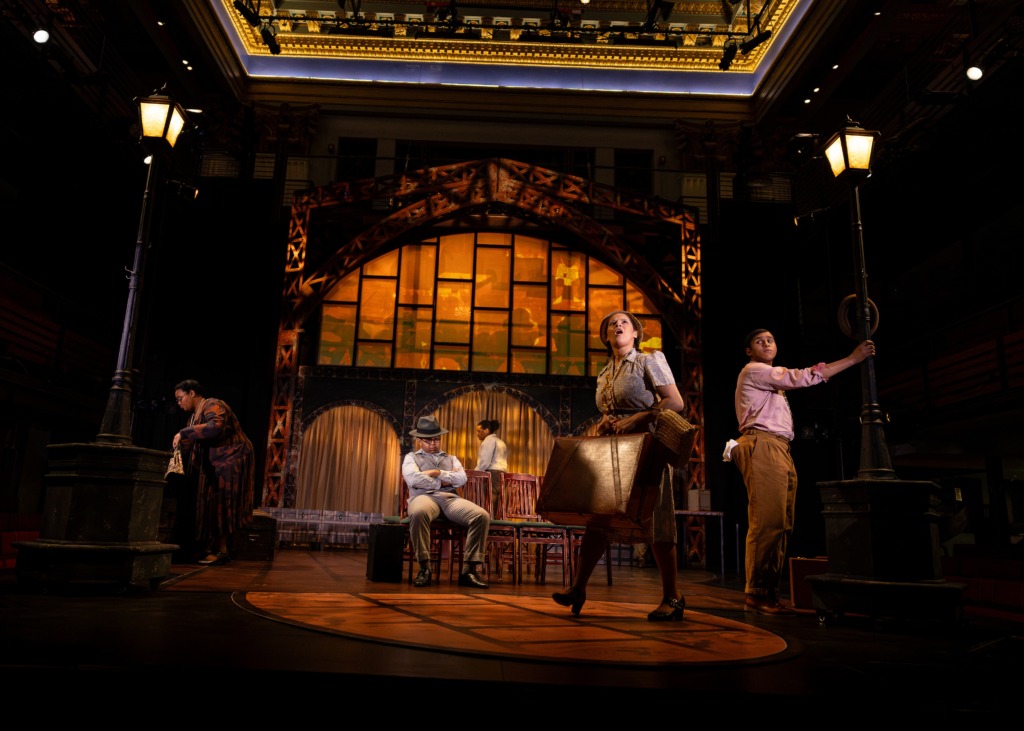
CSC’s sweeping tower-column stage setup lends itself to all sorts of creativity. Scenic Designer and Projection Designer Nate Sinnott has kept the scenery deceptively simple. The overhead high arch, rusted in color but majestic in stature sets us in Penn Station, New York City 1942 with the imaginative soundscape of the clattering tracks and trains (compliments of Sound Designer Kaydin Hamby) to prime the audience. Only the show doesn’t rest its bones solely in the train station. The streets of Harlem, the apartments of people, and The Black Church, all fluidly transition in and out of scenic purview by way of crates, two lampposts, and some clever, carefully plotting lighting effects (Lighting Designer Juan Juarez.) It’s actually Juarez’ lighting that is some of the most evocative technical components in the production, particularly the blue flush to shift us to the ‘Night Funeral in Harlem.’ The show’s costumes (Eric Abele) follow suit in that same vein of simplicity; marked for the times but elegant and tasteful without being overly complicated or grandiose. Sinnott’s projections— at times of living, moving silhouettes (shoutout to whichever run-crew/stagehand creates the ninth shadow person up on the balcony behind the stained-glass window when the eight performers are all down on the stage)— are what complete the aesthetic of the show; almost like water color paintings reflecting the scenes, the poems, the art-imitating-life-imitating-art captured in stillness, changing with each of the ‘seven ages’ of the blues.
There is a fluidity to Gerrad Alex Taylor’s adaptation, almost as if he’s captured the essence of Langston Hughe’s poetry in tangible motion and imbued it into the eight performers (of which he is one) on the stage. There is a narrative beacon, a leader-figure— Griot (Lauren Davis) and then other characters in the story as various stories unwind and unfold. The pacing is smart. The performances are at times a little out of sync with one another and the overall ebb and flow of the words but this doesn’t wholly detract from the experience. Some of the actors struggle in places to project fully but this again is not a consistent issue that prevents the show from being enjoyed. The general vibe and verve that Taylor creates with this adaptation is one of uplifting grace, gentle joy, and overall theatrical transformation. You start off uncertain what you’re about to see. And as the linearity and straightforward path are plucked away from the experience you become enmeshed, absorbed, surrounded. It’s like living inside of a Langston Hughes poem whilst also observing it being actualized by human beings. It’s a unique experience for certain.
With a cast of eight— Gerrad Alex Taylor as Simple, Lauren Davis as Griot, Amani Abdullah as Madam K, Ambar Auth as Minnie, Latrelle Jamez as Bruce, Dario Prioleau as Leonard, Manny Rimmer as Alex, and Tatiyana “Tati” J. Terrelonge as Lulu— you get a unique camaraderie on stage although the only time the characters are all eight on stage at once is at the end of the show and during the church and funeral scenes. (Technically at the top of the show once Davis’ Griot descends from the house balcony-overhang but at that point she’s more of a narrative beacon inviting them as well as the audience along for the journey.) There is a curious nature to the way Gerrad Alex Taylor blocks some of the scenes; sometimes other actors are standing in the background, the periphery, or even at the edges of the stage observing and/or existing, creating a relatability or understanding for those not actively portraying characters in those moments. Though this is somewhat inconsistent and there are moments— like the one comedically loaded monologue that Taylor delivers by himself— where there’s only one actor present on stage.
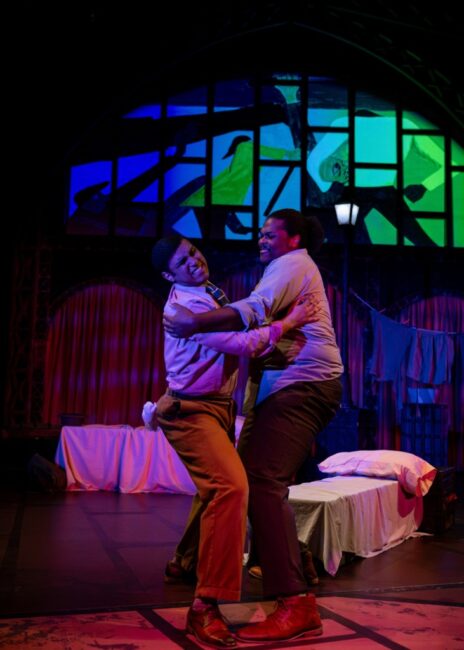
One of the more compelling scenes that really amps up what happens once we get to church is the shared poetry-slam-off experience between Bruce (Latrelle Jamez) and Alex (Manny Rimmer.) Jamez and Rimmer have this epic duel of words, followed by an actual stage fight (no fight choreographer is credited though there is a dance choreographer listed— Nigel Semaj), which charges up that scene divinely; watching words turn into actions becomes this heightened moment of intensity with both Jamez and Rimmer bringing drastically different character experiences into juxtaposition with one another. Rimmer appears later, ‘writing his page/letter’ from a pop-opening in the ‘stained glass’ fixture that obscures the second-story stage balcony and his words are just as readily flowing with intention and ease as they were when he took the gentle road in the scene with Jamez’ Bruce.
There’s a confidence that borders on cockiness with Amani Abdullah’s character of Madam K. You get to see this highlighted best in the standoff with Lauren Davis (who takes up the mantle as a landlady of sorts in that moment. Davis also plays a granny character opposite Terrelonge’s Lulu and her physicality and vocal affectation choices in those moments are superb.) Abullah has a really grounded moment as well, speaking about how printing her name in ‘American’ is best, which haunts its way from 1942 through to the present day and lands with an unexpected gravity punch to the audience’s ears. As the expressive, though more comedically edgy, Lulu, Terrelonge brings a different type of confidence to the stage. When she’s mouthing off at Dario Prioleau’s Leonard it’s fiery. Terrelonge showcases some subtler moments too, like when she’s thinking about who she should— rather— who she could write a letter to if she wrote one.
Ambar Auth arrives on the scene in that first ‘vignette’ as Cousin Minnie, with a southern drawl and a pop of flare that’s just zesty and bubbly all at once. (If there’s a complaint to be made across the board with performance disconnects its that Auth and Terrelonge both speak with a more modern pacing— their tone, vernacular, affectation, and in Auth’s case her accent, are all primed and set for 1942 but the speed at which their cadence is delivered has a much zipper ‘2020’s’ vibe to it.) Auth bristles and burbles against Gerrad Alex Taylor’s Simple in ways that tickles the audience and keeps those scenes both moving and lively. Taylor, in addition to all the other hats he’s wearing for this production, takes up a ‘leading player’ role, and gets a lot of the heavier truths as well as the funnier laughs from his character of Justice Simple.
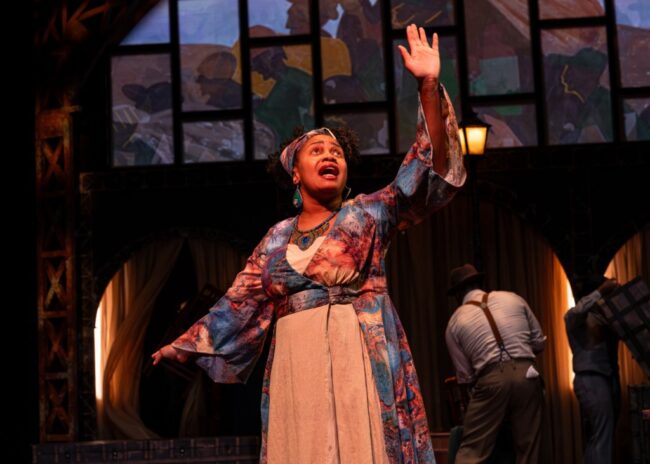
Lauren Davis is the harbinger of all spirits, all walks, all persons in this Langston Hughes stage adaptation. Expressive of face, voice, and body language, you get an enriching and vibrant experience from watching Davis gently guide the audience through this play. There are moments when she lives as a character— the biting landlord for Abdullah’s Madam K and the careworn granny to Terrelonge’s Lulu— but ultimately it’s her timeless wrap of the ending where she delivers the line— “…no longer accepting things I cannot change and changing the things I can longer accept…” as a part of a bigger ‘closing’ style monologue; its mesmerizing; it’s powerful and evocative; its gripping and lands with such intensity that it sends shivers up the spine (the whole scene where she’s bringing the show to the close with her bowl and basket but especially that aforementioned line.) Her presence is felt keenly, whether she’s welcoming the next of the seven stages into existence, welcoming the audience, closing out the experience, or playing in a moment as a character; Davis is a unifying thread in his work.
There’s a certain amount of traveling in a dream deferred. It’s highly recommended that you travel to Chesapeake Shakespeare Company’s downtown stage for this co-production of Shakespeare In Harlem before it closes on January 18th 2026.
Running Time: Approximately 95 minutes with no intermission
Shakespeare In Harlem plays through January 18th 2026 and appears as a University-Professional collaboration between UMBC Theatre and Chesapeake Shakespeare Company on the downtown stage of CSC— 7 S. Calvert Street in Baltimore, MD. Tickets are available by calling the box office at 410-244-8570 or purchasing them in advance online.