
author: Leonard Taube
Intense. Thought provoking. Suspenseful. Relevant. Those are just some of the adjectives I can think of to describe the powerful piece of theatre that is Silhouette Stage’s (Columbia, MD) current production of The Crucible by American playwright Arthur Miller. This dramatization of the Salem witch trials that took place in the Province of Massachusetts Bay from 1692-1693 may be part fiction, but one thing is for sure. While the play was written as an allegory for McCarthyism (when the US government persecuted people accused of being communists), there is an unmistakable resemblance to our current politically charged climate. The play was first performed on Broadway on January 22, 1953, to largely unfavorable reviews yet it won the Tony Award for best play. A year later a new production was much more favorably received, and the play became a classic, regarded as a central work in American drama much like one of Miller’s other most notable plays, Death of a Salesman.

Director Henry Cyr (who is also Silhouette Stage’s current Artistic Director) is a master director (MD) and, like a well-accomplished MD, has donned his white lab coat, pulled out his hypodermic and injected Miller’s play full of intensity and creativity. This is no ordinary shot in the arm, though. Cyr cast this production superbly and knows precisely where to punch up the volume (and believe me, there is some intensity in certain scenes) and where to tone down the mood. Cyr literally dove into the script and brought the characters to life to tell the story of a dark time of ignorance, fear and suspicion in our nation’s history. To say the mark his efforts have instilled in this production is nothing short of visionary would be the epitome of understatement.
One of the most enthralling things that I enjoyed as much as the play itself was the set. Lighting and Scenic Designer Sammy Jungwirth is well known in the community for his innovative sets and creative lighting techniques, and this production is one of those that, once experienced, one could argue that it should be used in all productions of the show. Sometimes Jungwirth’s work is complex; other times it’s simple yet effective. This is one of the latter, but don’t think simple means boring. There is one main set piece which consists of several pieces of large wooden constructure which are lattice works of interwoven lumber giving the feel of fencing or possibly an entrance to the woods of Salem. If you look closely, you will see that all throughout are crosses, a nod to the Puritans in the show and how their view of God and Christianity flavors the witch’s brew which flows through Miller’s script. All these pieces are upstage and, while two of them are moved at various times throughout the play, the far back ones are set. This huge omnipresent lattice is lit by two cleverly hidden lights creating shadows that eerily reflect. Other set pieces are brought on and off throughout the show, but it’s this montage of intricate laces of crosses that lend a visual tone as palpable as the scenes being played in front of it and, while the lighting throughout is effective and well placed, both play an important and integral role.
Costume designer Zen Tabligan (and Assistant Costume Designer Jaylyn Hess) have done an outstanding job outfitting the cast with period appropriate attire, from the dresses and bonnets on the women to the waistcoats and knee-to-foot socks/tights on the men.
Before I leave the world that is known as the Production Team (all of which deserve a nod for vitally important roles behind the scenes) and move on to the cast, I must return to Director Henry Cyr who also took on the role of Sound Designer/Composer Original Incidental Music. Yes, there is music in the show (and even a dance in the beginning) but rest assured this is original incidental music consisting of eerie underscores, tones and sounds to accompany scene changes and all perfectly choreographed to dialogue. MD Cyr breaks out yet another syringe and injects his own work into the auditorium’s sound system which emerges from the speakers to complement various scenes, and it is well played (no pun intended) indeed. As with Jungwirth’s set and lighting scheme, the music Cyr composed and wove into the show should be standard as it highlights the supernatural parts, intensifies the intense scenes, and creates some soul stirring drama.

The cast is 21 people strong and there is not one weak link. It never ceases to amaze me how many talented people there are in our communities, and it is gratifying to know that Baltimore (and Maryland in general) has a host of community theatres such as Silhouette Stages to allow such an outlet for these folks. This production is testament to that as anyone lucky enough to catch one of the performances they will see for themselves.
When you walk into the auditorium, the stage setting will make you think you walked into the wrong show. With nothing but fencing and a big black witch’s cauldron set over logs you’ll think you’re in for a production of Macbeth with the three witches coming out to conjure up a spell or two. But make no mistake, once the show starts you will see that The Bard has no hand in this show as a gaggle of young women come out to dance to upbeat tempo and flashing lights. The forest is transformed into a Puritan disco led by the main antagonist of the play, Abigail Williams (played by Carly Brownstein). Brownstein’s Abigail is sufficiently smarmy and delightfully deceptive. Beware this maid, as she uses her status to her advantage and winds up accusing countless citizens of witchcraft. Saying any more would be giving away too much but suffice it to say that Brownstein’s acting was so good that this reviewer wanted to slap her silly. She plays evil well.
Tituba, the Parris family slave, is played by Wendy Messick. Messick has the Barbados island accent down pat and she has quite an emotional scene when being questioned, so much so that the entire house went silent. Messick’s performance is gripping as we watch her scream, cry and protest to the point of hysteria. There is also a scene towards the end where we see her descent into madness that is equally thrilling, sad and filled with angst.
Reverend Samuel Parris, played by Nick Cherone, is the minister of Salem who cares more about his reputation, salary and how the current situation will reflect on himself and his ministry. Cherone’s Parris is unapologetically smug and, at times, downright comical with his facial expressions and fidgety hands.
Betty Parris, the daughter of the good Reverend, is played by Shannon Monroe. Betty is one of the girls caught dancing in the wood and winds up collapsing and spending a good portion of Act 1 catatonic in bed save for a few outbursts which causes some to blame it on witchcraft. But is she (as well as some of the other accused young women who were dancing) truly possessed by the devil, or merely pretending for some reason or other?

Ann & Thomas Putman (Rebecca Hanauer and Michael McDonald) are a married couple who have been through a lot. They have one daughter (who we don’t see but is referred to as being ill and besieged by the devil like the other girls), and we soon learn that Ann lost seven children as infants to illness but claims that they were murdered by witchcraft. A believer through and through, she quickly sides with Abigail. Hanauer is quite convincing as the grieving mother eager to place blame for her family loss while McDonald is a perfect foil for his wife, both loudly supporting her as well as being greedy and conniving. We later learn that he may have other motives for his accusatory behavior and McDonald plays on this well.
John Proctor (Matt Scheer), the play’s protagonist, is a farmer with a strong will and a strong conviction. To expound on much of this gives in to plot giveaway but suffice it to say that Scheer is the show’s standout. For reasons you will discover, he is also accused of witchcraft and sentenced to hang. But it’s the sheer (no pun intended) power in Scheer’s performance that will leave you stunned. Whether it’s an inspiring monologue, a round of bickering or a defiant outburst, Scheer’s portrayal is at times soft and at others full of raw, unadulterated passion that, quite literally, will take your breath away. His final speech at the end of Act 1, backed by Cyr’s underscore, left me sitting and staring for a few moments even after the lights came up.
Elizabeth Proctor (Glennyce Lynn) is John’s wife accused of witchcraft as well. She and her husband have a complex relationship for various reasons, and Lynn elicits so much pathos and angst from the character that it’s impossible not to feel for this woman as she’s been through so much in her life. Lynn has an emotional scene with her husband at the play’s conclusion, and her body language and facial expressions alone could have ended the show with an understanding by the audience if not for her last few words.
Rebecca Nurse (Suzi Eldridge) is an older, yet respectable member of the town accused of witchcraft. Eldridge’s Nurse is quite believable, as she hunches a bit when walking and speaks with an elderly yet friendly quiver. Likeable from the start, and talking good sense, her conviction comes as a surprise and provides yet another reason to question the whole witchcraft accusation thing. It’s performances like Eldridge’s, that make you care for the character, that are some of the most important as it causes more confusion and outrage when it affects someone so old and caring. Such is one of Eldridge’s strongest abilities.
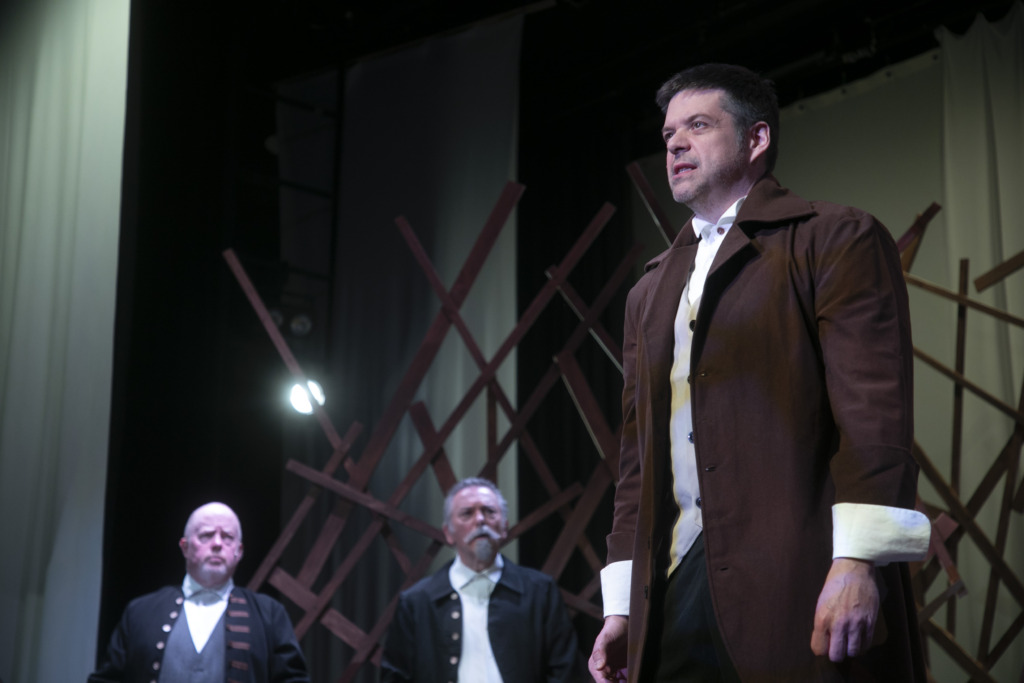
Mary Warren (Delaney Gregg) is the Proctor’s family servant. She deliciously waffles between good and bad, giving a performance within a performance that’s full of ups, downs and chock full of dramatics.
Reverend John Hale (Maxwell Wolf) is the minister called upon by Reverend Parris to address the debacle that is happening within Salem given his knowledge of witchcraft and probably one of my favorite characters. Wolf plays the good Reverend with sufficient reverence, promising to do what he was brought to do…investigate and assist with the charges; however, this is a man of principle and conviction. In Act 2 we see a definite about face as he becomes disillusioned with the trials and proceedings which appear designed to punish the innocent and reward those who lie, but at the expense of their reputation and standing. Wolf’s interpretation of the young minister teeters from objectively humble to sincere outrage and is well played. In the end he does try and save lives, giving in to his good human nature at the expense of his convictions. This tears at his soul and we can feel Wolf’s internal angst at the system.
Giles Corey (Nathan Rosen) is an older kindly man whose wife is also, you guessed it, accused of witchcraft. Giles’ character is based on a real person of the same name who also winds up meeting an unfortunate fate (listen closely, as it is told by Elizabeth Proctor towards the end). Rosen’s Giles is a hot-under-the-collar blowhard who is astonished at what is happening and one can’t help but like his fierce yet well founded outbursts. Even though we don’t see him that much, his brief scenes do make you care about him and his character, the mark of a good actor indeed.
Ezekiel Cheever (Judah Isaac Canizares) is the clerk of Salem’s General Court. He is the one who serves the warrants for arresting the suspected witches. Canizares’ ominous and forceful stage presence is matched only by the intensity of his voice. He quickly makes it known that he is a force to be reckoned with and is not playing around only by his line delivery and his smooth, deep, dramatic voice that would make late singer Barry White proud.
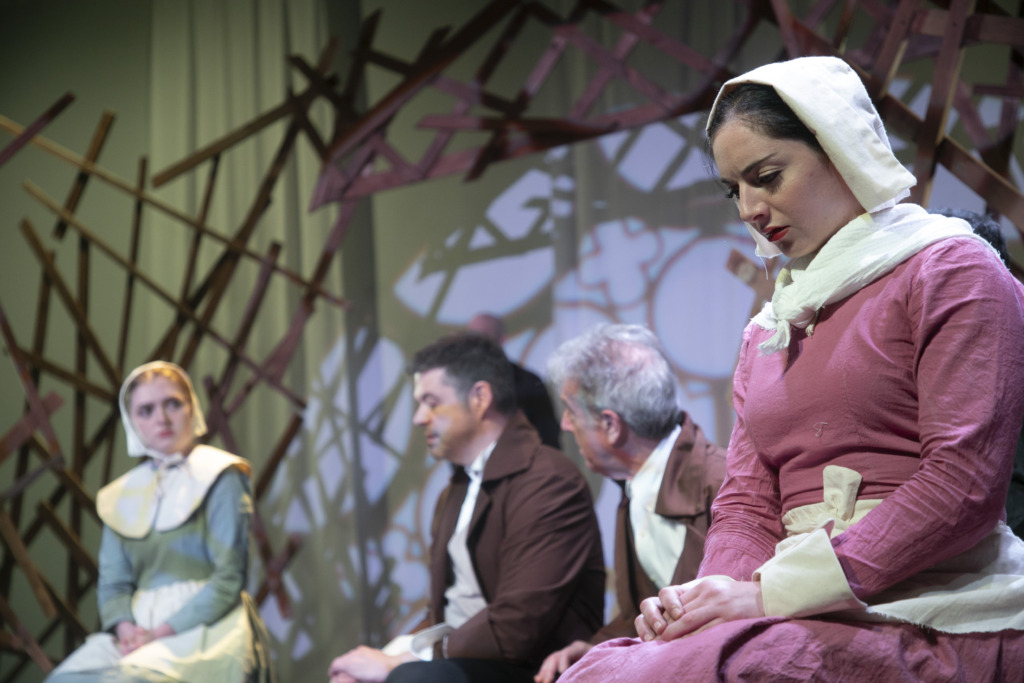
Judge John Hathorne (John Sheldon) is one of the two judges that hear the various cases of witchcraft brought before the court. Sheldon’s Hathorne is a curmudgeonly religious man who wants to find everyone in contempt. He does well as the judge who strongly believes in Abigail’s stories and Sheldon’s portrayal caused a few questioning headshakes in the audience on opening night, and for good cause. With judges like this in the world, what hope is there for justice? Sheldon’s one-track mind portrayal is precisely the kind of thinking that made this time in our nation’s history so disturbing, and which should cause a few headshakes even today.
Deputy Governor Danforth (J.R. Hontz) is the chief judge of the court, and it is said that Arthur Miller called him the true villain of the play. Full of muster and bluster, Hontz’s Danforth is a powerful force of steadfast conviction and is ready to convict those brought before him. Even if there is a shred of doubt as to the allegations brought, it’s as if Danforth wants to find something that may not be there but will do what he can to invent it if necessary if it means a conviction. Hontz is convincing and steadfast in his line delivery and intonation, and I must admit his character made me very uncomfortable at times when listening to his “logic” and I couldn’t help but put it into modern day context in my mind.
While I may not have noted everyone in this review, it is my sincere hope that those not given mention will not take any personal affront. To be sure, everyone in this cast did a great job and those not mentioned by name most definitely helped the flow of the production and added depth to the story.
So, while there’s still time, I urge you to leave your broom at home and come check out this classic tale which holds as much power today as it did when it was written. But don’t expect a story of witches and spells. Don’t expect to see on-stage hangings or anyone burned at the stake. This is powerful drama that will get you thinking. Cause you to reflect. Make you wonder how this could have happened and, most importantly, could this happen again?
Running Time: 3 hours with one intermission
The Crucible plays through October 26th 2025 Silhouette Stages at Slayton House Theatre in the Village of Wilde Lake Columbia— 10400 Cross Fox Lane in Columbia, MD. For tickets please call the box office at (410) 216-4499 or purchase them in advance online.