
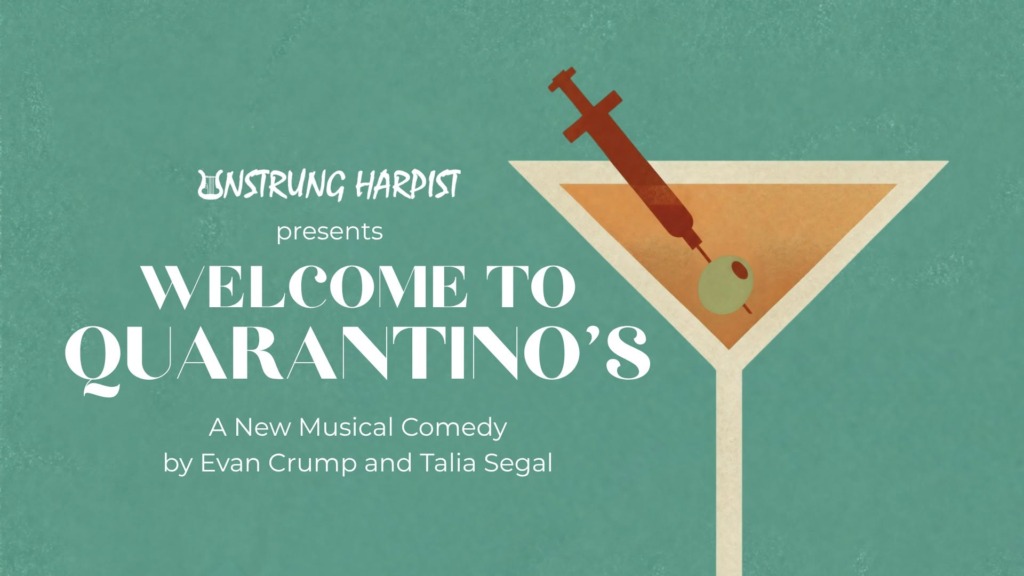
For me? It was the little dive bar— The Angle Inn— who was always pretty low attended, except on trivia nights and railroad-union worker meeting night, even before the lockdown so only allowing a limited number in at a time wasn’t ever really going to be an issue for them. That place that once the ‘small gatherings in public limited to X-number of people’ were allowed to happen…that sacred “third space” that wasn’t work and wasn’t home…the place we all still retreat to even on this side of the pandemic and certainly before the pandemic, without realizing that’s where we go when we need a safe place to be ourselves, unload, unwind, unburden, and just exist. Theatre is that for so many of us. And that topic— the sacred placement of the ‘third space’ especially during the lockdown of the Global Corona-Virus Pandemic— is exactly what this new musical Welcome to Quarantino’s sets out to explore. A new show written by Evan Crump and the late Talia Segal, self-described as “Last call meets lockdown in this irreverent, ridiculous, and unexpectedly heartfelt new musical comedy” is making its world premiere in Frederick this fall. In a TheatreBloom sit-down interview, we’ve picked the brain of Evan Crump and gotten an exclusive look at the show before it opens to the public.
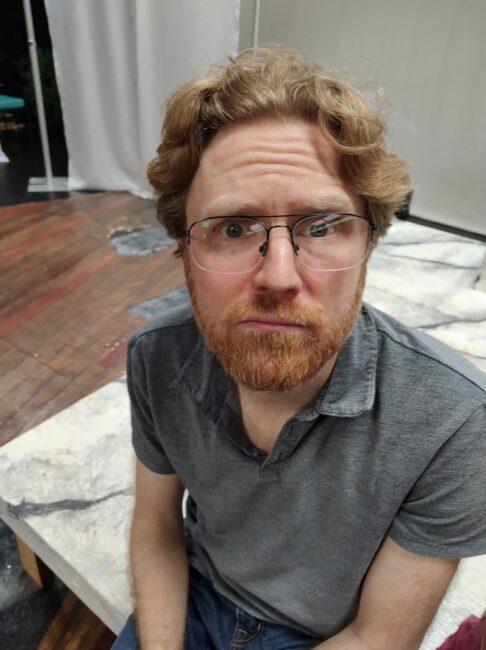
Thank you for sitting with us.
Evan Crump: Thank you for doing this.
Of course. So, you’re still Evan Crump, I’m certain that has not changed since I saw you as Benedick in Much Ado what feels like a moment ago but was actually a couple months ago. And the title is Welcome to Quarantino’s. Give us the two-line description of this new show without spoilers!
Evan: It’s set in the heart of the pandemic, in 2021. And Florentino’s is a COVID-casuality bar that is literally on its last night, about to close. This play is a musical comedy about the somewhat inept, somewhat incompetent but very heartfelt staff trying to navigate those troubled waters.
Where did the inspiration for this show come from?
Evan: It is very loosely based on a bar in my neighborhood that closed around that time. Really, it’s more like having a bar that I loved that closed gave me the idea to write a play about a bar that closed. None of the characters or the event is really related to the actual bar that closed. We were all so desperate for third spaces around that time. Places that weren’t work or home where we could see people and experience that social connection that’s so meaningful for humans. Especially if you work in theatre, I know we were all feeling it. That’s where we get a lot of our ‘third space’ is in the theatre world and that just wasn’t happening. Seeing that bar close as one of the few ‘third spaces’ that my wife and I could walk to and have our 45-minute, social-distanced experience at…it really drove home for me the importance of those third spaces. Not just during the pandemic, though that really made it obvious, but I think that more than being a play about the pandemic, this play is really about third spaces and how they’re disappearing and how important they are for us as humans in order to feel human.
What a beautiful observation and realization. Did you do the book and lyrics and music, how do you fit into the co-authored byline here other than being the genius idea propagator.
Evan: I co-wrote it with a dear friend, Talia Segal, who as you know passed away a little over a year ago.
I am so very sorry for your loss.
Evan: Thank you. She was the musician. I would send her poems and she would send me back songs. Sometimes they kind of resembled what I sent her. Sometimes they were so different that it really had a lot more to do with her than it did with me and that’s just fine! That’s how it should be. Talia was not only a musical theatre person but a very accomplished Indie musician in her own right. She had lots of albums and a decent amount of critical success. It was such a thrill to work with her. Life got in the way, and eventually her health got in the way of us ever trying to make this thing see the light of day. But when I was contacted about her Celebration of Life, which just happened two days ago*, as you know, we took that as a reason to finally give this play the real treatment that it deserved.
There are challenges with any show, but we were doing it with much less notice than one usually gets, so it’s been a fun ride but a challenging ride and it’s not over yet. We’re still figuring stuff out as we go.
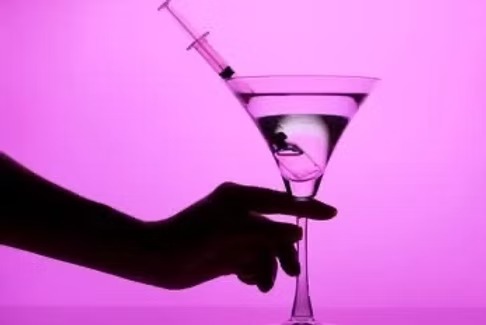
Of course. Now, when you set this idea down, did you always know it was going to be a musical or did that evolve as you started to work on it?
Evan: What I tend to do when I write is I get an idea and I sit on it for a few months and I see if it sticks. See if it percolates. The good stories are the ones that won’t leave your head until you get them on a page. This one wouldn’t leave. Somewhere along that way in those few months I got it in my head that this wants to be a musical. I didn’t know anything about writing musicals. I’d barely even been in them much less written any. I needed help. That’s why I reached out to Talia and said, “Hey. I got this crazy notion and we’re all just sitting around doing nothing anyway, do you have any interest in doing this?” Because we were writing it during the pandemic. And she was game! That’s kind of how it started.
I guess the idea of it being a musical came from me? But the actual making of it into a musical is very her.
Absolutely. But it’s nice to know that she must have believed in the project or had an interest to think it was going places, as you mentioned she had critical successes in her musical work as an Indie artist and theatre person.
Evan: You know what’s funny is I didn’t have word one on the page when I contacted her about it. I just had this idea.
I actually love that.
Evan: We had collaborated on some theatre stuff. She was very well-known in the Frederick theatre scene as well as some others but we actually first met because she was in my dissertation performance at George Washington University. And she was playing music in that, I learned about her music career, and I fired up Spotify for one of the three times I’ve ever done that in my life and listened to a bunch of her stuff. It was really more just the two of us working brains together. I would send her scene by scene by scene. I’d spend the night writing one, I’d send it to her, and she’d send me back some ideas. And I’d say “I think we need a song here and here’s what I think it might be” and then we’d work together to put it together. This went on and off for the course of eight months until we had a working draft. And then we did a couple of readings, just with friends to see how it worked. It continued to evolved. And it’s still continuing to evolve, even as we rehearse. This is a world premiere.
I am excited for a world-premiere of anything. I cannot tell you how refreshing it is to discover new work. And I will take a new work, even one that’s still evolving, over my 400th production of any one musical. How many characters are in this thing?
Evan: Well…it’s seven actors.
Seven actors? Why do I sense a but and or an explanation coming…
Evan: Yeah. So two of the actors we call them ‘Mansemble’ and ‘Femsemble.’ And they play several different characters each and that’s actually where part of the humor of the play comes from. They’re running on and off in different costumes, sometimes they’re even playing more than one character in the same scene. And we’re figuring out fun staging ways to make that work.
How funny! Weren’t we just talking about The 39 Steps before I started recording?
Evan: Yeah we were. And it sort of has a lot in common with that. I was in that show. Maybe that’s what gave me the idea! I was in another new play about ten years ago now called Play Date with Best Medicine Rep. That play is a two-hander, but they each play three characters and they’re constantly coming on and off as different people. I learned that there’s humor to be mined from having one person playing multiple people all at once. Gillian (area legend Gillian Shelley) is actually our Femsemble, which is probably the hardest role in the show. And we’re coming up with all these fun, crazy ideas for how she can be dragging herself around and talkin to herself and all these things.
This sounds like it’s going to be pretty phenomenal. It’s got Operation Mincemeat vibes, which as I may have told you, is one of my personal favorites— seen it four times on Broadway now, and it’s a 5-hander and each of the five play at least three main characters or more and watching them do those micro-flash quick changes is a hefty dose of the humor in that show. Now, are any of the characters based on you, Evan?
Evan: I’d say every character I’ve ever written is at least a little based on me? But there’s a couple that are more obvious than others. There’s one character, Shelby, he’s the sad-sack of the play.
Aww.
Evan: Well that’s not to say that I’m a sad-sack, well, maybe I’m a sad-sack, I don’t know. But Shelby is a professor who’s going for tenure and he’s very much mooning over Margaret, who is one of the other characters in the show. And he has a tendency to get passed over and ignored. He’s got a Charlie Brown quality to him. I think that his struggles to be recognized and respected and also his background in academia had something to do with me.
And then there’s Tad the bartender, who is sort of a mid-20’s-quarter life crisis-directionless, dropped-out-of-college type of person. That doesn’t quite fit me but I think he has a snarkyness and a desire to be the funny one and a desire to be taken seriously even though he’s a deeply unserious person. There’s a little bit of me in there too.
Okay! And you’re just directing and co-wrote this, you’re not in Welcome to Quarantino’s, are you?
Evan: No. I am not in the show. I don’t much care for being in a show that I’m directing. It’s enough. Especially when you’re producing, which I also am.
Oh right. Because this is an Unstrung Harpists show.
Evan: Yes, Unstrung Harpists.
You’re producing, directing, co-writing, and wearing all the hats.
Evan: Too many hats!
Hats are not a bad thing. You just need to grow another few heads to wear them all at once. Now, what would you say has been the biggest challenge in putting this whole thing together up to this point?
Evan: Without getting too inside baseball, you know that Frederick Shakespeare Festival was a pretty big endeavor for everyone involved. It kind of wiped out a lot of our potential staffing because they all wanted a break. Gillian was kind enough to continue with me on this journey but we kind of had to start from scratch with finding everybody else we wanted to work with.
So a lot of new faces?
Evan: A lot of new faces! And also, it’s a musical so it’s going to be new faces. And that is not a bad thing. But Frederick is a growing community scene. It still has a ways to go before it is thriving in terms of a theatre scene. It’s a little bit smaller of a talent pool. A lot of people don’t want to come up from DC or down from Baltimore. That was a challenge. And because of when we’re doing it— we’re up against Into The Woods at MET, and even though they’ll have closed by the time we open, they were in rehearsals and performance while we were. A lot of the talented musical folk who were involved with that were unable to come out for this, so that created a challenge.
But that’s the boring answer to your question.
I wouldn’t say boring. Technical or factual, but not boring.
Evan: The more interesting answer to what’s challenging about this is Talia’s passing left us with a lot of the music being half-finished. Well, that’s over-stating it, I think. What I mean is, she would be working with us right now to get everything up to speed and make sure the actors know what they’re doing. So what we ended up doing was reaching out to old friends of Talia’s in the musical theatre scene. We ended up getting the very talented Isabel Hernandez-Cata to be our Music Director. But she literally had surgery yesterday.
Oh my gosh! Is she okay?
Evan: She will be. She’s in recovery, but that’s just another challenge. So we’re cobbling together as we go. Staffing and personnel have been a real challenge for this show. And not least because we had to do it at this time because this was when the Celebration of Life was happening. We had to play without a full deck in terms of our musical backing because Talia is no longer with us. This sounds like complaining, and maybe it is— and again that’s not the interesting answer to the question.
Man. What is this interesting answer then?
Evan: The interesting answer really is that it’s always a challenge to bring new work to life. This challenge was multiplied by the fact that one of the main driving forces in bringing it to life is no longer with us. We have been trying, and I think succeeding admirably, in honoring her and honoring her work. But it’s more than just “let’s take this piece of work that’s finished and ready and put it on stage well.” Which is its own challenge but then to do that with something— this is literally the first time and you’re figuring out how things need to go…it’s a really interesting and meaningful challenge.
Of course. Would you say any of the characters in the show have either been molded around or evolved into representations of Talia?
Evan: I’m sure that’s true. You know there’s the character of Margaret, who I mentioned before, and she’s kind of crunchy-granola, very sensitive, very empathetic. Talia is one of the brightest pennies in the fountain, but she was also an extreme empath and so kind and thoughtful and giving of herself. I think there’s a lot of that in Margaret.
That’s really sweet. What is it that you are hoping people are going to take away from this unique, new, musical theatre experience?
Evan: Besides getting a bunch of earworms that stick with you for the next few days…Lord knows I fall asleep and wake up every day now with songs from the show in my head! And that’s not a bad thing. They just stick with you. But that’s not the real answer…the real answer is— I think that it’s easy to get caught up thinking about the ‘what’ of our lives and forget about the ‘why’ of our lives. I think that maybe for some of us, I think for many of us, the Pandemic helped with that in a way. It helped us really drill down on what matters to us. What’s just window dressing and what can’t we live without? The biggest theme, one of the main themes I was hoping to explore with this play was that idea of ‘third spaces’ and that idea of ‘why are we so important to each other?’ and ‘how can we be there for each other when life is making it really hard to do that?’ And life has a way of always making it hard to do that. But the Pandemic was especially so. If there’s one thing I would hope the audience would come away thinking or come away thinking about its “what’s my third space? What are the things that I need and the people that I need around me in order to be my full self?”
That is so brilliantly spoken and I think that is something we should all contemplate. And I do hope that this show helps people think about that. Is there musical number or a moment in the show that speaks to you and really defines what this project has meant for you?
Evan: Yeah. There’s a song towards the end of the show where a character who has had very little to say up until that point, suddenly reveals that they’ve been paying a lot of attention to everything that’s been going on. And they help some of the other characters realize something they’ve been missing about each other. I’m trying not to get too far into spoiler territory here. I think that song in particular resonates with me because sometimes it’s the quiet ones who have their eyes the widest open. Listening is important. They teach you that in acting school. It doesn’t always take. We all felt lonely during the Pandemic. But a big part of the reason that we all felt lonely wasn’t just that people weren’t there for us but we weren’t able to be there for people. And I think that’s what that song encapsulates for me.
Oh that sound truly lovely and I’m in love with it without even having heard it yet. Now, is this a dancey show? Will there be dancing?
Evan: There will be some. There’s one song in particular called “Tango of Plagues” and Gillian is doing some choreography for it. The first time we did a read through of this show, one of the people at the reading was very adamant— “this isn’t a musical. This is a play with music.” And I said, “I’m sure that’s a distinction that means something to someone.” I think if you’re looking for Ragtime or Chicago or something like that, this isn’t that. This is a play where people sing when the words don’t come out right any other way.
This is going to be much more along the lines of Murder Ballad or maybe Next To Normal where there’s a story being told and songs are used as a vessel to help carry the story?
Evan: I think yes but I also think that the songs do their own thing? Some of them are more story songs and some of them kind of do stand on their own in addition to helping serve the story and the characters. It’s sort of a hybrid in that way. But back to your initial question about dance, there will be some of that. There will certainly also be some stylized movement but that’s not a huge focus for this show.
Got it. Why do you want people to come to The Black Box here at Hood College and support your new work? Other than the coverall reason of “we should be supporting new, independent works”?
Evan: I really do think that this play has a ton of heart and a lot of humor and I think that it’s an important thing to find the joy and humor in an event that by all objective standards was pretty bad and pretty terrible for everybody. Nobody wanted the pandemic to happen. But artists find silver linings in things. They take the things that suck and they turn them into something beautiful. I’m not trying to toot my own horn and say “you must see this beautiful production” but I do think that we’re all putting together, as a collective unit of actors and directors and designers is going to be something beautiful. There’s a line in the show where a daughter is talking to their father about their departed mother and says “you took all that pain and used it to build something.” I think good art takes not just pain but takes from all aspects of our lives, the good, the bad, and the ugly, and it uses it to build something that we then share with others so we can all have that human experience of “I recognize that, I see that, I know what that is.” That’s what we were all missing during the pandemic in many ways. Maybe this play is an opportunity to revisit that feeling but without all the pain that came along with it. Just to remind ourselves that maybe it’s not all bad, maybe some good came out of it after all, and certainly some good is coming out of not being in it now.
I agree with that 100%. You just mentioned you’ve got designers! Who is doing your set?
Evan: Oh Aaron. (Artistic Co-Director of Ardeo Theatre Company Aaron Angello) This is a little inside baseball here, but they’re doing their school production of Romeo & Juliet, it closes, and we go into tech a day later, so we have almost no time to put our set in. It’ll probably work out. And we’re also not aiming for a super representative set or anything. It’s going to be more of a “you know it’s a bar because they tell you it’s a bar” kind of thing.
There’s nothing wrong with that.
Evan: Look, I cut my teeth on the bare stages of the American Shakespeare Center so I’m all about non-representative staging.
I feel like we’re back in Our Town, for those of you who need scenery, here’s two chairs and fence…but seriously, if you can pull off what you’re aiming for without excessive scenery, that means you have a solid story. Audiences will suspend their disbelief and engage with you if the story is solid.
Evan: We’ll have enough that you’ll know what you’re looking at but that’s not the focus of the show. We’re really trying to make it more centered around the humans who are on the stage.
Excellent. If you were not directing the show, and you were to put yourself into one of the roles in the show, who would you be?
Evan: I think I’ve probably aged out of Tad—
Oh here we go again with the aging!
Evan: Look, this is Aaron’s fault, he put that thought in my head and now it won’t leave. But I would definitely play Tad. I think he’s the character that I am best suited to play on the stage. Although, frankly, though I can carry a tune, I wouldn’t call myself a triple threat or anything. So I’m not sure…
I mean, you also claimed you couldn’t dance, and I witnessed first hand that that’s not exactly true…
Evan: I can…be coached into most things. I take more coaching than some.
I think if you can get the result at the end of the day, regardless of how much coaching is needed, I would say that makes you qualified.
Evan: The people that we’re working with in this show have not required a lot of coaching to get where they need to get, they’re all amazing.
Hooray! This sounds like it’s going to be awesome. Did I tick all the boxes?
Evan: Well, there’s one thing we haven’t really talked about and that’s that there are some absurdist elements in this show.
Oh! Yes! How silly of me. Let me ask about the absurdity component of your Quarantine-Pandemic-Bar-Musical.
Evan: Ha! So there is a character who thinks that they’re an extra on a set… either a theatre or a film set and they break the fourth wall a lot to talk about that fact. There’s a lot of references to a jukebox but it will actually be a live band that will be performing alongside the actors.
That’s very cool. Does the band have a name?
Evan: They don’t yet! Maybe they will by the time that we open. There’s a lot of little things like that. There’s an overzealous health department inspector who has his own G.I. Joe-style theme song. He’s played by Mike Harris.
Are there components of magical realism?
Evan: Maybe a little bit? You could say that’s what it is…but I think it’s more, especially with the Femsemble and Mansemble characters, they tend to be a little more ‘out there’ and a little more ‘pushing against the fourth wall’ for the audience. But the other characters more or less take it in stride and are more or less within the world of the play.
Very cool. You mentioned Gillian is your Femsemble. Who’s your Mansemble actor?
Evan: That’s Mike Harris.
I like the idea of absurdist and magical nonsense.
Evan: The absurdity is almost always for comic effect in this show. We’re not trying to spook anybody. We’re trying to get you to laugh at the inanity of things.
Would you say that this balances on a 50/50 scale? You’ll have all the laughs but there’s also some heart or choked-up moments?
Evan: Yeah, I think there’s some bittersweetness. Just the idea of endings and beginnings is a big theme in the show. If you come to care about these characters, I think there will be some moments where there might be a little mistiness. There certainly is for me.
True. You’ve also birthed these characters and/or married them/become them, so I would hope so for you.
Evan: It’s comedy with heart. It’s like M*A*S*H*. Maybe a little bit of that vibe. Without too many spoilers, I would say the ending has more of those heartfelt moments than the beginning.
Now you said you lost an actual bar in your neighborhood during the pandemic?
Evan: Yeah, shout out to Wine Harvest Park Potomac. I mean there were others, even then, that we rotated through during that time but that was the one where literally everybody knew us and we were like friends outside of that bar world. It was one of the first places to re-open after the pandemic hit. Technically you were only supposed to be in for a half hour or whatever but they would always let us stay a little longer because they knew us. So it was really a blow to us when it closed. It gave me a little bit of perspective on what that feels like and what that means to have something like that taken away. To have to reconcile with that. It’s like losing a person that’s close to you. And its weird to say when I’m talking about a play that I wrote with somebody who is no longer with us. There are these moments that give life clarity, for better or for worse, right? Losing somebody or experiencing those kind of hardships but it’s also a time that we can really use to come together. I think that the pandemic made us realize that we’re not all that different. Many people have since forgotten that message or its gotten buried under a lot of other stuff. But there’s a lot more that makes us similar than what makes us different.
Yeah. It was all very fresh, those of us fortunate enough to survive the pandemic. We all had that “we’re going to cherish each and every moment and live life differently now that we’ve experienced what that was like.” But then time passes, the feeling and the memory of what that was like fades and you go back to the routine.
Evan: Well that’s one thing that theatre and other arts can help us do. Revisit those moments and make sure they stay alive in us. I hope this play does that a little bit.
I hope so too. You said the bar is called Florentino’s. Does Florentino’s have a signature drink?
Evan: It’s funny that you ask! They are sort of forced to invent one out of whatever’s left over at the end of the night after a lot of it gets taken away. I believe the three main ingredients are Cinnamon Schnapps, Sloe Gin, and Kahlua.
Excuse me a moment, I think I just threw up in my mouth a little bit. That sounds like something us desperate college kids would do when we’d get back to the dorms after a bender around town! BLECH!
Evan: There are a lot of references to it being not particularly palatable.
Sounds like it! What is the one thing that working on this project has taught you about yourself? What’s your big takeaway here?
Evan: There’s a line in one of the songs that’s repeated several times: “Where we are is who we are.” And I have always been of the belief that it doesn’t so much matter where you are, it matters who you’re with. I proved to myself by writing this play and making this play about those kinds of ‘third spaces’ that if there’s one thing in my life that I need just to feel like myself and to feel like a functional human, it’s to be around people that I love, doing things that I love. That’s why theatre has been such a godsend for me.
I feel that on a visceral level. Theatre is a very, very important part of my life. When the pandemic shut everything down, not only did I lose all of the theatre I was seeing, reviewing, and supporting, but the acting company I run with was also shuttered, and all the shows we had in production just vanished. I remember vividly that harrowing feeling of “will we ever get this back?” I am so grateful that we did.
Evan: Yeah, a lot of theatres never made it back after COVID. A lot of places where I used to work all the time.
I know. A lot of the smaller professional ‘DIY-scene’ theatres in Baltimore died with the pandemic. It was a thriving scene coming into 2019 and 2020. They were very much like Unstrung Harpists, doing innovative, new, intriguing works, small-stipend, professional quality— and they just got wiped out.
Evan: It’s starting to claw its way back, I think.
It is trying. Baltimore has unique challenges but it’s not giving up. I remain ever hopeful that it will recover itself, thrive, and bloom again. Now— the final question, which I swear you must be used to by now…if you had to sum up your total experience of working on Welcome to Quarantino’s using just one word, which word do you use?
Evan: I’m going to cheat and use two: Productive Chaos.
I’ll hyphenate it for you. “Productive-Chaos.”
Welcome to Quarantino’s plays October 30th to November 8th 2026 with Unstrung Harpists at the Black Box Theatre of Tatem Arts Center at Hood College— 410 Hood College Drive in Frederick, MD. All performances are Pay-What-You-Can and tickets are available at the door or in advance online.
SEATING IS LIMITED. ADVANCED BOOKING IS STRONGLY RECOMMENDED.
*this interview was conducted on Tuesday October 6th 2026. The Celebration of Life for Talia Segal was held on Sunday October 5th 2026
Related posts:
 Speak Low If You Speak Love: A Round-Robin Interview with Ardeo Theatre Company’s Much Ado About Nothing Folk
 While You Live Tell Truth and Shame The Devil: An Interview with Evan Crump and Aaron Angello {mostly} on Henry IV Pt1 (and also a lil Much Ado)
 All O’ Frederick’s A Stage: And Unstrung Harpist, ESP, and Ardeo its Players
 Much Ado About Nothing at Ardeo Theatre Company