This story begins with a spark. A spark of light. A spark of life. A spark of humanity. Truly, an electrifying retelling of the iconic monster novel, now such a smashing success on stage that it’s already received it’s first extension before officially being open. Chesapeake Shakespeare Company jolts their 2026/2027 to thrillifying life with Mary Shelley’s Frankestein, by David Catlin, directed by Ian Gallanar and Lizzi Albert. This devilishly delicious sweet treat is the perfect pop of terrifying thriller to start spooky season on the right foot. Endlessly compelling with a sensational cast of five actors, the narrative exploration of creator and creature unfolds before your very eyes with remarkable expressivity, felicitous cheek and humor, and enough pulsating moments of heart and despair to twist you up inside just in time for Halloween.
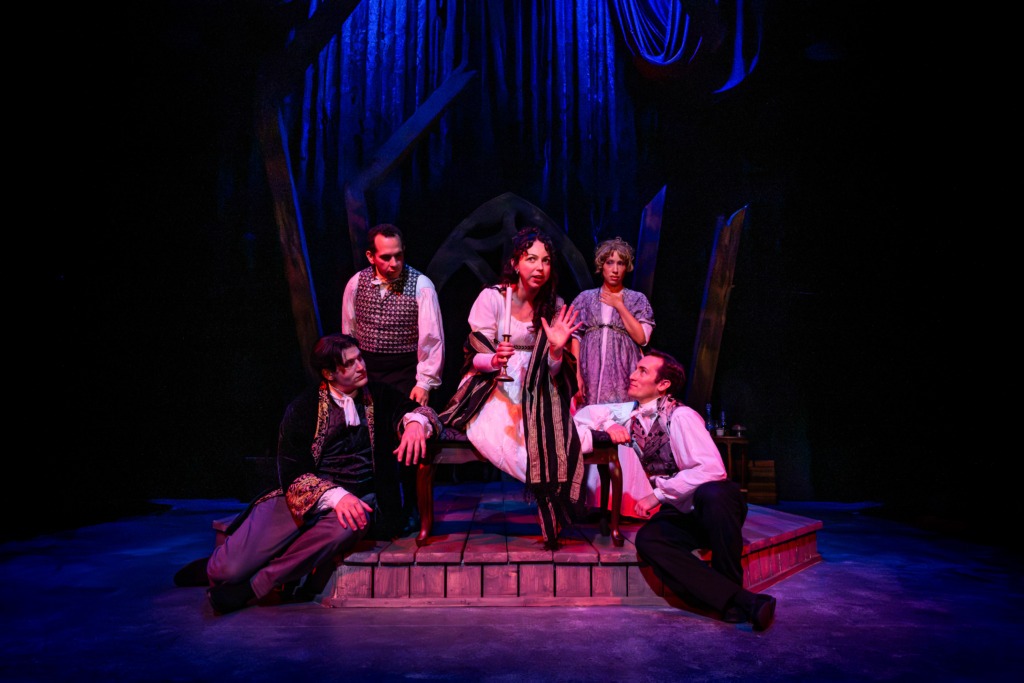
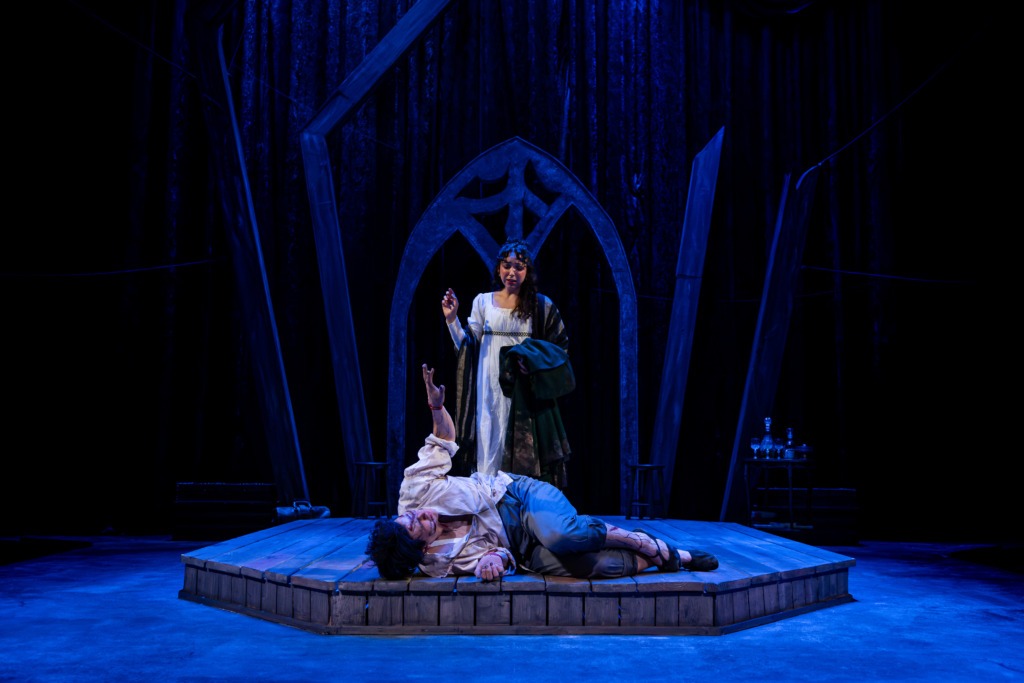
The show’s creative team has polished up the proverbial lighting rod and is attracting that mysticism of living, breathing theatre in their endeavors; the show’s lighting and sound effects alone are intricate and meticulously plotted (and at this performance, cued and executed with flawless precision by board-op Andi Pfluger) creating not only a stunning atmosphere but something of a sixth presence in the realm of the play. There are five actors, one exquisite puppet— a theme as of late that CSC has glommed onto and its working well in their favor— and this entity of audio-aural-essence. Sound Designer Adam Mendelson and Lighting Designer Katie McCreary, under the Technical Direction of Dan O’Brien, have fabricated wonders in their respective design work. Sebastian Sachs, credited as ‘light hang assistant’, is owed a nod of praise and thanks for the artistry that are arteries of lightning-veins that run around the balcony edges of the house. It makes for fabulous effects when those pulsating moments of life and light come into play. McCreary utilizes darkness and light in equal measure to create stunning visual effects, often paired with garish gashes of ghoulish green or that putrescence of chartreuse that bleeds up from below when the Creature is first exposed, which becomes a creation all its own throughout the performance. The top of Act II has McCreary’s flashes of dark-out and light, in time with action and the frenetic, omnipresent heart-throb of Mendelson’s sound design to create this notion of ‘Blinking through the Creature’s POV’ or perhaps a silent observer watching the Creature’s experience. It’s all very exhilarating and set the pulse racing, the butt to the edge of the seat, and the chest heaving slightly with sincere anticipation. Mendelson also deserves praises for his work with storm and ice effects, really drawing the audience into the experience in a wholistic fashion.
The way the lights are hung and strung impact the set sublimely. Set Designer Shartoya R. Jn. Baptiste has left a deceptively simple stage in play, though makes striking use of the ‘under-space’ with the pop-up door. The versatility of that door— as grave, as cavernous space for Frankenstein’s experimentation— is as eerie as it is wondrous strange. And the hidden catacombs backdrop with the corpse parts intricately woven in and subtly sticking out sets the tone for those moments when Frankenstein is frothing over his work. The scenery twists naturally into the show’s overall technical and creative design, augmenting the atmospheric experience tenfold.
Kristina Lambdin is always producing exquisite work when it comes to fabricating a sartorial selection for whatever’s crawling onto the stage at Chesapeake Shakespeare and her work with Mary Shelley’s Frankenstein is no exception. Paired in tandem with Hair, Wig, and Makeup Designer Hannah Brill, the overall timeless and simultaneously time-specific stamp that threads its way through these costumes is remarkable. Though it’s winged-Death and the makeup effects on the Creature that truly provoke sensations among the audience. The detailing alone in Brill’s stitch-work on the Creature’s limbs and the mask and prosthetics used to amalgamate his frightening look are sublime.
Properties Artisan Mika Nakano and Puppet Designer Chris Reuther are also making miracles in their respective design departments, with Reuther’s work being most noteworthy because of the ‘Companion.’ The rudimentary design and yet grace with which that puppet is assembled and then activated speaks volumes of its potential and its relation to the story as a whole; it’s mesmerizing to look on, particularly in the way the head and face are fabricated. And while there’s no particular ‘fighting’ with said puppet, when that particular entity meets its maker and its end, there is a fluidity with which such occurs, and that should be chalked up to Fight and Intimacy Choreographer Mel Gabel. There is a great deal of bashing and violence, it is a terrifying tale, after all, that happens in sequences throughout and Gabel does an exceptional job of making it look believable, even when it’s slow-motion attacks and strangulations.
If there’s a hitch in the production its Director Ian Gallanar’s choice for the overriding dialects that dominate the performance. While Dialect Coach David Norris does a decent enough job in assuring that all five performers deliver this choice, of what sounds firmly like RP (received pronunciation) of the time of Mary & Percy Shelley, it just creates a sense of mild confusion for the show as a whole. It starts in Italy at a house party for the evening with English writers who then tell the story in Switzerland and all the travels therein, but we never get accents of differing characters (with the mild exception of Joshua Williams when he adapts at thick German accent to be a momentary Professor and when Fabiolla Da Silva is first introduced in the meta-story as ‘Elizabetha Lavenza’ you get a hint of her Italian sound.) Clearly this assembled team of five have the skillset and capability to do various accents to showcase regions and this could have helped to create clarity, especially as some of the RP-pushes in certain instances sounded a bit muddled. But if the largest complaint about a professional production at this caliber is that the ‘wrong standard accent’ was used and it wasn’t as strong of a choice as it could have been, then the production and the company are well in the clear.
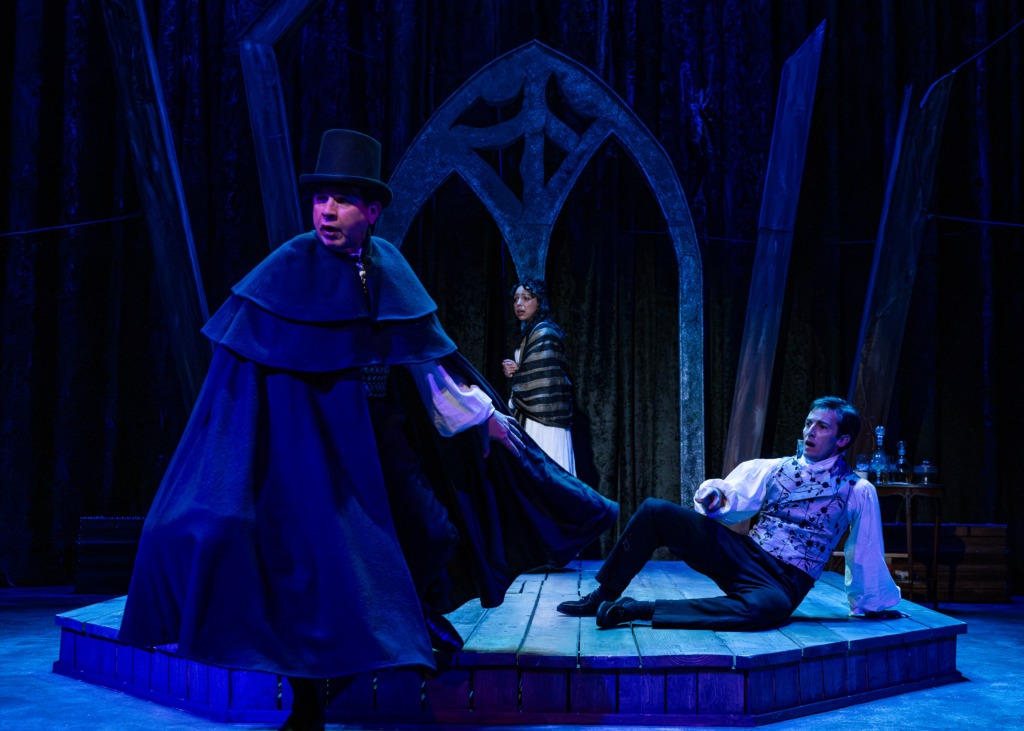
The play itself is a fascinating restructuring of Frankenstein because it highlights Mary Shelley as the true master of all tales. Playwright David Catlin starts the audience off at a house party in dreary November, circa 1816, where the humor and the cheekiness are in full swing with Percy Shelley and the then Mary Godwin, Lord Byron, Dr. Polidori, and Claire Clairmont, Mary’s pregnant stepsister. There’s flirtations and teasing and general camaraderie that set the good-humored natures of the play in motion, quickly followed by this notion that Mary will join in the men and their little ‘ghost-story-telling’ contest with one of her own. And thus begins the play within the play…within the play. True to form, Frankenstein is rescued from the ice in the Arctic and then it is his retelling of what’s brought him there, but being retold as Mary Godwin tells this idea. And despite the potential confusion, it reads flawlessly as the transitions from live-time to story-within-a-story glide in and out of one another, seamlessly throughout the evening. This is largely due to the seasoned expertise with which Directors Ian Gallanar and Lizzi Albert approach the script.
Gallanar and Albert are the quintessential dream-team when it comes to directing this production. Their use of the space— particularly when pulling characters up through the house— is exacting, each movement carefully placed and guided to elicit a specific sensation or feeling from the audience as they experience she show. Staging the Elizabeth Lavenza character up in the house-right balcony to deliver her wistful letters to here dear ‘more-than-brother’ Victor is as clever as having the Mother-Ghost character glide down the balcony to its edge, house-left whenever she is making that type of appearance. There is a sense of frenetic urgency that builds once the narrative storytelling gets underway, which creates a striking comparison when juxtaposed against the causal ease of the evening’s start in Lord Byron’s place. Gallanar and Albert create this enigmatic sense of suspense all throughout the performance; it’s frightening but not in a jump-scare sort of fashion. It is a fascinating journey from start to finish and the harrowing ending is a blindsiding shock that seeps in from nowhere like a fog to overcome the night yet feels so wholly natural that its spine-tingling with finality.
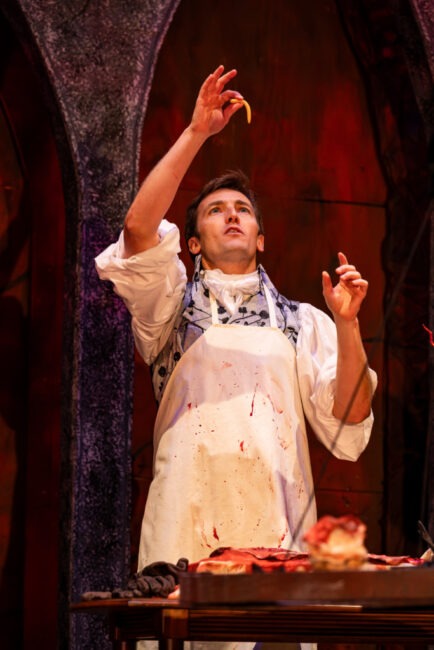
This cordon of five— Jose O. Guzman, Joshua Williams, Dawn Thomas Reidy, Fabiolla Da Silva, Vince Eisenson— play off one another with miraculous perfection; a high-voltage experience of connectivity, synchronicity, and theatrical excellence. The sense of warm companionship, tender care, camaraderie, love, and connection is all heavily palpable when you first meet this five as their historical-exterior characters— Dr. Polidori, Lord Byron, Claire Clairmont, Mary Wollstonecraft Godwin, and Percy Shelley, respectively— which sets up a glorious contrast to the lack of those very elements between Creature and Creator once the story’s story gets underway. There’s clever writing happening in their exchanges there as well, particularly when they continue to refer to both Byron and Shelley as monsters, as they respectively become The Creature and Victor Frankenstein, which does beg that brilliant questions— what makes a monster and what makes a man, as the lines are hardly discernable a times, particularly when hubris comes into play.
All five of these sensational actors possess an amplified level of animation. You see that most notably in Jose O. Guzman’s performance when he starts off as the eager Dr. Polidori, ready to engage with Mary’s story, diving in both as Walton and Henry, eager and enthusiastic. There’s an intensity to Guzman’s stage presence that never truly dissipates, even when his various characters are existing in moments of sincerity, somberness, or stillness; that’s a fascinating experience to behold. Of course he’s fit to bursting with vivacity at the prospects of ‘making merry’ with his dear friend Victor Frankenstein and much of what’s so captivating to watch about his performance is the way he moves across the space, fully conscience of the way his character absorbs or shrinks from the space it occupies.
Dawn Thomas Reidy, initially as Claire Clairmont, presents the audience with a plethora of amusing moments, particularly when she’s being insistent as the Claire character. That petulant “I want to play too!” moment early in the production is just a delightful stroke of humor that stokes the fires of the scene, really priming the audience for the theatrical mesmerism in which they are about to partake. Reidy’s in-story character span a broad range from maternal comfort as the actual Frankenstein mother, to the harrowing and looming angel of death, all of which feature precision movements, be they tender touches from mother or that slow, ominous path-sweeping as Death. Though truly, the personal favorite is the micro-moment she spends as ‘Wilmouse’ in the field; it’s charming and yet tragic.
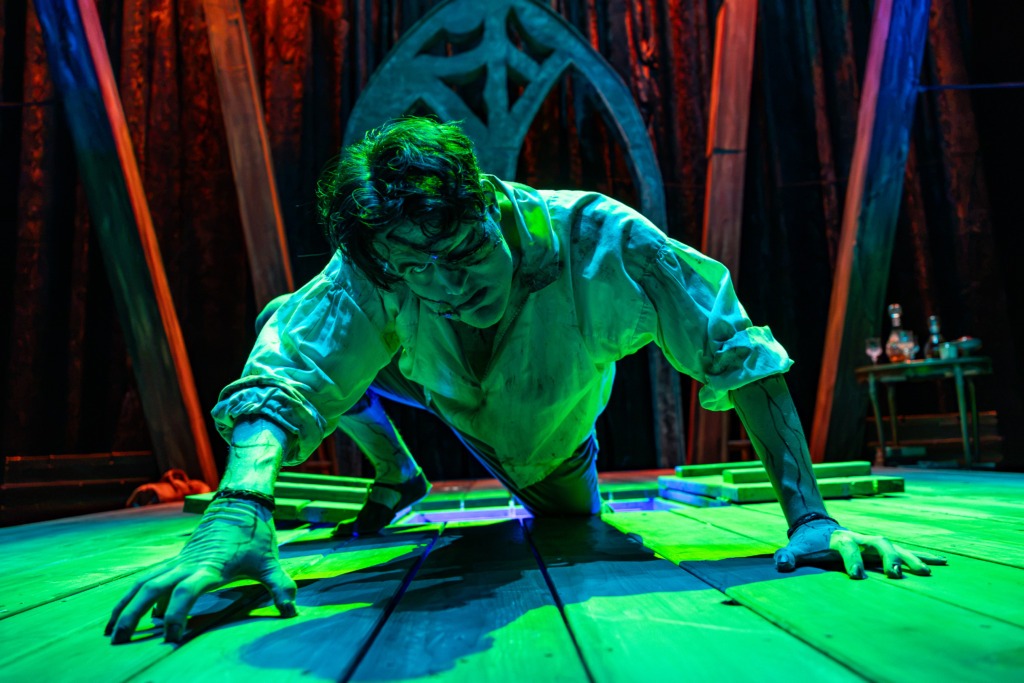
As Lord Byron, you nearly want to throttle Joshua Williams for all of his nonsense— particularly when he overly exaggerates his corpse antics rising up with the ‘it’s aliiiiive’ very, very early on. It’s hilarious in that ornery sort of way reserved for spoiled attention-seeking fiends. As the Creature, your heart bleeds for Williams and the sheer humanity with which he creates inside this ‘monster.’ The effortless physicality involved when he is first ‘raised up’ from the laboratory hole is fascinating; he looks weightless and almost as if he’s in suspended animation (it’s a glorious theatrical trick and effect to marvel over, even if it is just Williams limpening his body and popping up with precision timing.) There is a delightful discomfort that slinks down the spine whenever you catch sight of Williams creeping and skulking about as The Creature, particularly when he slinks up from within the house, watching, waiting, ready to strike. There is a powerful, all-consuming moment that takes place inside and outside of the ‘cottage’ with William’s Creature and Guzman as the ‘Blind Hermit.’ That entire scenic series is gut-wrenching; the extraordinary tenderness and humane compassion exchanged between the pair of them, followed swiftly by the brutality, scorn and rection from Felix (Eisenson) as he bashes upon the creature, immediately consumed thereafter with this show-stopping moment of fury and release. Watching Williams scream to the moon the agony, despair, and overall expressions of his inconsolable grief— ‘…I wanted to inflict pain on that which inflicted such pain on me…but I chose not to…’ is such a spellbinding moment that both cleaves the heart in twain and draws forth tears of compassion and empathy, it’s phenomenal. Joshua Williams’ performance as Creature sears your soul, particularly with that desperate decry of ‘my heart yearns to be loved’ an all too relatable condition of human nature.
Much of Williams’ interactions are the constant engagement with his Creator, Victor Frankenstein, played by the versatilely sensational Vince Eisenson. Watching their dynamic warp and distort and mutate is a masterclass in suspenseful stage thrillers. As the teasing but doting Percy Byshee Shelley, Eisenson draws a drastic distinction between that character and the Victor Frankenstein character, who readily and very quickly takes an affinity for live-spark-discovery and allows it to fester into an all-consuming obsession. Everything about Eisenson shifts— there is a spark and you watch it happen— triggered by a very specific event— his vocals, his physicality, the way he glances around, the slight twitch in his hands. From curious and passionate to engrossed, infatuated, wholly engulfed with this determined madness; it’s truly the mark of where the origins of fictious ‘mad scientists’ stem from liberally incarnate in Eisenson’s portrayal. There’s a perpetual fever dream essence to his stage presence, which snaps immediately into this oddly tender compassion whenever Eisenson goes from Victor in-story back to being Percy Shelley in live-time. And even when he becomes Shelley, that undercurrent of pulsation is present. There are moments when Adam Mendelson’s pulsing SFX-heartbeat that can be heard steadily and readily throughout the theatre appear to match Vince Eisenson’s very pulse, gently thrumming in his neck, propelling his movements through the play space. It’s titillating and terrifying all at once; a curious hybrid of performance if ever there was one, which makes for the ultimate storytelling experience.
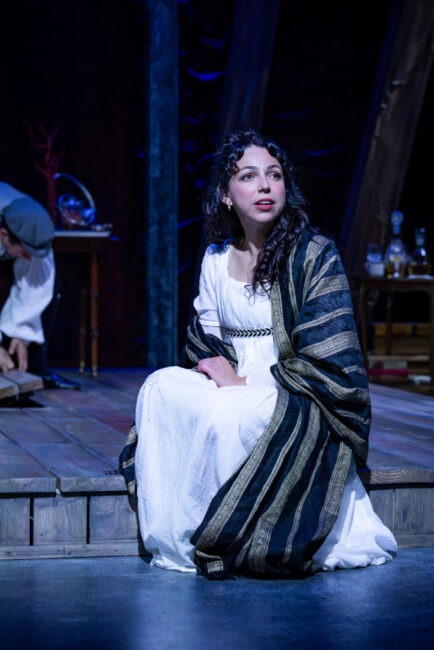
When Fabiolla Da Silva first begins the tale of the tale, as Mary Godwin starting in on the description, the cells in your being seize up— half in intrigue half in unsettling revulsion. The way in which she carefully glides over that first description of putrefaction, painting a grotesque image that is as lively as she is standing there reciting it, is the true catalyst for the evening’s experience. There is a becalmed mercurial maelstrom ever so gingerly unsettling itself inside of Da Silva, oozing out slowly in her storytelling, seeping out carefully in her speech patterns, cadence, and patois. This is not a reckoning storm, but rather one that inches in slowly, filling the stage with emotional fog and perceptive tension, one intricate layer at a time until you find that you’re in the center of this glorious tale with no means of escape, all superbly spun into existence by one woman. Da Silva is exquisite as Elizabeth Lavenza, of that there is no doubt, playing the ingenue type to perfection. But its her presence as narrative harbinger that has the audience hanging on her every word. And in those moments where she breaks from the tale, returning to herself as Mary Godwin— particularly in terse moments with Eisenson’s Percy Shelley— that your heart skips a beat, carried only by the ever-present pulsing sound that exists within the theatre. As the dawning realization of exactly what she’s telling unfolds (and is ultimately revealed at the end) on readily finds oneself blissfully lost in the sensationalistic experience of her retelling. Da Silva is a storytelling tour du force and will captivate you from her first word to her final breath.
It’s an extraordinary work of art (accents notwithstanding though they are serviceable and intelligible if not the most fluid or effective choice for this production) and is selling quickly. It’s the must-see of spooky season with five of CSC’s finest company members on stage, bearing up the torch of this narrative experience in all its flaming glory. Do not miss your chance to feel the life, see the spark, and explore the raw human nature of creation and creator, in every sense of the phrase, at Chesapeake Shakespeare Company this fall with their season opener, Mary Shelley’s Frankenstein.
Running Time: 2 hours with one intermission
Mary Shelley’s Frankenstein is now EXTENDED through November 8th 2026 Chesapeake Shakespeare Company— 7 S. Calvert Street in Baltimore, MD. Tickets a, re available by calling the box office at 410-244-8570 or purchasing them in advance online.
To read the interview with Vince Eisenson on playing Victor Frankenstein, click here.