
Death is fairer than life; it comes for everybody and does not discriminate. ‘Everybody got a time coming. Can’t nobody say they ain’t got a time coming.’ We all live on borrowed time from the start of our existence; nobody is getting out alive. On a play that opens with its conclusion in plain sight, driving you back through the events of how it ended up that way, August Wilson’s Seven Guitars is a harrowingly beautiful theatrical experience, currently happening at Spotlighters Theatre as a part of the larger, multi-year city-wide Baltimore August Wilson Celebration. Directed by Benjamin Isaiah Black, Seven Guitars is chronologically the fifth of ten plays in August Wilson’s American Century Cycle, appearing right in the center of the city-wide celebration. It is also completely and utterly sold out for the entirety of its run (please see ticketing potential-options at the bottom of this review.)

The set is simple; Justin Nepomuceno tackles the load-bearing columns that are the eternal challenge of the Spots’ postage-stamp stage by transforming them into the bricked exterior of this backyard/courtyard/alleyway behind a tenement house in Pittsburgh’s Hill District. There are doors and windows, respectively that lead into said tenement house, and a garden box; a picnic table, and that’s a wrap on the set. But Nepomuceno understands the simplicity of this show’s scenery; nothing overcomplicated because the story itself is the beauty, is the scenery, is the magic. Accentuated by the lighting design of Jaeden Arrington, Nepomuceno’s set is minimal but in an exceptionally functional fashion, one that truly serves the production exquisitely.
Costume Designer Wendy Snow Walker follows Nepomuceno’s lead when it comes to minimalistic simplicity; the costumes are befitting the era— no frills or fuss. Except for that moment when everyone is dressed for The Blue Goose, at which time the show’s sartorial selection is elevated to sophisticated splendor. The earthy, muted tones of the dresses on the ladies and on the daywear of the fellas reflect well the working class nature of the characters. Add to the show’s aesthetic a simplistic sound design (by way of Lorenzo Millan….though one does wonder why there’s mooing in that rooster-chaos scene when Mrs. Tillery lives in a tenement house in the Pittsburgh Hill District…not a countryside barn…) with plucked guitar blues between scenes and you’ve got the perfect setup for divine actors to perform the extraordinary work and words of August Wilson.
Wilson’s work is lengthy; there’s no getting around that. And that’s not to complain on the running time— but modern audiences should be aware what they’re investing themselves into, as society on the whole seems to struggle with more than ~90 minutes separation from their screentime. The show’s pacing is sublime. Stage Manager Steven Zhu (with run crew Alyssa Stambraugh) keeps the scene changes so swift you hardly notice them happening. (And that’s saying something as there’s nine different scenes in the second act.) But ultimately you don’t notice you’ve hit the hour and a half marker at the intermission until you check your time piece. The pacing is that tight, the acting is that good, the story is that engaging.
Director Benjamin Isaiah Black enchants the audience with this extraordinary tale. With a stellar cast of seven and a story that hits both dynamically and emotionally, Black’s work is beyond praiseworthy. There’s a moment, somewhere early in the second act, where the Hedley character confesses that he doesn’t like what he sees in the world, that people are too small— there’s something about the way the actor is directed and the way the actor delivers that line which is truly haunting. It’s a line from a play that takes place in 1948 but somehow transcends the decades and resonates with harrowing echoes right into the present day. And there are moments like this all throughout the performance where Black’s direction of these superbly talented actors really has everyone watching fully engrossed in what’s happening. Black also strikes the balance of humors within the production; there are some unapologetically brutal moments of emotional evisceration, some truly remarkable moments of discovery and contemplations, and then there are some moments of utter nonsense and shenanigans. And every moment feels synchronized with each other, nothing out of joint, nothing out of place. That is the mark of a truly phenomenal director and Benjamin Isaiah Black has left that exact mark on this production tenfold.
There’s a camaraderie with simultaneous disconnect between all seven performers. Like seven guitar strings coming together to make a perfect chord. The working dynamic and interplay between them all as a whole, how they connect and disconnect with one another, how they interact with one another— both one on one and as a unit— is a tremendous wonder to behold. It feels real, as if you were being granted access to historical footage rather than actors in a play. It’s rare to achieve such a bond on stage, particularly when the subject matters are dense like they are in August Wilson’s work. The emotions are forward, they guide the narrative as it flows; the connections and break-aparts are intentional; they create the maelstrom of emotional currents in this show. Even Destiny Jennings, playing Ruby, who doesn’t show up until the end of Act I feels as if she’s been a part of the narrative the whole time, a fixed point in the story.
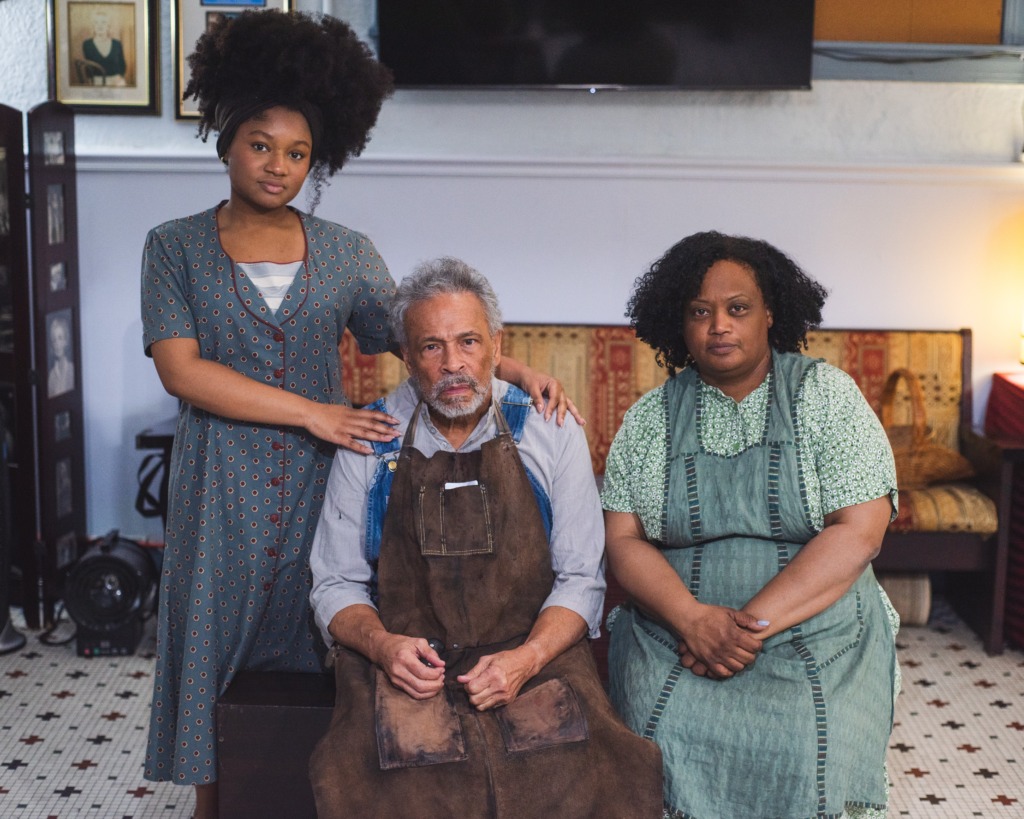
Jennings’ Ruby is presented as a powerful ‘inadvertent temptress vixen’ archetype. She knows she’s hot-to-trot, plays the innocent but works her charms all the same when it comes to interacting with the male characters. Despite not existing, save for discussion of her existence, until the end of the first act, Jennings’ character is fully present, readily invested, and very reactive in her own right. The scenes shared between her and the Hedley character are powerful and impressive.
Ruby’s narrative path is that of Louise’s (Jenelle Brown) niece. Brown, who exists as the female side of comic relief in this production, is not without her serious moments too, often witnessed in her silent, facial reactions when things are going off the rails around her. There’s a mouthy confidence to the way Brown presents the character— all three of the women characters in this play have their own level of confidences carried in different fashions— it’s endearing and gets quite a few chuckles out of the audience. Brown’s character is also the character charged with attempting to lighten the opening scene’s mood and she does so with jovial singing.
Vera (ReginaGinaG) is a complex and dynamic character who runs the emotional gauntlet from start to finish in this production. ReginaGinaG delivers this intensely versatile character sublimely, particularly in this brutal moments of emotional bombacity— like when she first calls Floyd out early on for leaving her behind. There’s a warring stillness and explosiveness fighting for dominance over ReginaGinaG’s performance and at any moment you don’t quite know which side is going to dominate her portrayal. There’s an unquestionable vivacity and unyielding intensity, even when delivered subtly, that keeps the audience riveted by all of her engagements, particularly when she’s having the more intensely driven exchanges with Floyd.
As Floyd, Jae Jones sparks like a live wire. There’s something intrinsically jumpy about the way Jones channels this character, almost as if the character’s essence physically cannot sit still. This is present even when Jones is standing still, though often times he’s moving about, allowing this energy to move his body, body language, and facial expressions— in addition to his voice— all around the play space. There’s a really captivating moment, when Jones’ character starts waxing nostalgic about missing his Mama before breaking into a really intensely beautiful acapella rendition of the Lord’s prayer; it’s moving. There’s a versatility, not dissimilar to the one that ReginaGinaG is bringing to Vera, that makes you want to cheer for Jones’ character, even when common sense tells you that he might just be speaking words or up to no good. Floyd is a vexing character— not quite a false protagonist but not actually a deuteragonist, though also his own antagonist— and Jones fills out this enigmatic role brilliantly.
The play is loaded with energy and Steven Forrester’s Canewell might be the human embodiment of that jittery, bubbly, effervescence that whooshes through a scene like a fire hydrant burst open on a hot July day. A great many of Forrester’s scenes are played in direct opposition to Red (David Mitchell) and the pair have this edgy and tumultuously humorous connection that reads like brothers only without being physically related. Watching them pair of them trip over each other whilst falling over themselves to try and impress Ruby upon her arrival is hysterical. When they’re going at it over ‘gun versus knife’ it’s equal parts intensity and humor. Mitchell takes his antics to the next level with his character in places— like when he’s carrying on about his ‘women troubles’ and the whole ‘biscuit debacle’. His facial features are by far the most animated in the production and it adds a great deal of much-needed levity to the script as a whole. Both Mitchell and Forrester have their moments of sincerity too, though Forrester’s is more notable, when he’s expressing his heart at Vera and Mitchell’s presents more subtly. This pair of actors are the structural support to this extraordinary narrative tale.
What fascinates me most is how what feels like a tertiary character— Hedley (Louis B. Murray) can become the zenith, pinnacle, and centralized focus of a show merely by his actions, his presence or absence on stage, and carefully cultivated and curated moments. There’s a moment late in the second act when Murray has the stage to himself— the lighting is subdued and the stage is that unsettling sort of quiet that sets the hairs on the back of your neck on edge. And Murray starts wandering all around the stage, spouting words with such vigor and gusto in that methodically practiced manner that he’s spent the whole show developing for his character of Hedley— it’s as mesmerizing and as intense as any titan who’s ever played Lear in the storm speech in King Lear. It’s deeply disquieting, wholly unsettling and makes you squirm in your seat. You get that impact, though on a softer, gentler approach, in his scene with Ruby where he’s explaining and confessing things to her. The mannerisms, the vocal tics, the affectation and delivery, the hand gestures, the body language, the affected movements when he walks— all of these components culminate in this exceptionally astonishing performance from Murray as Hedley and you cannot tear your eyes or ears away from him. Murray’s performance in this role is award-worthy and makes the impact of that final moment before the play’s end that much more potent.
It’s a remarkable play; Benjamin Isaiah Black and his cast of seven should be remarkably proud of the work they’ve accomplished and the emotional catharsis they’ve achieved with this production of August Wilson’s Seven Guitars. Tickets may be impossible to get, but if you can, it’s highly, highly recommended.
Running Time: 3 hours and 5 minutes with one intermission
Seven Guitars plays through February 1st 2026 as a part of the city-wide Baltimore August Wilson Celebration at at The Audrey Herman Spotlighters Theatre— 817 Saint Paul Street, Baltimore MD.
The run of Seven Guitars is completely SOLD OUT. Ticketing options are as follows:
- Call the box office at 410-752-1225 to discuss ticketing options
- Take a chance on a ‘standby ticket’** by arriving at the theatre 15 minutes prior to curtain to see if a no-show becomes available
- Keep an eye on the Facebook Page/Website to see if additional performances are added to the run (additional performances have been added though they too have sold-out!)
**standby seating is NOT guaranteed and cannot be guaranteed to provide seats together if more than one no-show occurs at any one performance.