In this hot summer heat if you need someplace cool to go—
Prepare yourself for a sensational show.
They put the ‘hell’ in hello, and you’re in for one hell of a ride
When you come see River Stone Theatre Company’s production of Bonnie & Clyde.
Why? Well, ‘cause ain’t nothin’ rhyme with Clyde & Bonnie. This rarely produced musical is currently appearing at the Opera House in Havre de Grace as River Stone Theatre Company’s third main-stage show and is directed and choreographed by Lauren Hampton, stage managed by Miranda Cockey and features musical direction by Jasmine Mays-Robinson. The glorified tale of two ‘hard-times’ kids in the 1930s turned infamous outlaw legends will have you laughing, tearing up, and enjoying a full couple hours at the theatre.
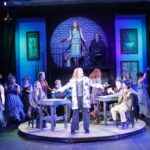
While the cobbled together nature of the show’s overall scenic design may not look like much, it serves a functional purpose and nods to the deconstructed, derelict nature of surviving depression-era Midwest America. It almost creates this meta-lens of a rag-tag theatre company putting on a rag-tag show (think Pippin or Godspell that lend themselves to this sort of simplicity but in a really striking and inspiring fashion.) Scenic Designer Bevin Gorin draws the attention not with furnishings or bits of mobile scenic construct, though the one multifunction platform on casters does make for a fine car, amongst other things— but rather was that exquisite backdrop (painted by Gorin and Keri Freburger.) It’s an ordinary scrim-canvas, covered with newspaper detritus, symbolizing all the articles of coverage about the infamous ‘Barrow Gang’, all about Bonnie and Clyde, with a giant bullet hole blown right through the center, powder burns and all. And in the center? The faintly pastel outlined map of rust-belt/dust-bowl America, where the story takes place. It’s really a sensational visual.
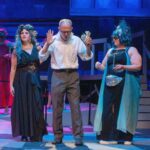
Speaking of visuals, costume designer Chuck Hamrick puts the 1930s vibe right into the show’s sartorial selection with all the drab earth tones and era-appropriate dresses. A odd pop of modernity here and there— a glittery shoe, a sneaker from present-day— gives you a momentary pause but isn’t such a travesty that it pulls from the incredible talent or overall caliber of the performance. The final ‘couture’ outfits on Bonnie, Clyde, Buck, and Blanche really fit the bill for the show’s bedraggled aesthetic and you get the sense that you’ve been washed in the dust and blood of this very specific time stamp.
Lighting Designer Khiyali Pillalamarri makes great use of colored lighting effects to augment and emphasize moments throughout the performance, particularly when it comes to highlighting some of those more intense moments like when Clyde’s passing the point of no return in “Raise a Little Hell.” A lot of the lighting cues wash against the backdrop and encourage a particular emotion or mood to uplift the musical experience in certain songs. Though we see what show Pillalamarri wishes she was really lighting when we get to “You Love Who You Love” as you get Elphaba-green split-washing the half of the stage where Blanche is parked for her half of the duet, and Glinda-pink which backlights Bonnie in that same number. From an aural standpoint, sound designer Scott Harclerode keeps the musical tracks balanced against the mics just fine. A misfired gunshot cue here or there should correct itself before the run closes; otherwise the sound exists in a more even field than what is often experienced inside the opera house when it comes to live theatre.
Musically the show is beautifully blended. Musical Director Jasmine Mays-Robinson pulls together this cast of a dozen and a half talented performers and creates a memorable, mellifluous experience. One of the most impressive feats that Mays-Robinsons achieves is the blend on various ‘end-of-song’ harmonies and the one that immediately comes to mind is the final note of “Raise a Little Hell (Reprise)” which features Clyde, Buck, and Ted. Not only is the note-blend striking and superbly even in all three of its pitches, it sounds hauntingly eerie, insinuating something’s about to go down. You get another such blend, though more heartbreaking and bittersweet at the end of “You Love Who You Love” from Blanche and Bonnie. The ensemble sounds full and rich, and they keep pace with the musical tracks as well.
One doesn’t expect much dancing from Bonnie & Clyde, it’s just not that kind of show. But director-choreographer Lauren Hampton finds little places to pepper her symbolic movements into the performance in a way that feels unobtrusive and serves her vision of this broken version of America that we’re currently ‘repeating’ in many ways here in 2026. The number of note is “Made in America” where the staccato-zombie shuffle is really visceral, wholly unsettling to watch. It’s a physical representation of what the dismantled living conditions of systemic failure have done to honest, hard-working, deep-feeling citizens through no fault of their own, reincarnated into a dance routine. The marching, the jittery-jazz hands, the rigid front-solo-kicks, it’s all quite brutal and yet tragically beautiful. And there’s some other, more lighthearted and fun dance bits sprinkled throughout the performance to keep things in balance.
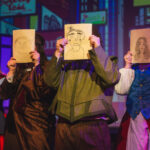
Hampton, as the show’s director, is savage with the show’s final imagery— which for fear of spoiling I can’t mention— but when the ensemble peels away from the ‘center fixture’ even if you know what you’re expecting (and despite this being history and the ‘ending’, much like Titanic or Jesus Christ Superstar, is well-known, I won’t divulge exactly what goes down) it’s a gut-punch because you weren’t expecting that. And it certainly drives home this overall notion of the way America brutally destroys hopes and dreams of the innocent. Hampton also utilizes Young Bonnie (Sophia Libertini) and Young Clyde (Brady Fiol) throughout the performance as harrowing reminders of that lost, youthful innocence. Both actors, who are spunky and filled with the joys of hopeful optimism of overcoming their life-dealt circumstance when they open up the show with “Picture Show” drift or hover in the background of a great many other numbers (even actively engage with their respective mother and father in a ‘silent memory’ scene during “What Was Good Enough For You”) and serve as this unshakable reminder that these two notorious outlaws, these robbing’ murderin’ fugitives were once simple, innocent children just dreaming of a better life. It’s a powerful message, it’s sensational visualization, and it’s one of the more creative lenses to be layered over any production that I’ve seen in quite a while. Fiol and Libertini also have strong voices, which are showcased in “Picture Show” and its reprise, and you really get a sense of their ignorant glee in that opening bid, which makes the show’s finale that much more impactful.
With an ensemble of six— Tiffany Mowry-Burgess, Ethan Fraley, Emily John, Nick Moline, Sophia McKinnon, and Holly Ruhling— and a few others who have named roles but also get used to fortify the ensemble numbers, you find yourself deeply invested in the nuances of the show and not just the main plot. Ruhling and McKinnon, as Trisha and Stella respectively, have little outstanding solo features in “You’re Going Back to Jail” (and you can catch Tammy Oppel here as the crotchety, limb-tremoring old biddy whose momentary scenic-chewing antics are just hilarious.) Oppel, in addition to the aforementioned silliness, plays the role of Emma Parker, Bonnie’s mother, and her accent and overall vocal affectation when speaking to Bonnie feels true to the character, sounds authentic too. Jasmine Artis deserves a nod for her role as the spine-of-steel Sheriff Smoot-Schmid as well. Unafraid to get right up in the Barrow boys’ faces and ruthless when it comes to stealing salon snacks, you get a fully-fleshed out character from a few cameo-style appearances in Artis’ capable hands. Nick Moline, who is the multi-purpose everyman, serves as the Barrow Father, and when playing some more of those unfortunately tragic moments opposite Cherie Gajewski (as Cumie Barrow, the Barrow boys’ mother) you get a real feeling for just how rough the depression was on honest folks. Moline doubles up as a prion guard alongside Ethan Fraley late in the first act and their ‘cruel laughter’ is one of the most cringe-worthy things you’ll hear in the production.
Now if you want versatility both in vocal style and delivery, seek out Angie Williams. She’s the preacher for this production and she’s giving holy-roller enthusiasm in addition to angelic vocals, vacillating between the two as the numbers call for it. When Williams’ starts “Gods Arms Are Always Open” the audience is blessed with that heavenly serenade though she quickly transitions to the ‘tent-revival’ flavor of spirituality and vocality as the number shifts to an up-tempo hop-about number. (You get a lot of box-swing moves with hymnal books in hand from the ensemble here as well to really fill-out the song and overall experience.) Williams also brings that somber sincerity to the reprise of the aforementioned number later in the second act and it’s a glorious, moving sound.
Drew Opdyke is transforming the track of ‘jilted lover Ted Hinton’ into something just a little bit deeper. There’s a sincere dynamism behind the way he approaches his role, balanced delicately with sincerity toward the end when he’s trying to talk sense into the other law enforcement officials, arguing for live-arrest as opposed to the blood-bath shoot-out they’re planning. It’s evident in his body language, and the emotions which he infuses into his singing voice that he’s never given up that little pilot light of a loving flame for Bonnie. You get a real sense of Opdyke’s vocal capabilities both during “You Can Do Better Than Him”, almost like a 1930s Raoul trying to convince Christine she doesn’t need The Phantom, and again with his tremendously impressive sustain at the tail-end of “Raise A Little Hell (Reprise)” where his voice blends into the trio to conclude that song.
Blanche Barrow (Heather Bounds) is a rather spicy pistol despite being a good, non-judging, professional-opinion-giving Christian woman. Her heart’s in the right place at any rate, and Bounds is doing the character a world of justice by tempering her sass against the circumstances in which the character finds herself. There’s a hint of a mercurial tempest loosed in Bounds’ Blanche, you get to see it in the way she interacts with Buck, all loving and sweet but ready at a moment’s notice to slap him upside the head with the word of the good Lord. And she adds a robust vocality to the character, particularly when singing “You’re Goin’ Back to Jail.” Though Buck and Blanche never sing together as a duet, their chemistry is cheeky, fun and undeniable. And when Bounds sets her voice opposite Bonnie for “You Love Who You Love” it’s a really a gorgeous moment of heartfelt passion. Bounds’ emotional delivery is exquisite as well, particularly right after “God’s Arms Are Always Open (Reprise).”
There’s something wildly wonderful about the way that Danny Dance approaches the character of Buck Barrow. Down to earth, humorous but also heartfelt. And the fraternal camaraderie between him and Clyde is superb. You won’t be able to take your eyes off of Dance during “When I Drive” for all the energetic, comedically driven dance moves he’s performing. There’s this zest to his comedy, particularly the way he’s flinging his body about in that number, and it just brings one of those real sincere grins to your face, along with a belly-laugh that just roars on up from deep in your gut. The way Dance responds to Blanche— with love and a little fear and a little frustration— is just perfect for their chemistry dynamic and his voice is solid too. You hear it in both “When I Drive” and in the back-half of “Raise a Little Hell (Reprise)” and he’s just a resplendent addition to the principal cast all-round.
Now that Clyde Barrow (Matthew Lischin) he’s something, alright, certainly something. There’s a grit and a tenacity that just percolates right at the edge of Lischin’s character portrayal and it feels electric. Almost like he could be the Browning Automatic his historical namesake was known for, ready to fire at a moment’s notice, fully capable of doing heavy damage in the right situation. Lischin is earnest above all else, there’s an authenticity and sincerity in his characterization as well as splendid vocals, honest chemistry, and a fire in his belly that just rips up out of him when he hits his limits. His versatility is impressive as well— you got solid, gorgeous sounds from him, all ablaze with intensity during “This World Will Remember Me” (and it’s counterpart Act I Finale “This World Will Remember Us”) and then you get this delicate, acoustic sound— intentionally breathy and sweet when he’s singing “Bonnie” that little poem song. Lischin possesses a cautious desperation; it’s never a fully-fledged dire-straights feeling but it’s always hovering— in his body language, in his spatial relativity, in his vocality; it’s riveting. He’s got the vocal chops, the prowess, and the physicality to be floor-sliding the likes of which even Bo Duke some half-century later could never hope to achieve.
And Bonnie (Kira-Victoria Holt) she is one class act. If you could capture the lightning of the 1930s sound in a bottle, give it a good shake, and uncork it? You’ve got Kira-Victoria Holt’s voice. There’s something romantically eerie, beautifully haunting, tragically beautiful, and classy about the way she sings, especially when she picks up the vocal hand-off from Young Bonnie during the opening bid, “Picture Show.” There’s a smolder that infiltrates her sound, her body, her facial expressions, when she’s singing “How ‘Bout a Dance?” and it just seeps out int the audience, washing into your ear and enchants you. But she’s not all saccharine and heart, there’s a ferocity, a rogue edge that jitters inside of Holt’s Bonnie at all times, often masked by how twitterpated she is over Clyde and how starry-eyed she is over the prospect of becoming famous. You feel it break the seams of her character construct during “Too Late to Turn Back Now.” Holt has power, vocal control, tonal ease, pitch perfection in every number she undertakes in this show. And the chemistry between her and Lischin’s Clyde is stellar. It’s meet-cute, deeply intense, whirlwind-dervish-rolling all at once and they feed off of and into one another every step of their journey. When Holt sings it feels like you’ve stepped back in time, it’s difficult to describe how perfect of a fit she is for this character.
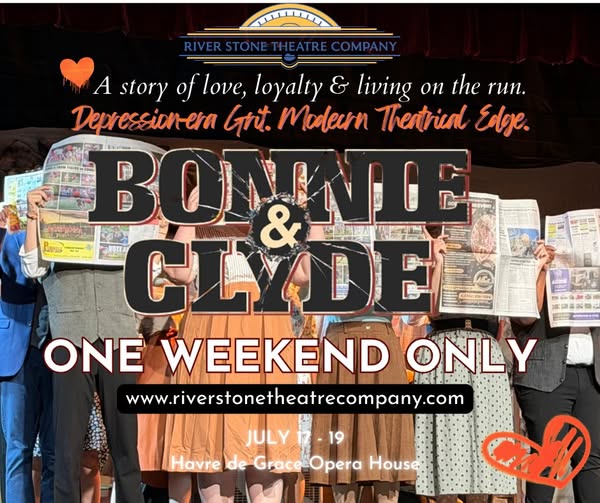
If you’re up for one hell of a ride— you’ve got four opportunities this weekend to catch that infamous duo of Bonnie & Clyde. River Stone Theatre Company will welcome you inside to their marvelous, brilliant showing of Bonnie & Clyde.
Running Time: Approximately 2 hours and 20 minutes with one intermission
Bonnie & Clyde, a River Stone Theatre Company production, plays four performances through July 19th 2026 at The Havre de Grace Opera House— 121 N. Union Avenue in Havre de Grace, MD. Tickets are available in advance online.