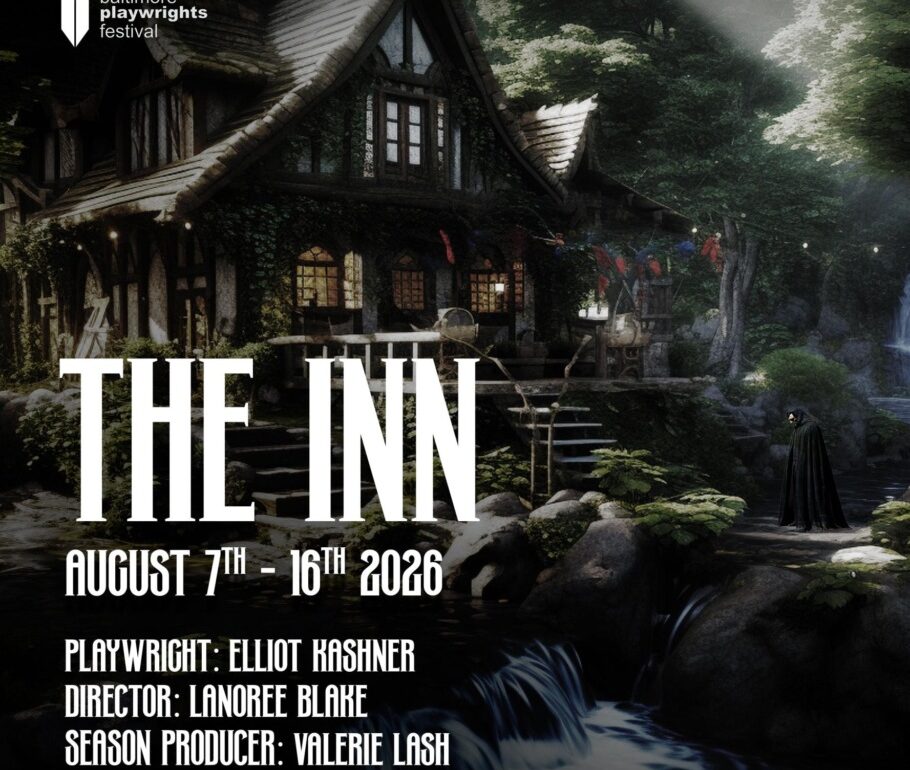
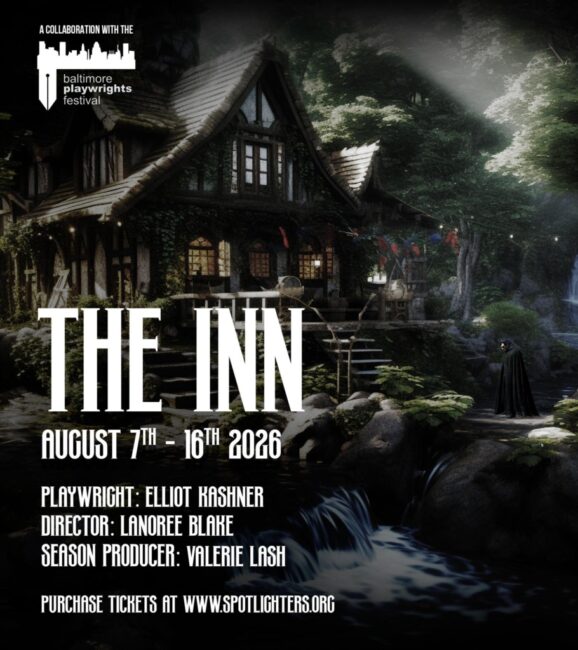
Certainly everywhere is somewhere. And after all, isn’t it more important to know whether there will be weather than what the weather will be? Or am I perhaps conflating Norton Juster and upcoming playwright Elliot Kashner. The latter, I think. Though his current new work, The Inn, appearing at The Audrey Herman Spotlighters Theatre as a part of the summer 2026 Baltimore Playwrights Festival offering, does— to my mind— transport me to my first encounter with NPCs. While I was not a video-gaming/D&D girly growing up in the early 90s (rest assured, I came into King’s Quest, Quest For Glory, and all of that in the late 90s early 00s), I do remember first watching the hyper-animated (and very trippy) film version of The Phantom Tollbooth, only to read it later, fall absolutely in love with it, and learn as a mid-30-something adult (now presently 40) that those ‘side-quest-style-characters’ who don’t exactly enhance the plot and aren’t controllable by you the reader/player/watcher are referred to as NPCs. I swear, this has a point. The Inn, a mysterious, albeit oddly executed, medieval fantasy escape play blends components of any roadside NPC-populated tavern that you might encounter in any of those references I just made, into the stage genre of Agatha Christie theatre-thrillers, and this one in particular follows a shadow-trajectory of An Inspector Calls. The play itself has a lot of potential and the scenery at Spotlighters is divine. Most importantly, it’s a new work, growing legs, experiencing life, and is well-worth investigating.
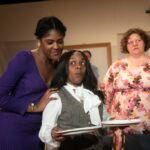
Set Designer Justin Nepucemo has outdone the expectations of pretty much any show at Spotlighters, but particularly a two-weekend-only world premier as a part of the BPF. The tavern scenery that Nepucemo has fabricated into existence is not only deeply detailed but enchantingly inviting. Like the minute you walk in, it’s a struggle to not want to step up on the stage, park yourself at the tavern stool and order…whatever questionable mead or ale that might be stowed behind the bar. The painted stonework and the overall spatial layout is impressive and it really engages the imagination. Lighting and Sound Design (Martin Sundiata and McKinley Nance, respectively) are effective, if questionably utilized at times. There are moments when ‘dimness’ occurs, by way of Sundiata’s lighting constructs, which happen very specifically when a character is recalling an event that happened either far away or in a time before, which while calling to that ‘memory’ notion, reads a bit on the overkill side, as the actor delivering those moments is already in that ‘deep recollective’ state and the illuminating enhancement, or rather lack thereof, just feels like a step over-the-top. Which, in truth, if the play had been pushed in a more farcical/send-up direction (and there’s a contextual pull in the script that cries out for such) this could have been a perfect effect. Nance’s moor wolves register the desired effect, as do the storm sounds when utilized.
From a playwrighting standpoint, The Inn has great potential. If there’s a hiccup, it feels like there are too many external ‘side-plot-threads’, which are arguably designed to be red herrings in the ‘whodunit’ vein of the play’s existence, but end up feeling like they’re separate parts of a series or other works that have snuck their way into this one. The prime example is the whole twist-tale of the Bruxa (terrifying female vampire) from Crestfall which ties two of the characters intrinsically together (spoilers won’t let me tell you which two.) And that whole backstory/exposure feels like it’s trying to be its own play (and very well could be with the way Kashner has developed the detail of that story and the characters that envelop it.) The Inn, as it stand, feels like it has too many red herrings, which leaves the impression that Kashner didn’t trust his own instincts of making it both subtle and or not subtle enough. (Think Angel Street/Gaslight where it’s in plain sight all along but you just don’t know what you’re seeing, right up until you do.) There are components of magical realism that thread beautifully into the suspension of the audience’s disbelief (all equally matched by the design team, including the costumes, which should be credited to Zen Tabligan, though the program might say otherwise. They’re most excellent in all their Medieval finery!)
If there’s another, let’s call it potential plot-hole, it’s the a certain thing happens because of certain actions that all parties on-stage have to do in order for the thing, as it is described, to make sense. There is no dialogue cue ensuring that one of the characters does this thing. (Though in a post-show discussion with the playwright, it was presented that the stage directions indicate at a later point in the play that the character does in fact do the thing…this was not made clear as an action or choice at that point on stage and should be made clearer otherwise the effect is going to be a big point of confusion for anyone paying half-attention in the audience.) But otherwise, Kashner’s consistency with details, backstory, and mystery is pretty impressive.
The play moves swiftly; it was under two hours including the intermission, and yet it didn’t feel rushed or that it needed fleshing out. Director Lanoree Blake seems to situate precariously atop a pointy fence post with her approach to this production. There is an uncertainty to where the play could be set (the program itself says Late Middle Ages, just past dusk, interior of a roadside inn) but the lack of accents and full approach to modern patois, cadence, and speech patterns— with the exception of the Hunter character, who feels like he was ripped straight out of any Medieval experience— gives the confusing vibe of “is this modern times with people LARPing or playing at being Medieval or is this indecisive medieval setting that didn’t quite come to fruition? There was also a general yen and overall tug from the text and character development for this play to be executed in a more over-the-top and campy fashion, which could have amplified the comedic nuggets tucked away in the dialogue exchanges, made the magical realism feel even more hyper-realistic, and ultimately better served the work as a whole. There’s also a few blocking choices that feel a bit awkward when it comes to Blake’s decisions to setup action for the in-the-square-round space. This is particularly true of the ‘gathering’ at the top of the second act; Blake has everyone shunted very closely to one lip-edge of the stage, rather than bunching them in the middle, which would make for better sightlines overall.
Six characters— The Innkeeper (Carolyn Kashner), The Drifter (Adanya Koger-Hobsen), The Merchant (Genevieve James), The Lady (Jesa Medders), The Troubadour (Caitlyn Hooper), The Hunter (Dave Iden)— all in search of…well, not an author, they’ve got that, without question. In search of…refuge? In search of answers. That might be the other micro-complaint about the plot/script as a whole; there’s somewhat of a convenience that they all end up at the same roadside inn the way that they do. (And honestly, Kashner has the fix to that built into one of the characters, as it could be explained rather readily when one of the characters reveals their…talents…that it was because of that character that they all ended up where they did rather than by extreme coincidence.) But they all play well and have a solid dynamic, particularly when it comes to pushing the action forward.
There is a deliciously unsettling nervousness about Adanya Koger-Hobsen’s Drifter, the interactions with Carolyn Kashner’s Innkeeper are the most intriguing as far as ‘questionable-dynamic-setup’ goes. As the Proprietor of the play’s setting, Kashner commands quite the presence. Her facial expressions are fascinating beyond compare and she uses her wit and charm to both gingerly stir discord and keep peace amongst those who drop-in.
Our Troubadour, Caitlyn Hooper, is lively, and perhaps the most versatile in an overt fashion of the six characters. You get sprightly and chipper, a sing-songy-silliness that accompanies the weary nomadic nature of a Bard with strings only to see that drastically shift upon encountering one of the other characters and the juxtaposition of Hooper’s happy-go-luckiness against the ruthless temper that flares up when the Troubadour encounters said character is wild. (No one wants to talk too much about who’s really entangled or enmeshed with who, as it gives away plot points and half the fun of a show like this is the art of discovery in the moment.) Though this particular entanglement is the one that feels like it belongs in its own story, or deserves more scene-work to flesh out and develop fully.
Genevieve James’ Merchant is arguably the most bombastic of the six, with Jesa Medders’ Lady being the most subdued. James is lively in an incendiary fashion, constantly in physical motion, even when seated, and tends to spout off at the mouth in a way that would arguably get the character flayed alive in an RPG-combat setting. Medders’ characterization of The Lady is befitting of the character’s eponymous nature, and this character exists with both the most and least suspicion at the same time, which is fascinating as she has what feels like the second-least amount of stage time/presence in regards to physically being in scene work.
Dave Iden’s Hunter feels wildly out of place and yet in place— it’s the vexing mismatch of the directorial approach to the show. Iden’s Hunter feels like he’s playing in the true-to-setting reality of the late middle ages, a proper creation of some fantasy world. But that he’s been dropped into this modern-times, living-present existence of five other people who have decided to play at being Medieval for the evening. Which, if that were made clearly as an intentional choice, could actually work and be a fun spin on the work as a whole. Iden is creepy, mysterious, and all the things you’d want and expect from the way this character; seating on the wall upon which you enter the theatre is recommended because a very cool special effect involving his character can only be seen from this angle.
It’s curious; it’s fantastical; there’s a puppet-esque creation that doesn’t get nearly enough stage time (microseconds at the very, very end— shoutout to Puppet Creator Lee Gross) and there’s some really glorious pre-show music that primes you for the adventure. Supporting new work, particularly local artists, should absolutely be on your 2026 Bingo card (and truthfully, every year’s bingo card) and Spotlighters in conjunction with BPF is giving you an excellent chance to do that with The Inn.
Running Time: Approximately 100 minutes with no intermission
The Inn plays through August 16th 2026 as a Baltimore Playwrights Festival production at The Audrey Herman Spotlighters Theatre— 817 Saint Paul Street, Baltimore MD 21202. For tickets call the box office at 410-752-1225 or purchase them in advance online.