
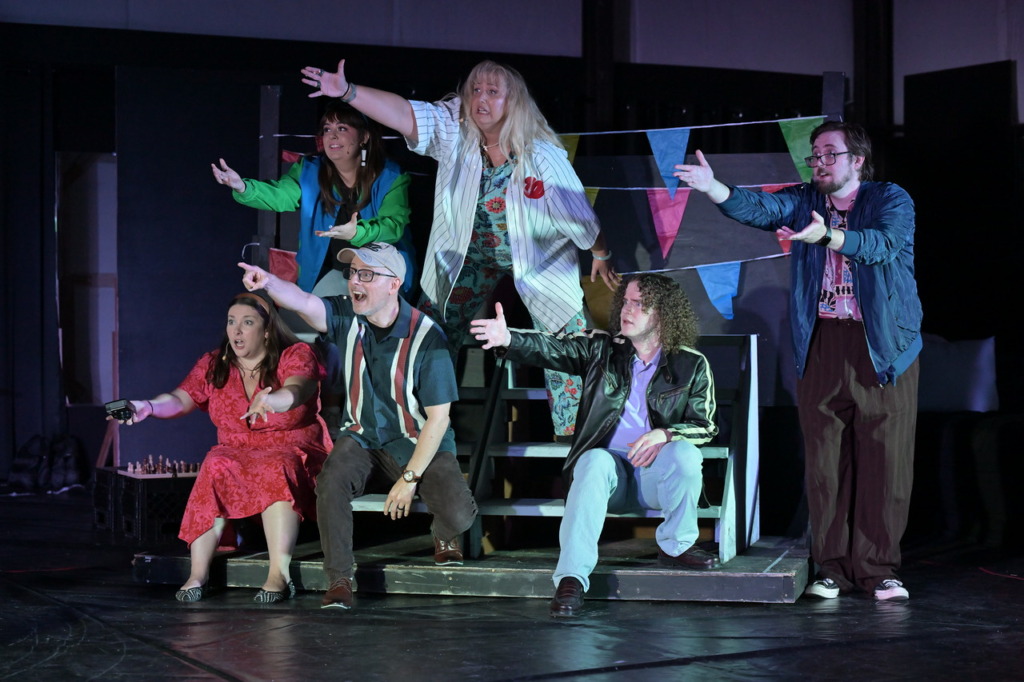
I’m neurotic. He’s neurotic. They’re neurotic. We’re neurotic. Though honestly? Life is moments you can’t understand. And I truly never thought that in almost a decade and a half of reviewing live theatre that Falsettos would be on my “I’ve seen it half a dozen or so times” list. (Let’s be real here, it isn’t Shrek or Les Mis, not to say that it isn’t important, it’s just sort of an underdog-cult-following type show.) I can’t understand it, but on the other side of the halfway point of 2025, here I sit watching four Jews bitching and six adults watching Jason play baseball in a warehouse-come-dance-studio temporarily resided in by Small Town Stars Theatre Company. This is not a bad thing. And given the way Directors Miranda Secula-Rosell and Joel Roberson, alongside Musical Director Lisa Dodson present the show, I’d say it’s a very, very good thing.

William Finn didn’t make it easy for theatre companies to want to produce his music & lyrics in Falsettos; it’s complicated. On par with Sondheim-level complexity and intricacy. And while most of the harmonies and blends are clean there are some hiccups here and there (at the final dress rehearsal, which by closing Sunday will be perfected beyond the shadow of a doubt, which is the way such things go with one-weekend-only shows that are beast-bears in the musical score department.) That and some microphone issues aside (despite a thorough pre-show levels & mic check, that pesky vaulted-metal cavern does all sorts of screwy things to the sound…but it’s sort of par for the show itself, playing into Marvin’s less-than-perfect reality that he wishes were perfect) the show is conceptually striking, vocally impressive, and moving to boot.
Co-Director Joel Roberson creates this ‘red box’ (which he talks about in his director’s note…don’t be like me spending ten minutes pre-show looking for it, it’s an outline on the floor) that contains, includes, and excludes all of the action inside the play’s narrative. It’s simplicity incarnate but also strikingly genius in the spatial blocking sense and in what it does to really delineate and demarcate certain emotional boundaries and moments over the progression of the show. Honestly, I’ve never seen something so simplistic, so minimalistic be so effective in its designed intent; bravo to Roberson for that choice. Three really striking moments come immediately to mind with that box— as it ‘contains’ the action of the play but there are definitely moments where its borders are used to highlight hard-hitting moments, creating some stunning and visceral evocative experiences. When Whizzer gets effectively tossed, and Trina, Jason, and Mendel sit on the couch, cozily tucked inside their ‘house’ singing “Making a Home” you get this charming happy-life snapshot of the three of them on their sofa, warm and safe and included, while poor Whizzer is outside the red line of the box, bitter, alone, with a suitcase and a broken heart that he’s trying to grin and bear through as he sings. It’s a really astonishing moment and it elevates the context of this number sublimely. The same is true with Marvin standing inside and again Whizzer on the outside during “What Would I Do?” and the final scene with Whizzer doing that look over his shoulder, again from outside the box; it’s all incredibly well-thought and works divinely for creating this sense of othered/othering and what it means to be included, be part of a family, be in the picture.

Roberson and Secula-Rosell have some other blocking choices that at first (and speaking only from my experience from having seen the show a half-dozen times or so) had me clutching my proverbial pearls with a “no, no, no, that’s not where they should be— it’s only supposed to be x-and-y on stage” mentality. But actually, what they’ve done in that regard works incredibly well to service both the narrative and the emotional perspective of the characters. It isn’t all the time, but there are moments where one character or a duet of characters are having a scene-song in the box and way in the upstage-right corner, another character sits— actively observing and reacting to what’s happening centerstage. Marvin has the most animated reactions of a person seated in that corner, though you get some really invested ones out of Trina too. It’s a diabolically genius concept that one wouldn’t expect to work or would at least expect to be distracting but in actuality it works brilliantly and adds this layer of “everyone’s a psychiatrist observing everyone” to the show that just fits it divinely.
I’m not sure how the pacing got ‘off’ in this production; especially as the show is on musical tracks but there are just a few moments where something is…not as smooth as it should be? It’s not even that noticeable until you check the clock at the end of the show, but feels worth mentioning since so much else of the production is really impressive. And musically, despite some of the aforementioned difficulties with blends and harmonies, everyone has a good handle on their solo segments, particularly Marvin, Whizzer, and Trina. (And to a lesser degree Cordelia and Charlotte; they have so few of them— these two characters don’t even appear until the second act! And they’re tertiary supporting characters that get shoehorned in like they were main-supporting characters all along; that’s on William Finn & James Lapine, though not our directors and actors with this production.)
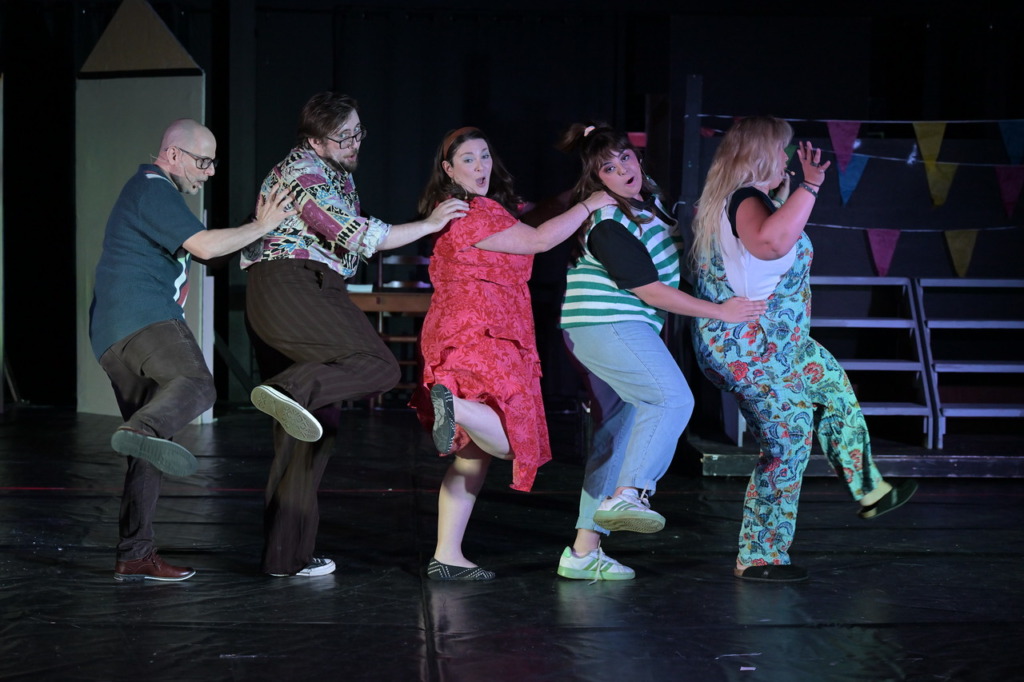
Secula-Rosell, who wears umpteen hats in the production sector of the show, is also the choreographer and while this isn’t a ‘dance-show’ you still get some wild moves— mostly from Mendel, and in that one number “Everyone Hates His Parents” you get a hilarious dance-out ending, which comes with an inversion spin that is just delightful to watch. “March of the Falsettos” (which is the number that always makes you feel like you’ve accidentally taken one of Alice’s mushrooms and gone down a rabbit hole unrelated to the show you’re currently watching— and yes, this is the case no matter who’s production you’re watching) is turned into some sheer nightmare-fuel-chaos-scape-shenanigans under Secula-Rosell’s choreographic influence. It’s done in dark-out (hats off to Dakota Secula-Rosell as the show’s lighting designer; it’s simple, clean, and effective with excellent consistency!) and Mendel, Whizzer, Jason, and Marvin show up with glowstick suspenders, bow-ties, and glasses, making creepy-giddy clown laughs, box-step dances up and down on actual crate-boxes, and some silliness that will set your spine tingling in the ‘GTFO’ range of ‘these clowns might get me in my sleep.’
While we’re on the Miranda Secula-Rosell train of praises, she’s the co-designer of costumes alongside Jennifer Secula and I have to say— the exercise gear for Trina and Mendel— complete with neon-geometric print leotard, highlighter pink under-top and glare-gold-mustard sports shorts and that rainbow-puff windbreak jacket— are my favorites. The costumes appropriately scream 1979 and 1981 and you feel like this pair gets the era without question. But my favorite involvement of Miranda Secula-Rosell in this production is not her direction, her choreography, her costumes, her intimacy coordination, or the fact that she’s the show’s producer…but rather her cameo pop-up late in the second act as ‘Diana-Caroline-Whoever-you-are’ in Mendel’s office. She gets this gorgeous vocal affectation going, has her back to the audience for all five seconds she’s on stage, and calls Mendel out on his crap, and it’s hysterical. Show-stealing moment by the woman who doesn’t even give herself a performance credit in the program; hands down hilarious.
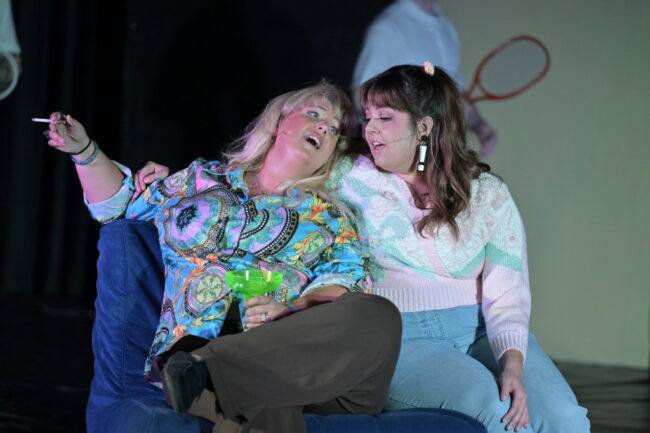
As for our supporting characters, Cordelia (Jordan Wheeler) and Charlotte (Katie Ketter) they fall into place nicely. You don’t get much of a chance for them to truly flesh out the dynamic of what it is that they’re doing in the story…other than existing as the lesbians next door who are friends of Whizzer and Marvin’s and by proxy somehow also godmothers to Jason, who’s almost 13 by the time they get introduced to the show. But for the supporting-cameo-tracks that these two women have, they give it their all and bring beautiful clean vocals to the mix. Wheeler and Ketter both gets solo moments later in the second act, during “Something Bad is Happening” and you get this curiousness out of Ketter’s approach to that moment. Rather than the downtrodden acceptance of doom-n-gloom, she’s legitimately querying it during her solo moment. And watching the pair of them goof off in the stands (nicely constructed, set team!) during “The Baseball Game” is an added bonus.
Jason (Beckett McIntyre) is the character around whom the show revolves. It’s Marvin’s story, it’s Whizzer’s experience, it’s Trina’s life— but Jason is the center point. He’s the thread and throughline for all of them. Vocally, McIntyre has a lovely sound, sweet and clear, perfectly suited for the character. There’s a mild gloominess that coats his character from his opening appearance through to the end, almost an Eeyore like sorrow that just sort of hovers in his general bubble, making you feel for him. Listening to him think games trump love and then later girls trump love is really amusing, especially as he delivers those solo moments with a simplistic deadpan that really secretly sticks it to Marvin in those moments. He has great, natural interactions with the other characters, particularly with Whizzer and the encounter with him both at the Bar Mitzvah at the end and earlier when they’re all pushing for him to see a psychiatrist are really touching.

Marvin is an asshole. Marvin is misunderstood. Marvin is greedy. Marvin wants it all and wants to not have to face or suffer or embrace the consequences of his actions. How William Finn & James Lapine managed to create such a disagreeable protagonist that people somehow still relate to and like is inconceivable and yet— there he is. Marvin. Conor Harris takes him on and gives us exactly what Finn & Lapine created; a self-centered, ‘I-want-it-all’, misunderstood, loaded-sense-of-entitlement protagonist with a glorious voice, a visceral edge to his emotional interactions and some outbursts that really make you rankle with whether you love him, hate him, or want to slap and hug him at the same time. Harris gets these really glorious vocal sweeps— Marvin does perhaps the most singing in the production? (I’m not trying to count line for line but this iteration makes it feel that way.) And you get an impressive emotional range out of Harris, conquering all sorts of feelings from the opening through to the close. His most impressive moments of volatile chemistry come when he’s paired opposite Whizzer, even in those more loving and tender moments, that undercurrent of intensity is palpable and present in Harris’ rendition of Marvin.
Erik Secula’s Mendel is somewhat personally infuriating and Secula is playing the character right on this teetering high-wire of over-the-top. There are these little moments where he’s a physical embodiment of zany-in-the-brainy— like when he’s in session with Marvin trying to show-but-contain his overstimulated reactions to Trina or when he’s hypno-movement-therapizing Jason— and it’s so over-the-top it’s genius. But then those moments quickly evaporate and disappear. I’m not saying that a character has to be a monolith of one extreme, in fact it’s good for a character to play up all ends of the spectrum in that regard but to me, it feels like Secula’s Mendel can’t quite decide if he’s a caricature, an over-the-top representation, or just a guy who has moments. (This might read perfectly normal and I’m way overthinking it, but that’s my observation.) He does excellent with his facial and bodily expressions and when he sings in tandem with others or with the group his voice blends well. His best interactions are also with McIntyre’s Jason.
Jessica Harris Keays’ Trina is a textbook delivery of a character who is just trying to keep it together. You get a perfect balance of exasperation, frustration, and humor from her. Plus superb vocals, particularly when she’s belt-blasting out “I’m Breaking Down.” This is the rubric by which all Trina’s are traditionally graded and Keays’ does not disappoint. It’s humorous, it’s unhinged, it’s emotionally raw and she delivers it with stunning vocal clarity. You also get those moments— “Trina’s Song” and its respective reprise— where you can see the whole of her vocal versatility and feel all of the turmoil that builds up within the character. Keays is stellar in the role and makes it work for her.
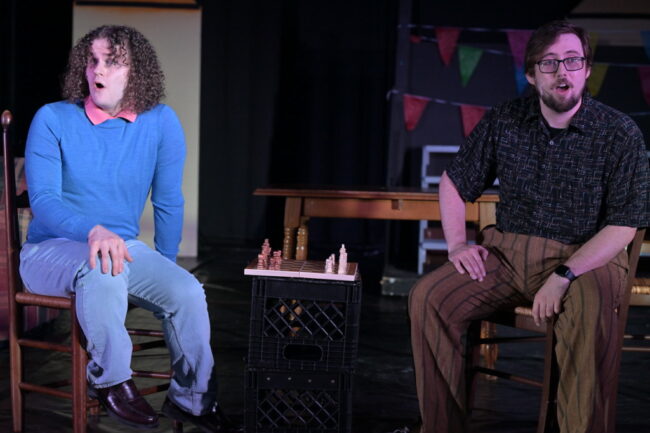
Emotionally evocative, with vocals that are seated at a professional caliber, Kyle Secula’s Whizzer is everything you want, need, and hope for when it comes to the character. There’s a smug confidence that rarely wavers in the first act, even when he’s having his desperate moment in “Making a Home” you feel him trying to bury those real feelings of fear and uncertainty with that smarmy, cock-sure confidence. He’s incendiary on his toes with Marvin during “The Chess Game” but then showcases this deeply vulnerable side in the back-half of the second act. Secula is an extremely capable and versatile actor, bringing deeply researched and explored character depth to all of his moments and he takes that ‘red box’ to the next level (possibly as his character is the one most frequently on the outside of it) by really taking note of how he steps in and out of it and what kind of border it creates. Secula’s vocals are glorious and angelic, loaded with pathos and perfect for all the moments that Whizzer has in duet and as a solo performer.
It’s a rather impressive production, especially taking into consideration the constructed concept of the ‘red box’ and while it used to be rarely done (perhaps it’s on a uptick and everyone will be doing it soon) I’ll still say this is a rare opportunity to catch this one in production and you shouldn’t miss it; this weekend only with Small Town Stars Theatre Company.
Running Time: Approximately 2 hours and 30 minutes with one intermission
Falsettos plays through August 31st 2025 with Small Town Stars Theatre Company at the Synergy Space Dance Studio— 519 Old Westminster Pike in Westminster, MD. Tickets are available at the door or in advance online.