
Hadestown (Teen Edition) is a remarkable show, and it has a gift to give; it could make you see how the world could be, instead of the way that it is. And Theaterworks Live is a sold-out experience, for their production of Hadestown (Teen Edition); the closest you’ll get it reading this here write-up to the strikingly talented teens who are tackling the stage over the course of four performances, singing their hearts and souls out in this evocative, beautiful tale. Directed by Cathy Koncurat with Musical Direction by Andrew Worthington & Megan Koncurat, and Choreography by Karlie Surgeon this heartfelt, visceral tale of love, loss, and how the world could be is the hottest ticket in all of (Hades)town— especially as the show is completely sold out for its run.
It’s worth mentioning, for those who do get to attend, that in addition to all of the usual faire offered at a Theatreworks Live event, there are specialty drinks (don’t worry, just fizzy-delicious-soda-pop) purposefully themed for the show— donated by Fizzy Mama Soda— with two delectable options: Hade’s Kiss (a chocolate-strawberry soda) and Persephone’s Sparkle (a lavender and berry soda). They are divine and available for purchase both before the performance begins and at the intermission. The proceeds benefit Theaterworks Live and are a great way to immerse yourself in the Hadestown experience this weekend.
The Set Design Team (featuring Mark Koncurat, Greg Watt, Tim Rhudy, Matt Eberhardt, Becci Wendler, Karisa Sikora, Katie Weeks) and Tech Crew (Lily Allen, Lily Wendler, Rowen Taylor), working under the supervision of Mark Koncurat as the show’s TD and Kody Coudon as the show’s SM, bring a mighty impressive set and series of lighting and sound effects to the forefront of the production, creating a professional atmosphere upon which these young performers can unfurl their natural talents in an enticing, storytelling fashion. The slow-revolve for the train/elevator back to Hadestown is a unique way to set the show and the overall verve of the atmosphere screams impoverished working town with a speakeasy on the side. It’s a two-tier set, which makes for magnificent entrances, particularly when Hades has to appear, and gives levels of play for the Fates, as well as our mythological protagonists to play with. It’s a visually appealing set, even in the muddied and subdued color scheme set forth, which well-serves the overall tone of the play. Pops and splash of color literally arrive in Persephone’s costume (we’ll get to the show’s sartorial selection, which is nothing short of sheer genius) in a moment, but the vivacity of Hadestown is meant to thrive in the vocal talents on the stage and it certainly does for this production. Of course I’d be remiss if I didn’t mention the outrageous lighting effects Mark Koncurat plugs into the performance— lots of moody blues, lots of hot and angry reds, an exceptionally well-executed strobe effects for beating Orpheus down when Hades first shuts him down, and a few other breathtaking moments, particularly when the various renditions of “Chant” are happening.
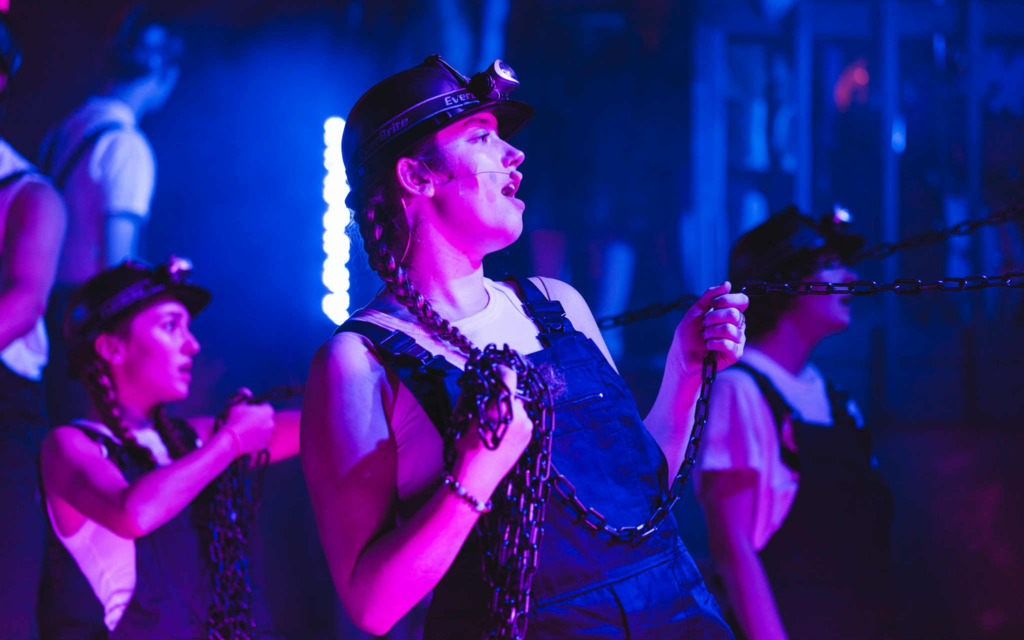
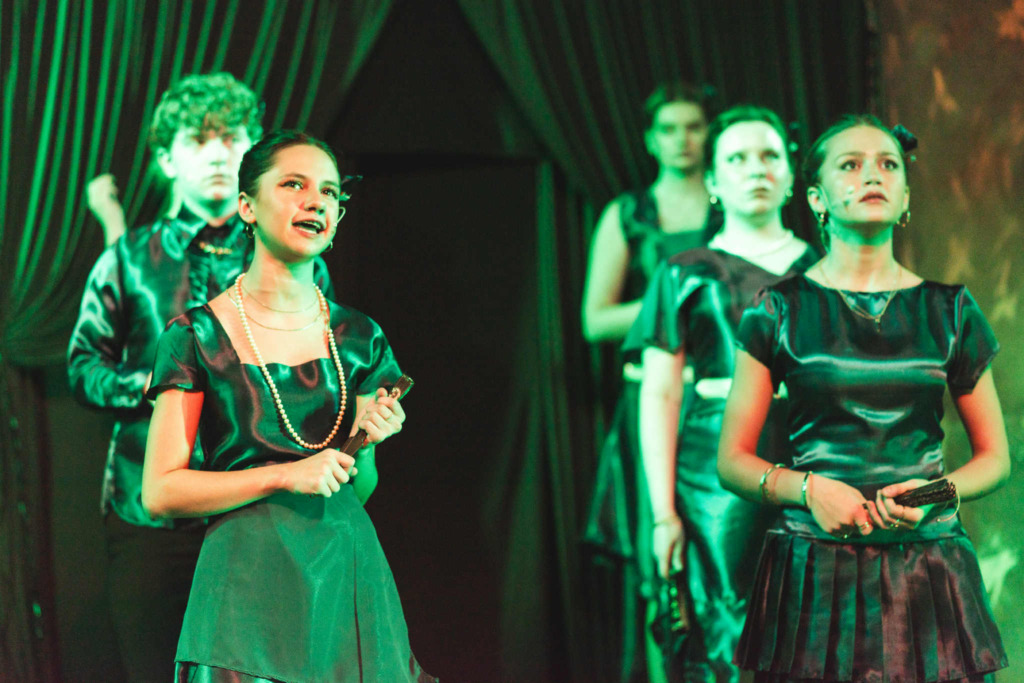
If the oppression of the masses is half the battle in Hadestown, costume designers Kelly Koncurat and Lucia Beanblossom have claimed victory in that department. Splayed over the hardest working chorus in the God-almighty world, Koncurat and Beanblossom have fitted out the ensembles (so named by their seasons) in hues of the earth, giving a double-down nod to their impoverished, ‘hard-times’ roots as well as the overall aesthetic of the show. When they shift into their ‘souls of the damned’ in the underworld, with the black overalls and matching miner’s hats, it’s uniform and consistent, making their entities as faceless and meaningless as their eternal existence. You get splashes of both style and color with the way Koncurat and Beanblossom have handled the Fates. It calls back to the bygone Vaudeville era in this rich, earthen almost deep emerald forest green saturation, five dresses and one snazzy dress top. Each styled just a little different from the other so each Fate has their own personality fitted right into their costume. Hades himself looks like something out of a steampunk noir graphic novel, as does Hermes, with the sleek double-breasted cobalt-and-silver pinstripe suit, and little ‘wings’ on the heels of those fabulous shoes. Persephone gets the glorious green affair, which later transforms into black when she’s back underground for the winter season; Koncurat and Beanblossom don’t hold back when it comes to outfitting this cast— my personal favorite is the half-brick vest seen on Hades, though Hermes’ whole suit is a close second.
An astonishing feature of this production is the teen pit (led and conducted by Musical Director Andrew Worthington, who also assists Jonroy Canady on keys.) Featuring Maddie Stevens on cello, Noah Mortez on bass, Andrew Bennett on guitar, Capri Blankenship, Peter Lein, and Kai Olsen on percussion, and Daniel Koncurat on trombone, this live teen orchestra is tucked strategically on-stage to enhance the overall musical experience. Instructed and rehearsed with a tremendous assist from Wayne Perry, this young musicians are creating professional quality sounds, which really add a dazzling effect to the overall performance. Worthington, hauling double duty in this regard, works in tandem with Megan Koncurat and together they get vocal excellence from a cast of over three dozen. Blending and harmonizing the six Fates, creating robust and resounding mixes from the full company, Worthington and Koncurat create a showcase of fulsome, enriching musical talent, packed full of heart and emotional intensity, not to mention energy.
And the choreography speaks to that energy as well with Karlie Surgeon crafting the dance routines. What she does exceptionally well is understand the space as a whole and blocks her dances accordingly with a keen sense of spatial awareness, not only of each other but of the smaller layer-steps built into the stage. You see this most clearly during “Livin’ it Up on Top.” And while there are other excellent moments of choreography all throughout the performance— particularly the meticulous rigidity with which “Chant” and its reprise are performed— the most fun number in the show is “Livin’ it Up on Top” and Surgeon takes care to incorporate as many special acrobatically-flared movements as can fit into one dance break. The young performers get to do a lot of 1920’s ragtime-jazz-Vaudeville moves throughout the performance as well, lots of ball-kick-side-steps and the iconic finger-twiddle-twirl, and it all looks amazing, with Surgeon somehow managing to concentrate the exact amount of dancers into the carefully compacted space so that it looks full but not overcrowded. You also get some wild solo moves from Persephone in Act II that are just the bees knees as it were.
Director Cathy Koncurat has really put her stamp on the production, sliding things into that speakeasy era and letting subtle moments really catch the eyes of the audience— like having Hades play live trombone at times (and Daniel Koncurat is a rather impressive trombone player to boot) or constantly having the Fates in perpetual states of ‘RRF’ (Resting…Rage Face.) Having the chorus never truly lift their eyes or faces when they’re chanting is such a powerful statement choice that really resonates with the song’s subject matter, it sticks with you long after you leave the performance. You get this hitting home particularly hard during “Why We Build the Wall” and it’s deliciously unnerving. The overall tonal shift that Koncurat achieves (working in tandem with the rest of the production team) as Orpheus rolls into “Wait for Me” and again with “Doubt Comes In” is spine-tingling. And there is a moment of sheer goosebumps and clinging to the edge of your seat just as the end of “Epic III” that will sit with you through to the end of the show as well.
Speaking of the hardest working chorus in the God-almighty world, you’ve got vocal talent galore broken up into three sets of ensembles, all providing backing harmonies, full-voiced carries of whole company numbers, and attitudes and personalities— even when they’re all monolithic and moving as one giant, lifeless cog in the Hadestown machine— which are exquisite to experience and I’m fortunate enough to have gotten to do so (I hear the performances are completely booked up so you’re lucky if fate has smiled on you enough to grant you a ticket!) The Spring Ensemble (Aaron Johnson, Bella Travers, Beni Feldt, Claire Aquilina, Emily Eberhardt, Finn Shramek, Hailey Nesemeier, Jude Mahoney, Riley Massoni,) The Summer Ensemble (Addison Rhudy, Emeline Beanblossom, Emmalea Sheckells, Gianna Libertini, Jayden Dukes, Lily Hannon, Megan McCormick, Siena Fiore, Sophia Libertini,) and the Fall Ensemble (Abby Lynn, Alex Blanford, Alex Colón, Hailey Luong, Isla Dukes, Kei Cassidy-Stewart, Rei Pence, Ryan Aquilina, Shawn Preisinger,) create powerful and beautiful, illustrious sounds for numbers like “Wedding Song” and “Road to Hell”, shifting on a dime the emotional tones that they carry in and out of these songs. You get a real sense of their vocal capabilities when they start rhythmically chanting their way through the appropriately named “Chant” and its respective reprise, and “Why We Build the Wall” is another prime example of their combined vocal tenacities. It’s extraordinary to watch them work together, moving the café chairs and tables in and out of the earlier scenes, tugging and pulling the chains in the later scenes, and vocally uplifting the tale as one harmonious entity; it’s a rare achievement for young performers to succeed at, especially with a score as magical and lyrical as the one provided in Hadestown.
The Fates (Bella Preisinger, Ellie Paquin, Evan Christy, Kaya McClelland, Lilah Fodel, Rebecca Van Nostrand,) are six seriously intense entities that eerily unsettling at the best of times. There is just something indescribable about their perpetual state of RRF (Resting…Rage Face) that makes you want to shy away from being anywhere near them. They carry themselves as a unit, slinking and sliding up and down the stairs of the set as if they wish to remain hidden in the shadows, up until they don’t and then they strut around the stage as if the world is theirs to command. What’s utterly fascinating about Preisinger, Paquin, Christy, McClelland, Fodel, and Van Nostrand is the way they mock and taunt Orpheus and Eurydice. Harrowing glances, furious body language, serving as an unrelenting reminder that Fate can be…and is…cruel and merciless. This half-dozen also proves that they are vocal sensations, particularly when they go at that “Nothing Changes” full acapella in Act II; the way their voices weave in and out of each other’s, blending together, creating this haunting but crystalline clear sound, it’s superb. And their dance moves are up to snuff and then some. You get these six featured in perpetual motion all throughout the performance, with “When the Chips Are Down” being a personal favorite because of the attitude they infuse into that song.
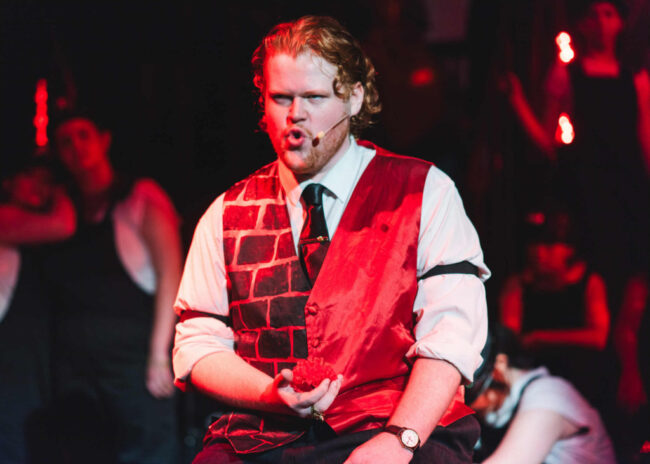
It’s a rather unobtainable bar that Patrick Page (the originator of the role of Hades in Hadestown on Broadway) has set— think higher than Mt. Olympus, only in reverse— with those basement-below-base ranges that he brings to the character, but Daniel Koncurat holds his own hitting some of those truly low-base notes, particularly in the second act of the show. His trombone skills are sublime and his overall capability to simply make an entrance and strike fear with a mere arrival is more than striking. (Plus he’s outfitted exquisitely and that helps in achieving such an effect.) There’s an unmitigated terror that Koncurat infuses into “Why We Build the Wall” at the end of Act I, which really does spark up the fear of both the ensemble and the audience in this production. “How Long?” is a brutally evocative duet shared with Persephone and his overall command of stage presence is gripping. Try not to get too spooked when he sings “Hey, Little Songbird” at Eurydice. Koncurat does have that stunning moment at the end of “Epic III” that showcases his emotionally charged acting capabilities as well. It’s a solid performance from Koncurat all round, especially with that impressive trombone work.
With a sleek confidence twice as dapper as her suit, Alyssa Brandon tackles the role of Hermes with confidence and a little jazzy soul. With a well-purposed voice and an easy-going attitude that slides right into the narrative nature of Hermes, you get quite the charming performance from her. Brandon is the introduction to the show, she sets the mood, she sets the tone, and reminds us of the players, their motivations, their feelings, their purposes every step of the way. “Road to Hell” kicks off the performance and Brandon nails it. You get to hear her vocal talents in other moments all throughout the production, of note “Way Down Hadestown” coming immediately to mind. There’s a tenderness that Brandon brings to the role as well, as if she’s not only invested in telling the story of Orpheus and Eurydice, but she’s secretly cheering for them, desperate to see them achieve success. It’s a hot take on the role and one that works well for this production.
Sassy, flashy, and selling spring like it’s a true summer fire-sale, Amelia Watts as Persephone is exactly what mother nature ordered. There’s an indefatigable vivacity, a youthful exuberance, and a perpetual sense of liveliness that accompanies Watts’ performance, whether she’s arriving like the burst of spring long overdue in “Livin’ It Up on Top” or she’s bemoaning the misery that has become her in that duet, “How Long?” paired opposite Hades. Watts slays, hands down, when she blasts her way through “Our Lady of the Underground”, which features not only her stunning vocals but her intense solo dance routines, and a trek up into the audience risers where you come face to face with Hades’ Queen. The frenetic intensity and unadulterated tenacity that Watts brings to the role is perfect for this vixen-diva character and she owns the role every step of the way, softening in those moments with Hades when the plot takes a twist late in the second act. Watts also leads the finale number, “We Raise Our Cups” alongside Eurydice (Bella Comotto) and reminds the audience of what it is we’re living for when we embrace theatrical extravaganzas like these.
As for the protagonists— Orpheus (Jonah Wade) and Eurydice (Bella Comotto)— it’s a love song, it’s an old song, it’s a sad song, and it’s beautiful too. You never get the sense that they know their fate— even when they come respectively face to face with The Fates during various moments of the performance. Comotto is belting her face off and living those larger-than-life emotional turmoils that crash through her character’s existence; this is felt particularly hard and intensely during “Gone, I’m Gone” and her more upbeat tune “All I’ve Ever Known”, which does start with a desperation but builds its way into something beautiful. The chemistry that Comotto and Wade share feels organic and is tended with care, particularly once they reunite in the underworld in the second act. There’s a warm, effervescence between them that gently teases its way through “Wedding Song” and the pair plays sublimely together as the end of “Doubt Comes In” hits in that most unexpected (even though we all know it’s coming) way.
Comotto, as the ‘hungry girl’ displays a myriad of emotions all throughout the performance, from distrusting to hopeful, resigned to enthused and everything in-between. Her solo number, “Flowers” is mastery of melancholy not only in her vocal execution of the number but in the emotional expression displayed clearly on her facial features, which transcends into her body language. The desperation of trying to remember is etched into the tail-end of that song and it’s utterly heartbreaking. Her powerhouse belts can be heard all through the montaged bits of “Doubt Comes In” where she’s evocatively crying out over the Fates and the ensemble, yearning to be heard by Orpheus in a futile attempt to save him from his own self-doubts. The pair of Comotto and Wade work extremely well together playing off one another’s energies with ripe enthusiasm and rich passion, making their story that much more harrowing as it wends into its conclusion.
Wade, as the ‘boy with a beautiful song’ is truly remarkable in his approach to those heavenly high notes. There’s something to be said for the way Wade’s voice graces delicately over those notes featured in “Epic” (and all its subsequent parts.) And it’s more than just gently hitting and sweetly sustaining those sounds, it’s the emotional evocation that he pours into those moments; you can feel it welling up from deep within the character’s soul, easing its way out through his fingertips on the guitar, floating out over his voice into the lyrics; it’s truly a phenomenal experience. There’s hardly a moment when Wade’s character is off-stage but when he’s on stage he’s so in-tune with what’s happening around him, it’s truly astonishing to watch. And your gut just twists, your heart squeezes so tightly in your chest, and your whole body is on edge as he enters “Doubt Comes In” and you’re on that journey with him; Wade has you so fully believing in the experience that it’s difficult not to shout out at him as the number unfolds. Playing blissfully well against everyone on stage, Wade is an exacting fit for the role of Orpheus.
They are raising their heads. They are raising their voices. They have changed their fates and are performing a show so beautiful that it brings the world back into tune. (Regrettably you can do all the head and voice raising you want, it’s not going to get you a ticket to his exceptionally sold-out production-run) Theaterworks Live has something extraordinarily special with this production of Hadestown (Teen Edition) it’s exquisite, it’s rare, and it’s beautiful.
Running Time: Approximately 2 hours and 15 minutes with one intermission
Hadestown (Teen Edition) plays with Theatreworks Live through July 19th 2025 in The Warehouse at E-Street— 2113 Columbia Park Drive STE 4A, Edgewood MD, 21040. Tickets are for the remaining performances are *S*O*L*D*O*U*T*