
“Don’t wanna be an American Idiot! One nation controlled by the media. Information age of hysteria. It’s calling out to idiot America.” We— the last of the American girls, the rebels, those of us who walk alone along the boulevard of broken dreams could not have imagined a louder time in history these rock-n-roll lyrics were needed and felt than when they came out with Green Day’s concept album release— American Idiot (2004.) Enter 2025 where we’re living in unprecedented times and the message that thrums at the core of this concept-album-come-stage-musical is more potent, harrowing, and in need of being heard than ever. And Street Lamp Community Theatre, as a part of their 10th anniversary season, is bringing you American Idiot. It’s outstanding. It’s phenomenal, it’s horrifically relevant, and it’s a glorious gut-punch to the emotional core and soul of your being whilst simultaneously evoking your inner rock-grunge spirit animal with it’s powerhouse musical numbers and equally sensational cast of 23 stellar performers live on stage.
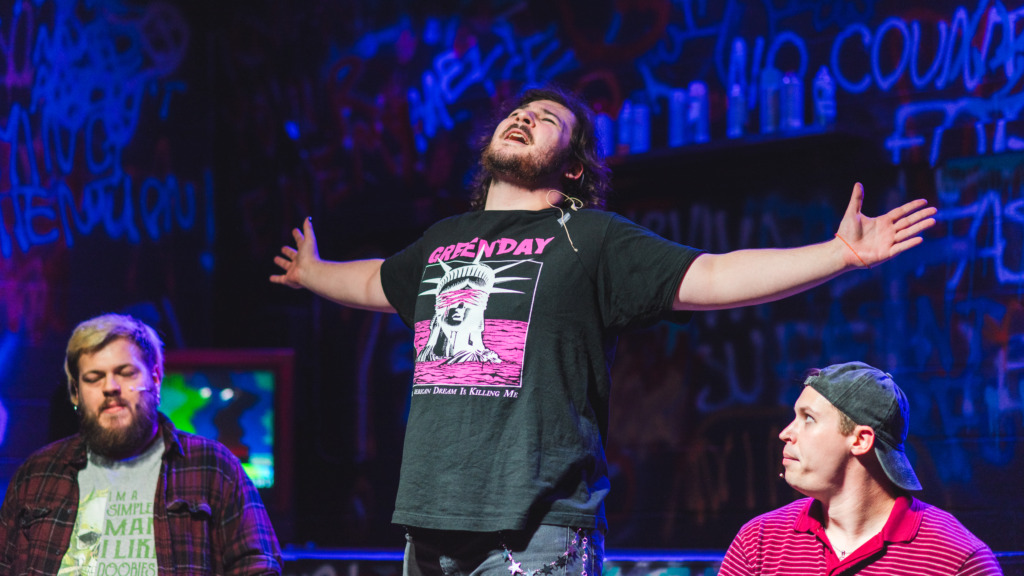
The unique and intimate space of Street Lamp Community Theatre’s black box stage lends itself to the grody nature of American Idiot. Set Builder Kevin Woods has fabricated a step-up platform in the upstage-right corner, spiked a watch-tower in the upstage left corner, and tucked away a pop-out (and pop-up) couch beneath the aforementioned platform. There’s two old-school, thick-screened televisions on stage as well that play video feeds in live time too, but we’ll get to their genius in a moment. The aesthetic crowning glory for this show is the graffiti wall. That is to say, the entire back wall of the theatre space, along with the watch tower, platform and its respective steps, and the sides of the walls that extend toward the house, have been sprayed with hundreds and hundreds of tags— all of which are glow-light/UV reactive, and draw you into this immersion of the album’s concept. It’s a scenic feature that wholly encapsulates the essence of grungy 2004, serving up violent and nostalgic vibes through its mere existence. There’s also spray-paint cans left on shelfs up over the platform, which double up as ‘adults beverages’ and other paraphernalia which just helps you feel the grit of the era in which this concept album was forged.
Director Matthew Peterson, who serves as the show’s conceptual master, designing everything from the costumes to the lighting, programing the live-video (and some of his selections are absolutely jaw-dropping with how well they convey certain evocative moments) and the layout for the spray-paint scenescape of the backwall, showcases creative directorial genius. Knowing how to play with the intimate stage space to create maximum effect, utilizing the platform for ‘concert verve’ and keeping St. Jimmy tucked away up on the watch tower are all done to striking visual and emotional outcomes when it comes to Peterson’s blocking. There are often moments in the production where three different things— revolving around the three main fellas— are happening and despite the cozy physicality of the stage, Peterson has clearly delineated three separate atmospheres, both with his spatial awareness and alignment of the players and through clever articulation of his lighting design. The live video feed on the two screens are miraculous augmentations of the overall environmental vibe and atmospheric timeline; my two personal favorites are the home-movie (of actual baby Matt Peterson) during “Wake Me Up When September Ends”, which inspires fierce nostalgia and a desperate yearning for times gone by because the world in which we live no longer makes any sense and the montage of sapphic scenarios that’s aired during “Rock & Roll Girlfriend” to enhance what’s happening between the Heather character and her fierce on-stage partner in that scene (Kalea Bray.)
Peterson’s lighting design is off the charts as far as being emotionally accurate; it’s also the primer for soaking the audience in this early 2000’s experience, dragging you into the grime, grit, grunge, rock, and overall sensation that is American Idiot. The trippy, harsh red and green blink-storm that rolls down when St. Jimmy goes on his rampage is a meteoric encapsulation of a drug-trip gone wrong. Peterson finds hot white moments and deep shadowy moments, perpetually playing with shadow and mood-enhancing illumination to make this show epic. For all intents and purposes, the lighting in the show might as well be its own character because it is as effective and impressive as the talent on stage when it comes to drawing you in and driving home the show’s message.
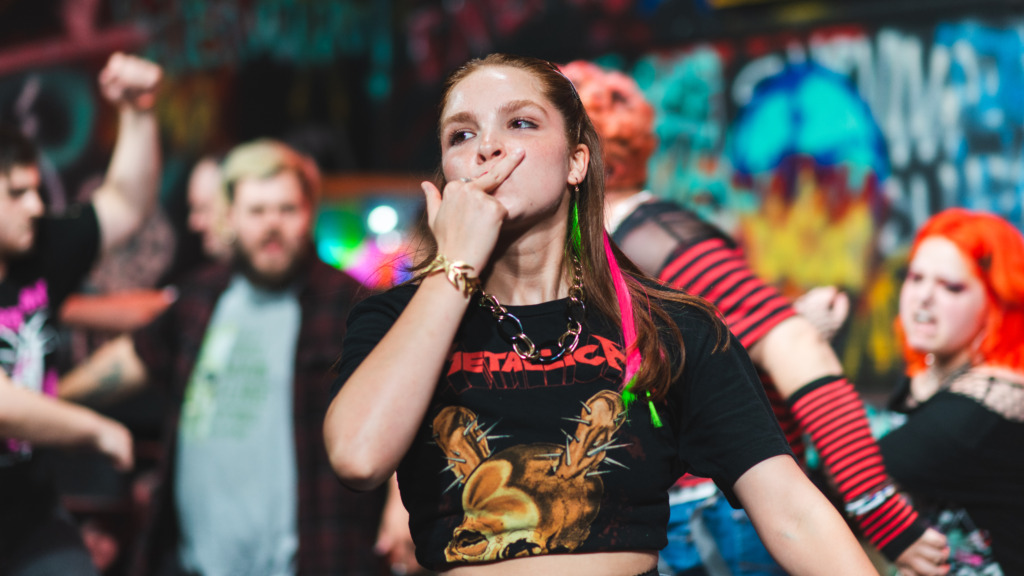
Rounding out the exquisite aesthetic in this show is the work that Peterson and the cast has put into their sartorial selection. Fishnets, mesh-tops, filthy band T-shirts; it’s all there. And it ties the whole essence of the show together sublimely, like wrapping the perfect Christmas present in that holographic foil paper, having all the edges come together seamlessly, and only using three pieces of sticky tape. These costume pieces add that extra-level of intensity, which helps to augment the already unhinged choreography, designed by Choreographer Jake Kline and assistant Choreographer Anna Jones. The jagged, staccato movements which alternate with full-body flinging mosh-pit moves are a noble homage to those wicked-sick concerts of the early 2000’s. But there are also stunning moments— like in “21 Guns” with the company about faces which result in a staggered setup of half the cast facing the back wall and the other half facing the audience and then the switch. Kline and Jones are on the same page as Peterson, fully understanding the space, the music, and the bodies in the space moving to the music and it makes for choreographic perfection for this show. The ‘Dance Corps Derby Girls’ (Sofi Becherer, Syd Goldstein, Lindsay Hamilton, Anna Jones) also serve as the subway train/bus during “Holiday” (with a bonus addition of Molly McVicker in those movements) and it’s a fascinating and clever way to create that ‘transit’ moment without trying to force a two-story scaffolding nightmare into the play space.
Musically the show is sensational. Musical Director Mia Bray (who sits keys in the live pit alongside Zack Patton on guitar, Brett Pearson on bass, and Dylan Marsden on drums) strikes that impeccable balance between rock concert, Broadway show, and musical experience. The harmonies gel, particularly whenever Bray gets the three boys moving their vocals together and this is particularly evident in “We’re Coming Home.” The overall vocal energy roars, the feelings are infectious and rages out to the audience regardless of what the tempo of the number. The overwhelming emotional surges that pulse into what Bray is conducting is extraordinary; you feel every note. Even when it’s grungy and loud. You even get to see Zack Patton, the show’s guitarist, walk up out of the pit-hole at the end and play live on stage with one of the main three for “Good Riddance (Time of Your Life.)” Both Tunny and Johnny take turns having their acoustic guitar on stage, playing in live time and that’s an impressive feat to experience as well.
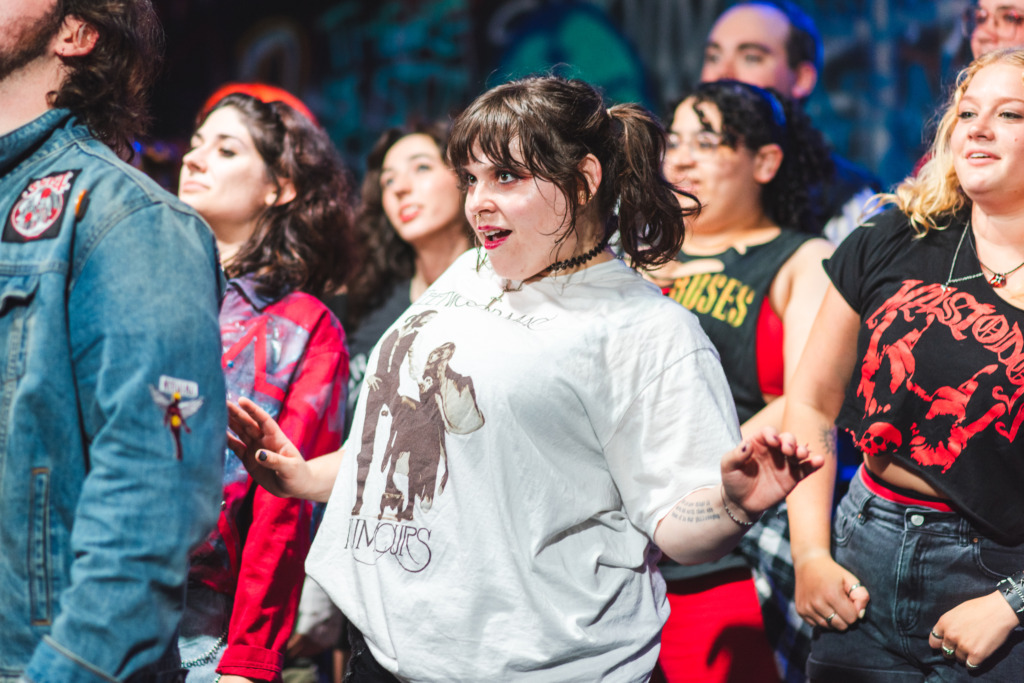
With a stupendous ensemble— Sofi Becherer, Kalea Bray, Casey Casey, Syd Goldstein, Nora Green, Lindsay Hamilton, Cory Huber, Anna Jones, Sophi Kinkus, Molly McVicker, Kai Mellarkey, Dan Michel, Beth Ostrusky, Sarah Paxton, Marissa Price, Riley Wachter— you’re getting professional caliber performances for all of the rocking and raging group numbers. The energy they’re bringing as a company to this production is second to none. Their versatility for emotional intensity is fascinating as well; you have full-blown rock-mosh-rage tantrums coming out of these performers both physically and vocally during “Jesus of Suburbia” and the titular number but then pin-drop stillness and soul-searing slowness during “Boulevard of Broken Dreams” and “Whatsername.” The full-company about-face in “Whatsername” as the eerie ghost lights of memories lost descends upon them, with Johnny shoulder-tap turning them one by one as he searches among them is a harrowing image and the way they slow-parade in that tireless circle around Johnny during “Boulevard of Broken Dreams” is like watching revenants comb the earth, soulless, slowly easing through the motions of pretending to live. It’s haunting and deeply evocative. And the way 15 woman rage on stage for “Letterbomb” is a sight that must be seen and experienced to be believed. There are innumerable moments worth mentioning; it would take me longer to write them all out than the actual 85-minute run-time of the show.
The praises went out to the dance corps already but there’s an extra special shoutout owed to Beth Ostrusky and Dan Michel, who play named-nameless friend support doing harmonic support during “Too Much Too Soon.” The primary vocals on that number are Heather and Will but you’ve got Ostrusky and Michel providing glorious supporting sounds to really smack the weight of that number around, letting the audience feel the blows in hardcore live-time. Molly McVicker, who gets to play the coveted role of Favorite Son, slips in and out of the ensemble— hold your ears when she shrieks her lungs out, it’s threatening to peel the graffiti paint off the back wall, which really drives home the intensity of the experience— and does so with effervescent ease. Her eponymous song is delivered to Tunny with the vocal support of the ‘Derby Girl Dance Corps’ and her vocals roar frequently throughout the performance.
Another character-turn-song-name (or vice versa) is Extraordinary Girl (Isabel Bray.) Sliding out of the ‘orderly’ role and into this exotic, mesmeric hallucination of perfection, Bray rolls into her eponymous number with an unapologetic finesse, enchanting Tunny, the audience, hell even the music feels like it’s moving to her and not the other way around. Bray becomes a living hallucinogenic; seducing Tunny’s nightmares into hyper-saturated fantasies (backed by intense rolling rainbow lights to complete the morphine-induced mind-trip experience) and her power-belts at the end of the number are feral.
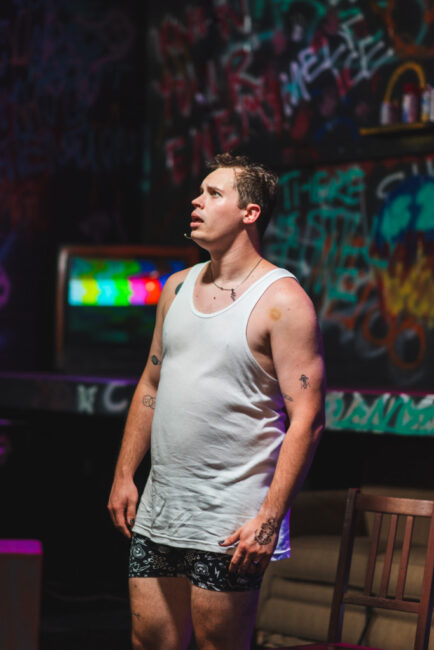
The anguished representation of responsibility appears in Heather (Jessie Simonson.) During the montage of “Jesus of Suburbia/City of the Damned/I Don’t Care/Dearly Beloved/Tales of Another Broken Home” we see Simonson arrive on the stage looking vexed, with facial expressions and body language that carries mellifluously into her verse of “Dearly Beloved” and then the fury and incredulity of her circumstance, which immediately follows when she reappears as that scene and song progress. Her wild outrage moments, up on the platform during “Rock & Roll Girlfriend” (featuring ensemblist Kalea Bray) are furious and humorous, particularly when the pair play one another’s body’s like a supercharged, lesbian air-guitar. Simonson has a beautiful sound that lends itself to her moments in song and you get to hear her emotional tempest bouncing around during “Too Much Too Soon” as well.
Winning my vote for best fishnet aesthetic, in addition to providing sublime vocal talent to the performance, Scout Lacey as Whatsername is a real treat. (Seriously, the ripped holes, blood-threads, glitter-shimmer, and generalized threadiness of her fishnets win Fishnets of the Show, IMO.) “Last Night On Earth” gives us a divine sampling of Lacey’s vocal capabilities but watching her interactions with Johnny and to a lesser degree the interactions with St. Jimmy, are part of what draws you into the narrative journey of this experience and helps to sucker-punch you in the gut every time you think you’ve hit a spot of hope or light.
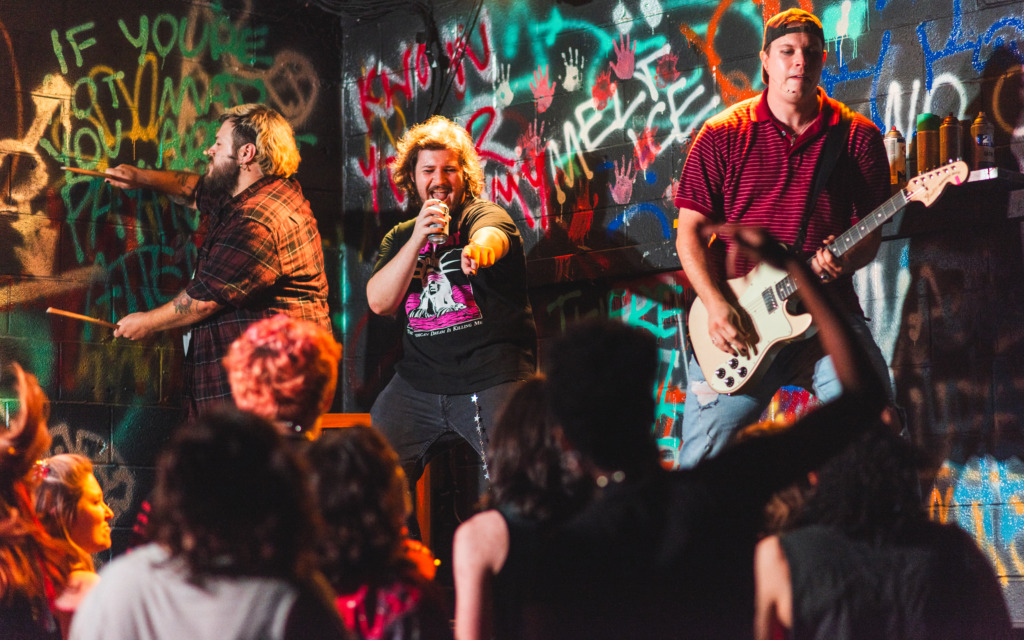
The main three— Will (Gabe Schaffer), Tunny (Pat Collins), and Johnny (Logan Wheeler)— are where the narrative begins and where it ends. Schaffer spends a lot of time ‘checking out’ as Will, between the bong, the video games, and the depression, he’s just clocked off on a different plane of existence and that’s okay. The enthusiasm is there when it needs to be, the melancholy too. Schaffer gets to sing in the quartet “Too Much Too Soon”, featuring the aforementioned Simonson, Ostrusky, and Michel, as well as leading part of “We’re Coming Home.” And the pose he strikes when he takes Simonson’s hand early on at the end of that first montage, before Tunny and Johnny roll out, is really an intense visual, solidifying a choice he later comes to appear to regret.
Collins, as Tunny, is the most facially evocative individual on the stage. The intimacy of the venue helps a tremendous deal when it comes to experiencing all of these deeply passionate and intense emotions written all over Collins’ face, all of which flow down into his body language and out into his voice. The whole sequence of “Before the Lobotomy/Extraordinary Girl/After the Lobotomy” is a harrowing experience and you can feel the agony and uncertainty that Collins’ Tunny is experiencing. His vocals are sublime and really carry the emotional fortitude of this brutal experience.
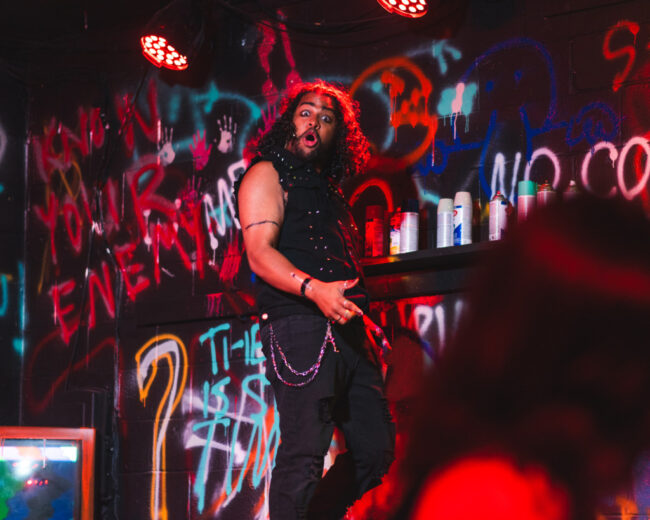
Johnny, oh Johnny, as played by Logan Wheeler, is this rebel without a cause that he truly understands, falling headlong into his drug-induced alter-ego St. Jimmy (Eric Bray.) It’s a fast and furious maelstrom fight between Wheeler and Bray from the moment St. Jimmy is introduced in his own eponymous song. Bray, who vacillates between perpetual states of high-octane volcanic explosion and paranoid observance, is the literal human embodiment of addiction; it’s raw, unfettered, unhinged emotional turbulence completely uncontrolled and off-the-chains. Which is why when Bray hits those crooner sounds, so subtly, so stoically, and so beautifully during “Last Night On Earth” it’s such a blind-siding sight and sound that you’re dumbstruck for a moment just trying to process it. Bray spends a good deal of the show being a chaos demon, with intense vocal growls and shouts that make him St. Jimmy in all that outrageous glory.
Wheeler serves as both foil and replication to St. Jimmy (his Johnny is a part of the addiction/alter-ego experience, after all) and the vocal versatility as well as emotional capacity that Wheeler throws into Johnny is awe-inspiring. Driving a good deal of the show’s turmoil— in moments that aren’t driven by Collin’s Tunny or the utter chaos that is Bray’s St. Jimmy— you get to see a pantheon of negative emotions that churn perpetually under the surface until they’re erupting into song. The intimacy of this particular venue helps Wheeler, Collins, Bray, and Schaffer lean into the pathos of their respective characters, and their facial expressions become as important as the way they infuse their songs with feeling. All four of these impressive players gets their moment— Collins and Tunny’s hardcore sustains loaded with desperate curiosity and a sense of being lost coming in at the end of “Are We The Waiting”; Schaffer’s Will vocally bleeding out during “Give Me Novacaine”, the heart-stopping intensity that Bray’s St. Jimmy drives into “The Death of St. Jimmy” and the harrowing, haunted sorrow that Wheeler’s Johnny spills into “Whatsername.” These all serve as examples of how invested, intricately involved, and utterly impressive the leading four performers are in this production. And being back by a powerhouse ensemble full of a-grade talent certainly doesn’t hurt.
So don’t be an American Idiot. There’s only two weekends and you won’t want to miss their American Idiot; it’s powerful, it’s meaningful, it’s heartfelt, it’s intense. SLCT’s production is utterly mind-blowing, soul-eviscerating, evocative. It’s a must-see this summer season.
Running Time: 85 minutes with no intermission
American Idiot plays through August 3rd 2025 at Street Lamp Community Theatre— 5 Valley View Drive in Rising Sun, MD. For tickets call the box office at (410) 658-5088 or purchase them online.