The instruments of darkness tell us truths. And the most delicious truth, buried deep in a centuries’ old Shakespeare is the one about the tyrant— the great builder of ballrooms that nobody asked for— buried in that delectable speech of knocking with the castaway character of the Porter. But let’s rewind a little, despite knowing that history repeats itself. Not a kingdom for a horse, not once more into the breech, but rather Burnham wood on the march to Dunsinane. That gory, spooky tragedy that haunts the theatrical stages about this time of year more than any other calendar month— Macbeth! It, along with its light and darkness, three weird sisters, and a bubbling cauldron are looming their way onto Silver Spring Stage under the superb direction of Madeleine Smith. Textbook but striking clean with a few curious choices and some exceptional digs at our country’s current tyranny, this production of Shakespeare’s popular Scottish tragedy is most impressive and even keeps itself under the two and a half hour marker.
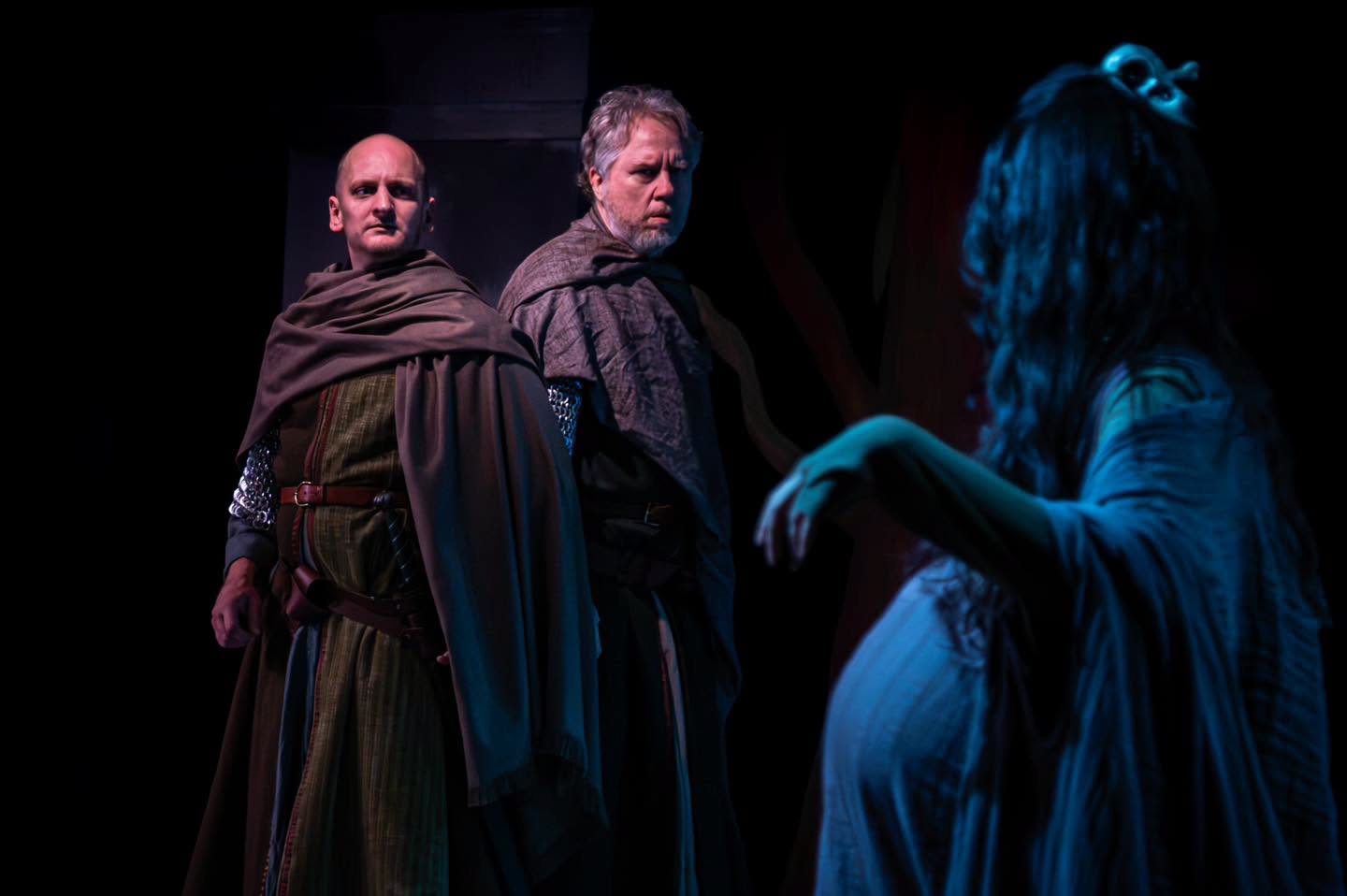
There’s a missed sound cue here or there (I say missed because there’s exquisite sound design that infiltrates the entirety of the production by master conceptualist MaeAnn Ross and it seems wholly inconceivable that midway through the second act the tail end of a scene or two simply don’t have sound programmed for them when all the other moments of transition are covered.) And there’s a pause in a place or two that lingers a beat beyond necessity, but if those are the hiccups with this production, Madeleine Smith and her crew are well ahead of the gambling game that is stage production. Ross’ aural scenescapes are delightfully unsettling, fabricating a cinematic quality into the production, which augments the show’s utilization of shadow, darkness, and tastefully delivered light.
The exceptional balance of illumination comes from Lighting Designer Sam Linc who uses shadows, ambient darkness, and those aforementioned instruments thereof to shed truth on scenes, on dialogue exchanges, and on the power-dynamic, struggle and control battles that envelop the text and unfold within the progression. Linc and Ross work hand in hand to craft something extraordinary that’s difficult to describe as a standalone experience. But if one can imagine a thread of light and a thread of sound weaving its way across stage and actors, that’s the culminative effort of the intense beauty being shaped into existence by these two designers. It’s one of those ‘defies description’ experiences but in a truly positive vein.
This all plays into the shadowy veil that Director Madeleine Smith cloaks over the play itself, which is pretty dark and grim to begin with. While not uncommon to work the Witches/Weird Sisters into the generalized mechanics of the play itself— in this case as in many, they become the castle servants, the assassins, etc.— this is the first time in 15 years and nearly a dozen productions of Macbeth where I can ever recall them having names, or being incorporated in such a fashion that it appears they are under the temporary control of Lady M. This makes for a fascinating dynamic because it’s an uncertain one; did she bid them do her dirty work only to have them get out of control? Or does it just have that potential verve because of how seamlessly they’re woven into the clockwork of this production? Either way it makes for a thrilling watch.
Smith’s overall approach to using the space is impressive. There are recessed sections of ‘woods’, crafted meticulously into the scenery by master carpenter Nola Werlinich at the behest of Set Designer-Painter-Dresser Birdgid Kelly Burge. These come in handy for some of the serpentine skulking about, not only of the Weird Sisters but of other characters as well, and are utilized more fully for scenes that feature sword bashing. Fight and Intimacy Director Bess Kaye has outdone herself with the authenticity of the sword fighting and attack scenes as well as how deeply passionate the dynamic between Macbeth and Lady M is perceived to be. If there’s one choice that begs questioning its Malcolm as Princess. When nothing else outside of the historical purview of the show has been adjusted, why not leave the actor as is and not change the pronouns and gender of the character. Princess Malcom and the battle cry at the play’s conclusion “Hail, Queen of Scottland” just feels a bit odd by comparison to the rest of the performance. But again, alongside a missed sound cue and an extended pause, the production as a whole has little to worry about.
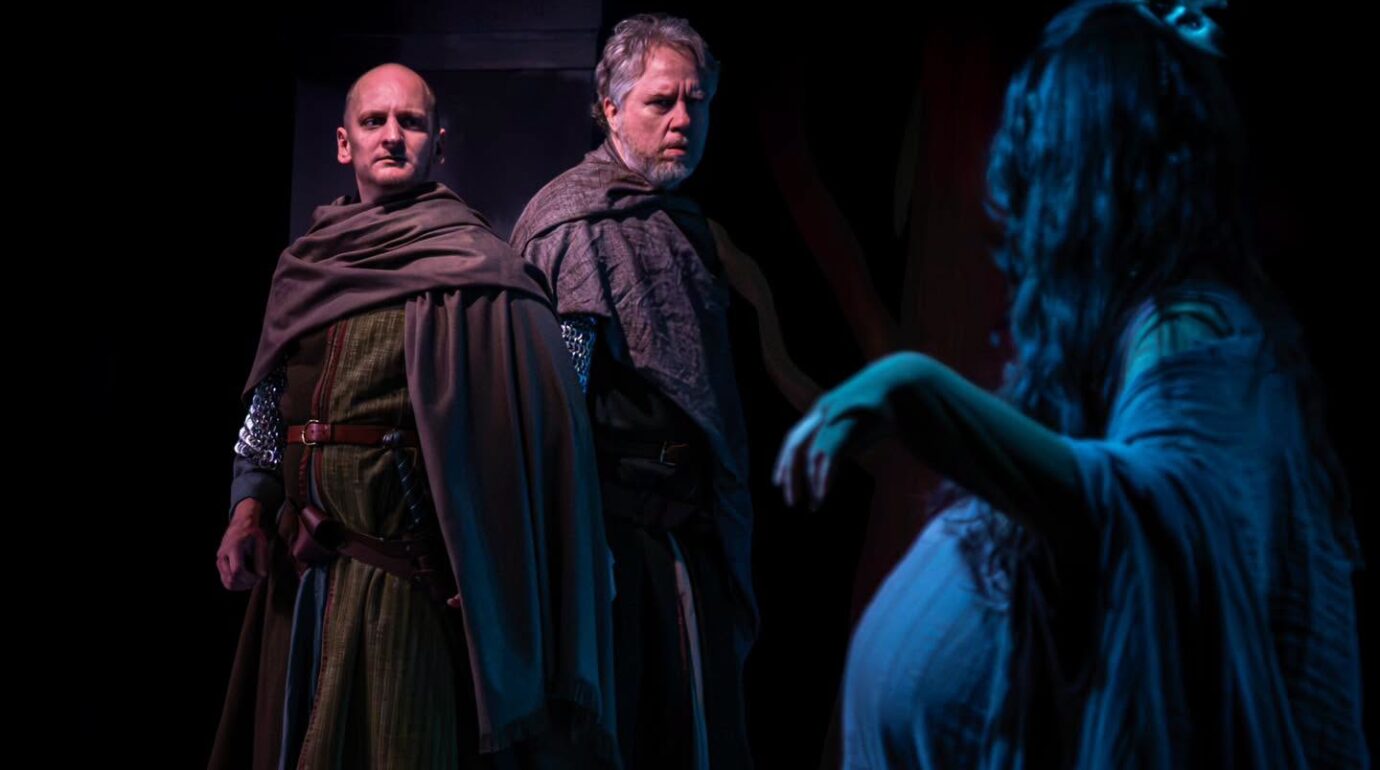
Craftsmanship and care have gone into the show’s sartorial selection as well, completing the overall aesthetic of this high-caliber production. Nathaniel Cavin (on swords and armor) as well as Noral Galil and James Carey craft a 13th Century Scottish aesthetic in a way that speaks of nobility. It’s a solid reflection to Smith’s overall approach to the show and her choice to leave accents out of it (beyond what is naturally occurring to the actors themselves) is a wise one. Smith also imparts a keen understanding of Shakespearean dialogue, all of the exchanges feel both natural and purposeful, moving smoothly whether they are scenes of heightened emotion or those of the more mundane variety. Her most impressive move might be a singular nod to our present situation, with the Porter’s decry of not wanting tyrants who build ballrooms that nobody asked for, but it was most welcome and gives the audience that momentary notion of what could befall the world if we’re not watching history closely.
Even the youngest among the performers has a handle on Shakespearean delivery. Appearing for but a moment with a few wondrous words, Zaina Ashour, as Young Macduff, is as adorable as one might hope in such a role. Julian Dorius, who appears as the fled Fleance, is of similar merit. And although our Princess Malcolm (Irene Denniston) has equally fleeting moments in scene, her lengthy back-and-forth with Macduff (Chris Holbert) is extreme well-received and she holds her own in that high-stakes exchange. Holbert, who eschews the thick Scottish brogue in favor of his natural accent, delivers the character well and when his character shatters at the news of the siege, it feels harrowingly authentic. You can hear it in his voice as well as see it on his facial features.

Others of note, passing in and out of characters and scenes, include Thomas Friend as Young Siward (facing down a most epic battle with the titular character, engaging with rigorous aplomb!) Evan Carrington as the nobly spoke Lennox, Ryan Gilhuly as Angus, and the remarkably felicitous of tongue John Jones as Ross. Watching these characters work around and through one another creates this intricately woven web that plays into the mastery of Smith’s approach to this iconic work. There’s also something to be said for the choice of having Hecate (Erica Irving) never reveal her face. It’s actually quite a beautiful and haunting choice, in addition to serving as the metaphoric representation that a faceless woman, an everywoman, is the master of all the mechanisms at work, controlling the threads of past, present, and future. Of course, Irving gets to double up as Lady Macduff, giving the audience a chance to see her vivid smile and facial expressions in addition to fearing her ominous presence of Mistress of All Witches.
If there’s a cameo favorite to be had, it’s The Porter (J.R. Hontz.) He gets that delightful ‘painter-of-noses’ speech, made even more epic by the present-political-callout, and gets to generally just be silly, drunk-stumbling through words and motions. Smith has done her cast a good service by giving Hontz that much more to do, as he starts off the production as King Duncan, short-lived (literally) as that role may be, and allowing him to conclude as The Doctor. It may be effective casting simply from a ‘smaller-cast’ standpoint but it also draws this curious throughline of all men, regardless of station— be they kings, porters, or learned practitioners of medicines— have the same fleeting importance in their existence and speaks well to the show’s overall vision.
Hart Wood, as Banquo, has a glorious voice. One wishes Banquo had more text just to hear him speak longer. There’s something about the way he carries Shakespeare on his tongue that sounds not only pleasing but as if it carries the weight of the Bard’s own tongue from centuries ago. When he appears at the dinner scene it’s a rather brutal, albeit glorious, expression of what has befallen, and it’s incredibly fascinating to watch this particular expression. So many lean into the vein of fury, revenge, or utter morbid vacancy. There’s a terror, a disbelieving panic painted on Wood’s face and in his…gurgles. The whole of the scene is o’er-watched and manipulated by Hecate and Morta, Decima, and Nona, the Three Weird Sisters.
Katherine Leiden, Tara Scully, and Stephanie Dorius, better recognized in ‘Scottish Tragedy’ format as Witch1, Witch2, and Witch3…Morta, Decima, Nona…and truly, inquiring minds want to know where the idea for these names came from, but these three ladies of stage, of shadow, and of masterful manipulation, ingratiate themselves into the inner mechanisms of the plot, sliding seamlessly in and out of roles like household servants and assassins whilst still very much acknowledging, albeit subtly, that they are the three fates. One of them even perpetually plays with a red string, representing the life-line of those in the purview of these weird, witchy, women. Their physicality is deliciously unsettling, particularly when they’re crouching about, lurking and leering, gazing upon the happenings of these foolish mortals. And their unison speak is equally sublime. There’s just something a little extra about how unsavory and unsettling these three women create presence on stage in their respective roles; it’s a perfect fit for the overarching dark threads that pull their way through this production.
A serviceable tyrant, running a bit higgledy-piggledy through the chaotic landscape of the character arc that belongs to the titular character, Matt Bannister as Macbeth creates an enigma. Soft moments, strong ones, a hybrid of uncertainty and curiosity muddled in-between. It’s a well-rounded portrayal, albeit a curious one. Makes one want to sit and ruminate for a spell or three before being certain which side of the power dynamic he’s on. Mere moments of madness before more calculated affliction, particularly during the ‘Banquo to dinner’ scene. Though there is malice aplenty that underscores a great deal of his soliloquizing. Watching the interactions Bannister shares with Maura Suilebhan’s Lady Macbeth is one of the most extraordinary features of the performance as they are both mercurial and share this back-and-forth, almost tug-of-war but in a well-intended nature with one another. It’s most notable when he returns from Duncan’s chambers, blood on his hands, decrying “sleep no more” and the ‘tough-love’ comfort that Suilebhan attempts to administer in that scene lands as edgy but necessary and wholly engaging.
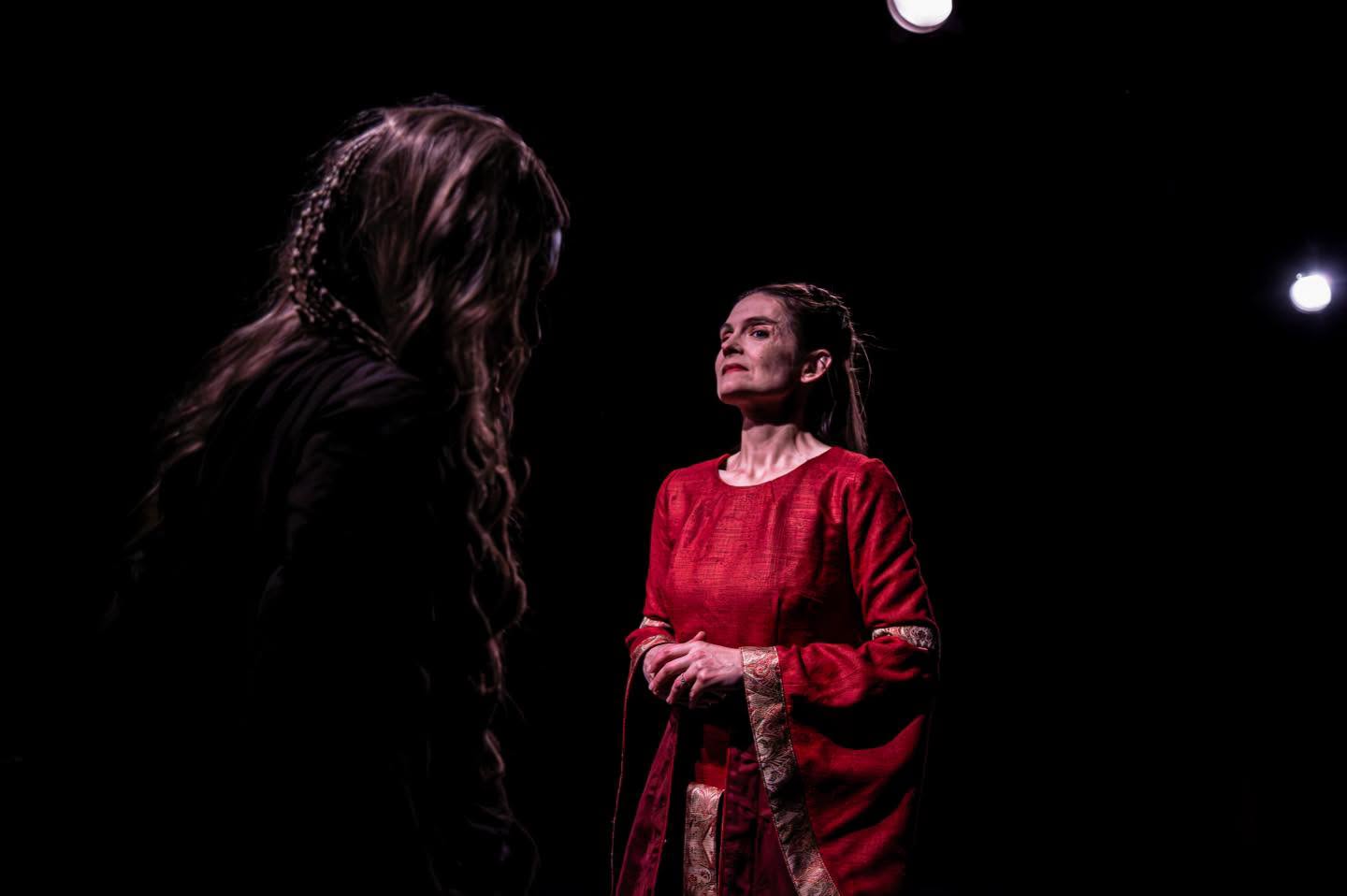
While Suilebhan’s Lady Macbeth takes a more linear course of descent, it is no less potent and certainly no less noticeable. There is ardent fury in her noteworthy speeches and destroyed madness that plagues her by the time she gets to her final scenes. There’s an entire world birthed between Suilebhan’s dominate, controlling, confident Lady M as she reads through his letter, plots firing in her mind’s eye before Macbeth even returns home to the unhinged, haunted, and utterly lost in her own delusional decline Lady M that stalks the stage in her final scene. And the juxtaposition of one to the other is sensational.
Truth shall out in these instruments of darkness; a comprehensive approach to what would otherwise be labeled a ‘back-to-basics’ Macbeth, there’s something impressive this way coming…and it’s come, arrived and settled in at Silver Spring Stage until the 15th of November. See it (especially before November 3rd!) and embrace the light and darkness that this potent power-dynamic struggle of a theatrical endeavor has to offer.
Running Time: Approximately 2 hours and 20 minutes with one intermission
Macbeth plays through November 15th 2026 at Silver Spring Stage— 10145 Colesville Rd, Silver Spring, MD 20901. Tickets are available by calling the box office at 301-593-6036 or by purchasing them in advance online.