They say you can’t remember pain. Maybe you can’t remember pleasure either. What does it matter, it’s all glitter anyway, isn’t it? What day is it? I scarcely know myself. Thursday, I think. Likely Friday by the time this makes print. Likely Friday by the time this show opens. Truth or illusion, though that might be the wrong Albee. Have to keep these things delicately balanced, you know. If you’re looking for something theatrically impressive, a production that will have you marveling at production value, conceptualization, directorial debut-ship, and the overall handling of Edward Albee’s verbose and lengthy script-work, look no further than Station North in Charm City. WFB Productions, returning to Motor House for their second full-length production, is live both this weekend and next with Edward Albee’s Three Tall Women as directed by Teagle Walker. Making his directorial debut with this uncomfortably humorous, beautifully dark, and exquisitely conceptualized play, Walker puts forth an extraordinary production featuring three exceptionally talented actors who will engage you from start to finish on this curiously chaotic whip-it style theatre-ride.
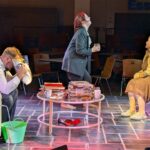
The black box space at Motor House is the perfect intimate backdrop for Teagle Walker and WFB Production’s approach to Three Tall Women. Walker and crew construct a neon lightbar frame to create a proscenium front, though its purpose is deceptively two-fold. As mentioned, you get the notion that you’re looking into a ‘proscenium stage space’ but it also serves to demarcate fiction from reality in a sense. The whole play blurs lines of what is real verses what is recollection and imagined trajectory of existence. And the glowing lightbar makes it almost so you’re watching an episode of an extremely unsettling drama on a glowing television screen. Only it’s live before your eyes. It’s a fascinating concept that works far better than I’m explaining it.
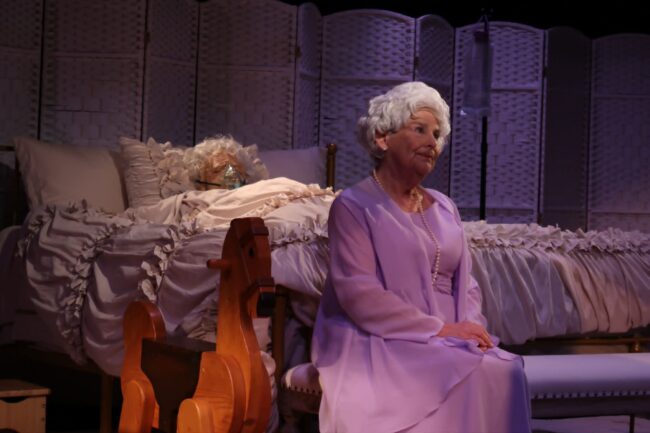
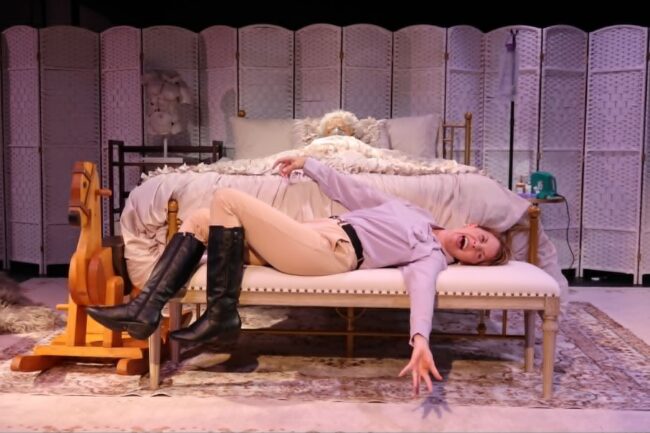
The scenery itself perches precariously on this border of opulence and warped nostalgia. White wicker weave screens create a ‘back wall’ and intimately crunches the play space closer to the audience in a mildly claustrophobic but still perfectly accessible fashion. You want to feel as if you’re right in the bedroom with these women, especially one they step through the glow bar and right into your bubble if you’re in the front row. That said, the space feels a bit like the TARDIS— lavish furnishings like that golden bed with its plush marshmallow-dollop dressings and the double area rug plus the shaggy fuzz-fur rug off to the side. There’s a recliner chair, vanity/desk (which is stuffed to the point of almost dysfunction when the drawer is opened in the first act to reveal papers and such, only to pop right open with a handful of glittery jewelry and bling in Act II) and stool, and a lengthy foot-of-the-bed bench (and a toddler’s handmade rocking horse) that all populate the space tastefully and usefully. It’s difficult to describe because you can readily see the spatial constraints of the play area and yet the furniture appears to take up all the room in the theatre and none of the room at the same time. It’s a bit like being trapped inside some sort of cursed dollhouse, which makes the second act feel even more delightfully surreal while being exceptionally realistic.
Lighting cues are subtle, sparsely used but to great effect when they are. It’s the sound effects— mostly that eerie, otherworldly hum— like if brown noise and tinnitus came together and spawned a horror-show signal— that accompanies moments of extreme dramatic expository expression. It’s a jarring yet equally calming sound; think Hypnotoad from Futurama only subtler and somehow both more and less disturbing. But its used meticulously and succinctly to trigger very specific moments, or rather arrives in tandem with said moments, truly ingratiating itself into he overall theatrical experience; it’s pretty unhinged in the most pleasingly unsettling way conceivable. And though it’s neither lights, scenery, nor sound, Walker and crew are owed mad props for the ‘bed-prop’ (don’t want to give it away) that appears at the top of the second act and becomes a performative staple all through Act II. It’s rather realistic and deserves a bunch of praise for its construction and life-likeness.
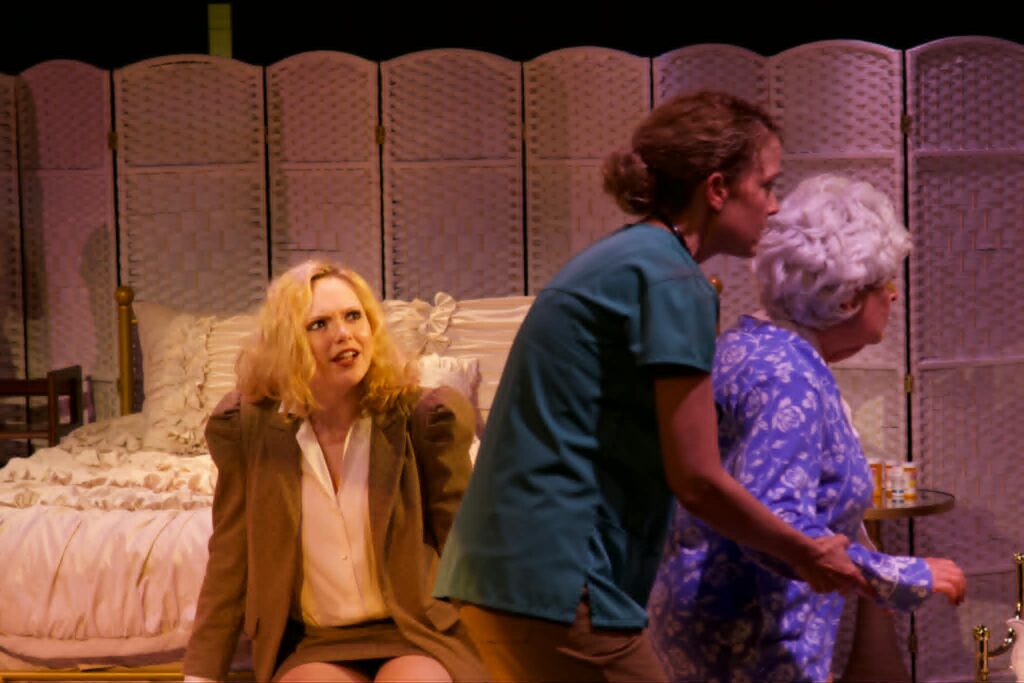
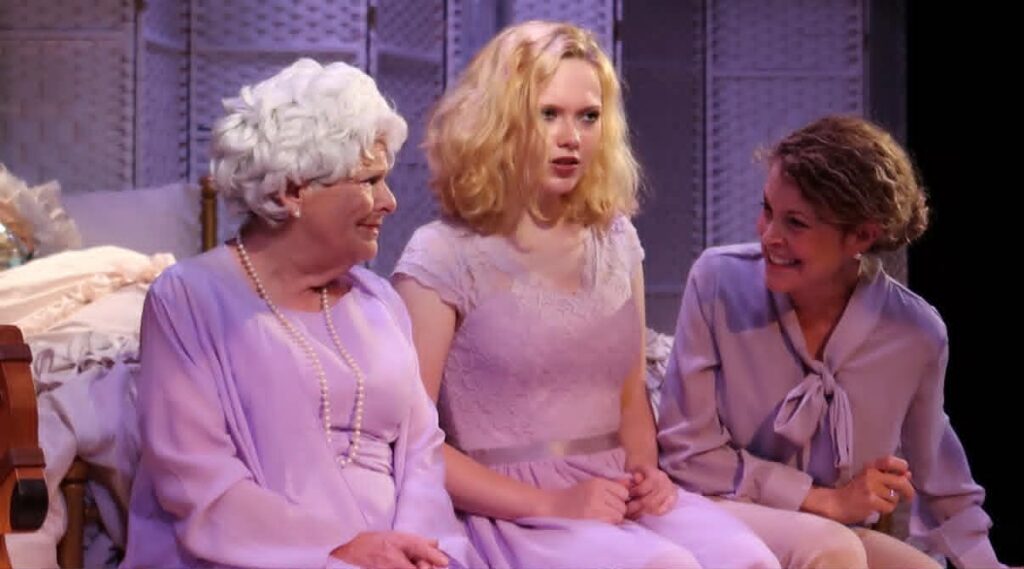
Polishing the production’s aesthetic to perfection is the divided reality of the show’s sartorial selection. The characters— only ever listed and referred to as A, B, and C, (Albee must have been thinking on Beckett)— appear in the first act as their job descriptors might insinuate. C is dressed primly, in a legal-looking business skirt suit; her character is there from the lawyer’s office so this tracks. B is a home-health aide and wearing a scrub top while A is in a typical granny-style nightgown and slippers. Act II sees the radical shift in costumes. Three phases of life represented in three different styles. A diaphanous chiffon affair— think grandmother of the bride— for A, riding trousers boots, and that same flowy style of material for the top on B, and a princess-fit-style ‘young lady’s cocktail dress’ for C. And all in this delicate shade of lavender-lilac. And they all have swish to them. It’s the brilliant intentional approach to show that they are all versions of one another and yet very, very different from each other. It crafts a striking and nostalgic portrait for these three characters.
It boggles and baffles the mind that a young visionary of just 16 years can have such a thorough understanding of Edward Albee’s text, can drive the pacing of this lengthy play and have it feel almost perfectly natural. (It ran a tight two hours and 10 minutes including a proper intermission and there was only one moment early on where a character seemed to slush through a beat rather than letting it breathe; an impressive mark for any level of director when it comes to Albee but all the more so because Teagle Walker is in his directorial debut and about to enter his senior year of high school; this young man has a gift.) The biggest success in Walker’s directorial approach is allowing those little absurdist moments to creep in, balancing them against the emotional severity of the situational experience, and allowing those two warring components to coexist and self-destruct all whilst perpetually moving forward inside of the narrative. And he does that sublimely with an incredibly talented trifecta of women. He also puts the bed to strange use. Don’t get me wrong, it’s a good strange and I’m grateful for the Chekhov Gun Rule in play here as that bed takes up all (and yet somehow not all) of the air in the space but there are definitely moments when actors are all over that bed in ways that just seem ‘odd’ but in the best light possible. It’s hard to accurately describe outside the larger context of the overall experience but it is absolutely not a bad thing. It makes you think, question, mentally thread-pick, and wonder with curious eyes on what exactly Albee was intending, what Walker was intending, and what the Ven diagram of their intersecting thoughts have evolved to be.
If there’s a complaint to be had it’s that at times, A (Elizabeth Levy Malis) is a touch too soft spoken. It’s sporadic and not too often but there are moments where her vocals could use just a little boost, particularly when she’s speaking into/over the SFX of doom-noise. But if that’s the only true problem you have as a 16-year old making your directorial debut on a complex Edward Albee script in a small, professional theatre, you’re well ahead of the curve and the game.
Walker also shows up in the production, though this is an almost completely silent appearance in the second act. There is a moment where words are spoken in tandem with B (M. Eden Walker) and it’s brutally haunting, particularly as the facial expressions align with B’s description of the way that incident went down. And while you don’t really experience much of Walker as an actor, his presence is palpable and only fortifies the second act experience, which is simultaneously married to and divorced from Act I.
In the first act, M. Eden Walker, as B, and Josefina Olsavsky, as C, bristle like oil and water. And then A (Elizabeth Levy Malis) is dredged over their dynamic like a spicy, bitter, and sweet ooze. Blend them all together and you get this crave-worthy actor’s dressing that wholly coats and tenderizes Albee’s crispy vegetal verbiage. What’s wild about the way these three actors transition into their roles of the second act is the little remnants of who they were portraying in Act I still linger, even though— with the exception of A— they’re wholly different individuals now.
The most important dynamic established in the first act is Malis’ bond with her character’s own limited existence, both physically and mentally. You get a really impressive bow-legged, hunch-waddled physicality on her every time she’s up from the chair. And there are excellent moments of confusion and fear that flit across her face when she loses her place in an anecdote or can’t quite remember whatever it is she was talking about. You can almost readily throw away both Walker and Olsavsky’s character creations from the first act because they become something else in Act II, though their utterly furious bristling with one another is highly comedic. There’s a brilliant moment where Olsavsky is seated at the vanity-desk, Walker is on or near the bed, perhaps even just standing, and Malis’ character lets another inappropriate slur slip out of her mouth— and by comparison this one is mild— and Olsavsky just flop-bangs her head down onto the desk in utter ‘I-give-up’ and it’s absolutely hysterical. Walker has a similar moment when she’s pulling faces at Olsavsky before that happens; the pair really do bicker like children.
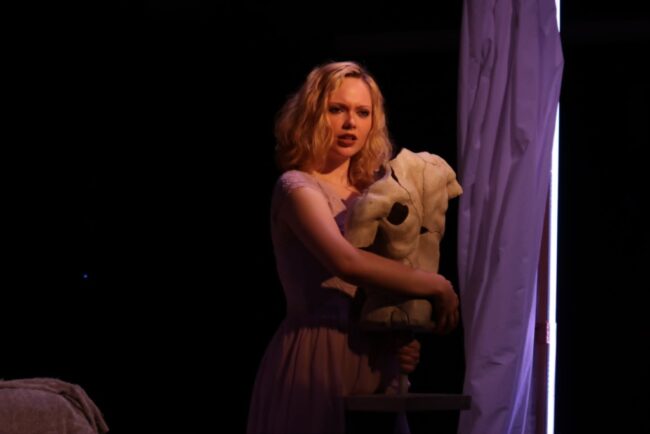
There’s an overriding sense of juvenility in all three of the characters, though it comes and goes briefly in all three of them in the first act and mostly funnels itself into C for the second act. It’s fascinating to see those threads of simple petulance and ignorance winding their way through each of the three characters at various moments throughout the performance. There is this beautiful monologue— half soliloquy half interactively disrupted by the other two— that Olsavsky delivers when she’s recalling or live-time reliving her ‘mannequin’ shop girl days and it’s thrilling to watch. It’s on par with her narrative retelling of the jet-black-haired-violet-eyed ‘first’ story. There is this radiant unlearned blissful ignorance about Olsavsky for the early parts of the second act which slips steadily into dismay, fearful loathing, and a frenetic decomposition of nerves, it’s actually quite sublime to behold. Olsavsky, also about to be a senior in high school, has a thunderously impressive command over her stage presence, her dynamism, interactivity with the others, and the general understanding of the role she plays in this particular Albee play.
M. Eden Walker has a fascinating versatility about her in the role of B, particularly in the second act. And when she has that earth-shaking meltdown there is a fury and a blinding rage that unsettles the bones and pinches the nerves to attention; you can feel the seething disquiet radiating tsunami style across the stage and it is intense! There are subtler moments in Walker’s performance too that are well worth mentioning, like her recollection of the stable hand and all that entails. The way she attempts to rebuke what Malis’ A is telling her about who she becomes, a mirror reflection but distorted through time to the way Olsavsky’s C was reacting and rejecting Walker’s expression of the same thing. There is a lively vivacity to Walker when she’s delving into the grit of what happened to their father. The way she engages with the text there is purely stunning. And her unabashed ability to let loose at a moment’s emotional notice is incomparable and wholly evocative.
Straddling two awkward sides of the same aged coin, Elizabeth Levy Malis, as A, gives the audience both versions of this lady in her dotage. You get the easily confused, agitated, grumpy and cantankerous stereotypes played to their fullest potential in the first act. You get the seasoned, wizened, wholly unphased by the passage of time, sense of acceptance from her in the second act. They are vastly contradictory and yet never once do you not recognize that they are the same character in different facets of their mental and physical capacity. There is this gorgeously tender moment at the very end of the production, Malis has come forward to talk about ‘the best moment’ and there is this teary-eyed sensation she jerks forth from your heart as she explains exactly what that means. There’s catharsis in it. So much so that you want to dig Albee up and brain him for allowing B and C to continue to interrupt her self-described rambling. There’s an elegance to Malis in the second act, even when those ornery traits from act one flare to life. It’s magnificent.
The working dynamic between the trio, particularly in Act II, is sublime and you couldn’t ask for a more engaging theatrical experience with this play. It’s impressive, hands down, across the board. Two weekend, limited engagement run; absolutely worth attending. ‘Enjoying’ is not the right word as this play will unsettle you and discomfort, but you will laugh and you will feel and that’s what theatre’s all about, is it not?
Running Time: Approximately 2 hours and 10 minutes with one intermission
Three Tall Women plays through June 28th 2026 with WFB Productions at Motor House— 120 W. North Avenue in The Station North Arts District of Baltimore, MD. Tickets are available at the door but advance tickets are strongly encouraged and can be found online.