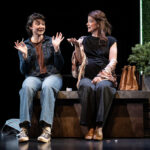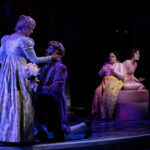
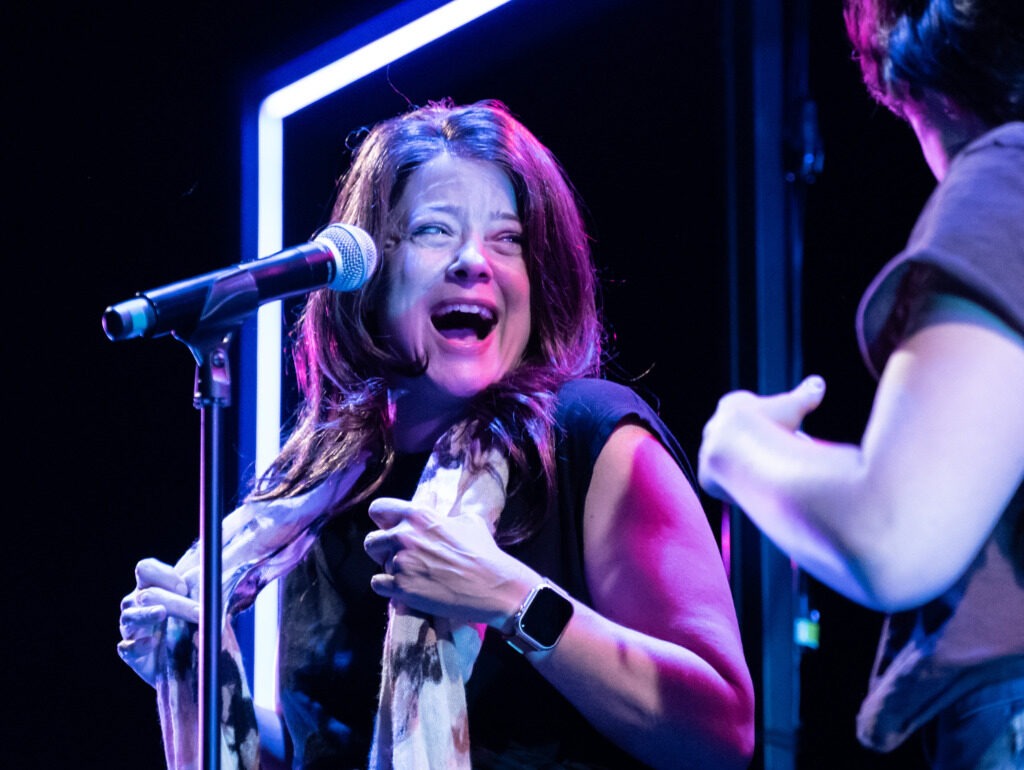
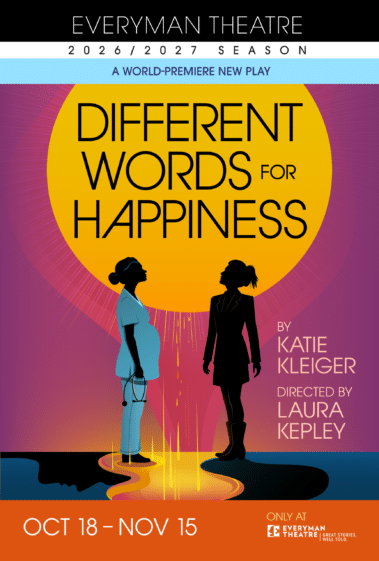
Intjoyity— the particular flavor of happiness felt when interviewing creative minded folks, often specifically playwrights or actors, or playwrights who are actors. And this is most certainly a feeling of Intjoyity. The construct of all these various fictitious words for varying degrees, types, and kinds of happiness comes from Katie Kleiger’s play Different Words of Happiness, which is currently making its world premiere at Everyman Theatre. In a TheatreBloom exclusive phone interview, we’ve had a chance to talk with Katie Kleiger (currently in the national tour of Operation Mincemeat, at the time of the interview in Toronto) all about the play and its joyful, happy existence.
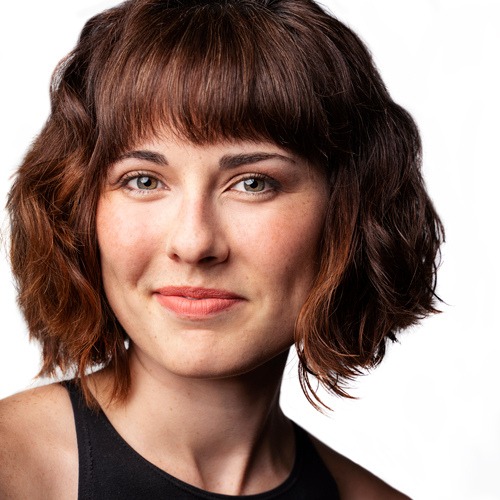
Hi Katie, thanks so much for giving us some of your afternoon, I really appreciate it, and I know the readers will. How’s it going in Toronto right now?
Katie Kleiger: It’s going pretty well; the weather is actually pretty great. I’ve been surprised. I’ve never been here but it’s in the 60’s today and I’m all about it.
That sounds wonderful, we’ve actually got similar weather back here in Baltimore. I was really very taken with your work and so excited that you could find some time to talk further about it, I really want people to get out and see it and discover the joy that it is.
Katie: Thank you, that means a lot, I really, really appreciate that. I’m really glad that you were able to be there on opening. I’m hoping, as well, to spread the word and get more butts in seats! You reaching out and doing what you’re doing really means a lot so thank you!
Absolutely! I love getting to see new work not only make it but thrive, especially when it’s this good. And I think the general public struggles so hard with wanting to take a chance on something new, even when they know the theatre that’s producing it produces quality work. But your show has such heart and intentional meaning behind it, I really believe that the world at large will benefit from experiencing it.
Katie: Thank you, thank you so much.
Of course, so let’s get into it! You’re Katie Kleiger, as we know, the playwright of Different Words for Happiness, which is currently receiving its world premiere here at Everyman Theatre in Baltimore, where you are a company member. I’ll start with a fun one— what is your favorite made-up word for happiness?
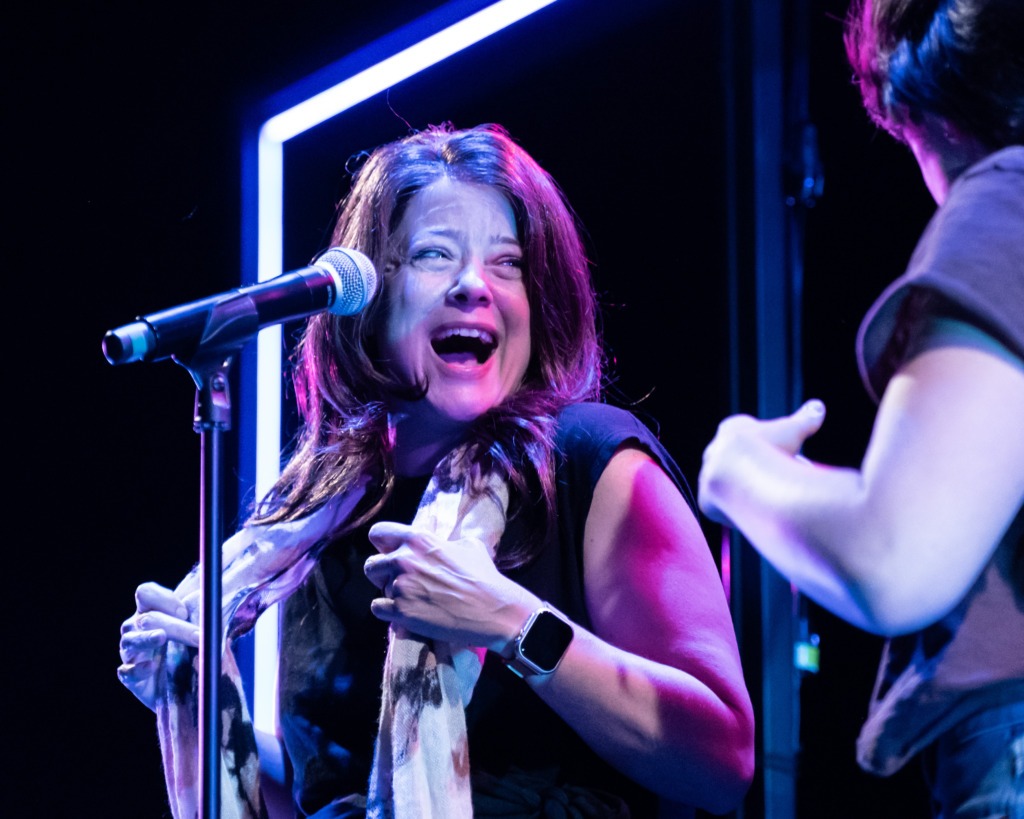
Katie: There are little snippets throughout the show— and I think all writers can agree with me on this— but little bits and pieces of real life always make their way into our shows. The story as a whole is rarely ever copied and pasted from real life but little tiny bits are. And this exercise is a real thing that I did with two of my best friends almost ten— no, eight years ago. There is one word that made it into the show that I actually use in my regular vocabulary, which is Sanswei. That is a word that I use quite often. My husband uses it, my friends use it, it has kind of become a real word to me. And that is the happiness from a weight being lifted. So often, for me, it’s used when a hard work day is over or something I was dreading. I get headaches a lot and there’s always that moment when you realize that the headache is gone and I like to acknowledge that moment. I feel like with physical pain, we’re always so aware when we’re in it and then we’re way less aware when we’re not in it. I always like to have this moment of “Oh my God! Sanswei! The headache is gone!” and celebrate that moment. That’s definitely my favorite.
I absolutely love that for you. What a creative mind you have! Now I noticed, upon seeing Different Words For Happiness, that it felt very intentional that the character of Nathan was left almost ‘out of it’ entirely and yet he did get that really relevant and heavy scene at the beginning and then appears again briefly later. Can you walk us through your creative process with Nathan? Did you find you needed or wanted him more or less, does he need to be in it at all? Where do you sit with the Nathan character in regards to how he ended up as he presently is?
Katie: I have a few thoughts on that. The very first thought, I think, goes back to the very first draft, or maybe even the first two or three drafts, but Nathan was a voice. Not a floating voice, but someone off-stage on a God-mic.
A disembodied head maybe?
Katie: Yes? Not an on-stage actor. And then I had someone read the script and they said, “This is a play. It doesn’t have to be real.” I think I thought well it’s a phone call on speaker phone so we don’t see him. I also think that part of my original idea behind that was another attempt at me trying to decenter him. However, I’m so grateful for the woman who said “Why can’t he be on stage?” And that evolved into “let it be up to the production as to how they interact.” In the script there’s just a phrase that says that throughout the phone call the Nathan and Ava character may choose to make eye contact, they may choose to share the same space or not share the same space at any point. And there’s no stage directions about when they look at each other or when they enter each other’s space at all. So all of the blocking you would have seen on opening night was specifically designed for the production happening at Everyman.
Oh wow.
Katie: And something that happened as I continued to write the play was I developed a very strong care and kind of protection, I felt very protective over Nathan. I’ve found this for any kind of “antagonist” that I’ve ever written, but because I’ve been an actor for my whole life and have played characters who are antagonists, you know when the writing isn’t taking care of those people. And you know when they’re there just to serve a purpose for another character. I think it’s really important to me that someone who might obviously seem like a “bad person” or a “bad guy” is not actually a two-dimensional antagonist. I think over the course of writing and re-writing this play, I wanted Nathan to be a character that a man would want to play, like a complicated, challenging role to mine. Where it’s not just what you get is what you get on the page. I don’t want him to be there just as the inciting incident for someone else’s story.
I’ve said before this play could easily be Nathan’s play. In a different writer’s hands, we don’t see Ava again and it’s actually a play about Nathan and Eleanor and not Ava and Eleanor. I wanted them all to have heart and be real humans with real needs and real obstacles.
I think you achieved that beyond successfully, and obviously with the women it comes across very clearly that they are dynamic and real, but with Nathan, at least for me and what I observed, I wanted so desperately to hate that character and just punch him in the face. But you’ve imbued him with just enough of this humanity that you can’t hate him. It’s very easy to hate a two-dimensional, static, means-to-an-end antagonistic catalyst. But you’ve made him real and I think that is a beautiful ‘care of character.’ I love that for both Nathan and for you.
Katie: Thank you, that really does mean a lot to me.
You’re welcome. Now, as far as Ava and Eleanor goes, as we were talking about little bits of ourselves sneaking into our writing, do you find that with this construction of these two female characters, are there parts of you, Katie, in either one of them or maybe even in one of them more so than the other?
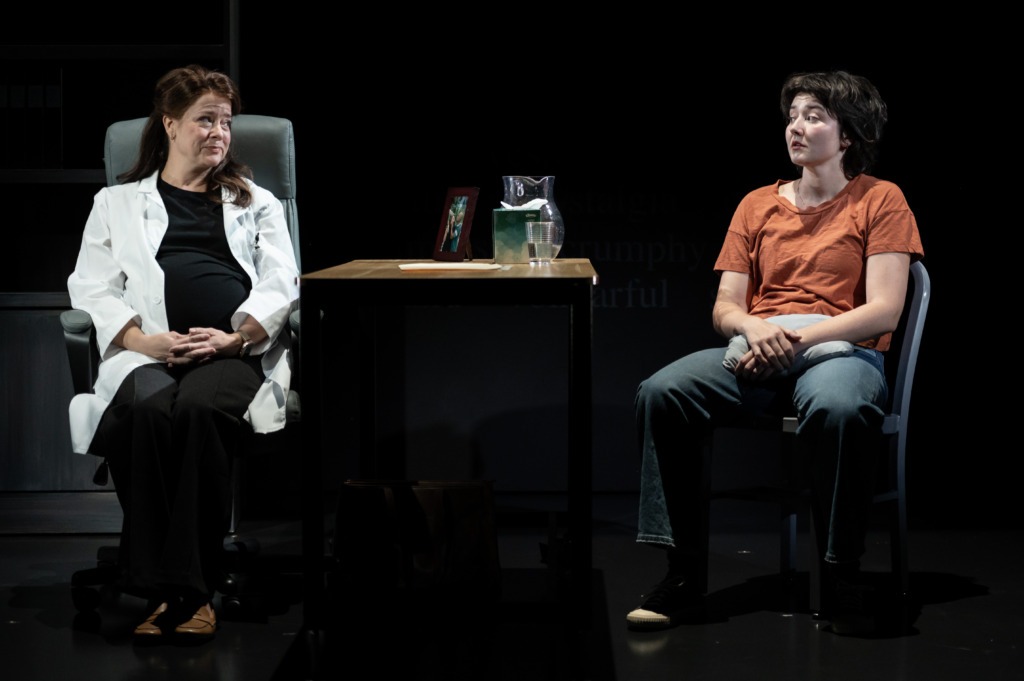
Katie: Yeah! I think anyone who has met me will recognize parts of me in Ava. Just simply from the way that she speaks and her sense of humor. I would definitely not say that I am Ava, but in terms of a character that I wrote in my voice, Ava comes the closest out of any character I’ve written in any play. It’s about rhythm and a sense of humor. When I was writing her, I was little bit more stream of conscience. I wasn’t editing my gut instincts and I was allowing my own cadence to come through. I wrote her when I was 30, she’s 30, and there’s a lot of overlap. But there are also so many ways in which we are so, so different. She is so much braver and so much more bold and brash and out there than I would ever be. Maybe she’s a version of me without social anxiety or barriers.
With Eleanor, it’s interesting, because I wrote Eleanor not as a foil to Ava’s energy but I did want them to feel very different. I think Eleanor’s initial reserve and guardedness and what I think can come across as coldness isn’t necessarily something that I related to. She’s someone who’s been constructed over a period of time from many different people I know and no one person in particular. I had a gynecologist who I was thinking about sometimes when I was writing her. And there are bits and pieces from friends of mine in her life. She was the slightly more foreign voice to write. I was more intentional sometimes with how I was choosing Eleanor’s words. Not that I wasn’t intentional with Ava, it just came more naturally, I think.
I think I know wha you mean. With Ava it was coming from inside, all at once, and there was far less of the ‘let me go back and make sure that sounds right’ whereas with Eleanor it was a ‘does that fit the character I’m constructing?’ because she was less you.
Katie: Exactly! Exactly that! I think that is actually a way that I’ve been writing more. I can’t write an Ava into every play. I think it’s easy to write a version of yourself, though I don’t want to necessarily say I’m a version of Eva, but I think you get what I mean.
I do, actually.
Katie: So it’s that and that makes Nathan and Eleanor feel a little more constructed as I went along.
Perfect. Where did this come from? There are certainly some playwrights who just say, ‘I’m going to write a play, I have an idea, BAM’ or there are some people who use playwrighting as a cathartic exercise, even if the topic and themes in the play don’t read true to specific life experiences, to help them work through something. Where did Different Words for Happiness come from for you, in whatever of that you’re comfortable with sharing?
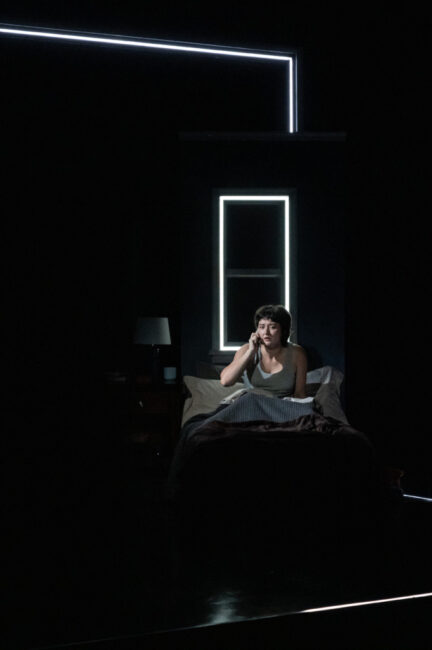
Katie: I had three images in my head that I was playing with. And I’m writing a new play right now and I’m realizing this is kind of how my plays start— as images of moments on stage. Everything kind of branches out from there, but the actual image that sparks everything never goes away. It finds its way and stays in the final product. For this one, the very first image I had was a phone ringing on stage in a totally black stage. And a phone ringing like three times, ultimately someone picking it up and then their face being illuminated by the phone.
The second image I had was the pap smear. I had had a lot of back-to-back-to-back gynecological visits in my 20s and at the time it was seemingly never-ending. There was just one thing after another and there was always something new they would find. It was this weird twilight zone of “I’m never leaving this gynecologist office.” And then I just became obsessed with this idea of really just doing the pap smear on stage. And that became the second image.
Then the third image I had, and it was the first night I was writing this play. I was at this writer’s retreat with my friend, I had no intention of writing a play, I brought my guitar because I was going to write music. But then I thought, “eh, why not, I’ll just start writing this first scene.” And it was the second day, when I’d written the first scene and I said, “I really, really, really want to write a play about karaoke.” I am obsessed with karaoke. I think it’s incredibly cinematic or theatrical. In college, or high school, it was either high school or college, I wrote a one-act about a karaoke bar. And it was so bad. SO BAD. But I’ve always been so drawn to that. And my friend said “why not write that into this play?” And at that point I’d already been outlining this work, the scenes at the gynecologist, and I said “karaoke has nothing to do with this play!” And she said “well it could.”
And those were the one, two, three where it started. And then it became about stringing it all together. And it went through a variety of iterations. The first draft that I got very far with but didn’t finish, in that first draft? Eleanor was a completely different person. She was the most passive, kind of dumb and I didn’t mean to make her dumb, but like super ignorant, so happy, so in love with Nathan, had no idea that anything was wrong. And then when Ava sees her its “but she’s so in love with Nathan, I feel so bad.” And then a friend was reading it and asked, “What if she’s miserable?” I know I’m digressing but I find it funny to think about all the different versions of what this once was.
Oh I love hearing the transformation process. At least for me, when I see something, I struggle to imagine it being any other way, and then hearing that it had a previous incarnation or other iteration is just sort of mind-blowing to attempt to juxtapose them together, at least for me. And you’ve given me the springboard for my next question by mentioning karaoke. Is it set in the script that the song that gets sung is THE song or have you given that more of a dealer’s choice component?
Katie: Great question! I am pulling up the script because I want to read what I wrote. And in the scene it says “Dreams” by The Cranberries comes on, see note on music. And this is the note I wrote on music:
“There is a song written into the script but I once heard that sound designers hate when specific songs are written into scripts, so while I want to say I don’t care what song is chosen for that moment, I do think this song works well. If it’s not that song it should be a song that’s instantly recognizable, pre-2005, a total bop, and inspirational somehow. A runner up for me was “Someday” by The Strokes. It’s probably not “Don’t Stop Believing.”
OH GOD!!! I LOVE THAT SO MUCH.
Katie: I don’t want to throw anyone under a bus, but I workshopped this play somewhere and I was on Zoom because I was in a show, so I was Zoomed in for the rehearsal and they said, “I don’t know ‘Dreams’ by The Cranberries can we pick another song?” And I said sure, you know, whatever, I guess. And they said “What about ‘Don’t Stop Believing?’ And I shouted “Absolutely not! NO!” I was so mad. I was so mad that I had to put it in the script. I did not want to show up to a production of this script with that song because I feel like then everything will have been misinterpreted.
Agreed! And let me just express, as a personal gratitude, when the karaoke bar came up during the play I had the rolling dread-agony thinking that it would be “Don’t Stop Believing” and I was so thrilled when it was “Dreams.” I was over the moon. Now, Katie, obviously you do some karaoke, what’s your go-to for karaoke?
Katie: You know I have a list on my phone, just like Eleanor. That part of Eleanor is very me. So I’m going to pull it up. I do know off the top of my head, I know my number one, which I’ve done so many times I probably do need to switch it up, but go-to karaoke song is “What’s Up?” by 4 Non Blondes.
I love that. I can hear you singing it in my mind.
Katie: Yeah. I think at this point it has become such a go-to karaoke song for me that I probably need to change it, but I’ve got to be honest with you. I do it really well. If I need to feel confident in myself or I’m in a situation where I just need to pull something out, it’s a good one to do. But I do have other songs. What else do I have? Let’s see. Alanis Morissette can be good—
Oh that’s my go-to right there. “U Oughta Know” and it’s the same for me, I do that one really, really well and if I’m getting up to feel confident in my karaoke, that’s my absolute go-to.
Katie: Oh yeah. I’ve got some ABBA here and— wow, there’s a lot of songs on here that I’ve never done. But I love karaoke.
Me too. Speaking of lists, I’m going to make the gentle assumption that you also have a bucket list, maybe also there on your phone or maybe it’s in your head. But what is something that’s on your bucket list that you haven’t done yet?
Katie: Literally jump out of a moving car. That was mine. A few of Eleanor’s are mine. Like throw my phone in the ocean was mine. Her weird ones were mine. But what else is on my list? I guess I don’t have it here on my phone, I think I used to or I thought I did, but I’m not seeing it. There’s a lot of travel things for sure, like Iceland, Japan, and things like that. Own a house with a garden. Have a garden is a bucket list item. I know that sounds so normal, but for someone who has only lived in apartments in cities, I want a garden.
I mean I too would love to have a garden, I even have the property for it, but I kill plants. With accidental negligence. I think for me, right at the top of list right this moment is go skydiving. That’s always been there for me, but being 40 now, I think it feels like more of a priority. I love that you have a bucket list that is not terribly dissimilar from Eleanor.
Katie: Yeah, she and I have that in common, maybe that’s the part of me that’s in her.
I love that for you and for Eleanor. What is it that you are hoping that audiences are going to take away from seeing Different Words For Happiness? What do you want them to take away from this experience?
Katie: I’ve said this and I don’t want to repeat myself but I do think that it’s true, which is I will feel like I’ve done my job, that I’ve successfully pulled this off— and I already feel like I have. But it will be extra special if there is one audience member a night who walks away feeling like there was something that they themselves have felt that they have not really been able to articulate or maybe they have been able to articulate it, but felt alone with their feelings in it or that they didn’t know that they could say it out loud and they saw that in what was happening on stage. I think there are a few moments in the show with these hidden feelings. Maybe they’re taboo, maybe they’re not what you expect. Whether that’s Ava’s response to her diagnosis, or the taboo of being the other woman, or Eleanor’s response to being pregnant. I’m really interested in the idea of articulating these hidden feelings and hopefully finding that there are people out there who maybe have felt them too. And that there’s some catharsis from that.
Absolutely. What would you say has been your biggest challenge in this whole process?
Katie: I think logistically, I do think about the alternate universe where I would have been able to be more involved in the premiere. And I do think what we worked out worked and I do think the production is amazing. I do think in the alternate reality where I was there ‘in-person’ more and was more hands on that would have been really fulfilling as well and really special to see more productions and be in those rehearsals. I know that I’m not there for a really amazing reason and I do still think we were able to mine my and everyone’s time, update the script, have all these zooms, and it all worked out.
From inception with this script, a challenge for me was taking myself seriously and knowing how to talk about myself and put my foot forward with confidence and belief that I had something to offer. I think that I’m better at it now than I was two years ago, much better. But there’s still leaps and bounds to go. I think it’s really hard to believe that you have anything important to say.
I do understand that, I really do. I get the doubt. I think you do have a lot of really important things to say. And I think this is a— I like to call them the “EveryPerson Plays”— when the appear at Everyman Theatre and meet the marker of being accessible to everyone. This is that, for sure.
Katie: Oh thank you.
What has been your biggest personal takeaway from this whole experience? What are you taking away from having put your heart, soul, spirit, words, intentions, and ideas into this play that is now having its world premiere, open and living a life of its own, what’s the takeaway from that for you?
Katie: I am so grateful that because I wasn’t able to be hands on, as hands on as I had wanted to be, that the group of people who put this on and were boots on the ground, the creatives that were in that room, I’m so glad it was those people. For me, I was learning how important it is to have collaborators with a premiere, especially when I can’t be in the room, that I know and that I trust. I never felt like these characters or this play was in the wrong hands. There’s a whole other level of stress and anxiety that I never tapped into that I know could have been there if I had chosen a director who I didn’t know, that I didn’t trust. And they’re all so great. Megan Anderson (Everyman Company member playing Eleanor) I’ve known for almost nine or ten years now, knowing she was Eleanor, knowing Em (actor Em Whitworth playing Ava), who I’ve now known for shockingly only a year but whom I consider to be a very close friend at this point, and Maboud (actor Maboud Ebrahimzadeh playing Nathan) who is an incredible actor, I just felt like it was an embarrassment of riches. I think my takeaway is that collaborating with people you trust is really important.
I feel that. Having seen Megan Anderson on stage for the better part of 20 years now, and getting to see her do something that was so— and I don’t want to say ‘out of character’ because Megan is the pinnacle of versatility— but getting to see something that she doesn’t generally get assigned to her was pretty thrilling.
Katie: That’s exactly how I felt watching her. I felt like I had never seen her access that side of her and I couldn’t tear my eyes away from her. It was so breathtaking to see her so dropped in the opposite of a people-pleasing character, seeing her be this really heavy and complicated woman, she did such a good job. I mean everyone did such a good job, it was just so— again, an embarrassment of riches is how it felt. And the designers too, knowing that I had Juan (Juan M. Juarez) as the lighting designer, that Daniel (Everyman Company member Daniel Ettinger) was the set designer, having these people that I know and have worked with, what an incredible way to collaborate when you have a shared vocabulary.
That must be such an incredible experience. You’ve been a company member with Everyman for a while now, yes?
Katie: I think it’s eight years? Let’s say eight years.
Embarrassment of riches is such a beautiful phrase for it. To get to work with these people, this company, that you’ve had in your collaborative, creative corner for nearly a decade, and to get such a rich, enriching, and riveting experience from it, what a wonderful thing. And I know we talked about what you’re hoping will take away from seeing Different Words For Happiness, but why do you want them to come out and see it?
Katie: I think that this is a show that on the page, you could say “oh, this is a show for women in their 30s and 40s who are going through a midlife crisis.” I gotta be honest with you, I’ve had more men come up to me with tears in their eyes than woman. And maybe it’s even, maybe it’s 50/50 I haven’t been counting, but the amount of young men, old men that I have spoken to— I’m amazed. I think there are universalities that I wasn’t even aware of in these women’s journeys that strike a chord with people. I think it’s different things for different people. I think there are different moments in the show that will hit. Whether that’s the medical journey or Eleanor’s pregnancy journey or Ava and Nathan’s journey. How many people have been Ava in that situation, how many people have been Eleanor, and how many people have been Nathan? I think that a lot of people might find themselves relating to one of the three at one point and I think I’m going to go back to the idea that there’s catharsis to be found in live theatre in general. I believe there is in this play.
You are 100% correct; there are levels of catharsis built into this play for sure. And as someone who has been in the Ava situation, it is definitely— I think like you were saying earlier, it creates that safe space where you can feel like you’re not alone. Now we get to see there are other people out there who are finding themselves in these situations that we’ve lived through or are living through or will live through, and seeing that on stage creates this sense of freedom around it, it gives us permission to say ‘I’m not alone, I don’t have to feel guilty for experiencing my experience, for going and living through this.’ And that is a very beautiful, if not much needed thing for people to be able to access from this live theater experience. It is a beautiful thing you have created.
Katie: Thank you, so, so, much. Those words are so meaningful to me.
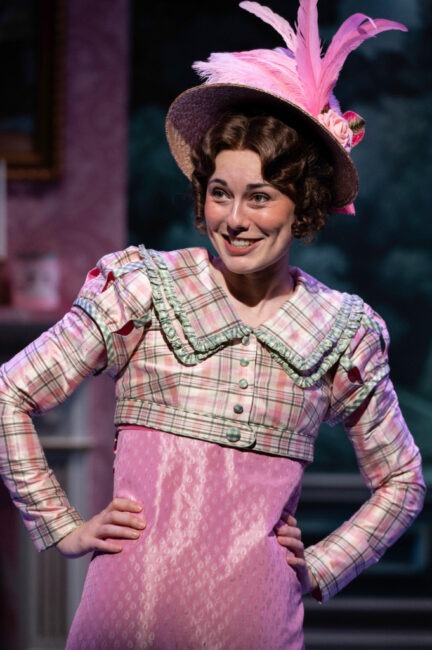
And I’m really excited that Laura Kepley (director of Different Words for Happiness) was on board for this, you worked with her last season too, I believe in Emma?
Katie: I worked with her on Emma and on POTUS. Shows like Emma are amazing directing opportunities, those big farces, and I don’t want to speak for her, but she was telling me that her bread and butter, the thing she loves to do the most is new plays. So I think that it was a really cool opportunity for both of us to work together on something completely different than POTUS and Emma. And she just shined. From beginning to end, the way that she’s collaborated with me on script, on changes, on design, on her vision for the show, it’s just been awesome.
It’s fascinating to me, something you mentioned earlier, about scenic directions or rather lack thereof, particularly regarding Nathan in that first scene— and I won’t get into it because I don’t want to spoil anything for anyone who hasn’t seen it yet— but the way Laura chose to stage that, to me, it’s like the reverse of triggering. It’s a “oh! We needed that!” without realizing that we needed it. It’s a beautiful construct that she’s brought in with this open-ended freedom that you’ve allowed that really augments his humanity and his significance to the play.
Katie: Oh absolutely! From this experience, and this is maybe another learning experience, quite honestly, but one of the most exciting things for me has been watching other artists interpret what I’ve put down and make choices that I’ve never thought of. That includes the staging, that includes one of my favorite moments of the whole thing which is the way that Ava goes in and out of the gynecologist montage, where she’s walking front and trying to take her gown off, but realizing she’s still there. None of that is written in the script. That was them. Laura and Em, they constructed that idea. That blew me away when I first saw it. So much so that with this script that I’m currently writing, I’m really challenging myself to not write as many— or even, I’m basically trying to not write any stage directions. I’ve been reading a lot of plays. I just reread Cock by Mike Bartlett and there’s not a single stage direction in the whole play. Same thing with Lungs by Duncan MacMillan, which is one of my favorite plays of all time, and I’m realizing how much joy there is in the doing of it. The creative joy that comes from seeing someone take something with no stage directions and no kind of guidance, other than the lines, and then seeing how they interpret it. That’s another learning experience for me for sure. What if the next play I wrote had even less direction and even more playground for interpretation?
I love that you call it a playground. That gives me a new type of happiness that I don’t have a word for yet!
Katie: I love that!
Thank you so much for your time— oh I almost forgot the final question there. If you had to sum up your experience on working with Different Words for Happiness with Everyman Theatre, the whole process and experience, using just one word, which word do you use?
Katie: Transcendent. It felt like I was passing the normal kind of emotions and experiences that I’ve felt and it entered into a new realm of agency and creative fulfillment and excitement. My heart was so full. So transcendent!
Different Words For Happiness plays through November 15th 2026 at Everyman Theatre— 315 W. Fayette Street in the Bromo Arts District of Baltimore, MD. For tickets call the box office at (410) 752-2208 or purchase them online.
To read the TheatreBloom interview, click here.