When do we— ride into Jerusalem? When do we— ride into Jerusalem? When do we— ride into Rising Sun? When do we— ride into Rising Sun? What’s the buzz— I’ll tell you what’s a-happening? JCS— that is what’s a-happening! Triumphantly returning to the Street Lamp Community Theatre Stage under the majestic direction of Rylynn Woods, Musical Direction of Mia Bray and Choreography of Stephanie Peterson, the iconic Andrew Lloyd Webber & Tim Rice rock opera Jesus Christ Superstar is back! And it’s essentially sold out!
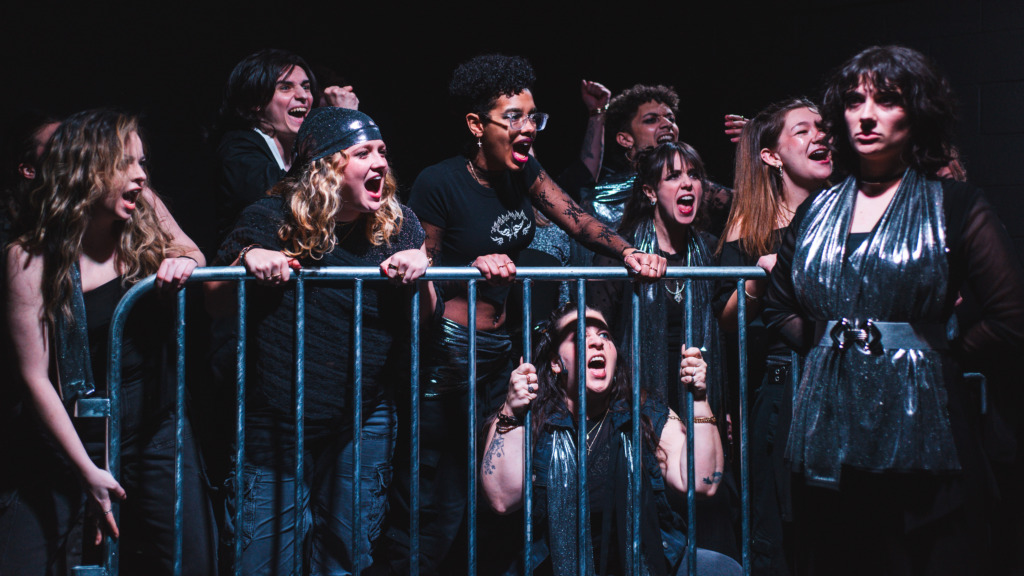
Director Rylynn Woods leans into the rock-opera verve of Webber’s score whilst simultaneously keeping the show’s conceptualization clean and simple. There’s an overriding grunge-punk-goth-rocker aesthetic that fits soundly into her vision for the show without trying to reinvent the entirety of the production; it’s refreshing to see something simple and elegant and yet deeply effective and cleanly executed. The cast of two dozen are outfitted in various shades of black, ‘concert-gear’ attire, with those in the vein of corruption adorned with silver lamé scarves. These scarves, which provide the visual representation of the silver ‘blood money’ double up on the lepers during the scene at the temple, which is a wholly intentional connection between the blood of the needy and the blood money that serves as the catalyst for the overall Judas-Jesus betrayal. Plus it pops like a shimmery temptation against all of the show’s black sartorial aesthetic. One of the aforementioned scarves even becomes the whip for “Trial By Pilate/39 Lashes” and it’s an excellent way to execute that number without getting caught up in the need (or mess) of stage blood. The scarf even wends itself around Pilate’s blazer once he appears alongside the high priests, hinting to the audience that he’s controlled by the corruption (as he previously appeared in his dream number without one.) By contrast, the disciples (though they double as lepers and the screaming crowd who cries for the crucifixion) have subtle gold accents in their costuming, the subtle hint of ‘God’s love and light’ though it’s most noticeable on Mary.
The lighting in this show is equally impressive and intentional as the sartorial selection. It’s used to great effect, particularly when Pilate is delivering his “Pilate’s Dream”, he starts in cool white and with a simple step at the exacting moment, when the dream turns darker, he’s flooded in red; it’s a profound effect. And there are many such effects that happen throughout the performance, including the rainbow pride lights we get flooding the stage for “Hosanna” and the progressive slow-build blinker strobe effect during “The Temple.” It makes all the difference to have these lighting cues timed so succinctly, particularly when the set is just the bare black box with raised platform and a lone cross (intentionally left black so it blends into the wall…because when it’s backlit— it’s a wild effect that is truly striking.)
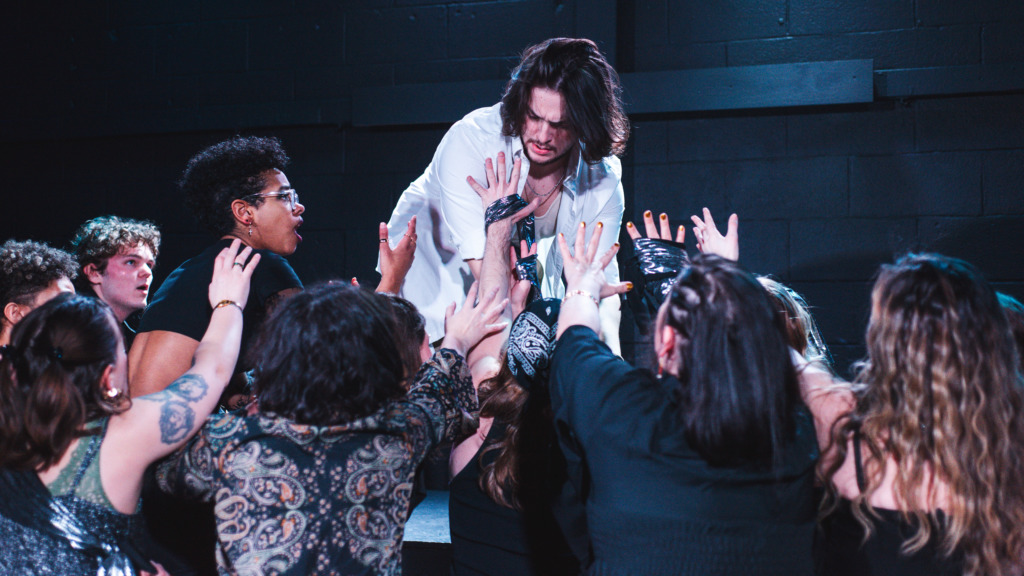
Choreographer Stephanie Peterson knows how to utilize the intimate space of Street Lamp Community Theatre’s black box, and although there’s never a moment in the show where all 24 cast members are dancing on the stage, there are several numbers that have at least 14 individuals engaged in dance and Peterson knows how to space them accordingly so that you never get this sense of overcrowding. There’s a lot of engaging movements in Peterson’s choreography and it’s not repetitive. You got ‘bonus content’ with Peterson’s ‘Soul Girl Quartet’ (featuring Anna Jones, Shannon Hargreaves, Sadie Cole, Abbey Edwards) during “Superstar” as they do leap-twirls and flings in front of Judas with the rest of the cast rocking out up on the riser. Peterson is also responsible for one of the most visually impressive moments in the show, which occurs during “The Temple.” The lepers encroach upon Jesus, backing him up the stairs to the riser, essentially pinning him to the wall with the cross behind him; the visual is stunning— an actualization of Jesus being crucified by his actions before Pilate orders his crucifixion. It’s an evocative zenith that really motivates the blast that arrives at the endo f that number.
The production is chock-a-block with those gloriously intentional moments under director Rylynn Woods’ keen eye. While “The Last Supper” looks a little more like a gothic, punk-rock picnic at Woodstock she still takes that moment to freeze frame the disciples like the iconic portrait. There’s also a feral intentionality behind having the disciples getting drunk at the tail-end of “The Last Supper” as it makes them gently passing out for “Gethsemane” more believable rather than the more traditional approach of ‘his best buddies fell asleep even though he asked them not to’ framing of that scene. Choosing to have the corrupt priests offer Judas unidentified alcohol is also a wildly intentional moment, especially as he refuses it the first two times and when he finally drinks it, that visceral imagery of ‘I’ve drunk the kool-aid on the wrong side’ really rings through in a deeply disturbing way. Woods’ show also moves swiftly, one moment and number into the next, the way the show was written.
What makes the show even more impressive is the way musical director Mia Bray brings the cast of 24 together. There are balanced moments that catch you by surprise (disembodied voices singing echoes from either side of ‘off-stage’, which is startling because it’s a black-box play space with no wings in which to hide actors) and some evocative harmonies— like during “Could We Start Again Please?”— that just sound sublime. And the vocal energy is kept at a consistent peak, making for an enthusiastic ride from start to finish.
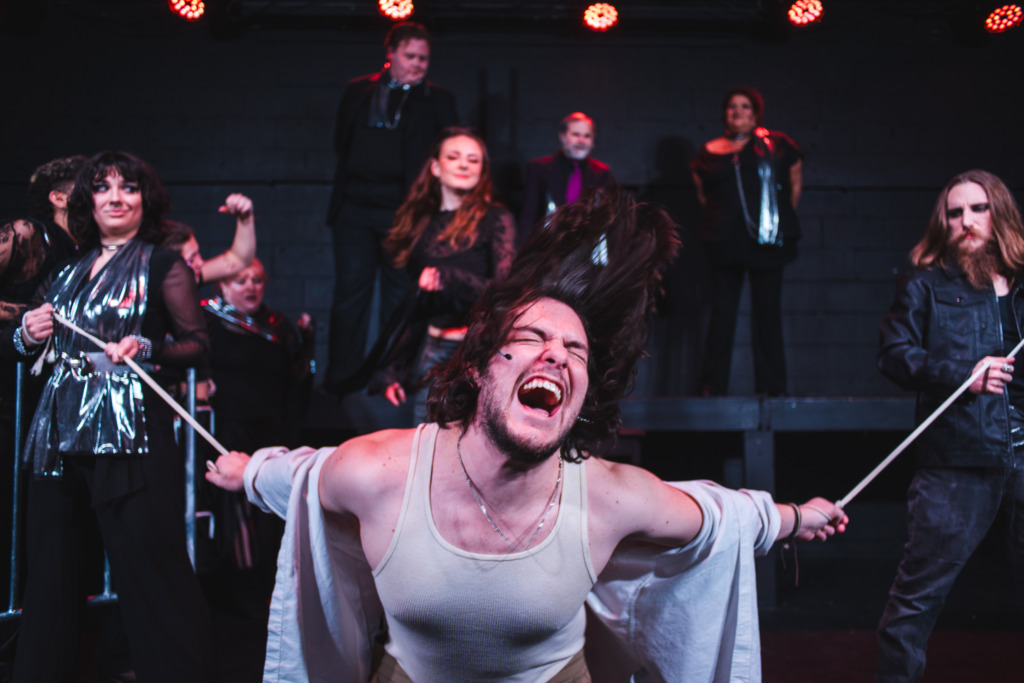
The only truly questionable component to the show are some of Jesus (John Murphy)’ choices. While he mostly nails some of those screamo-tenor moments and does an excellent job of visually expressing his anguish during “Trial By Pilate/39 Lashes” there’s some sort of disconnect going on in the earlier scenes and numbers with Murphy’s performance and it isn’t clear if it’s nerves, undefined character choices, or just being a little lost in general. Murphy’s Jesus starts out with an awkward arrogance that comes and goes inconsistently (if that’s the choice, make it and make it bold and stick with it, allow it to fester and be humbled by it later, which would ultimately make for a radically fresh, hot take on the character.) You also never get the sense of true connectivity— either brotherly or betrayal-wise— from Murphy when he interacts with Judas, though he does find moments to connect with Mary when she’s attempting to calm him.
The ensemble is popping with vocal prowess, really engaging with the music, the dancing, and being activated characters in background moments. This is most readily witnessed during that run-on opening sequence of “Heaven on Their Minds/What’s The Buzz/Strange Thing, Mystifying” where you get clusters of mostly-silent interaction happening in the background while Jesus, Mary, and Judas take the foreground action in song. Featuring (in no particular order— Casey Casey, Shannon Lloyd-Ragan, Soif Becherer, Isabel Bray, Lannon Fritts, Tommy Moe, Katie Gibson, Sarah Paxton, Natalie Hudson, Abbey Edwards, Sadie Cole, Shannon Hargreaves, Anna Jones, Kai Mellarkey, Brayden Piccolo-Klein, Dirk Carr, Bevin Gorin) the group swaps off as lepers, disciples, blood-thirsty Romans, and they move as expediently as the score, as swiftly as the story, and with as much enthusiasm as the show deserves. Shout-out to Dirk Carr as Simon, whose eponymous song is stellar and delivered with a good deal of zeal and glee, and to Bevin Gorin as Peter, who pricelessly delivers the look of ‘not me!’ when Jesus insists one of them will betray him. Gorin sings beautiful harmonies opposite Mary (Lindsay Hamilton) during “Could We Start Again Please?”
As the becalmed Mary, Lindsay Hamilton brings a delicate innocence to the character. If you didn’t know the story of Mary Magdolen, you’d never know she was anything other than a Jesus groupie. Her voice shines gently with a warm, soothing sound during “I Don’t Know How to Love Him”, which serves as a nice repast from the more agony-loaded vocals given to her male counterparts in this score. If you want edgy angered vocals, you have to look no further than Anna Owens as Annas and Michael McDonald as Caiaphas; the pair sing at one another and at Judas with a sinister sensation that unsettles you in your seat. Though by far the most impressive thing about their character representations is the spiked pearl-studs on their faces (one on the left side and one on the right) showing how they’re essentially two halves of the same corrupt coin. And props to Brayden Piccolo-Klein whose ‘murder-face’ death glare out into the audience is the epitome of unsettling when he’s playing one of the Soldiers.
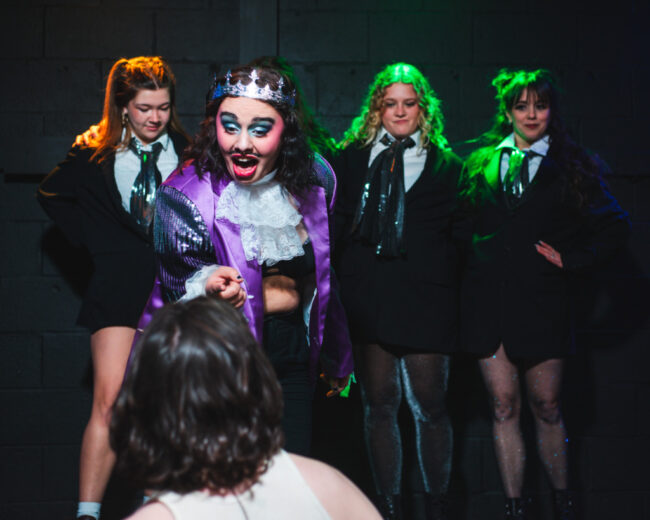
If you want a scene-stealing, show-stopping, celebrity-style cameo appearance, look no further than Alana Guardipee who flounces in, decked out in regal purple, shimmer, and a whole bunch of drag-esque makeup and razzle-dazzles her way through “Herod’s Song” as Herod. Like the way Guardipee lays down this number you want it to have a better title and last longer because she’s that good. And she’s so vocally lit that she doesn’t even bother with a mic (her prowess would blow it out anyhow.) From the shimmer-shoes right up to snorting glitter-coke off the back of one of her servant-chairs, she’s unhinged in the most entertaining fashion imaginable. And her whole scene and song will live rent-free in your head until your next encounter with Jesus Christ Superstar.
Taking a really minor character and making us enamored not only with the character’s existence but his overall charisma, stage presence, and general command of space around him, Christopher Zaczek has all eyes on Pilate for the two scene-songs that his character is conscripted. There’s something simple and humbling about the way he appears for “Pilate’s Dream”, unassuming and ordinary and then this dulcet, sweeping tune mellifluously drifts from his mouth. But it’s the staging and the facial expressions that really turn that number into something extraordinary— the red light as the expression of being deeply troubled crosses his features, Zaczek contemplating the meaning of that dream and what the implications of it might be for his character. And when he arrives in full vocal blast for “Trial By Pilate/39 Lashes” it’s incendiary. Raging and trying to temper the lyrics to be just, Zaczek finds the balance and nuance of this double-number in spades and when he gets to lash 25/26, watching his face sour as he’s forced to look away, but still continues to count is gloriously brutal.
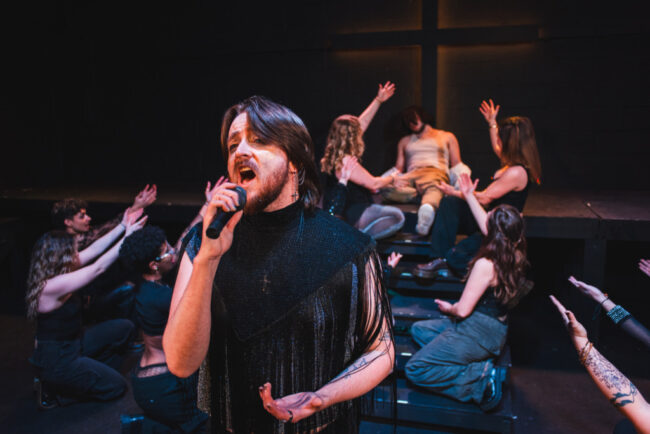
Superstar— Judas, do you know what they say you are! Jacob Gross takes the angel-light in this production, with sensational vocal powers, expressive emotional control, and an overriding sense of emotional versatility and dynamism. There’s this whirlwind of emotions perpetually churning inside of Gross as he navigates the tempestuous hills and valleys of the Judas character— anger, reflection, contemplation, guilt, fear, and desperation all wound up into one maelstrom that gets the richly deserved vocal release every time Gross sings a number. Watching him agonize during “Damned For All Time/Blood Money” is fascinating. And the way he power-rolls through “Superstar” is astonishing. Vocally, Gross is a show-stopping sensation (right up there with the raw and un-mic’d Alana Guardipee) and his ‘untimely ending’ number hits hard and deep, really driving home the regret of his character’s decisions.
If you can snag a ticket to ride into Rising Sun— and find the buzz— they’ll tell you what’s a-happening with their production of Jesus Christ Superstar this weekend! One weekend only— definitely worth the hike!
Running Time: Approximately 1 hour and 55 minutes with one intermission
Jesus Christ Superstar plays through February 8th 2026 with Street Lamp Community Theatre— 5 Valley View Drive in Rising Sun, MD. For tickets call the box office at (410) 658-5088 or purchase them online.