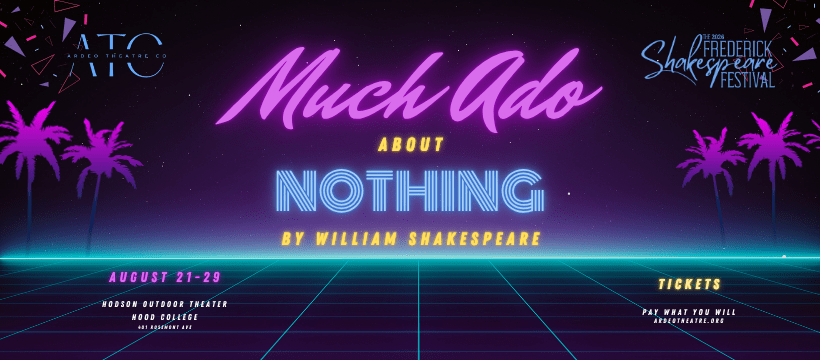
Be vigitant! And if you have legs— you will come! To the final production of the 2026 Frederick Shakespeare Festival— Ardeo Theatre Company’s Much Ado About Nothing! Set in the bodacious and totally rad 1980s, this hilarious Shakespearean comedy is directed by Aaron Angello and features a mostly repertory cast from the FSF first main-stage show of 2026, Henry IV Part 1. Witty, humorous, heartfelt, and above all fun, this tried and true comedy is putting the joy back into Shakespeare. Come one and all and make merry!
Director Aaron Angello has designed a simplistic yet effective set; a little pyramid of stairs against some shiny white pipe-and-drape backdrops and POOF that’s it. Messina with a splash of 1980s couture and aesthetic overriding it. Minimalism at its functional finest, working for the actors, the script, and most importantly the humor of the plot! The show— outdoors at the Hodson Outdoor Amphitheater— lends itself to free movement of the players both in the ‘play space’ and the audience. Angello sets up the infamous guiling scene of Benedick with the poor lad roaming drunk on his bottle, through the audience and making direct-ish contact with audience members, which lends itself exquisitely to the nature of this comedy. And once the three fellows who ‘have him on’ in that scene (Leonato, Antonio, and Claudio) take up their places ‘on the stage’ watching the Benedick fling himself wildly to hide among the patrons, their lawn chairs, and blankets, trying to shush reactions so as to not give himself away— is pretty epic.
What’s even more amusing is the switch for the following scene. If you’re unfamiliar with the general plot of Much Ado, buckle up for a wild and entertaining ride; if you are familiar, you know the guiling of Beatrice follow shortly after and most productions tend to just repeat in reverse as the scenes are both structurally similar and contain similar bouts of dialogue exchange. Angello lets this one run in a different direction, having Beatrice disappearing behind the curtains, poking her head out of what are essentially walls, diving under the stairs of the pyramid, and making a whole bit about trying to disappear from sight and getting partially stuck in the process. It’s epic, well-executed and hilarious.
The 80s aesthetic bath that Angello and Costume Designer Mauren O’Neal (assisted by Rachel Smith) have layered over the production just screams ‘perfect fit’ in that awesome-80s verve that only that decade can command. The vintage pieces that O’Neal has sourced for the production— her own pink party dress and her initial wedding dress, Beatrice’s double jumpsuit, first the loud leopard wrap-around and later the sparkly spangly affair, and not to mention Claudio’s dope-ass-shorts— are sick. And totally on brand. Though costume of the show (don’t come at me, because I so, so, so wanted it to be either the dope-ass-shorts or one of the aforementioned gowns) but the costume of the show— hands down— is Dogberry’s security uniform. Those matching black short-shorts, with the gold-lettered security hat (everyone else on ‘the watch’ has silver lettering) and the shirt— and maybe it’s just the confidence that the actor pours into that outfit, but it’s seriously winning at 80s life. (Also, somebody needs to give Rook Bartlett some praises— the show’s lighting designer— because after the sun dips— the actors can still be vividly seen!)
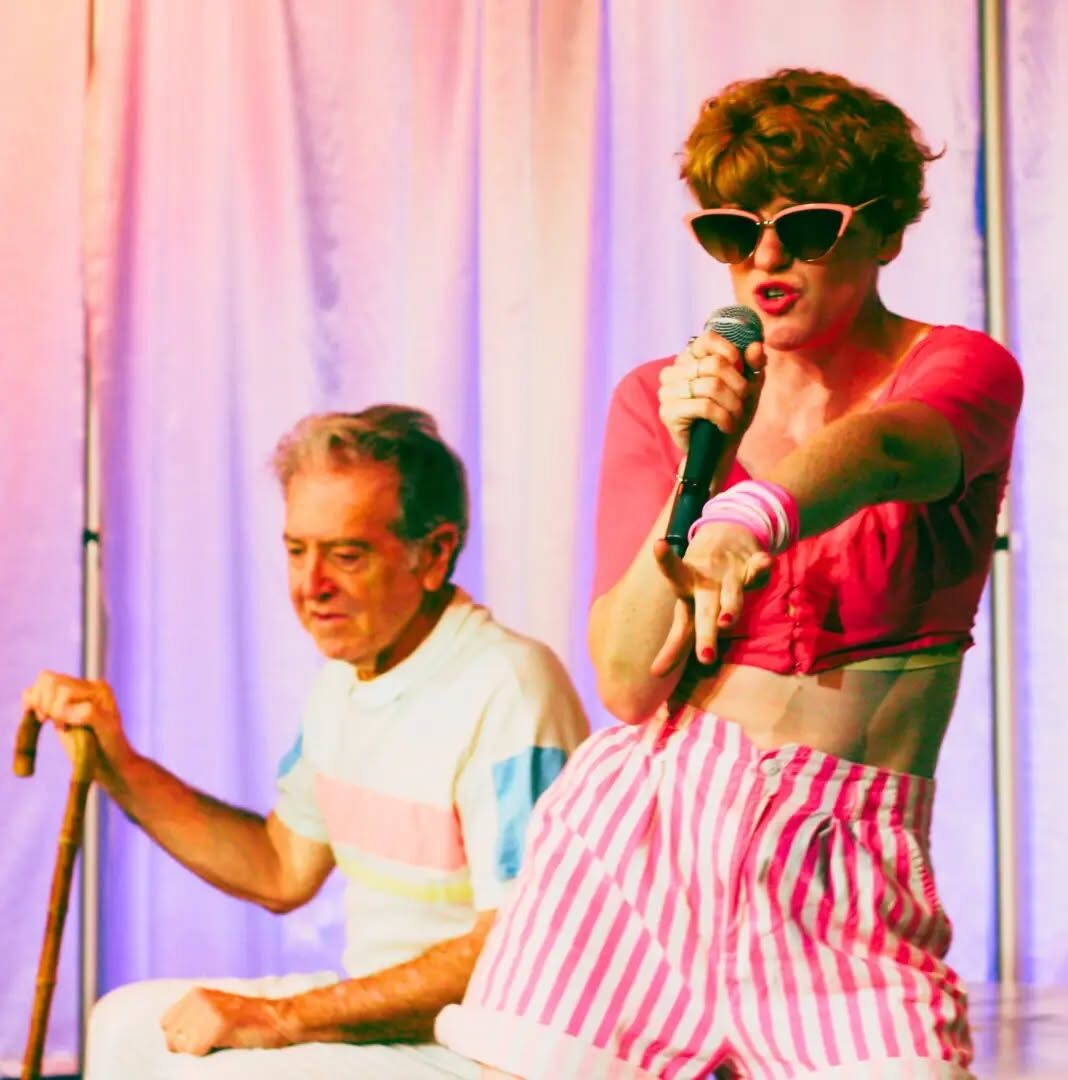
Of course there’s more to this 80s splash than just the couture (and again O’Neal and Smith do stellar work with everything from the Hawaiian shirts on the ‘old guard’ to the 80s military fatigues on the soldier boys and all that falls between) because there’s also 80s music. There’s a blend of cross-fades with diegetic and non-diegetic use, iconic 80s tunes are utilized in the show— including Claudio wailing out “Every Rose Has It’s Thorn” as the epitaph for Hero (which should be the sober and somber moment and turns into this hilariously enjoyable thing that the audience can’t stop tittering over!)— and— and— and— did I mention— KARAOKE!? That’s right. 80s karaoke performed by the characters as a part of the pre-show and intermission experience. (Shout-out to Fred Fletcher-Jackson who was mid-number at the intermission when there was a freak power outage, the way he covered, recovered, and carried on once power was restored was truly improv skills hard at work!)
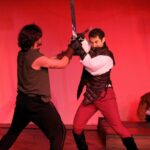
I may be singing all the wicked praises of Angello’s ideas but what I haven’t gotten to yet is his overall directorial approach to the production. Yes, there’s a lot of flavor in this 80s vein and it’s great— truly one of the better aesthetic overlays for Much Ado that I’ve seen in my 15 years a reviewer— but there’s a lot of nuance, attention to detail, and overall impressionable understanding of the story, plot, and dialogue that’s being palpably pressed into the performances. The pacing of the production is sublime; Angello has scenes dovetailing so sharply on one another that there’s scarcely room for audience applause (nobody is complaining about this as it doesn’t feel rushed!) and the way certain little moments happen— like when Hero is peeking out from the curtains at Claudio near the end and Beatrice sees this, has a ‘oh hell no’ look on her face and snatches Hero back, to much comedic effect— all of those little detailed moments are smashingly delightful and just add contextual layers of forethought to the experience. Angello also fleshes out the gravity of the show— it’s pretty heavy, man— in the second act and doesn’t let it free-swing between the comedic instances. There’s heart to those moments, particularly in the Beatrice and Benedick exchange when he makes a promise to her and again when he goes forth to make good on that promise; you feel the weight of the emotional integrity shining through when all too often, particularly in this comedy, those scenes are glossed over, rushed through, an overlooked. At the same time, Angello doesn’t let them stew in their own primordial angst for too long, finding that exacting dynamic balance, which ultimately leads to a ‘happily ever after’ style conclusion as such Shakespearean comedies are wont to do.
Angello’s cast breakdown is hardcore on point, servicing 13 actors over more than 20 characters (including sneakily doubling up one of the ‘fantastic four lovers’ as the Sexton!) and it gives each of these performers a chance to really sink their teeth into fun characters, 80s karaoke, and a lot of engaging stage banter. Michelle Norris and Erin Clary, as Ursula and Margaret respectively, have loads of fun in their scene with Hero leading the guiling charge against Beatrice. Norris, who doubles up as that ne’er-do-well Borachio has a sick denim jacket and is the epitome of 80s edge fashion when she appears in that costume. You get Alyssa Byers (Verges, Messenger, Watchman) who pops up all over the place and with vigor when messages are to be presented— particularly that Pedro’s brother has fled and when the boys have returned (at the opening) from the battlefields. Rebecca Carroll serves as the Friar, Balthazar, and Seacole, a unique menagerie of pop-up characters; her costume as Friar is most delightful to look upon and her antics as Seacole, perhaps the smartest of Dogberry’s bunch, are well fitted into the overall shenanigans that reign in those scenes.
Enter: The Old Guard— Antonio (Nathan Rosen) and Leonato (Bill Bodie.) There’s an engaging felicity about them both when they’re of a merry-making mood, particularly in the beginning when teasing Beatrice over her distaste for Benedick, and when encouraging Hero to be excited but patient over her very sudden engaging nuptials to Claudio. (The whole play “hi, you’re cute, let’s get married, the end” if you’re unfamiliar, with true Shakespearean hiccups and hijinx thrown in to take 5-minutes stage craft and properly flush it forth into two hours’ stage traffic.) Bodie displays exemplary versatility in his role as Leonato, going from festive and jubilant in scenes where it is required to furious inferno, belching out rages once he thinks his name has been besmirched. The intensity that he brings to the stage is masterful. And when Rosen is trying to go to blows on Bodie’s behalf, shaking that cane like a madman, it’s pretty epic. Rosen also doubles up as one of the dingleberries in Dogberry’s watch and has delightfully comedic moments accordingly.
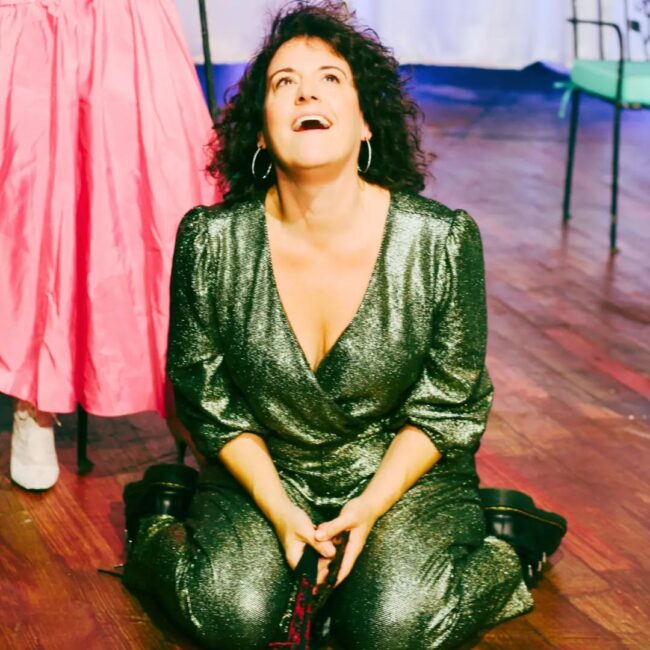
Despite Don John (Fred Fletcher-Jackson) not having much stage time or text (tis true no matter which rendition or adaptation you find), Fletcher-Jackson makes the most of his villainous moments. He’s a catalyst of nefariousness that sets the plot into slippery-slope action. And while he’s mostly stoic and somber, not showcasing those flavors of vileness like an Iago or a Hotspur, you get the sense that he’s perpetually up to no good, just beneath the surface. Don Pedro (Eric Jones) on the other hand, the epitome of nobility and sincerity and Jones’ affects his movements and existences on stage accordingly. There’s humor to his portrayal, though lightly sprinkled, and there’s sobriety to the more somber moments, deftly handled, making for a solid supporting figure in the production. He’s uproarious to watch when literally using the fishing reel gesture to rein in Claudio’s over-the-topness during the guiling scene; it makes for exceptional comedy. There’s something about the liveliness with which Jones approaches Don Pedro too, that creates a perfect foil for the static stillness that Fletcher-Jackson brings to Don John, making it wholly reasonable that while they are brothers, they could not be further from one another than if they were strangers.
Knave. Ass. All that and a bag of chips and short-shorts and you’ve got The Matt Provance as The Dogberry. Honestly, he’s exuding that much 80s wow that should be the end of it right there but he’s such a stellar performer in this role that he deserves more than a sentence’s worth of praise. There’s an unquestionable cocksure confidence that Provance brings to the table as Dogberry, which jives so flawlessly with that 80s mall-cop intensity and you’re just screaming for it. Spoiler: get to the ‘theater’ early, not only to catch the pre-show karaoke but so that you too can be hysterically set upon by Provance’s Dogberry as he’s patrolling the perimeter and making his way over the grounds in character; it’s pretty epic. I’ve seen a lot of Dogberry’s in my day, in he’s just got suaveness like nobody’s business. He’s overly confident but not in that bumbling way, which makes his character’s bumbling antics that much funnier. And he pops that bubblegum like he’s on Big League Chews’ payroll, which is just an added layer of humorous character definition.
If you wanna talk roller coaster— Maureen O’Neal and Jake Urtes, as Hero and Claudio respectively— have got you covered with their performances. The gushy, simping, OMG does she like me/does he dig me simplicity of their characters upon the introduction spirals up so fast into love-to-marriage-at-first-word and then explodes down the other side as ‘things get exposed’ that you almost get whiplash from watching the pair of them in their micro-trajectory. (Shakespearean scholars and layfolk alike will argue if the main plot couple is Hero and Claudio because they’re the ones that are undergoing the drastic changes, even though the ‘main plot’ for all intents and purposes appears to be the sparky discourse between Beatrice and Benedick.) When O’Neal and Urtes are ‘up’ they are UP. The giddiness, the affection, the joy; it’s palpable and ridable in waves. And when the dynamic shifts because of spoilers-to-be-revealed— it’s a brutal shift— like getting knocked off that surfboard by a big kahuna wave. At the wedding scene, when O’Neal collapses, watching her dead, lifelessly detaching stare— it’s a torturous kind of brutal, knowing she’s been overcoming with a situation out of her control but still having to feel all of those emotions in live-time; it’s intense. And you get a similar mirrored reaction when revelations are brought upon Urtes’ Claudio later in the game. Of course they both have a fantastical felicity for getting the most out of their guiling scenes, with the pair (even though they’re in separate scenes) making giddy delights of trapping their respective friends into the honey-trap that is love.
A feral raccoon and a plucky duck walk into Messina, spend the whole show snapping at one another and somehow everyone gets a dance party at the end. It’s dream-roles come true— and performances that accurately reflect the intention, the passion, the dedication, the commitment, the ferocity of comedic timing— all across the board for Gillian Shelly (Beatrice) and Evan Crump (Benedick.) Crump is serving up textbook Benedick with a twist; there’s this almost goofy aloofness to his Benedick— go with me here— that you experience most in his body language and occasionally in his facial expressions. It’s what makes the biting barbs and quip exchanges between his Benedick and Shelly’s Beatrice land so beautifully. Because her snarky, cheeky, sassy sour-patch-kid tongue-in-cheek retorts, replies, and responses in their quarrels are fierce and land with a punch that there has to be a softness to his existence in order for them to land as expertly as they are delivered.
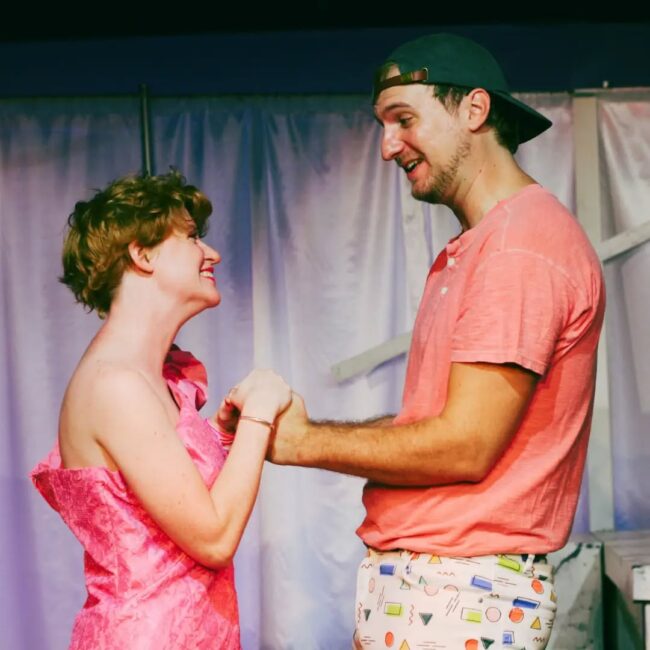
When Crump is stumbling drunk through the house, having a good spleen-vent about Beatrice and women in general, he masterfully convinces the audience that he’s confident, and has a handle on his feelings; it’s an epic scene to watch unfold as it spirals into the guiling scene— and watching him boo Balthazar’s singing from right beside wherever you’re sitting is an added bonus treat. Much like Shelly, Crump possesses an impressive switch of versatility, going from the maddening encounters with Beatrice in their flirty-denial fashion to those more somber moments once a call to action has been made. The sincerity with which he hits those moments, making promises to Beatrice reads as heavily as if he were suddenly delivering lines from Hamlet and it strikes a beautiful balance in the play as a whole, though he’s quickly able to navigate his way back to the lovely comedy by show’s end.
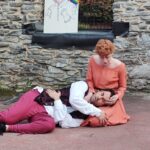
Shelly is a walking work of art when it comes to navigating the mercurial nature of Beatrice. Meredith Brooks’ iconic one-hit wonder song (yes, yes, it came out in ’97 but still feels wildly appropriate for Shelly’s characterization) “Bitch” is the perfect embodiment of how Shelly creates Beatrice. She’s a contradiction of all things, everything all rolled into one and she’s playing all of those aspects, elements, and components of Beatrice at exactly the right moment. She’s serving up sauce like Gordon Ramsey when she starts verbally smacking down on Benedick before he even arrives, she’s quick with a quip— slinging cheeky insults during the masquerade scene and with such precision that one might swear Shelly’s Beatrice made the choice to know that it is Benedick with whom she’s speaking! Fiercely overprotective, her face looks as if it could commit murder when Hero is wronged (literally giving a new Merriam-Webster entry to “if looks could kill” in that moment, clutching her cousin to her bosom) and when she bears the depths of her wounded soul to Benedick over the injustice, it’s as haunting as any tragedy. There’s an undefinable professionalism to the dervish of intricacies that Shelly puts on display, each in exacting, calculated measure, resulting in the perfect portrayal of Beatrice if ever there was one.
So be not an ass! Because you will be if you miss this production— and book early! (And make sure you do book! It’s the only way to guarantee you get a seat if weather forces the show indoors) This Much Ado About Nothing is far out and totally epic. Catch it!
Running Time: 2 hours and 15 minutes with one intermission
Much Ado About Nothing, an Ardeo Theatre Company production, is the final main-stage production in the 2026 Frederick Shakespeare Festival season and plays August 21st 2026 through August 29th 2026. Nine performances only at the Hodson Outdoor Amphitheater at Hood College— 601 Blazer Trail, Frederick, MD 21701. All tickets are Pay-What-You-Can and booking in advance is strongly recommended. Book tickets here.
This performance is outdoors*
*in the event of weather, the performance will be moved to the Black Box at Tatem Arts Center but only those with advanced booked tickets can be guaranteed a seat indoors if such a venue-change is enacted.
To read the interview featuring Beatrice, Benedick, Hero, and Claudio, click here.