author: Amanda N. Gunther
Wherever you are, whoever you are, it’s alright. A powerful message being blasted out— central Manhattan style— in the now-touring production of Alicia Keys’ Hell’s Kitchen. With book by Kristoffer Diaz and Music & Lyrics by Alicia Keys, this ‘love letter to her mother and to the city of New York’ jukebox musical features the iconic hits of Keys— including “Fallin”, “Empire State of Mind”, “Girl on Fire” and more— to paint a semi-biopic retelling of Keys’ life growing up in the Manhattan Plaza artists’ accommodations. Directed by Michael Greif with Chorography by Camille A. Brown and Musical Supervision by Adam Blackstone, this flash back to the 90s will hit the nostalgia button for many on its two-and-a-half-hour stage journey.
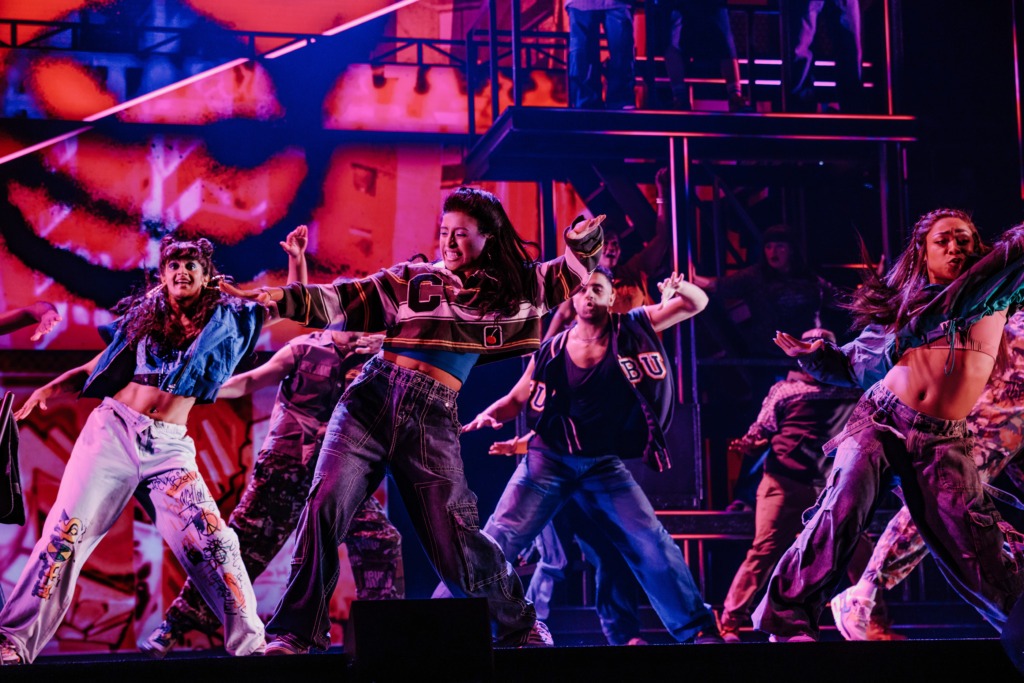
90s nostalgia is firmly cemented into place by the show’s only flawless production element: Costume Design. Dede Ayite effortlessly captures that living pulse of Hell’s Kitchen/Manhattan fashion in the show’s sartorial selection. Bejazzled denim, colors and patterns, an iconic look that everyone recognizes instantly when they spot it. Ayite’s work definitely sets the time stamp for the show, even if some of the other design components meander in a ‘creative-boundary-pushing’ path away from it.
The most powerful moment in the show lands right at the end of the first act— an intense and sublimely perfect delivery of “Perfect Way to Die” from the Miss Liza Jane character. Until that point the show feels a little stagnant, milling about in its own one-dimensional world of your typical, whiny-forward, teenager who has a conflict with a mother who just wants to protect her. That powerhouse number, which completely shifts the focus of the musical, primes the audience and prepares them for what will surely be a tightly re-focused and meaningful exploration in the second act. Instead, Kristoffer Diaz’ book shifts hard into the generic formula of jukebox musical, with numbers shoe-horned into plot devices and vice versa. No one is questioning the sensationalism, popularity, or commercial success that is the music of Alicia Keys (she’s got 17 Grammy awards), but it does beg the question as to whether or not her music could have been used to tell a more powerful tale, rather than a storyline, true though it may be, that audiences have seen many, many times.
Diaz’ book is also somewhat uneven and the way he introduces this ‘fourth-wall-self-awareness’ is at war itself. It’s great that the Ali character acknowledges the audience in direct soliloquy, not unlike any Shakespeare or artist telling their tale. But then midway through “Girl On Fire” Tiny (Sydney Townsend) comes in and tries to make a hyper-self-aware political statement, something along the lines of “this girl is unstoppable because she’s got a man?” and not only does it fall flat with the audience but there’s no on stage acknowledgement. Tiny, Jessica (Lauren Chanel), as well as Millie (Melanie Sierra) and Crystal (Romelda Teron Benjamin) get introduced at the top of the show as Ali’s friends her mom’s friends, respectively, and while they pop up here and there— they basically dissolve into nothingness in the second act, making you wonder why they were important enough to make mention of by name in the first place. Same with Riq (Sean Holland II) and Q(‘Zaiah Ellis),they have one cheeky little scene about “something needs to be said”, which does garner a great deal of laughter from the audience because it’s comedically timed and delivered by these two performers, but as the focus in that trio is Knuck, and while they do drum buckets alongside him, why lean into making them feel important if the narrative never actuates their importance? It leaves the audience feeling cheated out of characters and overall story threads.
Where the show’s libretto does get it right is in assigning a lot of the iconic hits to the mother character of Jersey (at this performance Tyler Olshanksy-Bailon.) This cements the ‘love letter to mother’ component of the show. The scenes and musical numbers with Miss Liza Jane are the strongest in the production and that pivotal learning lesson of ‘your rage is real, your fear, your anger, your feelings are real, use them’ could have been more centralized and augmented, rather than the broader sweeping brush strokes of the angsty teenager-needs-to-grow-up story that gets presented.
The production values as a whole also feel somewhat one-note. There’s a lot of flashy lighting, but it’s the same flashy lighting whenever a big dance number comes on stage. And while those ensemble dancers are putting a tremendous amount of skill, talent, and energy into those dance routines, choreographer Camille A. Brown’s work is a plateau of repetitive movement. If there’s a dance routine happening on stage and the grand piano is also on stage, someone is up on it doing moves. There are times when the dancing takes a shift into interpretive-movement influenced by the music and that’s intriguing but it never gets explored thoroughly enough before falling back into the same hip-hop inspired street moves that get seen all throughout the rest of the performance to really feel like it’s different. The dancers are succeeding at being impressive; they deserve more variety and dynamism to match their efforts. Shoutout to ‘Zaiah Ellis and Christopher Miller as a featured dancers during “Unthinkable”, to Destini Hendricks and Jerimy Rivera as a featured dancers during “Work On It”, and to Marques Furr as a featured dancer during “Hallelujah.” Five sensational performers breathing exquisite movement-based life into the show’s overall choreographic plot.
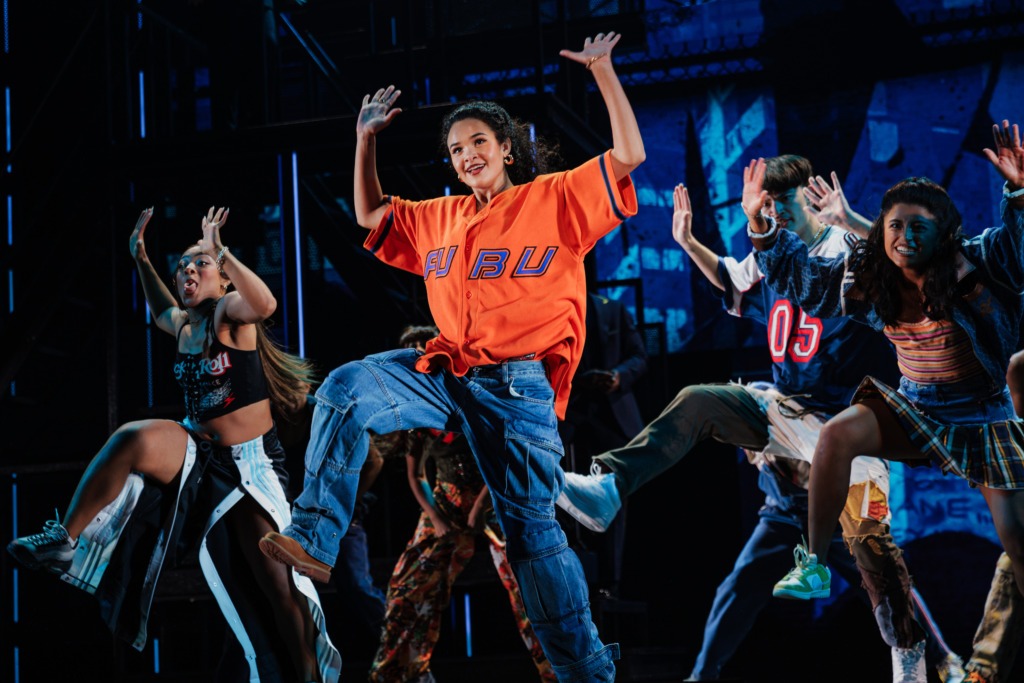
Lighting Designer Natasha Katz and Project Designer Peter Nigrini make success with the elevator lighting, but then there are other moments— like during “Kaleidoscope”— where the lighting and projections seem to blossom late, as if they were miscued or written with intentional delay. (And whoever was operating the house follow-spot at the opening night performance was having a rough go of it, always a half shift and step behind the Ali character.) Sound balance was off as well; there were time when even with the whole company singing that lyrics were muddy and overpowered by the orchestrations.
While the scenery is nothing to write home about, Scenic Designer Robert Brill creates a series of scaffoldings and platform elevations that do inspire the notion of high-rise life in Hell’s Kitchen and that effect gets amplified by Katz’ lighting design and Nigrini’s projection design. One of the most striking scenic images in the production is the ‘Ellington Room’, where the real heart of the story lives— Miss Liza Jane, that grand piano, and all of the Ali character’s emotions. With such a powerful setting in that one room, it almost begs the question as to why Kristoffer Diaz didn’t restructure the overall linear flow of the libretto— start in that room— like a heartbeat and branch out to other scenes, in live time and in recollection— to tell the tale, bringing it all back to the central components that matter the most— real feelings, real raw experiences, and having somewhere for them to go— into the music and learning the piano.
The other key struggle with this iteration of the tour is Myia Ann Butler, taking up the narrative beacon protagonist role of Ali. She’s an excellent petulant teenager. She’s got real emotions to express that infuse their way through her whole body whether she’s twitterpated over Knuck or having it out with her mom, Jersey. Butler even has a really strong voice. But when she’s trying to imitate that iconic Alicia Keys style, she ends up having nearly every sustain— even when it’s just a half-note’s length— be front-loaded with vibrato. It sounds like she’s trying too hard to imitate a vocal style and it causes pitch consistency issues. Butler’s voice, when she does catch some of those moments not trying to imitate Alicia Keys, is clearly a talented instrument. The show and her character portrayal may have been better served without all the attempts to sound exactly like Alicia Keys; the audience would absolutely buy into her being Ali in her own voice.
At this performance, the role of Jersey (the antagonistic foil from Ali’s point of view) is tackled by Tyler Olshansky-Bailon and some of the knockout, sensational belts, sustains, riffs, and options that she achieves in some of those numbers are mind-blowing perfection. “Pawn It All” is truly that conflagration of ‘burn it all to the ground’ and that fiery demon of matriarchal protection comes blasting out of her like an ethos inferno that just blazes right up through the rafters and out onto Eutaw street; it’s beyond sensational. There’s also wild level of chemistry flaring up between Olshansky-Bailon’s character and Davis (Desmond Sean Ellington.) When they get to that scene in the apartment with “Fallin’” you get a real sense of their passionate intensity and Ellington brings on that song with a sultry smolder that really gets the audience chuckling at their inevitability of attraction to one another. Ellington has smooth vocals that are stellar when it comes to situating a male voice over songs more traditionally sung by Alicia Keys. He has this really endearing moment with Butler’s Ali, singing “If I Ain’t Got You” (which eventually becomes a duet.) Watching her trying to ignore the number, refuse to participate in the moment, and the exchange of antics between them as they attempt to foster a rekindling of father-daughter dynamic is really a sincere moment that puts an emotional anchor in place for this show.
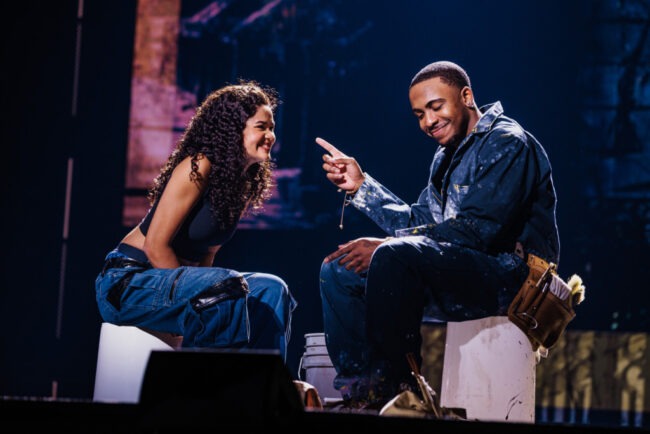
As Knuck, JonAvery Worrell is easy on the ears, eyes, and the heart. The character is done somewhat of a disservice by Kristoffer Diaz’ book, sort of being shoe-horned in as the purposeful clash-against-perceived-stereotype-because-we-need-a-love-interest-for-the-protagnoist, but Worrell rises above those limitations and really puts heart and soul into his portrayal. While the duets he sings with Ali are a little uneven, again falling on Butler’s overly-forceful vibrato in all the notes, when he has moments in solo song you get a clean sound that articulates his emotional experience from inside the character’s mind and heart. There’s so much more that could have been mined with this character had it been written differently but Worrell is really making the character worth enjoying, particularly when he sings his part of “Like You’ll Never See Me Again.”
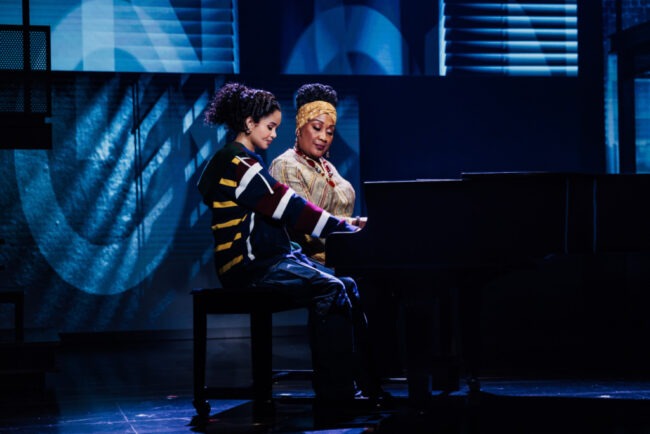
Reminding us that we are seven billion stories and even that’s alright, the character of Miss Liza Jane (Roz White) is the zenith around which the show could and should have been built. “Author’s of Forever” may be White’s second number but it is this quintessentially perfect moment of emotional reality, gravity, and catharsis, all powerfully wrapped up into one. White has this seasoned voice that lays into the music of Alicia Keys in a way that doesn’t just stir the soul but slides in and pops it open from the inside-out. It’s stunning. Her sharp, intentional way of speaking adds this sassy edge of humor to the character and the way she interacts with Ali is like this guiding force of ancestral wisdom come to realign Ali to where her heart and her feelings will best serve her life. “Perfect Way To Die” is such a blind-siding emotional maelstrom, sung with deep sincerity, intense experience, and an overall flawless sense of intention that it redeems nearly every single issue that the show and the performance has leading up to it. Roz White’s performance and existence within this production makes the whole of it worth experiencing, amplifying the importance of representation, connecting with humanity, and existing even when things are not ‘alright.’
It’s ultimately a coming of age story, even if it is one we’ve heard and seen before, but the importance of diversified representation on stage in musical theatre, speaking to audiences in the way that other jukebox semi-biopic musicals cannot, is still there. It’s an experience, made exponentially more valuable by some of the secondary characters, but worth a glance all the same.
Running Time: 2 hours and 40 minutes with one intermission
Hell’s Kitchen plays through November 22nd 2026 at The Hippodrome Theatre inside The France-Merrick Performing Arts Center— 12 N. Eutaw Street in Baltimore’s Bromo Arts District. Tickets are available by calling the box office at 410-837-7400 or purchasing them in advance online.