
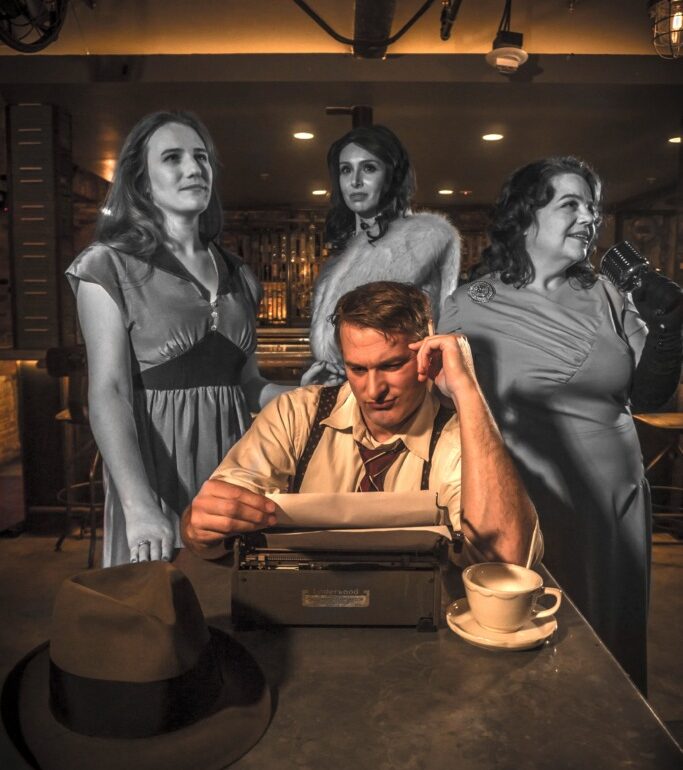
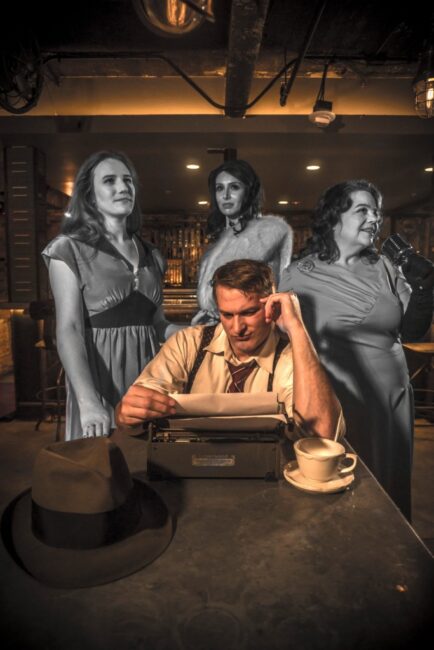
People never see themselves as other people write them. And when you write them walking into a tangled web of film-noir meets golden-aged Hollywood with musical theatre camp and coziness all cuddled up together on the squarish stage of Colonial Players, well that’s one script you just have to see to believe. City of Angels— that rarely produced hybrid gem of show-inside-a-show like a nesting doll of page-to-screen-to-stage— is now playing as the penultimate production of the 77th season at Colonial Players of Annapolis. Directed by Beth Terranova with Musical Direction by Michelle Bruno, City of Angels (Larry Gelbart- book, Cy Coleman- music, David Zippel- lyrics) is a dizzying discovery of old Hollywood tropes, campy theatrical caricatures, and a zesty blend of ‘when worlds collide’ with some extraordinary moments that will pull you right into the calamitous confusion that is the world of Los Angeles, circa 1940-late, Hollywood-writer’s-room.
As they in the biz, you can’t fix a problem if you don’t know you got one, and this production has a few minor ones that bear addressing. Director Beth Terranova makes a couple of blocking choices with this production that juxtapose poorly against her seasoned experience of working in and directing at Colonial Players, particularly when it comes to that pinched-off corner up between the house seating banks of B and C. It’s completely understandable why the larger corner-entrance (between C & D) gets utilized for the morgue scenes and the iron-lung scenes, however, several of the tighter more ‘minutia-focused’ scenes (particularly with Stone being seated or Oolie singing from her seat) being blocked in the corner make for visual difficulties for three quarters of the audience. The scenic changes are also somewhat inconsistent. There are absolutely moments where musical vamps and interludes hit (by way of Sound Designer Arin Laycook) and the minimalist furnishings are wheeled in and out sublimely but then there are other moments where those scene changes drag (once or twice with either a late-start to or no musical coverage whatsoever.) Several of the scenic setups could involve presets from the stage hands— the one popping immediately to mind being the various furniture that’s getting fixed into place after Oolie is over on the telephone at the entrance valley between D and A (which leads out to the main lobby) as she’s in a murky darkness with only a lone spotlight to highlight her. There also doesn’t seem to be a particular pattern as to why certain changes move more quickly than others, but if as the production continues its run, these scene changes fall into alignment with themselves in an expeditious fashion, the overall run-time of the performance could be tightened.
The other problematic issue with the production is the casting choice for the written character of Munoz. He’s written into the script very specifically as a non-white character (to the point where a minor part of the plot calls for Stine to take out some of the politically charged pieces about his race), complete with stereotypical speech patterns (that were a socially acceptable trope of the times and a product of the late 1940’s time-stamp) and phraseology. Casting an older white actor in this role and having him affect his voice in a ‘Speedy Gonalez’ style really doesn’t sit well in 2026. And it takes all of the humor out of that character’s big song and dance number “All You Have to do is Wait.” Rather than watching what could potentially be a silly and campy number with a disgruntled ex-partner cop singing and dancing, it becomes an uncomfortable mockery that reads with the wrong intentions.
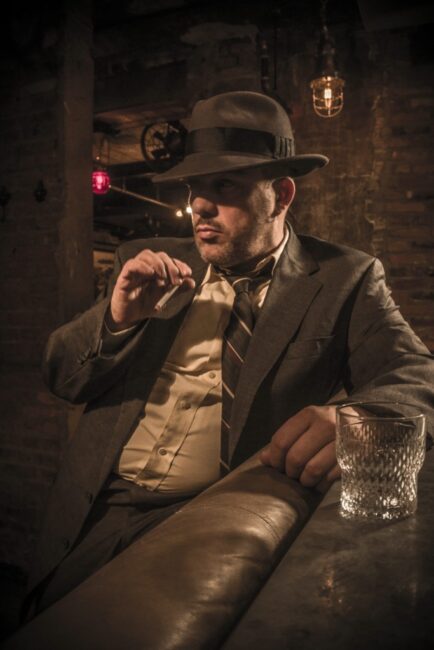
These issues aside— the production values, particularly from an aesthetic standpoint, are stellar. There’s an entire team— Jan Blome on hair & makeup, Ann Edwards (and her team) on costumes, Edd Miller on set decoration, and Charlotte Robinson (and her team) on props. Jan Blome deserves the highest of praises for all of those meticulously coifed and curled and ‘set’ hairstyles (many of which appear to be done without the use of wigs which is always an impressive feat to see in action) it pulls you directly into the era of 1940-late. And matching Blome’s superb vibe in that arena, Ann Edwards costumes fit the bill second to none. From the moment Stone saunters into the scene— that jaunty cockeyed angle on his hat, the way his suit is almost that perfect shade of gray making you think maybe he is an old black-and-white picture come to life— you know you’re in for a visual treat with the show’s sartorial selection. And you get a vivacious variety of outfits all throughout (which is another praiseworthy mention as this cast feels like it has several hundred performers in it!) Aesthetically, the show is hot to trot and there can’t be enough praises for the attention to detail in Edwards’ costumes, Blome’s hair & makeup and honest to goodness— Dudley Whitney and Cheryl Duvall deserve a whole paragraph for that Iron Lung. (There’s a really cool diagram on the wall in the lobby that details the inspo and construction and it’s worth arriving to the theatre early just to read through and have a look at it!)
Terranova, who doubles up as the show’s set designer, does make excellent use of both Dianne Trickey-Rokenbrod’s lighting and Richard Atha-Nicholls & Dudley Whitney’s projections. One of the most impressive uses is when Stone is getting his case handed to him by way of knuckle sandwiches in the back-alley courtesy of Big Six (Adam L. Conklin) and Sonny (Cordell D. Smith.) Using a series of video projections and ‘storyboard sketches’ (though it would have been nice to have them projected on all the walls not just some) you get to see this ‘fight’ happen as if you were watching film-edits in the production room. It’s wild and works exquisitely. Trickey-Rokenbrod also helps the audience follow along the live-time ‘rewrites’ as Stine is sitting at his typewriter, deleting and retyping— you get rapid-flash warm glow blinking lights, with garbled, ‘rewind’ audio (Arin Laycook) and the actors moving backwards, ‘undoing’ what just happened in the scene. It’s a very effective series of effects and its execution is impressive. There are other praises to be given to this sector of the creative team but the show itself is three-hours long and I’m not aiming for this review to be as well and we haven’t even started in on the music and performers.
Michelle Bruno’s musical direction is one of the aces of this production. Cy Coleman did not lay down a clean or easy score and there’s a lot of minor-key numbers that create all sorts of problematic musical sounds, all of which Bruno handles brilliantly. And her work with various actors to create the appropriate sound in some of these songs— so that it has a technicality to it and still fits the style of the era— is immensely impressive. Her most obvious successes are with The Angel City Singers (an octet consisting of Christian Hudspeth, Dillon McCarrick, Marela Kay Minosa, Becki Placella, Laura Schaeffer Raynor, Macrae Smith, Finch van Greunen, Davis Wootton-Klebanoff.) Their opening doo-wap/scat number and whenever they’re providing backing vocals for Jimmy Powers (Dillon McCarrick, the smoothly voiced, suave crooner character) and other moments showcases not only the radiant talents of these eight vocalists but Bruno’s capabilities to blend velvet harmonies. Bruno also deserves praises for getting robust sounds out of all the singing performers; this stage configuration does not have personal mics but you never feel like you’re missing out when it comes to the singing in the show.
There’s a lot of cameo character moments that are just swell, really snapping up your attention. Personal favorite comes from Marela Kay Minosa, playing Bootise (she’s also an Angel City Singer, etc.) but as that momentary hooker character she’s hilarious. Shuffle-bouncing with exuberant glee into the scene, flinging herself onto the round cushion with giddy intensity; it’s hysterical and it’s a ‘lives rent-free-in-your-head’ moment 100%. You also have Kelly Gilmore, who is featured as Luther Kingsley— the husband who is trapped in the Iron Lung contraption. But Gilmore doubles up in the ‘movie cast’ as Mahoney, a studio press agent, whose handle on the 1940’s patois, cadence, and overall vocal affectation is stunning. And the way he’s disguised in that scene— looking like a reporter in his mid 40’s— you’d never know he was the same actor in the iron lung! Talk about carefully crafted versatility! The Studio Cops (Adam L. Conklin and Cordell D. Smith from the ‘Hollywood Cast’) are also worth mentioning for that nonsense-keystone-cop-style madcap fight with Stine in the final moments of the show. The fight choreography in that scene is hysterical and really catches the eye.
When it comes to the big players, you get these sensational character-choice constructs (guided by director Beth Terranova) to show how the ‘Hollywood Cast’ people let themselves bleed over a little into the ‘Movie Cast’ characters. While you don’t see this as much with the Irwin S. Irving/Buddy Fidler (James Zemarel) character, you do get a wildly entertaining experience watching Zemarel as the sleazy Hollywood director/producer. He’s got all the mannerisms, the body language, and the zest that the character requires. And he carries a tune quite solidly for his various moments in song. He’s so oozy, unctuous, and oily, when he finishes “The Buddy System” you want to mop him up with a chamois. After he dervish-spins Stine out of the scene he sits back like the fat-cat-on-cream and gets wheeled out in his fancy chair; it’s epic. His bombastic over-the-top explosions in the final scene are pretty darn intense too.
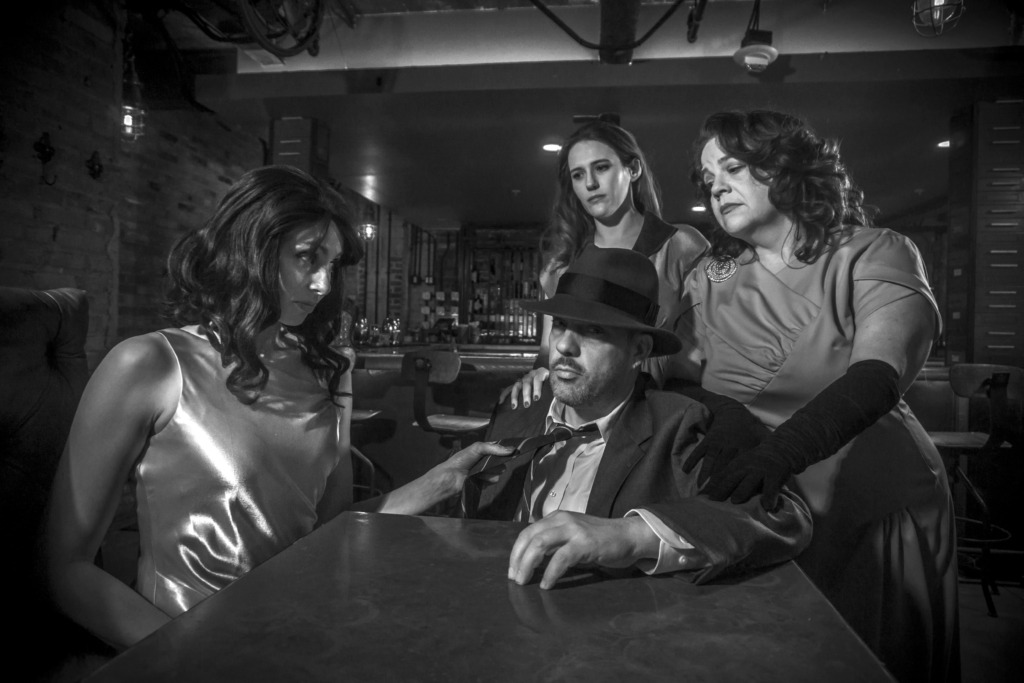
As Avril Rains, Taylor Hinds is the dippy epitome of the gooey-eyed ingenue, desperate to flash her attentions at Stine. That naivete gets left in ‘Hollywoodland’ when she’s playing Mallory Kingsley in ‘Movieland’. As Mallory, Hinds possesses an intensity that is ferocious and vivacious. With a gloriously seductive voice that just melts into “Lost & Found”, its easy to see that Hinds isn’t afraid to embrace both the sexuality and sensuality of the character, she’s unabashedly going for that scene and that number, really generating the appeal of that particular Hollywood trope. Hinds’ approach to that whole scene (guided by Intimacy Director Mel Gabel) is sultry and creates a hypnotic component that really sells that moment both to Stone and the audience.
In the melodramatically charged role of Alura Kinglsey, Erica Miller is serving up some serious camp and caricature stereotype. It’s delightful. It’s the epitome of what you expect from that dame-gone-rogue character in one of these film-noir style films. Miller has an exquisite sense of stage presence, even when she’s playing the scene up for its melodrama. And her vocals are impressive too. “The Tennis Song” becomes this rich, double-entendre-innuendo duet opposite/at Stone and it’s deeply satisfying to watch her serve up femme fatale cheekiness in this number. When Miller switches over to being Carla Haywood, Buddy’s wife (in Hollywoodland) you get hints of that ‘melodrama’ only filtered through her ‘fed-up’ trophy-wife narrative. When she dismisses the Avril character at the big brunch it’s uproarious.
If you want sincere singing satisfaction, you’ll look no further than Kasey Colligan, doubling up as Oolie, Stone’s secretary, and Donna, Buddy’s secretary (Movieland and Hollywoodland respectively.) The entire cast seems to really have a handle on how to speak and deliver that 1940’s cadence, but Colligan has a divine mastery of it that percolates readily not only through her speech patterns but also into her singing voice. “What You Don’t Know About Women” is the first real taste of Colligan’s vocal prowess; a duet paired opposite Gabby (which is one of those rare moments where Hollywoodland and Movieland bleed together and happen simultaneously.) Colligan (and Shelly Work, playing Gabby/Bobbi) nail the complexities of that number, hitting those syncopated rhythms, hot-lyrical patters, and vocal nuances with resplendent ease. Colligan gets to show-off even more during “You Can Always Count On Me”, where her vocal chops really get to shine. Bonus points to the performer as she makes a practically flawless costume change in a micro-darkout to switch from Oolie to Donna mid-song.
The aforementioned Shelly Work is another singing sensation in this production. As Bobbi, Work takes you on a transformative journey— that dulcet, moody-bluesy sound ringing out of her for “With Every Breath I Take” in the nightclub-flashback scene sets the tone for her character’s downfall. When you encounter her later in the second act (still as Bobbi and Gabby pops up frequently here and there) for the reprise of that number the palpable demise of her character’s spirit is harrowing. She’s grown dark, bitter, and jaded, and it feels dramatically insightful. As Gabby, you fall in love with her brassiness. It’s easy to write the Gabby character off as the nagging-but-loving wife, but Work brings a deeper purpose, an intense dynamic layering to the character and it’s wholly evidenced in “It Needs Work” her powerhouse knockout number directed at Stine in the second act. The facial expressions she presents, the body language, the way she just puts it all out there in this song— it’s my second-favorite moment in the show (third-runner up is Minosa’s Bootsie and the trophy-taker is actually a freeze-frame lighting cue with Stone backlight behind Stine right before he hits his mental breakdown in the final scene.) There’s honesty in the way Work digs through that number; there’s sincerity in the way that she plays Gabby in a perpetual turmoil with Stine, and there’s delicate moments that hint at her woes as both character; she’s a real sensation in this show.
He walked onto the stage, see, and you were ready to call Joe Dollar, Dick Tracey, or any other iconic PI and say ‘lookout, bub, Stone (Luke Tudball) is in town. Tudball’s portrayal of the character is unhinged in the most show-appropriate fashion possible. He’s got the swagger— not the ‘I’m a hot shot who can bed the broads, bust the bad-guys, and win the cases’ confidence swagger, oh no. He’s got the ‘I’m down-on-my-luck-but-still-gotta-eat-been-workin-these-cases-too-long-but-can’t-give-it-up-need-to-pretend-I’m-still-top-dog’ swagger. And that’s impressive. It marries sublimely with his ability to work the time-stamp’s very specific cadence, patois, and overall use of language into the character. There’s a lot of stone-cold looks (pun probably intended) from Tudball and he brings a gravitas to his various scenes. You don’t even mind that he’s not the strongest singer in the cast (and how could you ever hope to be with those four femme fatales— Colligan, Work, Miller, and Hinds spinning circles around you?) because he’s got chutzpah, he’s got intention, he’s got drive. When he duets up with Stine (Nathanael Quay) for that wildcard number “You’re Nothing Without Me” it’s exciting and thrilling and a whole lotta fun. There’s just something indescribably right about the way Tudball approaches the Stone character, makes it feel like he really was written right into the role.
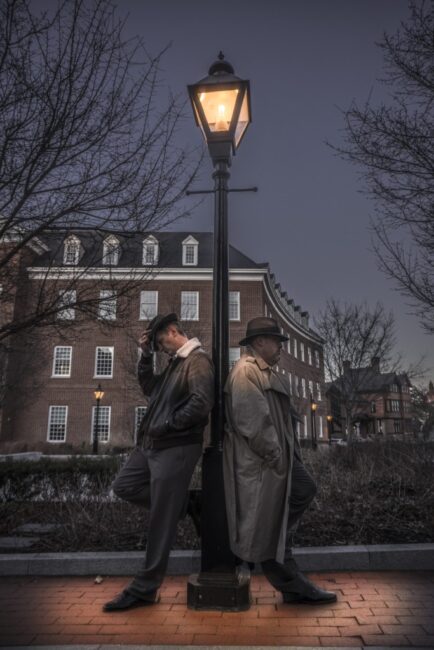
As the poor, upended novelist, Nathanael Quay is presenting some exceptional vocal acrobatics to get those intense sustains at the end of his big solo numbers every single time he sings. “Funny” is an exacting representation of his vocal prowess. He’s quite the charmer on stage, sliding easily into the role like a second skin. Watching him react, particularly when trying to salvage his scripts against all the brutal edits that Buddy keeps putting out into the ether is a real prize moment, as Quay has heightened and animated facial expressions that radiate out into his body language, informing his overall movement and the way in which he speaks and responds to moments on stage. He has good working charisma, particularly when edging to and away from the entanglement with Donna, and you almost feel sorry for him when he gets laid out by Gabby. That moment when Quay’s Stine and Tudball’s Stone come together at the very end feels like the perfect kismet conclusion to the utter ‘what-the-heck-is-actually-happening’ chaos of the ending of this show.
Everybody’s got to be somewhere— people don’t just vanish into thin air. So if you ain’t gonna be vanished, maybe be at Colonial Players— that’s a somewhere— for City of Angels because it really is a wild ride, a unique experience, with a hardworking cast, a lot of little cameos popping up to tickle your fancy, and a whole bunch of new experiences to enjoy.
Running Time: Approximately 3 hours with one intermission
City of Angels plays through March 28th 2026 at The Colonial Players of Annapolis— 108 East Street in historic Annapolis, MD. For tickets call the box office at (410) 268-7373 or purchase them online.