
You have come here! In pursuit of your deepest urge— in pursuit of that which till now has been silent…silent. It’s here— the music of the night— it’s here— truly, this time— The Phantom of the Opera. To launch the North American tour, after what feels like an eternity of missing-in-action, Andrew Lloyd Webber’s iconic and most infamous musical has returned to the stage, and what better a stage to return to than Baltimore’s own Hippodrome Theatre at The France-Merrick Performing Arts Center? Broadway’s longest running musical (still holding that distinction, despite closing in April of 2023 with 13,981 performances to its name on Broadway) kicks off under the Direction of Seth Sklar-Heyn and is prepared to delight audiences across America, once it leaves Charm City on November 15th 2025.

Not quite ‘not-your-mama’s-Phantom’ though for the die-hard fans, there are some modernizations in the technical-spectacle department. Those looking for the sweeping swells and haunting strains of melody that only Andrew Lloyd Webber can do will not be disappointed and those seeing Phantom of the Opera for the first time will be mesmerized. The production is of an exquisitely high caliber, though not without its faults (a few of which feel like microscopic technical misfires that should and likely will be corrected as the performances continue to work out the kinks and get underway), and ultimately does the libretto, music, and lyrics a fine justice. The flawless technical component of the show is its lighting design (Andrew Bridge) particularly the way the keys on the piano during the scene of ‘A rehearsal for don Juan Triumphant’ are lit and those in the ensemble standing behind said piano have the under-chin ghastly ghost lighting to make that moment even more effective. Sound Design (Mick Potter) is a close second in its perfection, especially when it comes to the balance between those singing and the live orchestra. And the way Potter played with ‘audio-all-round’, for those moments when you never quite know where The Phantom is, was stellar.
Set Design, adapted by Matt Kinley is true to the spectacle, more or less, that one expects when they come to see Phantom and truly will steal the breath of anyone who’s never seen it. The grandiose set pieces— the grand staircase for “Masquerade”, the Pegasus statue for the top of the opera house, the Daae family crypt featured during “Wishing You Were Somehow Here Again”, of course the chandelier— are all magnificent. Though the chandelier (on the night I attended) did not seem to spark quite as lively as promised, it’s still a wonder in its own right, living perched above the house audience before doing its own— illuminating magic. There were other technical issues— one of the six candelabras in Phantom’s lair rolled into existence unlit, the veil with the mirror caught and failed the illusion of that moment, etc.— which one would have hoped (being midway through the run at this performance) would have been corrected, but are likely only to be noticed by audience members with exacting eyes on details or die-hard Phantom fans.
The performances across the board were somewhat uneven as far as principal players go. The ensemble, however, both dancers (with original choreography adapted and recreated by Chrissie Cartwright) and singers (musical staging and choreography by Gillian Lynne), were stellar, truly making the music of the night a map of aural bliss and the visual movements the show— particularly during “Masquerade” an awe-inspiring delight. (A glorious shoutout to Maria Björnson, production designer and the two associate costume designers— Jill Parker and Hunter Kaczorowski— to the vivacious Carnivale-brights featured during “Masquerade” and the exacting iconic looks for some of the other more notable sartorial selections featured in the performance.) Musically and movement-based, the ensemble performers really provided engaging and magical performances.
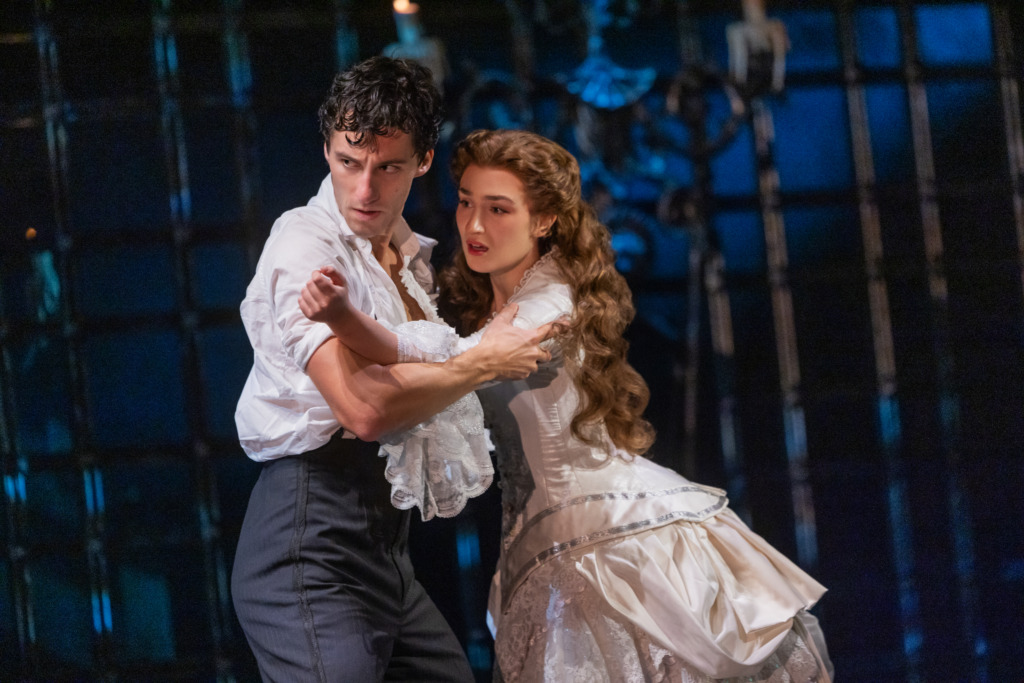
It was disappointing to hear Lisa Vroman, as Madam Giry, somewhat lacking in an accent, particularly when everyone else in the production was either putting on (and in some cases, perfecting) an English, Italian, or French accent. Vroman also lacked the necessary rigidity that the character’s structure requires, making her almost feel nurturing whilst simultaneously milquetoast about the whole affair. Her vocals, however, were quite impressive and when she sang at Raoul, you could tell she had been well-taught. Melo Ludwig (as Meg Giry) and Daniel Lopez (as Raoul, Vicomte de Chagny) also gave imbalanced performances, particularly when singing. Lopez’ vocal approach to the character was nasally and sharp, which made certain numbers sound odd. But his chemistry with Christine Daaé (Jordan Lee Gilbert) was extraordinary and he was the performer whose articulation was best understood during “Notes/Prima Donna”, a dizzying septet which is written to have that cacophonous moment of seven people singing different lyrics and harmonies to overwhelm the audience in an attempt to mirror the chaos inside of Christine’s mind.
Jordan Lee Gilbert started off the performance sounding a bit too modern. Her vocals are extremely impressive, but all of the numbers in the first half of the show where Christine Daaé had features or solos— “Think of Me”, “The Phantom of the Opera”, “All I Ask of You”— sounded as if Gilbert were singing a pop-modern concert version of these songs. She course-corrected astonishingly in the second act and had a much smoother and more classical sound to her singing, particularly when delivering “Wishing You Were Somehow Here Again”, which was arguably the second most emotionally impacting number in the show (second only to pretty much any moment where The Phantom himself was singing.) Gilbert’s chemistry with both Raoul and The Phantom was on point and her overall stage presence was quite mindful, particularly when suffering those moments of questioning her own sanity.
The true scene-stealers of the production were Monsieur Firmin (William Thomas Evans) and Monsieur André (Carrington Vilmont.) Their lightly-approached comedic antics were tasteful and just the right amount of humor for this show, particularly at the top of “Masquerade.” Both have magnificent voices, well suited for the musical style of this show, and both did a stupendous job handling the humor and exasperation of “Notes/Prima Donna.” A bonus shoutout is owed to Ben Roseberry, as Monsieur Reyer, the rehearsal-director character, when the pair are introduced to the Opera Populaire and later during the Don Juan Triumphant rehearsal scene, as he is cheeky, sarcastic, and oh-so-over-it.
With glorious operatic sounds, Christopher Bozeka, as Ubaldo Piangi, and Midori Marsh, as Carlotta Guidicelli, give tremendously beautiful performances of both their characters and their music assigned to their roles. Marsh has the haughty-diva attitude refined to perfection and when she flounces about on stage you can feel her character’s sense of entitlement rolling out into the audience in tsunami-force waves. Bozeka’s Piangi is a bit more subtle in his existence, serving as a vocal and physical accoutrement to Marsh’s Guidicelli. Marsh delivers a stunning rendition of “Think of Me” before the chaos that usurps that scene and when she’s belting out her notes during “Notes/Prima Donna” it’s aurally sublime.
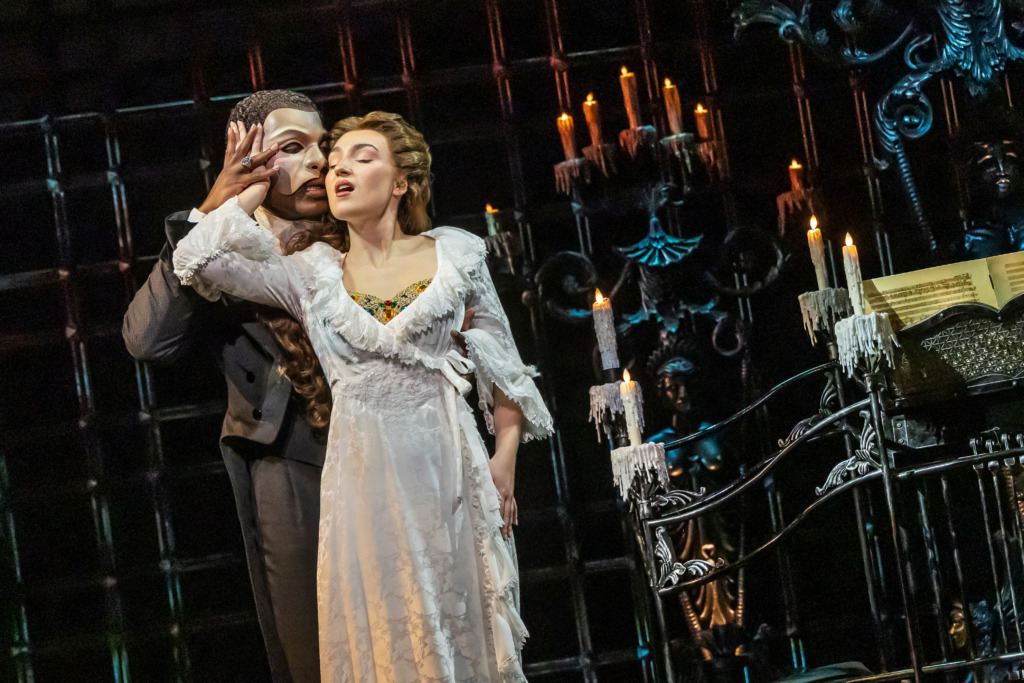
Haunting, remarkable, vocal ephemeral mysticism, charming terror, terrifying charm, mere mortal words don’t seem to quite grasp the splendor and illustrious beauty that is Isaiah Bailey in the titular role of The Phantom. You get little hints of his voice during “The Mirror” and then the full, robust gusto of his impeccably perfect sound during “The Phantom of the Opera” as he descends into the lair with Christine in tow. There is something spine-tingling about the way he enchants her and that’s even before he gets to the hallmark number by which all Phantom’s are measured. Bailey’s voice is mellifluous and light, yet turbulent and harrowing as he glides through “The Music of the Night”, soaring and drifting with intense emotional purpose, he stirs the soul, awakens the heart, and melts the mind; it’s on par with the great likes of Michael Crawford and Norm Lewis, both whom have previously tackled the role on Broadway. There’s a tear-spawning tragic beauty to Bailey’s voice when he sings “All I Ask of You (Reprise)”; the way he infuses his pain, his experience, his raw, visceral pathos into that moment will scorch your heart. And his overall stage presence is both frightening, comforting, and hypnotic; a magical amalgamation of this ethereal creature all rolled into one, phenomenally talented being. Isaiah Bailey alone is worth the cost of admission and is carrying this production to magnificent heights.
The music of the night will not stay in Baltimore long, and with many of the performances completely sold out, it’s best to contact the box office directly to ensure that the tickets being purchased are legitimate. Do not miss this once-in-a-lifetime opportunity to see the national tour launch— the first official performance of The Phantom of The Opera (since closing at The Majestic Theatre on Broadway in April of 2023) at Baltimore’s own Hippodrome Theatre; it truly is a rare thing to behold.
Running Time: 2 hours and 45 minutes with one intermission
The Phantom of The Opera plays through November 15th 2025 at The Hippodrome inside The France-Merrick Performing Arts Center— 12 N. Eutaw Street in Baltimore’s Bromo Arts District. Tickets are available by calling the box office at 410-837-7400 or purchasing them in advance online.