
It always pays to raise the roof. No limits. No boundaries. No compromise. Other Voices Theatre is certainly pushing their boundaries, breaking their limits, and giving it their all for their current production of Andrew Lippa’s The Wild Party. Directed by Diane Causer with Musical Direction by Sheila Melendez and Choreography by Amanda Patten, this musical is one heck of a bumpy and wild ride, so buckle up, put your bugle beads on and get ready for one intense evening of theatre.

The show itself is a beast, a bear, a massive undertaking, and then some, for a whole host of reasons, not the least of which is its risqué subject matter, overall through-lines of despicable characters and manipulation thereof, and general sense of affluent hedonistic tendencies. In addition to all of that, the score is a musical monster, the vocals are an unrelenting tsunami of intensity, and the character and scene work is challenging even for the most skilled professional; it would be a tremendous effort even for a well-versed professional theatre who works in obscure-intense musicals on the daily. Other Voices Theatre gets props for attempting this monster and do have some truly remarkable moments wherein they create success, albeit unevenly.
Todd Mazzie’s set concept (painted by Scenic Artist Christine Levy and dressed by Pat Dickinson & Heather McFadden) does wholly encapsulate the claustrophobic notion of Queenie (and by proxy, Queenie and Burrs’) world. We’re trapped in a tenement slum in the hot, hot summer of 1929 in New York City and Mazzie’s vision lends itself to that flawlessly. Having an intimate in-your-face stage to work with is an augmented boon for Mazzie’s ideas, though he’s smart enough not to use the top level of the play-space for anything but the orchestra and the occasional ‘overlook’ from the ‘ensemble.’ (Ensemble is used loosely here because though they’re all ensemble, sans the principal four, they are all named character.) Mazzie also doesn’t utilize the pop-out windows (they stay masked and covered and static for the duration of the performance) which helps cloister in the experience and ultimately builds the ‘heat’ which drives the play’s actions. It’s simultaneously cramped and spacious; a wild concept for a wild party. If there’s a…let’s call it a curiosity…in the setup of the stage it’s putting the bed flush at the stage-break so that Queenie’s non-existent headboard is practically in the lap of the first row of the audience. And while this is deliciously immersive, particularly when Queenie or Queenie and Burrs (or literally whoever as that bed isn’t used solely by the pair of them) are on said bed, it makes for an awkward experience when the final confrontation between Queenie, Burrs, and Black goes down as the good first half of that high-octane scene has Queenie with her back to the audience and you lose all of the intense expressions painted across her face (that you see once she finally side-swings onto the edge of the bed and throws herself into the middle of the action.)
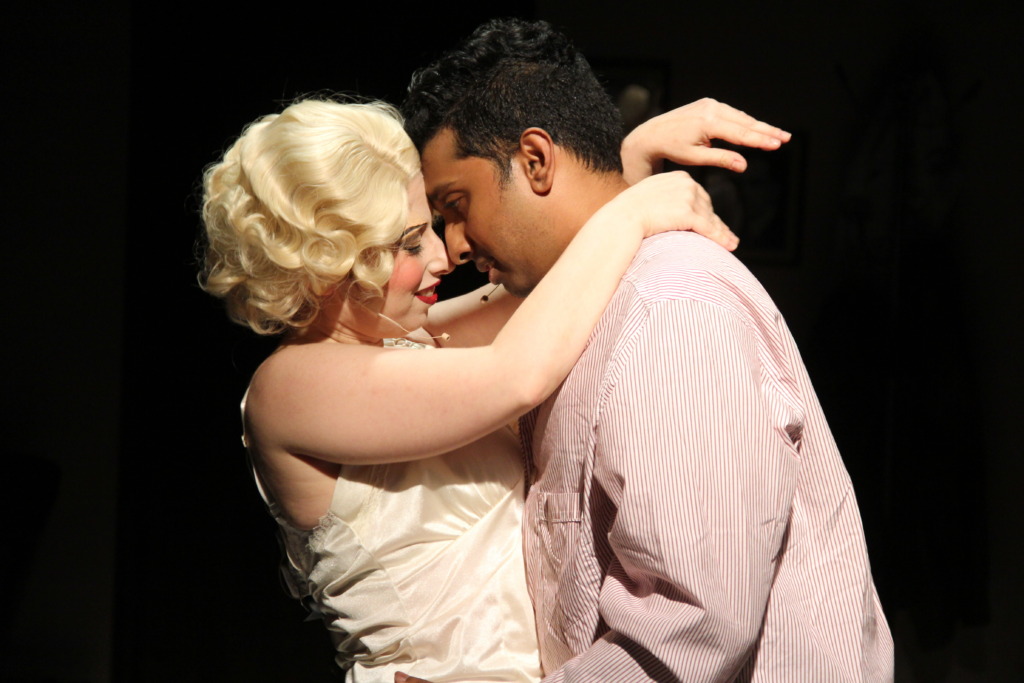
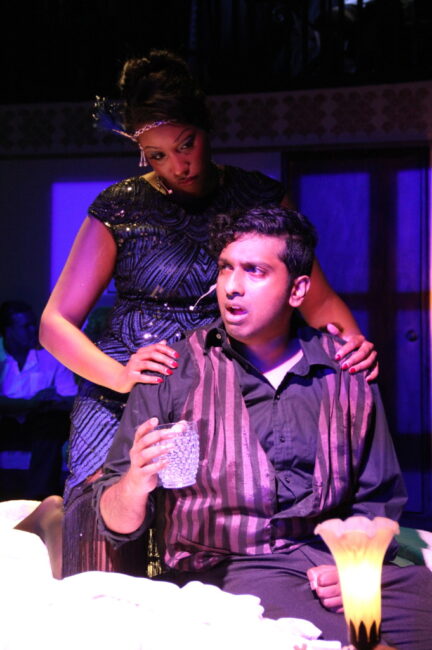
Sarah Ward and Victoria Howell have created the splashy, effortless look of the roaring 20’s, which would have been at its zenith in the summer of ’29 (stock market didn’t crash until October) and the beads, bangles, hair accessories, and dresses are on point! Accompanied by Hair & Makeup Artist Kristen Smith, the polished effects of these ‘bees-knees’ costumes are just aces. Though one does wonder what effect Smith was attempting to achieve with the mime-makeup-masks featured on Oscar & Phil d’Armano (I’m guessing it’s the clownish nature of being a Vaudeville producer, but if that’s the true intent that’s a very subtle, bordering on questionable approach to achieve such a sentiment.) Smith does deserve high praises for the perfectly styled wig on Queenie; it’s the blonde bombshell of the era, manicured to perfection and it is giving that girl all the 20’s rizz.
Sonically the show is a mixed bag. Where it’s winning? The orchestra. Hands down. Jack Benedict on keys, Keric Ellison percussion, Eric Proffit on guitar, and Justin Baughman on reeds are really jiving to Andrew Lippa’s score. There are several moments when those orchestra members are fiercely on fire with their playing, specifically Justin Baughman with his saxophone during the back half of “The Juggernaut.” Where it’s questionable? Sound balance. Sound Designer Sam Tousey hasn’t quite figured out the balancing component of whatever microphone system (bodies & drops combined, I believe) is in play at OVT to give the performers the power needed to overcome the orchestra, who though small, are still fierce and loud. Where it could use some improvement? The vocal blends. Musical Director Sheila Melendez doesn’t appear to have as firm a handle on this intricately chaotic score as one would hope. There are instances, particularly in some of the larger group numbers where the harmonies and blends just don’t come together clean and it pulls attention from what’s happening in those moments. The score is tricky and is putting up a fight, even with 15 performers on stage and four orchestral performers up on the elevated deck.
Visually, costumes and scenery aside, the show is equal parts a mixed bag. The show’s choreography, though it’s only the one big dance break in “The Juggernaut” that requires dance-specific choreo, is enthusiastic though not as synchronized or polished as one might expect it to look. This could be intentional on choreographer Amanda Patten’s part, trying to recreate that ‘drunken party chaos’ atmosphere of the roaring 20’s, though some of the dancers are perfectly unified with one another in those wild pelvic swivels and slide-steps, so its hard to make that stretch-connection in that number. The fight choreography (Jehan Silva) is pretty intense and reads clean and authentic, particularly during Eddie (Christopher Holden’s) bashing scene. The intimacy choreography (Karen Fleming) has varying degrees of success— at least in appearance. The show is edgy and sexual in nature, and there are some coupled-up performers who during the big orgy number don’t engage as well as others. If you’re going to tackle a show like The Wild Party you have to embrace it fully, unabashedly and with that intense consistency. For the record, the intimate moments between the principals— mainly Queenie and Burrs and later Queenie and Black— read just fine.
There’s a disconnect happening somewhere in the show, though it’s difficult to say what or where. It almost feels a little like director Diane Causer is shying away from the darker, more sinister components of the show out of an abundance of caution for audience opinion or audience clapback (which begs the question why do such a provocative and incendiary show if you’re not going to embrace it) or perhaps its newer performers who haven’t yet delved into this level of theatrical darkness. Either way it gives the performance a disjointed feel that does not feel intentional. The overall production feels like it’s shying away from or even afraid of the manipulation, toxic relationships, calculated evils, and other nefarious deed that Andrew Lippa meticulously threaded into the plot, which makes for strange viewing experience.
The cast has talent, though at times, it feels as if it needs more guidance. More pinpoint direction in character motives and expressions, more vocal attention particularly in the bigger group numbers, more one-on-one discovery of these characters, etc. The ensemble (as previously mentioned, they’re all named characters) features Riley Smith, Alex Hamilton, Sarah Ward, Alex Gude, Richie Dobson, Christopher Holden, Chloe Weiss, Jimmy Schwartzman, Danielle Carter, Jillian Dove, and Breton Stailey. And they are bringing great levels of enthusiasm to their performance, particularly during “A Wild, Wild Party.” If you’re looking for a pair of stand-out performances, you get it hands down from Danielle Carter as Mae and Christopher Holden as Eddie. Carter’s Mae is a real pip, complete with the perfect accent and cadence in her spoken vocal delivery. She’s enthusiastic and just radiant to watch and when she partners up with Holden during “Two of a Kind” it’s a real sparkling gem of a number. Holden fits the bill for the champion boxer-fighter type and plays up the punch-throwing stereotype sublimely. Keep your eyes on Jillian Dove as well, playing the ‘minor’ Nadine; her terrified facial expressions of trying to keep herself safe at that licentious party are so very intriguing. If you want the queen of the ensemble, it’s Sarah Ward in the role of Madeline True, self-proclaimed lesbian. And although she only gets the one number, “An Old-Fashioned Love Story” it’s such a ‘grabber’ as far as the number goes and Ward sells it with such gusto and intention, you desperately wish her character had more to do. Keep an eye on Ward in the background during the group scenes, she’s brilliant to watch!
The roundabout dynamic between Queenie (Melanie Kurstin), Burrs (Jehan Silva), Kate (Mikayla Gilmer), and Black (James Claxton IV) is blurred and somewhat misunderstood. Silva’s character is never perceived to be the brutal, abusive, gaslighting-narcissist that he’s written to be (it almost reads like Silva is a little afraid of being ‘too harsh’ or ‘too dark’ going back to the overall issue of not embracing the brutality and darkness upon which this show is built) so when he finally hits that unhinged moment and drags out into the ‘final confrontation’ it feels blindsiding out of nowhere. The dynamic between Silva’s Burrs and Kurstin’s Queenie never really feels all that toxic, it gently bubbles along the surface of dysfunction but never goes deeper than that. There is no chemistry present between Gilmer’s Kate and Claxton’s Black; whether or not this is an intentional directorial choice seems unclear, but Black would either have to be plaid as a nefarious-ne’er-do-well to go along with Kate’s scheme, which would negate his compassion and ‘good-guy’ appeal to Queenie, or he’d have to at least somewhat romantically involved with Kate to follow her lead in this disruptive arrival at the party. Kurstin’s Queenie and Claxton’s Black do have a meet-cute chemistry but it could have gone further. There’s just a level of technical dysfunction in the character dynamic that could use reshaping, guidance, and overall restructuring in this particular production to make it a more engaging theatrical experience.
All four of the lead performers are strong of voice, with Claxton having the most tonal control, Gilmer having the most expressive and intense eyes when she sings, Silva having the most clearly consistent notes that land when he’s singing, and Kurstin having the most expression both in her voice, in her facial expressions, and in her overall boy language. Kurstin appears to be shouldering an unfair amount of the show’s narrative burden, which again could have been a directorial choice— intentionally trying to set the show only through her eyes and perspective, but if that’s the case it didn’t go far enough. Kurstin has sublime body language, displaying a myriad of emotions, particularly as the show races through the back end of the second act, giving us anguish, despair, and disillusion all at once. The vocal acrobatics Kurstin achieves to create the correct sound for the Queenie character is beyond praiseworthy and her ability to hold a belted sustain is both impressive and astonishing.
It’s an endeavor that most wouldn’t tackle and while it’s uneven in places, the actors appear to be pouring their hearts and souls best they can into the work and they even appear to be having fun during the ‘fun bits’ of the performance. It’s worth a peek, especially if you’ve never experienced Andrew Lippa’s The Wild Party and it’s a testament to Other Voice’s Theatre’s attempt to push their boundaries, go outside their comfort zone, and try new things.
Running Time: 2 hours and 20 minutes with one intermission
The Wild Party plays through October 19th 2025 with Other Voices Theatre Other Voices Theatre at The Performance Factory— 244-B South Jefferson Street in Frederick, MD. Tickets are available by calling the box office at (301) 662-3722 or by purchasing them in advance online.