
“Embracing happiness is f**king terrifying.” ~Sarah Shulman A Very Jewish Christmas
We don’t usually censor words around here but tis the season and you never know which little ones might be reading alongside the adults in hopes that Santa Claus or Hanukkah Harry or whichever present-bringing seasonal deity will see them being a good little offspring, reading the theatre review of the Maryland Ensemble Theatre’s latest new work to grace their mainstage. A Very Jewish Christmas, by Sarah Shulman is a charming, if verbosely clunky, little holiday dramady that hits home for theatergoers everywhere. Even if you don’t come from a religiously-blended family, the dynamic of familial relationships in Shulman’s work is something everyone can relate to, particularly at this ‘festive’ time of year. Directed by Sache Satta-Fleming, A Very Jewish Christmas hones in on a family steeped deep in the traditions of celebrating both Hanukkah and Christmas, where the kids are grown, and change isn’t always easy to understand or accept.
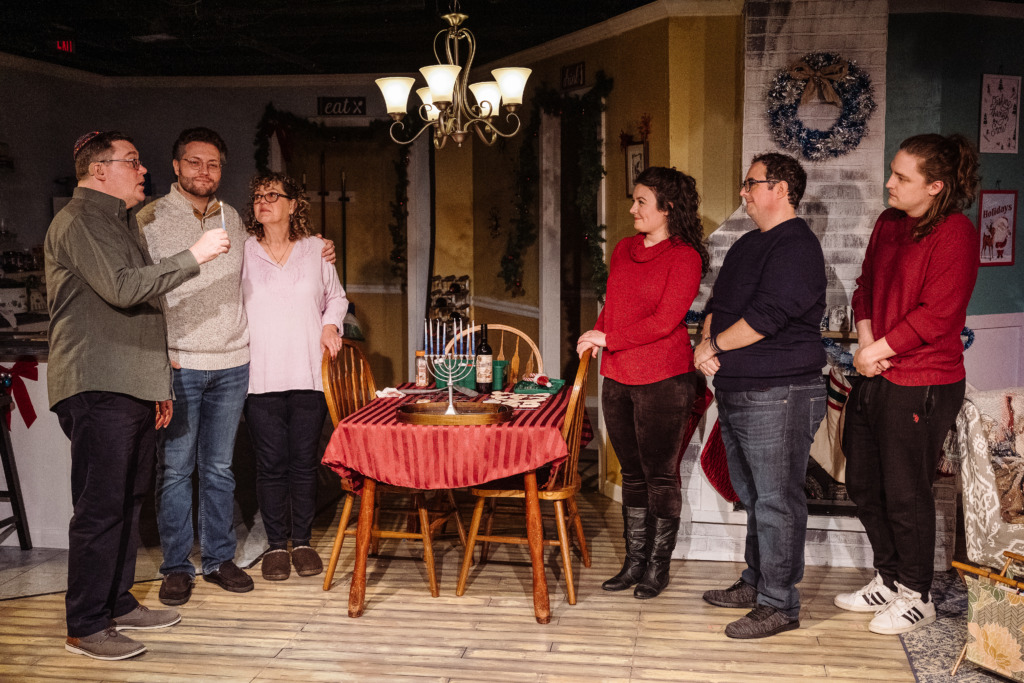
Scenic Designer David DiFalco has done a superb job of crafting the interior of this festive family home DiFalco’s elaborate set is almost a little too plush for the execution of the play in the sense that there is so much space to be utilized that sometimes the execution of blocking and overall spatial arrangement is out of sync with the action of the play, but that’s more on the shoulders of Director Sache Satta-Fleming than on DiFalco. It’s a sprawling family home interior including the exterior porch— for lots of anguished emotional contemplation— a living room, dining room, kitchen, and the illusion that the house spreads further along. DiFalco’s detail-oriented play-space creates the perfect cozy scene for families gathering for the holidays and the house is tastefully festooned with the perfect amount of seasonal flare— be it for Hanukkah or Christmas— with just enough spirit to show enthusiasm but not so much as to display a sense of overkill. And this is going to sound crazy, but shoutout to Technical Director Cody James for the fortification on the porch door. All too often one sees a flimsy set door that wobbles, won’t stay closed, or nearly caves in but not on this set. James’ ensures that DiFalco’s door is not only sturdy but gives that satisfyingly cathartic bang when it’s slammed for effect.
While we’re praising the aesthetic, Properties Designer Lori Boyd has gone out of her way to get those Christmas and Hanukkah cookies looking authentic and tasting delicious (or at least convincingly palatable as several of the actors munch on them all throughout the performance.) The show’s lighting, by way of Issac DeMarchi, feels cozy and natural for an interior space as well. The sound design, by Tom Majarov, is one of the highlights of the show as Majarov utilizes the actual audio clips from the 1946 film, It’s A Wonderful Life. And this becomes a critical moment near the very end of the performance, and hearing the actual clips (as opposed to a dubbed voiceover) is so very delightful that it completes that very wholesome moment on stage perfectly.
The issues with the production are predominantly in the script. While Sarah Shulman has an excellent concept, good, heart-felt emotions, and even strongly developed characters, a good deal of the dialogue just does not have an organic feel to it or a naturalized flow. There are many moments, particularly when intense, emotionally-weight conversations are about to unfold in the scene work, where said discussions just clunk their way into existence. The show’s narrative is rolling right along— it hits a pause and the subtext of the scene reads along the lines of “an important conversation needs to happen here” and then the conversation just drops into the scene without transition or segue. Even if Shulman was attempting to replicate those family discussions— or often times fights— where things explode into the dialogue exchange from out of nowhere, like a detonated-non-sequitur, she doesn’t quite make that clear. There are several exchanges, particularly between the Becs and Zeek characters, that feel read as presentational. “We’re over here having a loud, sibling-style thing, look at us.” The lack of fluidity in the conversations and overall organic verve of the show’s dialogue is somewhat of a disappointment because the topics that Shulman are bringing to the forefront of her play are both relatable for a whole host of people and really hit home in a deep emotional way.
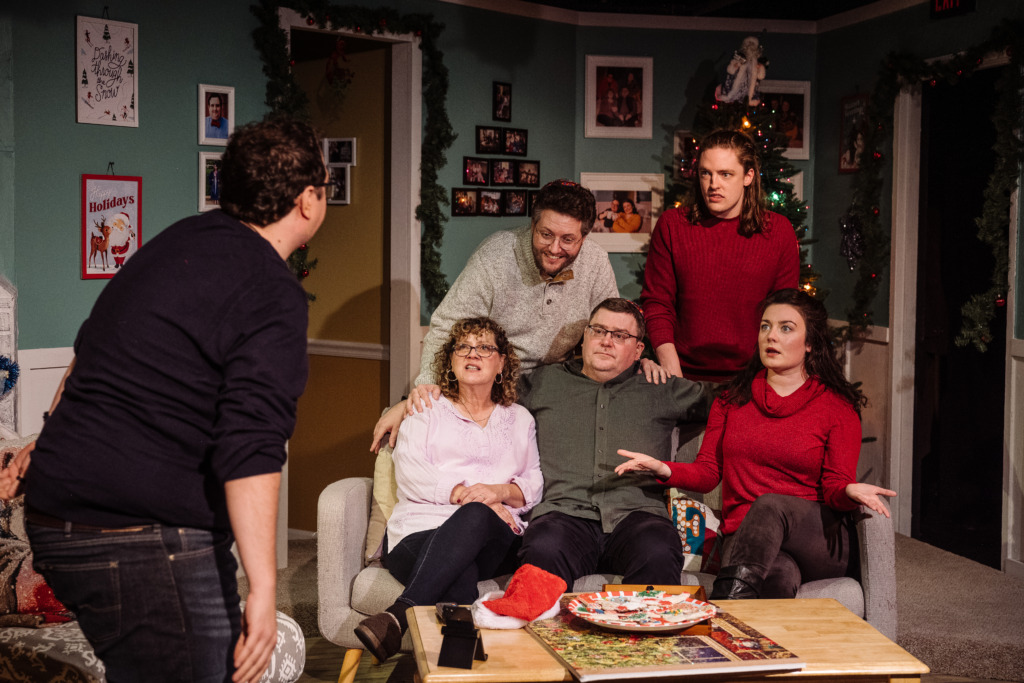
To Shulman’s credit she’s done an impressive job of encapsulating real family issues that so many people can relate to, especially at the holidays. Creating a paternal figure who suffers from and struggles with mental illness and attempting to normalize that without all of the negative stigmas that often accompanied with such stereotypes is an impressive feat and one that Shulman does well when it comes to the Jacob character. Though in my opinion, she could have spent more time making this the focal point of attention rather than dividing this factor with the other ‘white elephant’ in the room, which is relationship functionality and dysfunction, depending on whose relationships are in the limelight at the moment. Without wanting to spoil what turns out to be a major and pivotal plot point, the subject of polyamory gets pulled into the production and Shulman writes about it with grace and reverence, both from the characters who are engaged with it and from the characters attempting to understand it. Shulman has also done an exceptional job of showcasing the generational struggles of how love is portrayed from father to son, in addition to creating an exceptional cross-sectional examination of a blended-faith household who celebrates both Christmas and Hanukkah. One of the most emotionally striking moments that Shulman has written into the show happens near the end with Jacob and Zeek on the couch; the discussion itself is earnest, truly heartfelt and even a little humorous.
The show’s other slightly off-putting problem is the way director Sache Satta-Fleming utilizes the robust and hearty play space of the stage. There are some blocking challenges with this u-bend dining-room/kitchen/living room setup, not the least of which is consistency. If you want the audience to believe that that characters are struggling to hear one another whilst sitting just six feet apart— one in the kitchen and one in the living room, though you can clearly see the cross-space that serves as the dining room as it sits between the two— by having them call through the back of the house, then entrances and exits into those designated spaces need to consistent. There are times when the characters go out the back of the living room, cross through into the kitchen from behind and vice versa, but there are other moments where they walk through the invisible wall of the ‘dining room’ space directly into either the kitchen or the living room, which shatters the illusion of the set’s spatial alignment. It seems like such a small thing to complain about, but with a set that impressive and actors that talented, consistency in this fashion is imperative to a fluid execution of the production on the whole.
Satta-Fleming’s blocking challenges aside, the emotionally bombastic explosions that are evoked from the players are exquisite. The whole show is layers of character reveals, surprises, and unchecked emotions and Satta-Fleming does an exceptional job of coaxing the cast through these moments in ways that feel authentic and also hit hard for the audience. A few ‘whispered/intimate’ conversations aside where the actors are actually whispering instead of stage whispering, which makes certain snippets of dialogue difficult to hear depending on where you’re seated in the house (primarily a problem for the Annie character when she’s in the kitchen in the second act), Satta-Fleming gets excellent performances out of the seven performers featured in this production.
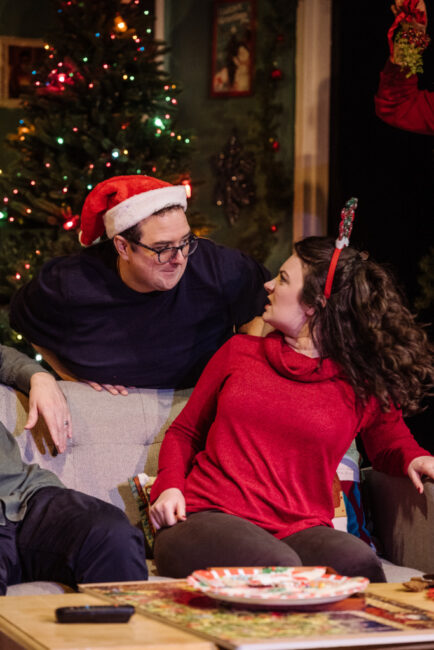
Shouts of quirky praise can roll straight out to Taylor Rieland, who plays Tim. A semi-superfluous character that appears to exist solely for the perhaps of farce-style comic relief, so much so that the character isn’t even in the second act. But Rieland has you laughing hysterically at his antics once he gets going with the cookies and you won’t soon forget his shenanigans, even if the character disappears by the end of the first act.
Benji (Willem Rogers) is another character who at first feels like he’s been somewhat shoe-horned into the play by the playwright, given all of the other plot twists and things that are unfolding throughout the performance, however, Shulman gives the Benji character meaning as more than just a ‘side-plot-angle’ by the end of the second act, and it’s rewarding to watch that storyline play out. Rogers, as the slightly off-kilter friend-of-the-family-might-as-well-be-family sort of figure is grounded and gives a solid performance, particularly with his more humorous one-liners at the top of the production. And his perfectly timed arrival at the end of the show is the frosting on the cookies, as it were.
In a family of five— Mother Annie (Laura Stark) Father Jacob (Jack Evans) daughter Becs (Mallorie Stern) son Zeek (Matt Harris) and Uncle Paul (Eric Jones)— there’s quite a lot of drama, emotional baggage, and generalized seasonal chaos to unpack. The dynamic relationships that these five characters represent, and that their respective actors portray with gusto and earnest vigor, really hold the story together. The way the family plays off of one another feels earnest and natural, even if at times the script’s dialogue doesn’t land them there smoothly. Laura Stark, as the maternal figurehead in the household, has a balanced sense of both humor and sincerity about her character portrayal. There’s something intrinsically comforting about watching her in this role, like she could be an EveryMom, but with depth and emotional dimensions.
Watching Jack Evans, as Jacob, go from the stereotype of comic-puttering-old-dad to a very clearly neurodivergent individual who has so many complex layers all wadded up into one tangled jumble…not unlike the Christmas lights used to decorate the tree near the end of the second act… is truly fascinating. Evans delivers a nuanced performance and at times is even quite frightening with his levels of both emotional intensity and his physical volume. It’s difficult to find accurate words to describe the way Evans deftly navigates the tumultuous roller coaster of emotional states of existence that the Jacob character experiences but it truly remarkable to see it handled so brilliantly. It’s wild to watch his mercurial performance, explosive dynamics and all, especially considering the static potential for the character based on the opening scene.
As Becs, Mallorie Stern makes the audience both love and hate the character at the same time. With the potential to be just a little more than annoying (and more than just Benji gets annoyed with her nonsense), Stern finds an equilibrium that makes the audience want to love her…even when they are over her indecisive chaos and generalized whiny-state of existence. There is a truly glorious moment, where the Becs character is stood out on the porch (again, beautiful craftsmanship on the scene design team side here) and she’s pouring her heart and soul into this monologue and it’s both a gut-punch of wonderment and a happy-ugly-cry moment that you can relate to on a visceral level. The runny mascara and snot with tears is an added authenticity bonus that just really pulls you into that moment with her.
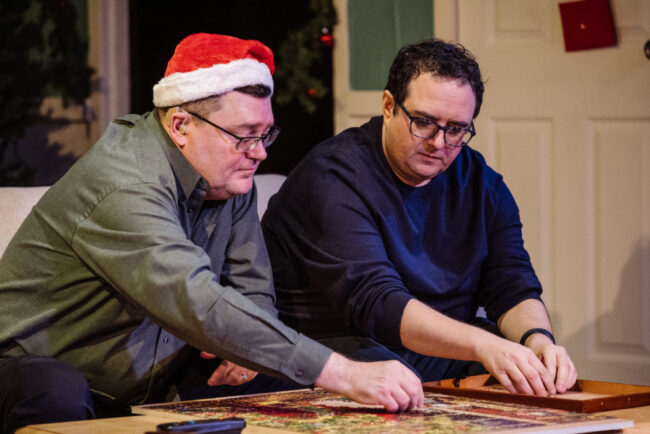
Making perhaps the greatest character growth of the show, Matt Harris’ Zeek has quite a few emotionally explosive moments that really lands in the audience like pathos bombs being dropped from the sky. You can tell from the moment he enters the scene he’s teetering on the edge of keeping it all together; Harris does an exceptional job of playing the character right at the precipice of meltdown and then leaning into the wind of it as his character tips over that ledge into these exasperating moments of emotional turmoil, frustration, and internal confusion. Arguably the most touching moment in the show comes when Harris’ Zeek and Evans’ Jacob have their heart to heart on the couch over the Christmas puzzle. It’ll give you a whirlwind of feelings and make you happy-ugly cry all at once.
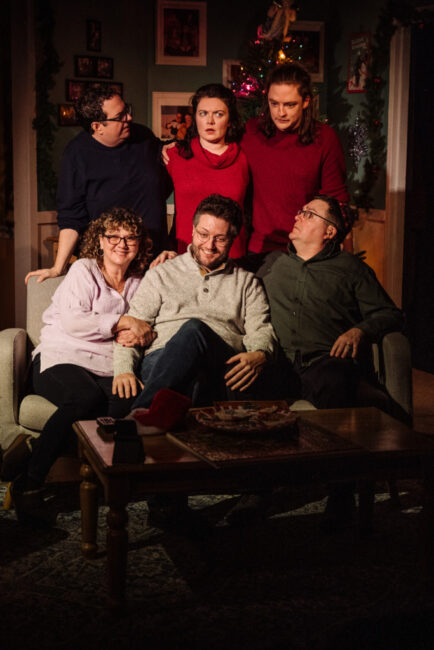
The Uncle Paul character has the potential to blow in a great many directions but the way Eric Jones settles this avuncular, familial man is just the sublime star atop a shining Christmas tree. There’s the potential to ‘ham up’ certain components of the character’s internal makeup, which would be more in alignment with some of the more farcical Christmas capers MET has produced in the past. Jones smartly doesn’t take that approach. Instead, Jones keeps the character with both metaphorical feet on the ground, trying to be the calming beacon in a maelstrom of family struggles and dramas all throughout the dual-holiday season. There’s a gentleness and a sincerity to the way Jones approaches each of the relationship dynamics that the Uncle Paul character shares with each of the other family members in play; it’s a rewarding experience to see someone remain so sincerely calm even in the face of chaos. (If only every family were so lucky as to have ‘one’ like this iteration of Uncle Paul.)
It’s truly a holiday treat— good bits of humor, real issues that hit hard and quick, especially at this time of year, and a wild and lovely set to enjoy in addition to excellent performances. The subjects, overall emotional performances, and general experience of the play is both solid and life-affirming, if not entirely enjoyable. The holiday season won’t linger forever, so be sure to catch A Very Jewish Christmas this month on MET’s main stage.
Running Time: 2 hours with one intermission
A Very Jewish Christmas plays through December 22nd 2024 on the Main Stage of the Maryland Ensemble Theatre in the Historic FSK Hotel building— 31 W. Patrick street in downtown historic Frederick, MD. For tickets call the box office at (301) 694-4744 or purchase them online.