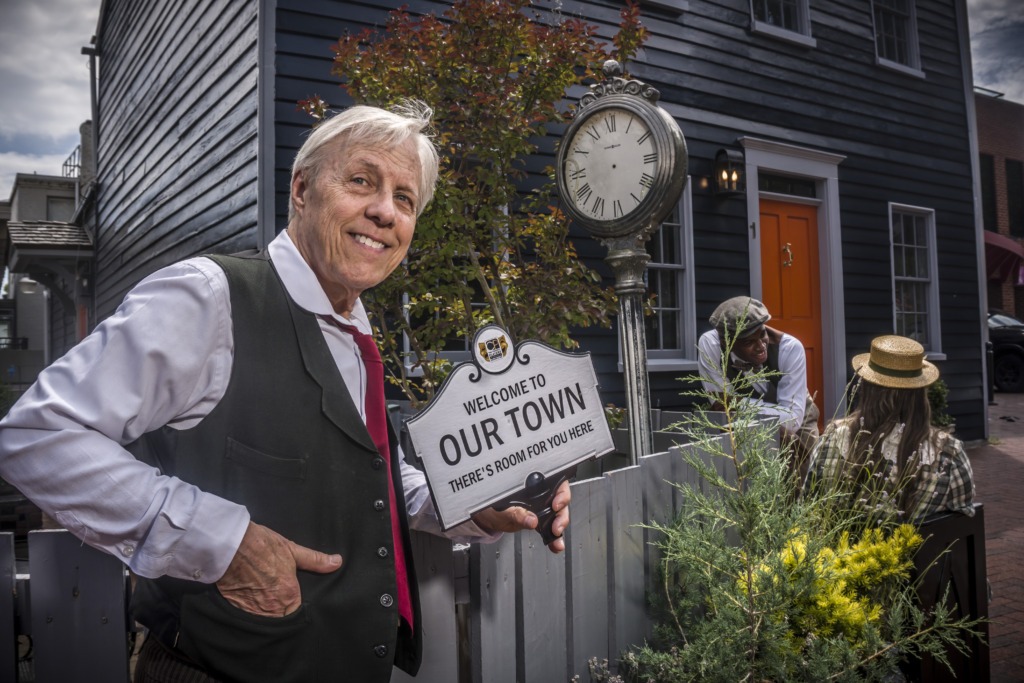
Some people ain’t made for small town life. And everybody is entitled to their own trouble. Of course, there’s layers and layers of nonsense whenever you come near the human race— and if our present day societal existence isn’t proving that one, I don’t know what is. But small town life, whether you’re meant for it or not, whether you’ve got your troubles with it or not, has come to Church Circle in that little black-box-in-the-square of Annapolis because Colonial Players is kicking off their 78th season with Thornton Wilder’s American chestnut, Our Town. Directed by Rick Wade, this tried and true stage warhorse (which appears to have surprisingly never been on the CP stage in its 78 seasons of existence) is the epitome, if not the foundational block, of ‘slice-of-life’ stage drama.
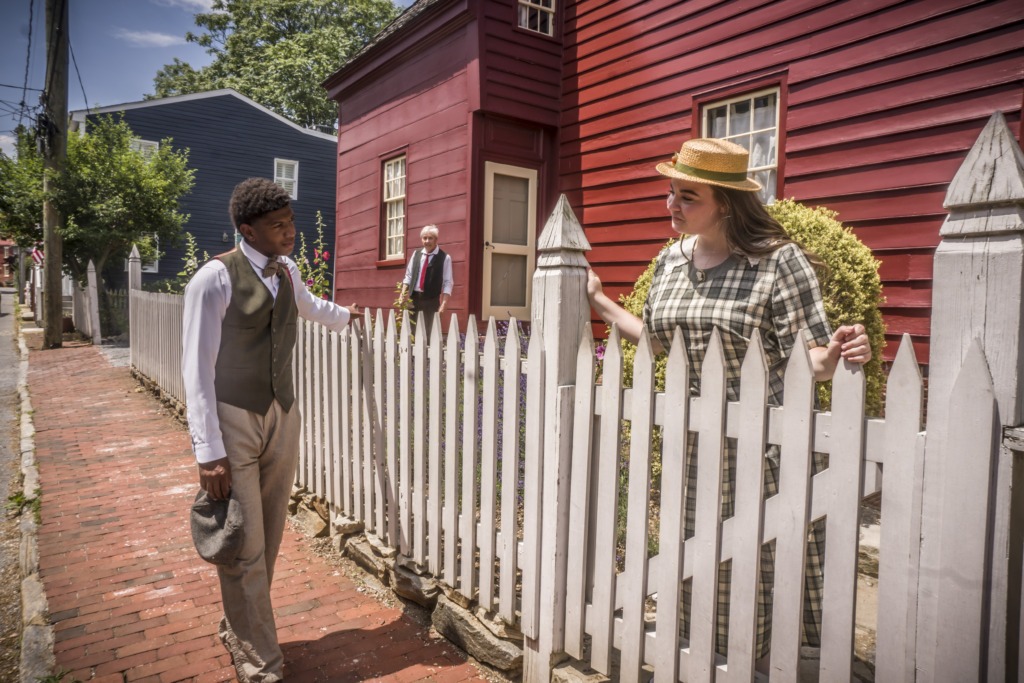
The production is well done, simply put. There’s even a bit of scenery for folks who think they need scenery. (Traditionally, the play is both scripted and produced without such trappings, which makes it appealing to a great many playhouses and theatre troupes for a whole host of reasons.) They’ve gone to the trouble of crediting Laurie Nolan as the set designer, and so will I, though I suspect its for her pretty painted floor (whose credit gets shared with Nolan, Constance Robinson, Jim Dell, and Lynne Wagner) more so than anything particularly scenic. It’s a minimalist show, minimalist set— highly appropriate and well-adjusted period costumes (by way of Costume Designer Megan Venton) and some useful if not wholly mood appropriate lighting, illuminating the various scenes compliments of Lighting Designer Frank A. Florentine. The most impressive production component about the performance is the soundscape, crafted by Sound Designer Sarah Wade. It’s little things, like the train whistle off in the distance as it wheels through the depot, or the clanking that Howie Newsome’s old gal Bessie gets to making every time the milk cart stops. I think there’s even some rain sound effects in there, which make for a right nice third act setting.
Rick Wade should be commended on his ability to move the performance along swiftly. Lots of folks, both in and out of Grover’s Corners— the fictious New England township where the play takes place— and in and out of Annapolis know Our Town to run lengthy. This one comes in at a miraculous two hours and 15 minutes and that includes the intermission. Wade cuts the number of intermissions in half (more traditionally as scripted and delivered, the show has two intermissions, one between the first and second and then again between the second and third acts) and this keeps the overall momentum of the performance moving. There are also bits and bobs of Wilder’s original text that have drifted away, like the fleeting essence of our mere mortal lives, but no one’s missing them, and the play feels whole without them.
The question herein is this: why Our Town? Most companies that attempt it want to re-invent the wheel with it, put a modern contextualization over it, use it as a lens to make a statement of some sort, or something sparky and exciting. Rick Wade is delivering a textbook production of Our Town, nothing flashy or special, decently acted with good pacing, nice costumes, and minimal scenery. Not every play needs to be exciting or a musical or have some agenda behind it, but of all the ‘slice-of-life’ shows out there, why this one? Or if this one, then what purpose did you intend for it to have? It just makes one wonder. Is anyone sitting in that audience truly contemplating the conclusion that Emily Webb comes to by the near-end of the performance? Or at they just enjoying a non-boat-rocking evening out at the theatre? That isn’t to say it isn’t worth seeing, mind you. There’s plenty to enjoy, even a little bit of this and that to laugh at or cry over; all wrapped up in one ‘cross-section-of-small-town-existence’ in a time that hardly nobody remembers any more.
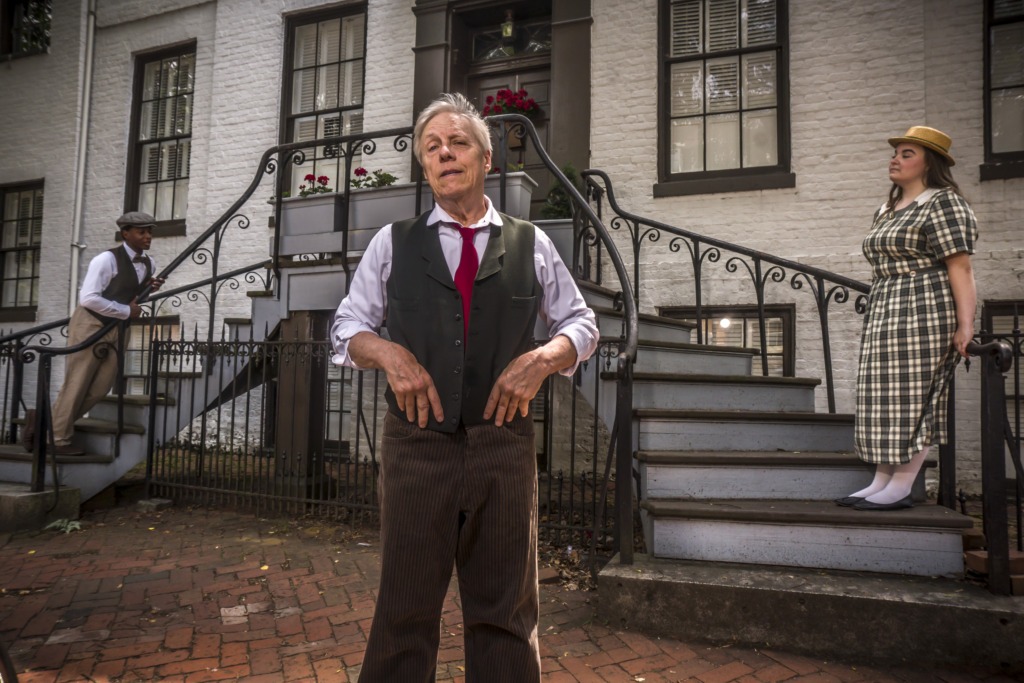
Some of the performances just feel a little dull, a little lack-luster, a little ordinary, though I think this may be intentional on director Rick Wade’s part. It’s meant to be ‘ordinary life’ in a time when everything moved a little slower, nothing was spectacular, because the everyday living of life— picking beans for winter, staring up unable to sleep because the moon is just too bright, carrying books on the walk home from school— was meant to be the spectacular element. You have the whole of the named ensemble doubling up as the town Choir Members (Greg Anderson, Jane Carrigan, Dana Fleischer, Angela Germanos, Christine Kinlock, Denise Sudell, Frederick Taylor) and they’re led by the Choir Director Simon Stimson (Josh Mooney), the town drunk. While Mooney’s character only appears in the choir scene in the first half of this performance, he is arguably one of the most lively characters in this production. And he’s hardened by the time they get to the graveyard scene in the final act. There’s an agitated presence about him that just speaks to an authenticity of the character, as if Mooney’s Stimson is existing in a three-dimensional version of this play and the other characters are milling about in a static, storybook retelling. Maybe that was intentional too; Wade wanted to highlight the truly tragic, those who escaped— like Sam Craig (played by Matt Leyendecker, who also shows up with this lively gusto that feels authentically out of place for most of the other performances in Grover’s Corners)— and those who experienced life— the two ingenues, Emily Webb (Anna Janssen) and George Gibbs (Cordell D. Smith.)
Though Grace Wenzel, playing young Rebecca Gibbs, is due a great deal of praise. She’s just the ‘little sister’ character and while the character itself doesn’t seem to serve the plot in any way shape or form, she gets one of the most striking moments in the performance. Wenzel’s delivery of the ‘postcard/letter address’ where she reads off into the night sky really puts into perspective the vast significance and insignificance of humanity on the planet earth, which is quite the impressive feat for such a young performer. Cole Skinner, as the other youngster Wally Webb, is also quite a pip and enjoyable to watch.
The aforementioned Jansen as Emily Webb and Cordell D. Smith as George Gibbs have the meet-cute chemistry you’d expect as young neighborhood sweethearts. Jansen has a firm handle on the overall cadence and patois of the time period, as does Smith, though it’s more noticeable with Jansen, particularly in their scene that ends the up at the soda counter inside the drugstore. Several of the performers, including Doc Gibbs (Andrew Rappa) and Mrs. Gibbs (Dana Fleishcher) have that lilting hint of that Grovers Corner accent, while other performers like Editor Webb (Gary Louis Appel) and Mrs. Webb (Jane Carrigan) lack the accent but manage to sound as if they’re sitting in the turn of the century. Appel has a fine scene shared with Smith’s George and the banter they share in that ‘morning-of-the-wedding’ is just delectable.
A lot of the pop-up characters are the ones that catch the attention of the audience, even if the story itself revolves primarily around the Webb-Gibbs families and their respective young children falling in love with one another. Constable Warren (Fred Taylor) for example and Howie Newsome (Gary Brick) are but fleeting townsfolk who have a few lines here and there but their delivery, the way they carry themselves on stage, stick in the mind. Maybe that’s all a part of what Rick Wade was trying to do with the production; make people notice the mundane.
Jim Reiter is delivering textbook Stage Manager with just a hint of accent to his character approach. You do get some really humorous facial reactions out of him when Professor Willard (Greg Anderson) starts gassing on about the geological history of Grovers Corners, rather than the anthropologic-socio data. Reiter is most lively when he pops into the story as a character— his best by far is the Druggist, handing out ice cream sodas to Emily and George.
The production is solid, the performances are good, and it runs smoothly, albeit some folks sound a little modern, feel a little ‘present day’. It’s worth investigating, especially if you’ve never taken in Our Town, and it will remind you to take comfort in the ordinary, solace in the mundane, and appreciate all the little things in life, as so many of us so often overlook.
Running Time: Approximately 2 hours and 15 minutes with one intermission.
Our Town plays through October 3rd 2026 at The Colonial Players of Annapolis— 108 East Street in historic Annapolis, MD. For tickets call the box office at (410) 268-7373 or purchase them online.