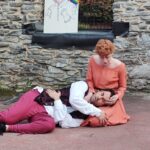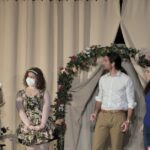
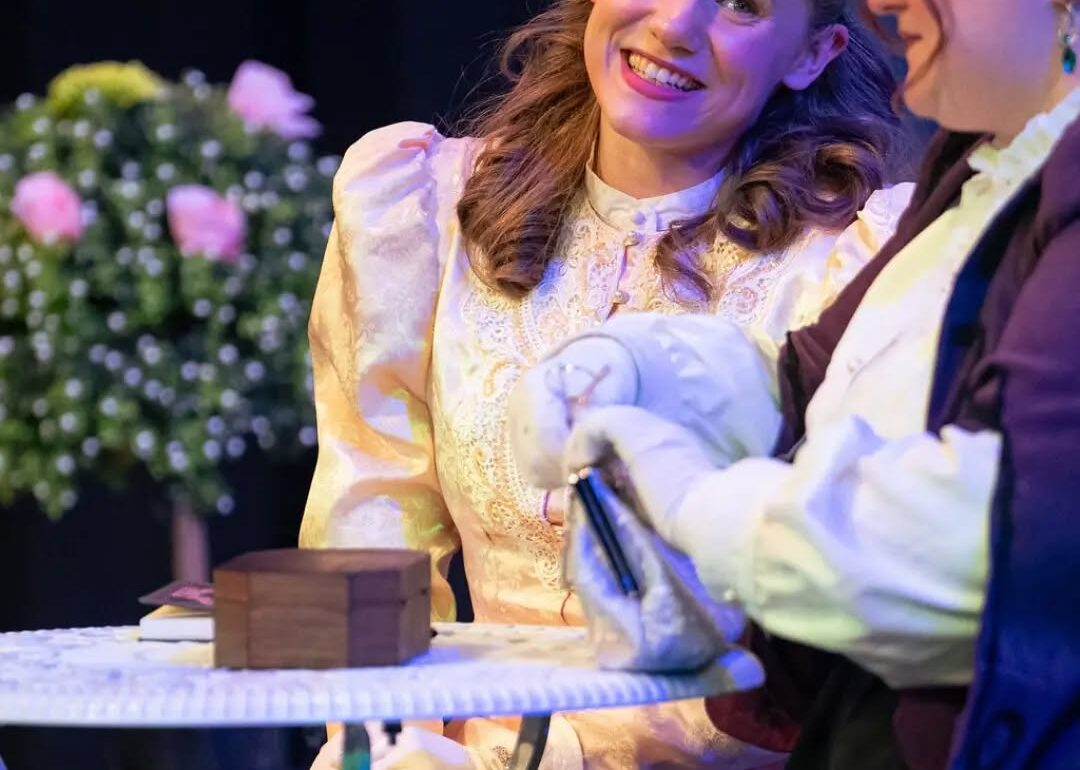
The very essence of romance is uncertainty! Will they? Won’t they? Is it a Happily-Ever-After? Join The Endangered Species Theatre Project as they embark down the well-worn theatrical path of Oscar Wilde’s The Importance of Being Earnest this summer as a part of the Frederick Shakespeare Festival. Co-Directed by Christine Mosere and Kayla Swain, there’s some giddiness abound in this indoor-festival production.
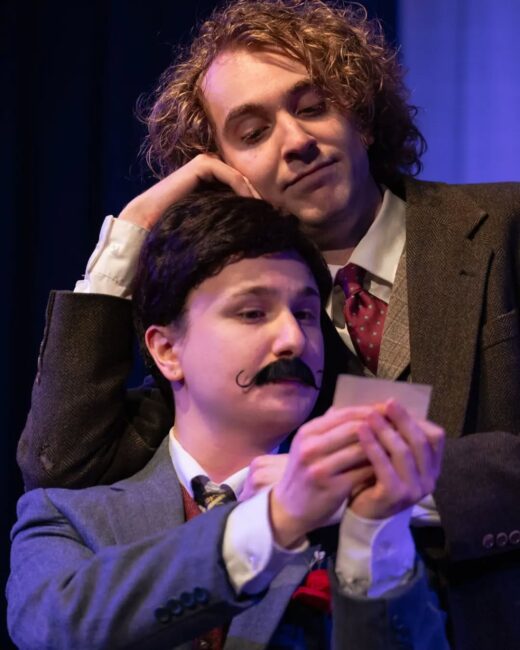
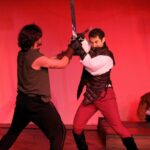
Part of this production’s challenge is the overall pacing, which one wouldn’t think would be an issue considering the duration of the runtime, which includes the intermission, but with the first act coming in at just over 45 minutes and the second act being a little more than an hour and 15, it feels unbalanced. There are scenes where the dialogue needs to be tightened, the action and exchanges as well, and there are scenes where words— often delivered in a state of vocal excitement and at peak volume— that need to be eased back down from their grand-prix speed of delivery. The scene changes are also cumbersome. Set Designer Sam White overloads the stage with unnecessary scenery (immediately coming to mind is the carpet being rolled out after the garden scene to showcase ‘moving inside’) and this creates a drag in the shift, in which the audience gets unsettled. Theatergoers will suspend their disbelief of moving from out in the garden to a locale’s interior by way of the acting and dialogue cues without necessitating all of the furniture. Where White does succeed is with the interstitial instrumental cues to help disguise the length of some of these scenic changeovers. Though to Fight Choreographer (and perhaps directorial) Matthew Bowerman’s credit, when Jack and Algy exit the garden scene, they pick up their respective chairs in an attempt to bash each other over the heads with them, and it’s the most clever execution of clearing furniture to be utilized in the performance.
At the opening weekend Sunday performance, the actress playing Lady Bracknell was not ‘off-book.’ Circumstances arise in live theatre where replacements are often called for, sometimes even just prior to curtain in order to execute the notion of ‘the show must go on.’ Whether or not this was such an incident, remains to be seen, but in not being off book, a great deal of comedic timing was jumbled, delivery and pacing was lost, and moments that should have been explosive or snappy fell short. That said, audiences will forgive even that if it’s executed correctly. A scroll of some variety had been fashioned for the actress (Props Designer Deanna Kinzie) only it didn’t appear to open/unscroll and the actress appeared to have trouble reading from it. A more believable solution might have been to have a notebook or ledger book from which the actress could have been perpetually ‘taking notes’, reading her hidden lines, and responding to dialogue cues accordingly. If the performer buries the ‘reading lines’ in a meticulous character-choice-driven task, most of the audience will be none the wiser. Hopefully this will improve before the production closes.
It also sits unwell as a professional production that is coded for actor’s equity that part of the company’s mission statement is to “provide diversity” and the program lists not one but two Diversity, Equity, and Inclusion Advisors (Rikki Lacewell & Rain Pryor) though the production itself appears to be somewhat lacking. There is, to the inclusionary credit of the show, a ratio of 62-38 women/female presenting/identifying performers to men/male presenting/identifying performers.
There’s something to be said for both directors playing major role in the performance as well. In this rendering, truncated though it is, Prism (Kayla Swain) feels to have more on-stage time and presence than she might if a full-length/unedited version were being used. The same for Lady Bracknell (Christine Mosere.) While there are some extremely funny moments— largely falling on Algernon (Jackson Peters-Mosere) and John Jack Worthing (Daneil Summerstay), particularly on the latter and the way he flings his physicality all over the furniture throughout the performance— a lot of the humor gets jumbled up or lost entirely in the pacing and a great deal of excitement and enthusiasm is garbled and drowned in shouting.
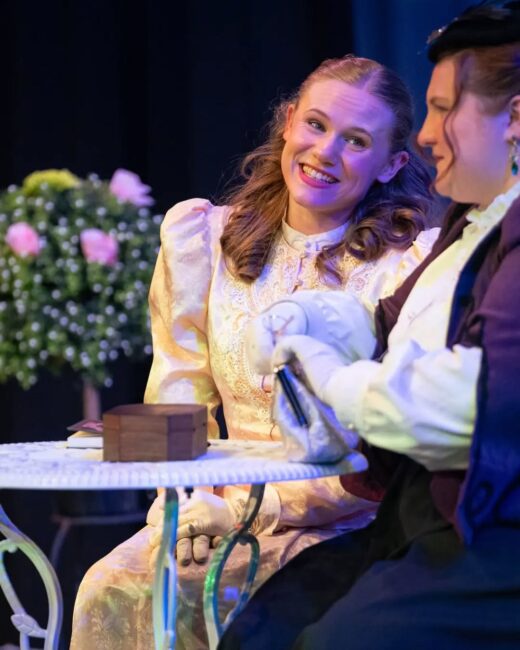
Arguably the most nuanced performance is given by Emma Justine Roeder as young Cecily Cardew. Her petulant tantrums, expressive facial features, and overall interactions with others. Her childish and juvenile nature feels mercurial and dynamic and is really fun to watch. This is especially true when Jack (Summerstay) arrives in the second act bedecked in funerary blacks and a 12” stove-pipe top hat, adding to the actor’s already tremendously towering stature. (Shoutout to Costume Designer Rebecca Summerstay and Rachel Smith; this might be the finest achievement in the production!) Roeder does a splendid job of driving the tea-garden scene between her character and Gwendolen Fairfax (Elena Echeandia.) When it comes to expressing syrupy sentiment over their respective beloveds, both Echeandia and Roeder have that well in hand. Roeder also pairs well with Summerstay; they pair have the two most consistently authentic accents in the performance and while Roeder leans more into vocalizations to create humor within her character’s existence, Summerstay does a stupendous job of relying on his physicality to express comedy. He’s literally the funniest thing on stage when he starts flinging his towering stature here, there, and everywhere; pairing him opposite Jackson Peters-Mosere for the visual comedy of a very, very tall Jack and a significantly less tall Algy becomes a recurrent and delightfully played-upon bit in the production.
We all understand that producing high-caliber, quality theatre is a challenge, even for a small professional company with limited budgets. The audience, for the most part, seemed to enjoy the production, even if at present it doesn’t feel like it’s fully living up to the standards of a small, professional, equity-coded performance. But if butts are in seats, and no one’s walking out at the intermission and not coming back, then surely that’s an opportunity to continue trying, keep learning, keep growing. And the cast (including the aforementioned in addition to Jess Elser as Lane/Merryman and Ben Hemler as Rev. Canon Chasuble), are giving it their best efforts.
The truth is rarely pure and never simple. And truthfully, if you’ve never seen The Importance of Being Earnest, there’s a lot to on-board with this production and for the most part it’s two hours’ stage humors that will likely please a decent amount of people who would otherwise not go out to enjoy an afternoon or evening of theatre. Being in a theatre is better than not being in one. Go be in The Importance of Being Earnest, see what it’s all about this summer.
Running Time: 2 hours and 15 minutes with one intermission
The Importance of Being Earnest plays through August 13th 2026 as an Endangered Species Theatre Project production, a part of the Frederick Shakespeare Festival. This production plays at multiple venues on different dates, for more information, click here. All performances are pay what you can.