
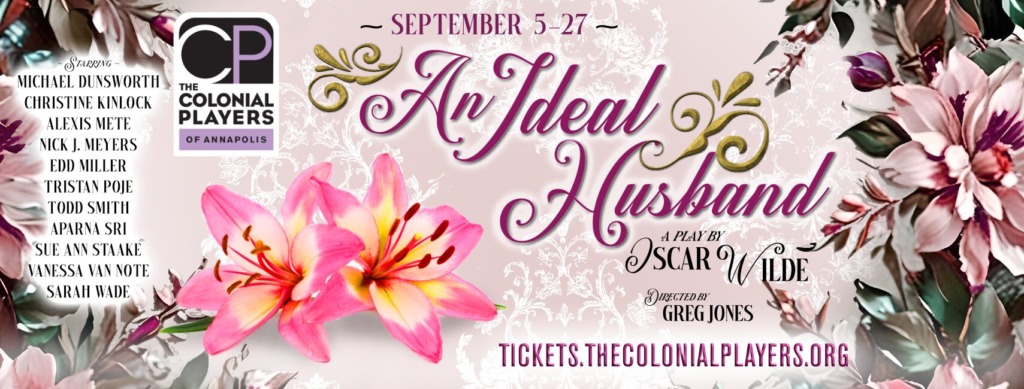
You are cordially invited to the final dress ball of London’s 1894 season hosted at the illustrious grand estate of Sir Robert Chiltern. Do come prepared to gossip, scandalize, and be gossiped and scandalized about.
Translation? The Colonial Players of Annapolis is kicking off their 77th season (Time & Transformation) with a production of Oscar Wilde’s An Ideal Husband, directed by Greg Jones. While not as farcical or tickling as The Importance of Being Earnest, this dainty little romp of Wilde’s has all the grandeur of Bridgerton with all the charm of a drawing room dramady, and is a dainty way to use nearly three hours of your evening or Sunday afternoon.
One expects there to be dancing at a grand ball but let’s not dance around the issue of the play’s interminable length. One might think Oscar Wilde was being paid by the word for the amount of dense and superfluous verbiage contained within this play. And you can’t really fault Director Greg Jones or the players as it isn’t the pacing or delivery…it’s just the density of the text and how at times it just droops in its essence and necessity. There are certainly humorous moments and terse, tension-driven interactions, but the text of the play meanders in and out of itself in somewhat of a tiresome fashion, which does cause one’s attention to wander…to all the microscopic details in the show’s aesthetic work (but more in that in moments!)
Really and truly, in high-prose fashion, I must confess how very much I wished to loathe and detest the five-minute carousel-dance-scene-change that was intricately arranged and executed by Choreographer Lindsay Zetter. Why on earth would one want to force a lengthy play into even longer a stay upon the stage? Truly! And yet, Zetter has done such a remarkable job with this little parade of people and furnishings that it becomes one of the more delightfully amusing components of the show. (I spent a good 20 minutes trying to find fault with it; it’s simply too perfect, both in its execution and overall construction.) You get elegant yet edgy instrumental music of the period (props to Sound Designer Dudley Whitney, also responsible for lights and projections and there are more praises for Whitney to be had, most assuredly) in a semi-dropped dark-out while Stage Crew (Sarah Flanagan, Gemma Gamberdelli, Maureen Mitchell, Diana Tobin) dressed as household servants, alongside Alexis Mete, Vanessa Van Note, and Nick Meyers (tertiary supporting characters from within the play) shuffle furniture on and off-stage in a rhythmic whirl, all the while being directed by Phipps (Todd Smith.) It’s quite the orchestration to watch and all the little antics that develop, particularly with Mete and Van Note fiddling about flopping on the furnishings and Smith’s Phipps shooting daggers at them; it’s just a gem of amusement that really catches the audience off-guard in a most lighthearted and entertaining fashion. Bravo and Brava to the whole affair— it happens twice!
Aesthetically the show is opulent and laced with exquisite detail in the design components. Set Designer & Decorates Dudley Whitney and Edd Miller (along with Set Painters Connie Robinson and Lois Evans) bathe the scenery in a sense of societal decadence. The painted floor is a personal favorite; the thin lines between floor tiles are created with such precision and the illusion of depth that you find yourself wondering if they’re actually tile laid down over the stage’s natural flooring. The paint work and patterning as well as the detailing in the ‘stamp-decal’ work of the floor is just divine! (Remember when I said that the script gets languid and gooey and you start looking at the scenery? Praises to the quartet of scenic artists who give you something so lush and detailed to look at! And a bonus shout-out to the Properties Designer Carrie Shade!) Whitney also works projections into the in-the-rectangle walls of the play space— the grandest one by far being the dancers dancing at the ball in the opening scene. His light work is equally impressive, particularly during that recollective memory scene where Sir Robert goes into a subdued anecdote about the Baron and how he found himself in the predicament in which he’s found himself. If there’s a fault in Whitney’s work on the show it’s the ‘light-freeze-bell-chime-cheat’ moments. They happen at an odd frequency and then strangely disappear; it’s almost like Whitney was attempting to make those ‘aha’ cheeky-for-the-audience moments to highlight certain things, and it just felt oddly off. Maybe more of it at a greater consistency and frequency to add farce-edged humor or scrap the bit entirely. But if that is the show’s lone design complaint (maybe a pair or two of ladies heels that are ever so slightly more noticeably ‘not of their time’ than others) then as a designer, Whitney is well ahead of the game.
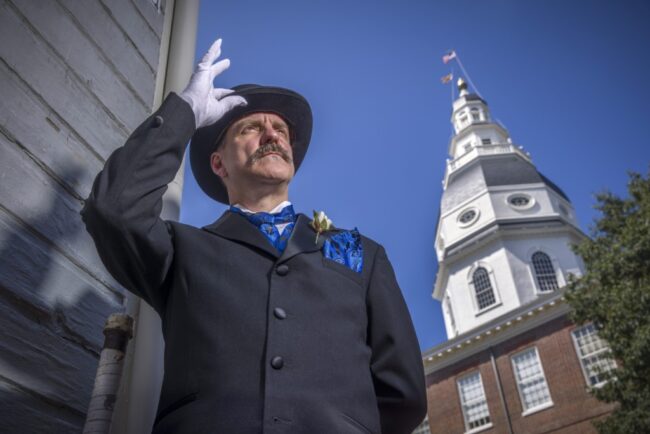
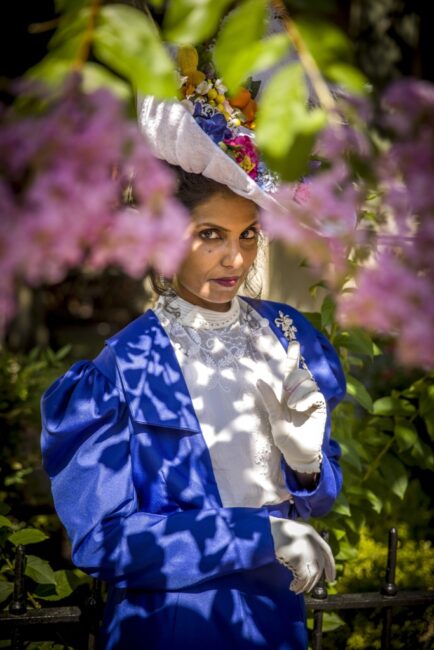
If you’re going to fabricate a show in Oscar Wilde’s playground the grandeur has to radiate not only in the show’s scenery but in the show’s sartorial selection. Costume Designer Maggie Balacki and her legion of seamstresses (Jan Blom, Ann Edwards, and Christina McAlpine) ensure that the show’s togs are up to snuff, perfectly push, and well reflect the characterizations of each induvial. The gents have proper spats on their shoes and (for the most part) the ladies have exceptionally appropriate heels. Rich colors and patterns seem to be the signature affair for Balacki’s work; coming immediately to mind is the dusky-mauve-rose teardrop affair featured on Gertrude and the lively spring florals utilized to enhance Mabel’s youthfulness. But the crown jewels of Balacki’s costume choices are featured on Mrs. Cheveley— three gorgeous gowns with matching accent jewelry in radiantly saturated gem-tones of ruby, sapphire, and emerald. The fit, form, and overall style of these gowns are lavish and perfectly suited for the enigmatically vindictive character upon which they are styled.
The performance as a whole is impressive and well-acted. As previously mentioned the issue with the show isn’t the pacing; Director Greg Jones (assisted by Stage Manager Ernie Morton) does a remarkable job of actually keeping things moving (he can’t help if the dialogue isn’t as interesting as more modernized audiences would hope for, though maybe cuts here or there may have been prudent.) And for high-caliber community theatre, the accents are at least strongly consistent and reflective of the society in which the play is set. Gertrude’s accent takes a wild-Irish-rose meander toward the final scenes of the play but we’re going to chalk that up to performance fatigue; the show is lengthy— for the performers too! One of Jones’ greatest successes, though the dialect should be counted in the pro-column of successes for this production as well, is the intrapersonal dynamic he cultivates between the performers. You get that cheeky coy flirtation verve between Mabel and Lord Goring right from jump-street. You get this sororal bond of sniping gossip girls between Lady Basildon and Mrs. Marchmont the moment they are introduced; each of the dynamic relationships between the characters really pop and grabs the audiences attention, which helps draw you into the performance, even when Oscar Wilde’s text drags on.
Introducing:
Mrs. Marchmont (Vanessa Van Note); Lady Basildon (Alexis Mete); Mason (Nick Meyers); Phipps (Todd Smith.) A quartet of tertiary characters who get put to excellent use during the scenic changes, each bringing their own little pops of energy, enthusiasm, and color to the performance. Mete and Van Note titter about between one another making idle gossip, amusing themselves as much as the audience with their subtle shenanigans while Meyers and Smith play the ever-duty-bound servants. Smith in particular is hysterical, chasing Lord Goring all around the stage trying to fasten his buttonhole in place; it becomes a moment of high physical comedy that is still perceived to be of the intellectual variety, resulting in much ado about nothing over a flower pinned to his jacket. It makes for quite the scene.
Lord Caversham (Edd Miller.) Bumbling, bombastic particularly when it comes to engaging with his ne’er-do-well son, and charming with simple put-upon graces, Miller’s portrayal of the elder-statesmen is amusing. At times it is a little difficult to hear Miller as his voice drops off but his physical antics make up for that misstep in his performance, and if you’re to look at the character through his son, Lord Goring’s, eyes what on earth do you need to be hearing him for anyhow? Miller fits the bill of the character delightfully and the razor-edged repartee in which he engages with Lord Goring is some of the wittiest banter exchanges in the performance.
Lady Markby (Sue Ann Staake.) With a great vocal wind in her proverbial sails, this character is the one you have to make the polite faces at. Staake does a superb job of creating the character in a self-important vein of elegance and arrogance. Though some of her longer-winded speeches has everyone— on stage players and audience alike— gazing with glazed eyes off into the details of the scenery. Staake carries and comports herself according to her character’s station and her vocal affectation and approach to the accent is the most flawlessly aligned with the character’s intentions in the whole of the production. She manages to temper a larger than life caricature into the scene work in an engaging, albeit intentionally irritating, fashion.
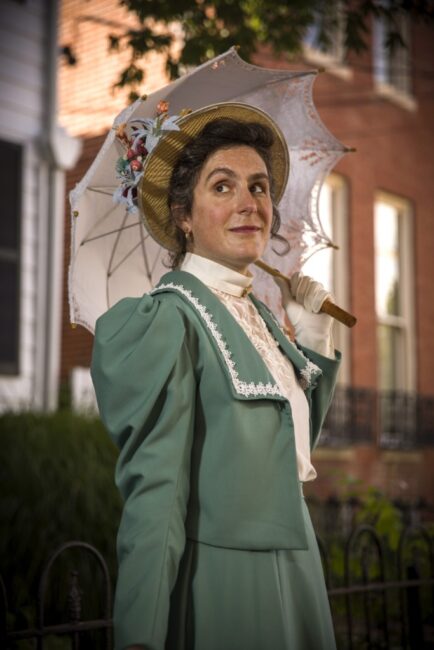
Miss Mabel Chiltern (Sarah Wade.) This is the character that one wishes Wilde had spent more time making centralized. (Though a good many might see flavors and hints of this particular character equally redistributed in Cecily Cardew and Gwendolen Fairfax in Wilde’s later work, The Importance of Being Earnest.) Wade is cheeky but toes that line with flawless perfection, never truly being sarcastic or too frosty for her age, station, or position in society. Her enthralling antics and exasperation as she regales the stage at large over the woes of being proposed to multiple times a week are hysterical. She’s amusing, both to herself and others, and the banter that volleys back and forth between her and Lord Goring is so utterly charming and intriguing. The pair of them get on like a house on fire and truly make their scenes some of the most sparkling in the production. The way Wade flounces in and out of the scenes, with a youthful exuberance to meter and match that of Lord Goring (Tristan Poje) is pleasing. And her little one-liner-zings that fire in his general direction are caught with charisma and returned with equally friendly zaps of sting and affection. They play exquisitely well together.
Lord Goring (Tristan Poje.) Spry of foot, quick of wit, masterfully charming and delightfully contradictory, Poje delivers an excellent portrayal in the role of this ‘only-just-34-year-old’ character, moving effortlessly through the play, both physically and emotionally. There is a dynamic depth in Poje’s portrayal because there certainly are moments— in deep stewing conversation with Sir Robert— wherein Poje has to abandon his frivolous nature as a scamp-bachelor and be serious! Heaven forbid! Though he does so with such ease, it’s a true testament to Poje’s versatility as a performer. And while those moments are lovely and truly heartfelt— one comes to an Oscar Wilde looking for the gaiety and silliness that accompanies the situational comedies of the script. And that is where Poje truly delivers! His snarky interactions with his father (Miller’s Lord Caversham), his physical flopping on the floor, failing to retrieve stolen goods during that scene with Mrs. Cheveley, the swaggering charm used to play and snipe with Miss Mabel, the dismissive desperation he employees when dealing with Lady Basildon and Mrs. Marchmont early on; all of these moments, in which Poje fully invests himself in developing the humors of the character and the situation, are just divine examples of his theatrical prowess. Poje is a stage gem in this production for certain.
Mrs. Cheveley (Aparna Sri.) Everybody’s talking about Mrs. Cheveley! And not just because of her opulent, bejeweled and richly saturated dresses or the sultry way in which she slinks in and out of a scene. Sri is living in the era of the character. Everyone on stage is floating in the world of Oscar Wilde circa 1895 while Sri is fully submerged in it, deeply steeped in it, and letting it influence everything from the way she moves to the turn of her head. It may seem like such a small detail, but the way she sinks down onto the divan, in that intentional slow-motion-movement, easing herself as a lady of class, rather than a more ‘modern sit’ is just extraordinary. It’s Sri’s mercurial attitude that truly impresses in this production. A glossy veneer of charm and seduction under which burbles a frenetic malice, sense of self-entitlement, and a rich vein of villainy. Sri’s serpentine nature slithers unctuously in and out of her scene work, never settling for a one-note depth of nefariousness as might be appealing to do with such a character. And she speaks with perfect articulation, even when dropping her vocal volume into something low and deadly serious.
Lady Gertrude Chiltern & Sir Robert Chiltern (Christine Kinlock & Michael Dunsworth.) A seemingly ordinary upper-class married couple but don’t let appearances fool you. Kinlock and Dunsworth have some truly compelling scene work, both with each other and with the other characters peppered throughout the performance. Kinlock wins the prize for most repressed facial expressions, watch her closely as different ones are being announced, introduced, and appearing in the opening scene; it is it’s own breed of hilarious, watching her try not to react and have emotional expressions of an outward variety because she’s the wife of the host of the ball. But as a rule, everybody turns out to be somebody else and Kinlock is no exception; her Gertrude turns out to be deeply compassionate, expressive character, and when she fights and rekindles with Dusnworth’s Sir Robert, its fascinating and captivating. Dunsworth feels a little flat at first, but this actually strengthens his character’s growth arch and really lends itself to the bombastic outburst that he has at Kinlock’s Lady Gertrude when the tail-end of the Act-I finale blows up. With such intense vivacity, Dunsworth delivers those lines about women failing to love men faults and all; it’s a striking and powerfully received moment. Dunsworth’s exchange with Poje’s Lord Goring when discussing the initial ‘predicament’ is also quite intense and well-delivered, though in a very different vein of emotional existence.
Follies, imperfections, flatteries, and all do await those in possession of a ticket to this grand production; don’t hesitate to book in for the start of the fall season. Translation: An Ideal Husband is quite impressive, despite its length, and should be seen at Colonial Players before it closes on September 27th.
Running Time: 2 hours and 45 minutes with one intermission
An Ideal Husband plays through September 27th 2025 at The Colonial Players of Annapolis— 108 East Street in historic Annapolis, MD. For tickets call the box office at (410) 268-7373 or purchase them online.