author: Wes Dennis
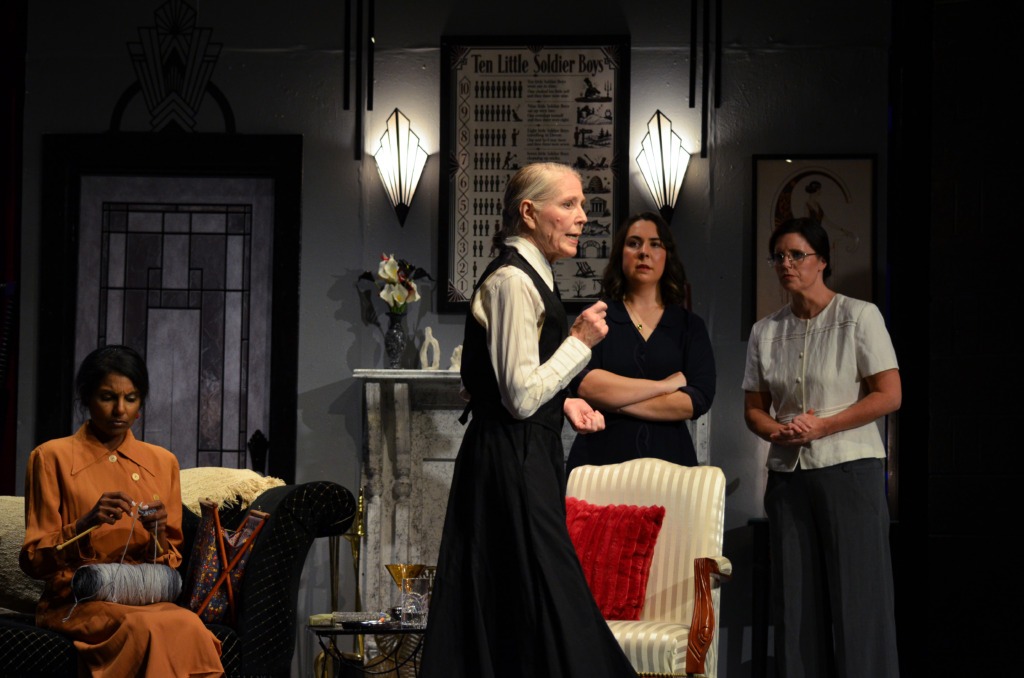
The more palatably named And Then There Were None, the latest production from Bowie Community Theatre, is a gorgeous show. No surprises there— director Tatum Moss’s aesthetic sensibilities are always on point, and the Bowie Playhouse remains among the more impressive community theatre venues in the DMV. Moss’s set concept is expertly realized by designer Dan Lavanga: even before the action begins, the set, with its elegant doors, fireplace, and bar — with various knickknacks (including an excellent Ten Soldier Boys poster and curious disappearing figurines to remind us why we’re here) and furniture courtesy of props designer and set dresser Roy Hammond — suggest the quality of the production to come.
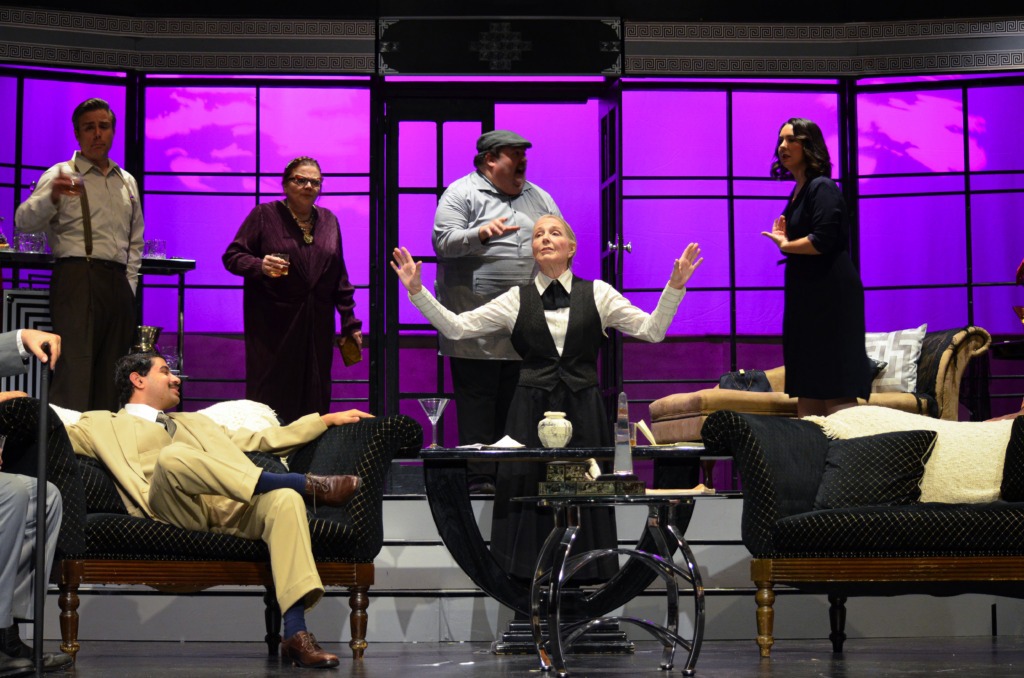
Lighting designers Moss and the Bowie Playhouse staff deserve kudos here as well, as the rear of the set is outfitted with terrace windows overlooking a horizon that ostensibly changes colors in accordance with the time of day. While I am admittedly not sure how well that information is actually conveyed by the lighting (the purple is lovely but doesn’t quite map to real evening/nighttime skies), the vibrant colors splashed across the rear wall — further enhanced by nifty cloud gobos — add that much more to a production that is clearly and impressively intentional in the aesthetic it presents. The lighting during background flashback scenes, parts of the show where the characters lose power and are forced to endure by candlelight — with appropriate, non-uniform dimming of the stage lights in accordance with where the candles appear in the set — and trickery like occasional lightning flashes also deserve praise.
The look of the play is further enhanced by Jeano Binney’s costume design, though for some audiences that might represent a slight hiccup — though the play is explicitly set in 1939, the clothing here includes much more modern styles and fits that might give a period costume snob pause. Here, however, I very much appreciated the intention behind the costume color choices. With items like a red smoking jacket, a cream-colored overcoat, a navy jacket and an amber blouse providing color pops that pair well with the crimson curtains, lampshades, candles, and pillows — and of course that ever-changing sky bringing up the rear — And Then There Were None is always a beautiful production to behold.
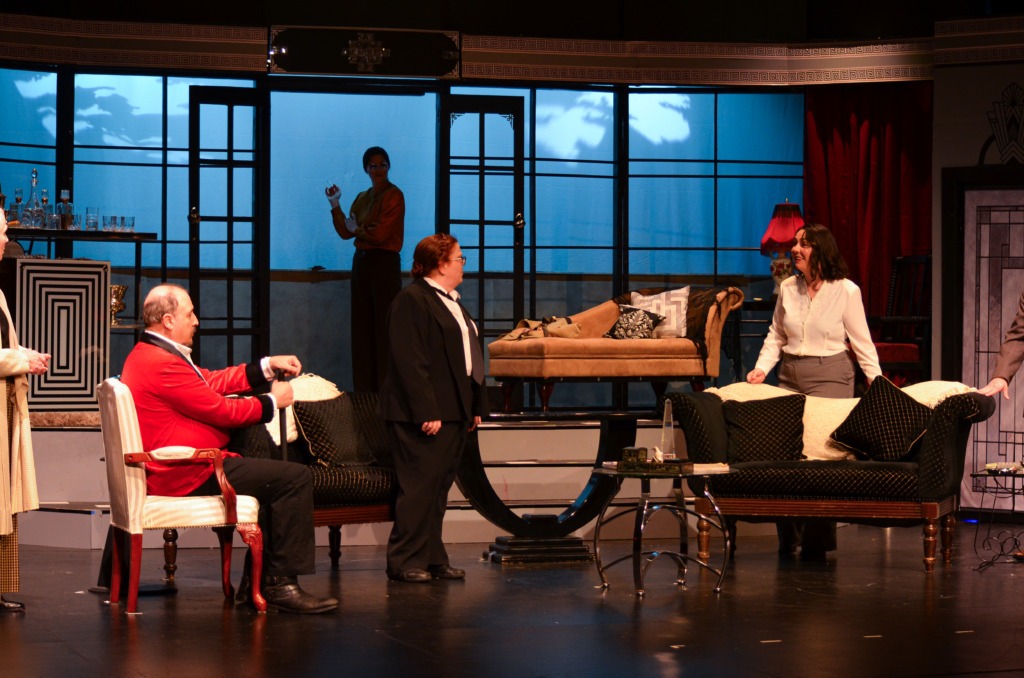
The sound, too — with Moss as sound designer as well! — is deliberate and good, though I admittedly did have some issues here. While the various ambient noises when the terrace doors are opened, occasional thunder rumbles, and other assorted sound highlights do indeed complement the action, this is hardly what one would call a sensory friendly production. As characters rush about with meticulous blocking that creates one gorgeous stage picture after another, the excess of movement and color and sound proved occasionally overwhelming for me, and I appreciated the times when the terrace doors were shut and the noises ostensibly coming from “outside” were silenced. Moss also makes the choice to have the actors speak in British accents, and — though said accents were mostly serviceable — they nonetheless did make it more difficult for me to track precisely what was being said throughout the production. Fortunately, there are several places in the text where the surviving characters inventory their murdered compatriots and methods of dispatch; I found these quite helpful for catching up on details I missed when the scenes got the better of me. Your mileage may vary.
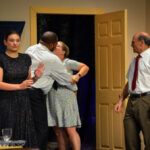
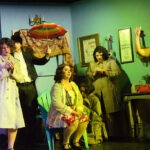
Accents notwithstanding (and, again, that may have more to do with my limitations than the production itself), the performances, too, were outstanding. Murder mysteries tend to be true ensemble pieces, and everyone in this cast of 15 brings something indispensable to the production — even the members of the run crew (including assistant director/intimacy coordinator Sarah Luckadoo, assistant stage managers Carly Brownstein and Jaila Desper, David Jackson, and Ryan Squiers), whom Moss has also folded into the story by having them serve as background characters during flashback bits. It’s a touch I’ve always liked (having been on the inside of those kinds of productions, getting at least a moment in the spotlight does make one’s experience that much more satisfying), and — again — it feels like such a deliberate addition to a production where almost every detail was clearly pondered. The ten little soldiers themselves perform admirably, with actors Gavin Shown (Thomas Rogers), Bob Singer (General John Mackenzie), and Sara Worley (Ethel Rogers) offering more subdued performances in keeping with their characters; Jenny Ephrussi (Dr. Evelyn Armstrong), Jeanne Louise (Justice Lenore Wargrave), and Selah Holland (Vera Claythorne) often occupying center stage and assessing the events rationally; and Brendan Cuddihee (Captain Philip Lombard), Amy Heller (Inspector Willa Hester Blore), and Aparna Sri (Emily Brent) offering up plenty of bluster and comic relief. (It is perhaps worth noting just how much gender swapping is happening with this particular cast. It does result in more women wearing pants in this production — which harks back to the note on costuming — but it also potentially cuts against the 1939 setting even though a google search confirms that women could serve as magistrates and police officers by that time in the UK.)
Finally, though he’s the first to go, Vijay Dev is a delight in his turn as Anthony Marston. I admit that my taste in murder mysteries tends towards the comedic — which this production mostly does not — so I very much appreciated Marston’s flopping about and flirting with the ladies even as he brags about his fast driving and nonchalantly dismisses the deaths of two children he hit. He’s fun — even his inevitable death is somehow fun — and I tend to think the production would have been better served by at least a little more of that energy.
But a sillier production would not have been in keeping with the production Moss wanted — in her director’s note she expressly regards the story as a much more complex story of flawed humanity and wrestling with guilt and so on — and this And Then There Were None is very much Moss’s production. Even where it didn’t work for me (because of personal sensibilities or physical sensitivities), the talent and intentionality on display here are undeniable. Moss is a director who prioritizes the creation of Art. Love it or hate it — and there’s very little to *hate* here — it’s worth witnessing with one’s own eyes.
Running Time: Approximately 2 hours and 45 minutes with one intermission
And Then There Were None plays through November 22nd 2026 at The Bowie Playhouse with Bowie Community Theatre— 16500 White Marsh Park Drive, Bowie, MD 20715. Tickets can be purchased by calling the box office at 301-805-0219 or in advance online.