
author: Amanda N. Gunther
In theatre, every problem is just a challenge. The challenge of finding a show to produce, the challenge of finding a space to produce it in, of fining an audience who wants to see it, every problem is a challenge. One that theatre folk will throw their all into until it’s resolved. And that’s exactly what Red Hill Theatre Group is doing, presently producing Giulianna Marchese’s Death and The Girl through November 15th 2026 in the black box play space at New Spire Arts Stages. Directed by Cody James, the play itself has great potential to be a meaningful theatrical experience, though in its present iteration, feels jumbled, disjointed and loaded with rage-bait for gratuitous purposes.
The play is described as ‘an Appalachian ghost story for modern audiences’ though if there’s anything that makes the story distinctively Appalachian, it isn’t clearly identified either in the source of text and dialogue or in the design approach to the production. Giulianna Marchese has a concept— a deeply troubling, hits-home-in-the-hardest-way, topic woven into this play that has a lot of potential to be mined, to really make an impact, and to really speak ugly truths in a way that could bring a powerful message to audiences. As its presently written, there’s a lot of jumbled confusion and muddiness that makes the play somewhat unpalatable. Disturbing subject matter and sensitive topics (appropriately forewarned by the company) are not the issue here, but literally the ‘what is going on/who is who’ and a lot of ‘is that really necessary’ in the overall structural build of the play itself is what keeps this play from being as powerful, meaningful and intensely intentional as it could be.
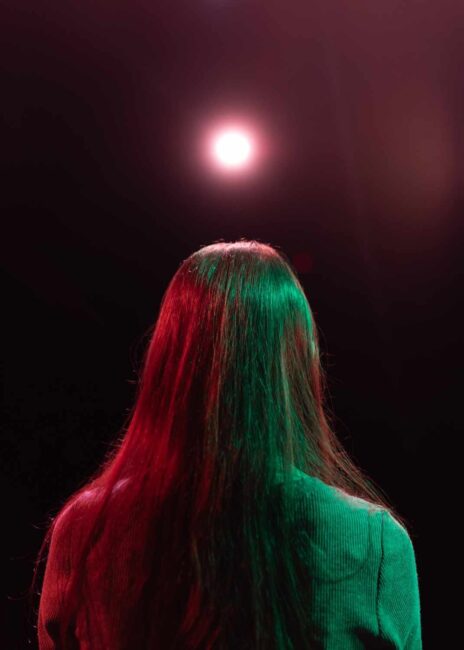
Marchese sets up the story— you don’t even learn the main character’s (I caution to say protagonist as it’s unclear whether it’s Dru’s story or the story of the man or an every-person-fits-all universality tale) name until a ‘cut-to/flashback’ style scene between Dru and her mother (which happens in such a discombobulated way that it takes a minute to catch up to the fact that we’ve jumped from the present ‘limbo reality’ into this flashback. And while it could be said that there should be a more definitive usage of lighting or sound to make that shift notable, it also should be said that a change in temporal location in a play should be demarcated clearly without relying on production values or gimmicks to make it clear to the audience, whether that’s a simple costume flip, a scenery shift, an actor shift, etc. and that happens with increasing frequency throughout this performance. If Marchese has written this in such a way that it’s only meant to be a two-hander where one actor plays Dru at all times (but then also delves into being some of the other ‘characters’) and The Man is meant to be everyone else— from Dru’s Mother to the theatre teacher to The Defendant— then her writing hasn’t made those switches and transitions effective enough to be clear for the audience.
This work feels like it’s begging to be handled the way a Tectonic Theater Project show (think The Laramie Project) would be staged and written. Marchese has included enough voices (and this Red Hill Theatre Group production even features three extra bodies— literally nameless movement people who occasionally hold props and minor scenic pieces in place, act as the embodiment of a physical action, and in one scene even are a wordless pantomime serving in opposition to one of the principle speaking actors) for there to be multiple actors and that would actually clarify and significantly clean up all of the muddiness between character flips.
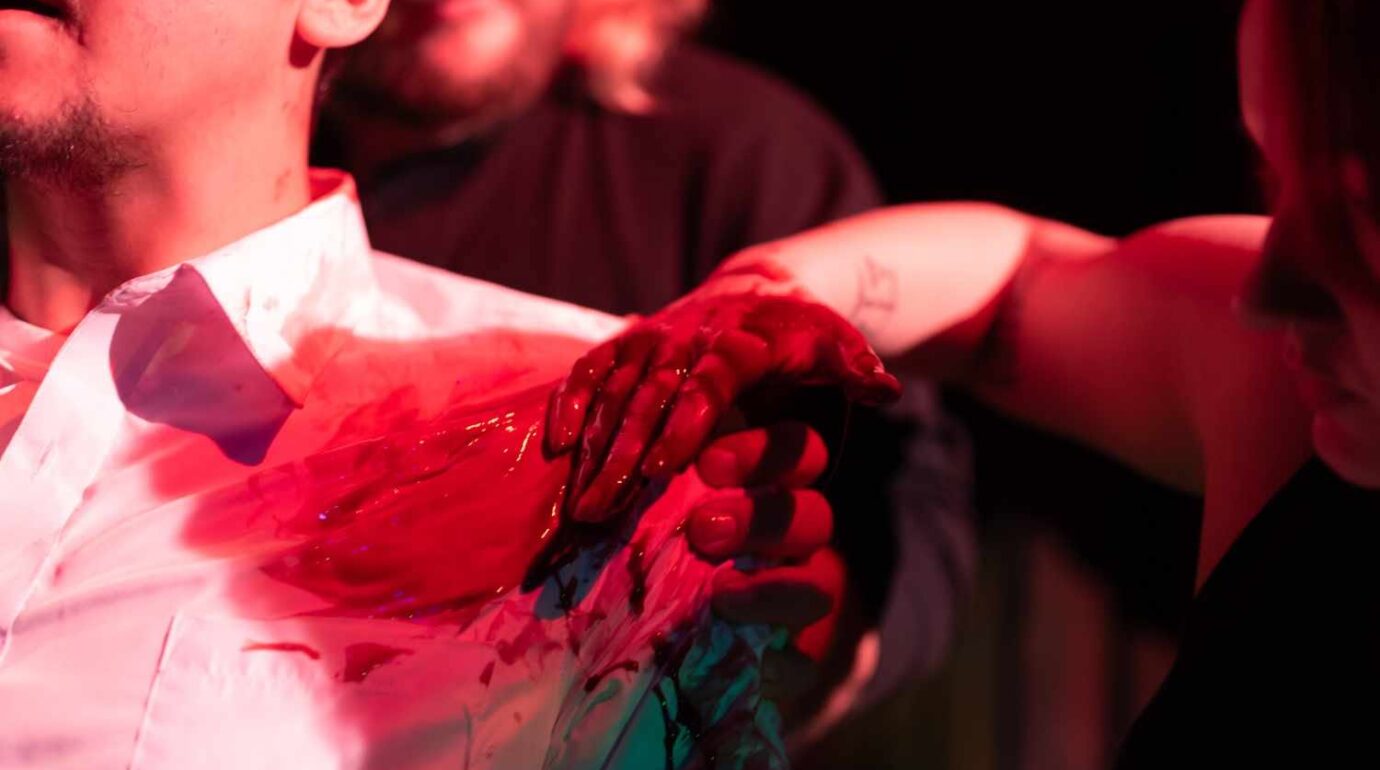
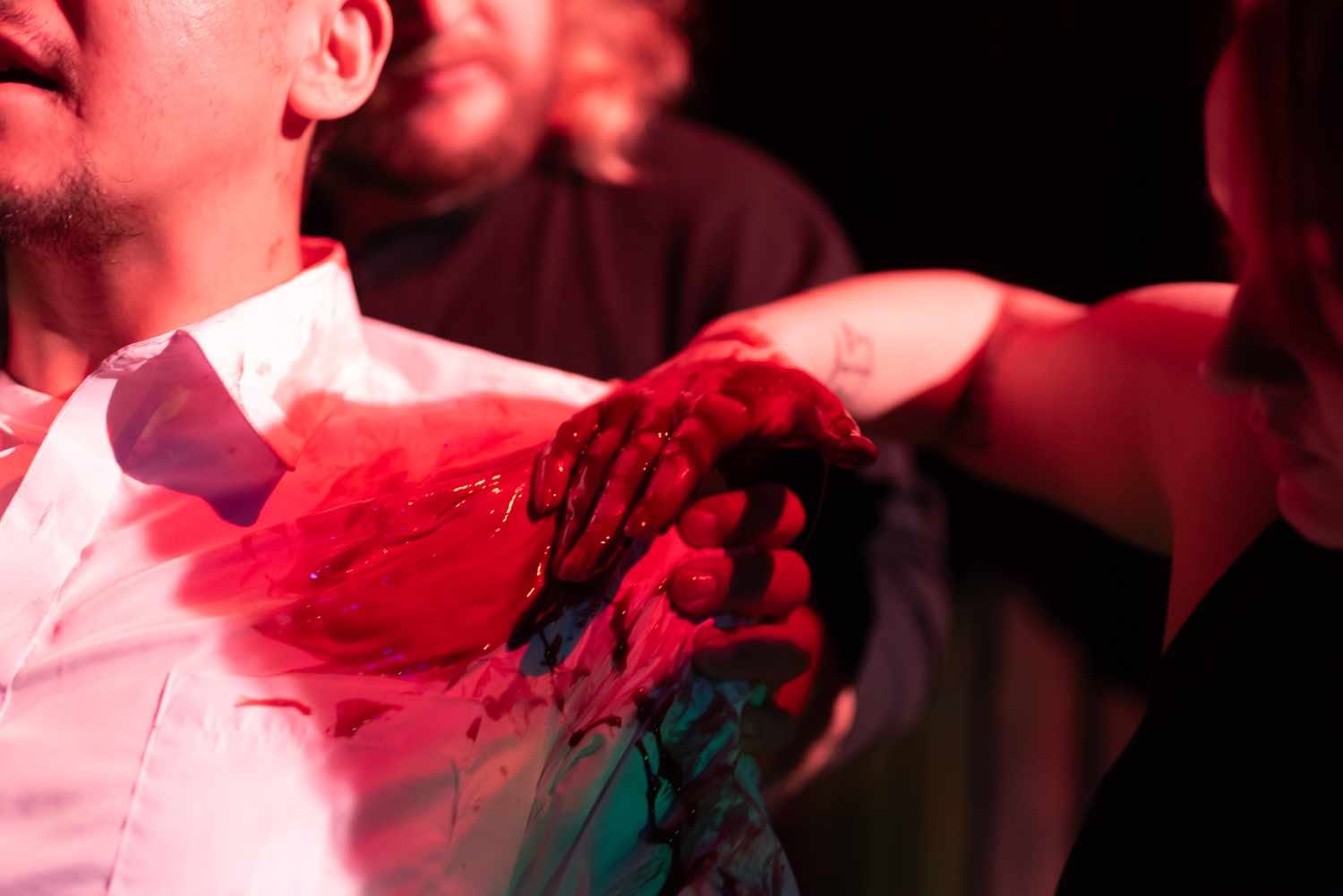
And while it’s not to say that Marchese’s work isn’t emotionally impactful; there is absolutely a lot to unpack, particularly in the attempt she makes at humanizing The Man’s experience in his monologue at the end, but there’s a lot of scene work that reads like gratuitous rage-bait. One of the most impressively constructed scenes in Death and The Girl is the scene where Dru is at the party and The Man approaches her, making awkward conversation, creating a tense dynamic, very clearly demonstrating Incel behavior, very readily identifying The Man in that moment as an Incel. Shortly thereafter, the audience is exposed to multiple progressive scenes of Incel rage-bait rhetoric, and although Marchese has written it in a way that has the actor playing Dru take on the personalities delivering it— it’s superfluous, intensely in your face and not in a “shock value” or even “support the previous scene” fashion. It almost reads like Marchese is attempting to glorifying the vitriol that Incels get themselves hooked on rather than shine light on it. (Lighting, which comes into play frequently and often in a good way, designed by Shayden Jamison.) Yes, The Man is off cowering in the corner as these scenes play out but that gets wiped entirely from the audience’s attention (partially by the way he hides behind one of the totem spikes of the set) and because there is a lighting shift to draw even more attention to the actor speaking in that moment. It reads as off-putting and not in a ‘disturb the comfortable’ kind of way but in more of a Marchese didn’t trust the scene she’d written prior to truly explain to the audience what kind of danger was being dealt with kind of way. Or maybe she was trying to sympathize with the Incel character. It gives hateful rhetoric— without any real balance, comeuppance, equalizing factors— unnecessary stage time and detracts from the overall experience and clarity of the play.
While the “are we in limbo/who are you” mystery factor of the play is compelling, and at times fascinating as you find yourself questioning what exactly it is you’re watching, this component of the play’s writing feels uneven as well. It feels obvious pretty early on that he’s someone who has done this girl harm, that they’re both dead or waiting in that liminal limbo between life and death, but the mysterious shrouds of trying to keep that ambiguous creates theatrical mud rather than intrigue. One place in Marchese’s writing where the blur of character dialogue is very powerful and does work as intended is when the Dru character is sitting as the witnesses/jury and rattling through a series of lines in hot, quick flips, taking fragments of testimony and opinions that would have been spoken at The Defendant’s trial— using that run-on blur that builds in intensity as she expounds those words is really striking and if it were the only jumbled moment in the play it would be excruciatingly profound and make the work overall land with so much more of an impact. The same goes for the scenes with Dru and The Mother and Dru and The Theatre Teacher (both played by the actor who also plays ‘The Man’ and while the actor does a few things with his voice to attempt to differentiate between characters, this isn’t always clear either.)
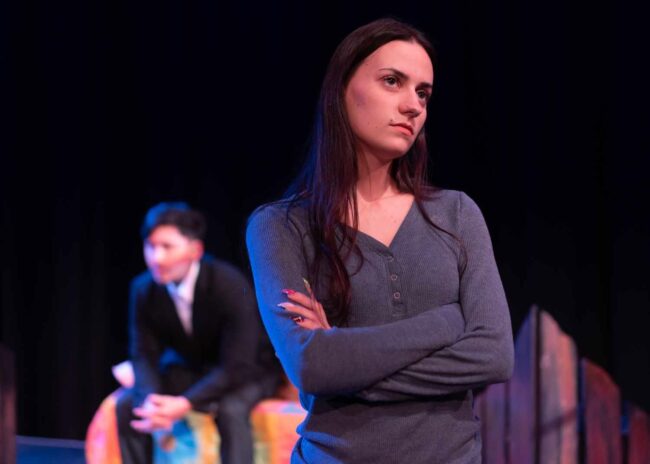
The acting team— Kay Davis as Dru, Chi as Man, and the three-bodied movement ensemble: Amanda Thomas, Katie Thompson, and Jacob Reese— are working very hard to make this play land. At times there are some projection issues…New Spire is not the greatest space for sound period and sometimes Chi and Kay Davis are a little harder to hear (it’s just a vacuum for spacing) but that aside, you’re getting powerful moments of dialogue from both of them. One of the most touching and heartfelt scenes is actually when Chi is playing the Drama Teacher and Davis is attempting her audition and then later running lines in the rehearsal. There’s raw human connection and nurturing flowing between them, which is augmented by Director Cody James’ blocking in that moment. James puts Chi off the stage, creating a physical space between them, which serves a dual purpose. It creates a distance between them that forces the actors to close it with emotional and psychological connection in those two scenes, which they do, sublimely. AND it helps to delineate the flashback/memory/recollection moments from the limbo-ethereal existence in which the play is set. There are other moments where that delineation is slightly less clear (though the Movement Ensemble, coached by Amanda Thomas, are brought in to hold pieces of scenery or props to help establish that we’ve shifted into a past/memory reality of sorts.)
The play has a curious cyclical ending (that’s about all that can be said without rebooting an explanation and spoiling a lot of it) but the thing that stands out most critically in that moment is Katie Thompson’s opossum onesie, complete with baby opossums on the back. Coolest costume in the show, hands down, and it gives you that subtle representation of innocence. Praises should be given to all five of the actors for navigating the convoluted structure of this play and they each find ways to really make it their own, though I wish for all the world that the movement ensemble could have jumped in as characters, which could have evened out some of the distortion (which though I’m sure is attempting to be intentional just reads as confusing) in the writing as a whole. Chi does a particularly good job of humanizing the various descriptions of ‘method of execution’ though when you juxtapose his vividly visceral descriptions, where you want to comfort him, up against the character that he’s revealed to be, you certainly get a hard disconnect experience that feels a little more shocking than necessary. And Dru Davis does a superb job of fabricating a character with dyslexia and reading troubles into a believable, dynamic individual.
You can tell that the project has meaning for James and the Red Hill Theatre Group team; they’re tackling it like a challenge and putting a lot of heart, emotional intensity, and devotional dedication into its performance. It’s important to support smaller, adventurous theatre groups like Red Hill Theatre Group. The play itself may need work but the work they’re doing to the play is important. Catch their final performance on Sunday November 15th 2026 at New Spire Arts Stages.
Running Time: 70 minutes with no intermission
Death and The Girl plays as a Red Hill Theatre Group production through Sunday November 15th 2026 at New Spire Arts Stages— 15 W. Patrick Street in historic downtown Frederick, MD. Tickets are available at the door or in advance online.