Who knows what miracles you can achieve when you believe? Woods Memorial Presbyterian Church and their annual theatrical production is in and of itself, a true miracle of theatrical excellence. And this year, they’re tackling the newly released DreamWorks musical, The Prince of Egypt. Directed & Musically Directed by David Merrill with Choreography by Elysia Merrill (and Matthew Walter serving as assistant to both offices) this stunning retelling of Moses’ story is an extraordinary example of theatrical excellence at its finest, in full evocative, heartwarming production on the stage of Woods Memorial this spring.
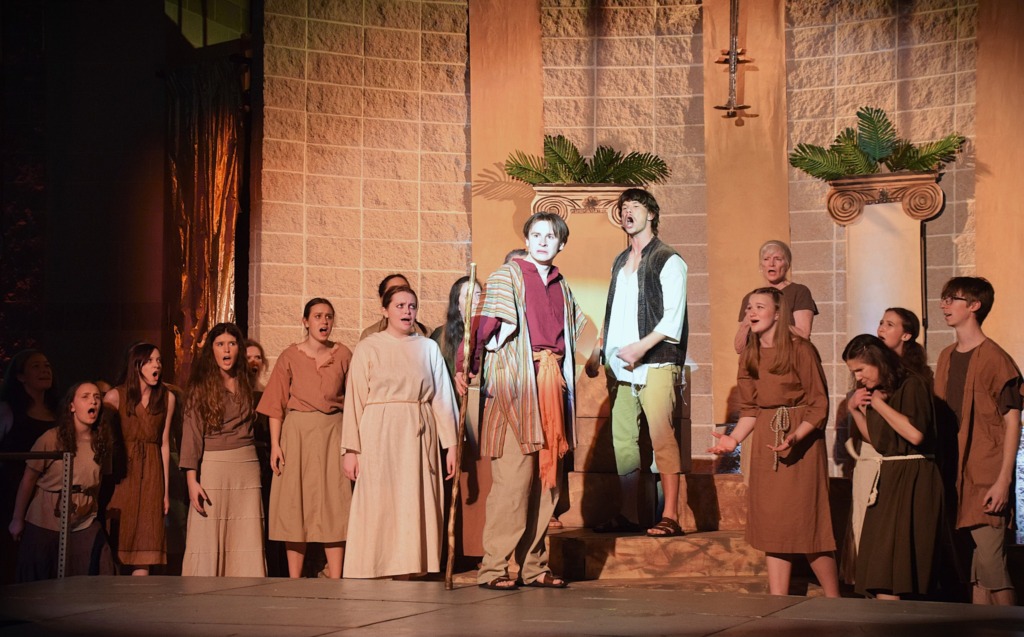
You’ll be hard-pressed to find a more thoroughly conceptualized and equally actuated production on any stage in Maryland this calendar year and the lone regret that accompanies this review is that I didn’t get to see it until their penultimate performance. The dedication, determination, and wholly earnest joy, compassion, empathy, and sincerity that Merrill & Merrill (and their 100+ cast/creative/crew team) pour into every instant of this performance is not only palpable but so wholly enjoyable that for not-quite three hours— you forget the dark and difficult times in which we currently live our daily lives. It is a miraculous testament to what theatre can and should be in every sense of its existence. You will certainly sing a song of exultation and make a joyful noise upon experiencing this theatrical wonder.
David Merrill takes the sanctuary space of Woods Memorial and transforms it into a theatre. And while there are a lot of companies that play out of church spaces, what makes Merrill’s approach to theatre so utterly impressive is the very simple yet effective approach he takes. Building up an extended apron that splits the audience aisle in half not only increases the play space for action but it elevates the performers so that everyone in the house, regardless of where they’re seated, can see the experience fully. Working in tandem with Set Designer Pete Bishop & Elysia Merrill and Scenic Artist Gigi Kingsland (and a slew of builders, painters, and decorators too numerous to list), Merrill’s vision for this production is fully actualized in a way that immerses the audience into the story and the adventure. It’s the utilization of the space— the way action happens with Merrill’s meticulous blocking and utilization of the space that makes the production stellar. The infusion of Merrill’s slide-designs enhances the scenic experience without overbearing it and creates a cohesive atmosphere that transforms a catwalk-runner into the roads of the market, the waves of the Nile and the Red Sea, the halls of the palace, and much, much more. Merrill’s spatial awareness is also astonishing and is exceptionally reflected in his blocking choices to make scenes pop from the stage, or create the illusion of distance when it cannot physically be actuated.
I could readily spend the running time of the show itself discussing all of the meticulous attention to detail, exacting focus on minutia, and otherwise flawless conceptualization that Merrill & Merrill and the creative team put into play just from a staging vantage point— though highlights include use of the tower that serves as the centralized focal point of the set (not only is it Ramses & Moses’ secret room in the palace but it also becomes the ‘heavenly ghost platform’ which presents such a striking visual that it truly deserves praise) and the rolling platforms that carry Moses and Ramses, respectively to and from their respective sides of the stage near the Act I Finale. Suffice it to say that every intention that the pair and whole of the creative team puts into the ether for this production is brought to its fullest living potential in the performance.
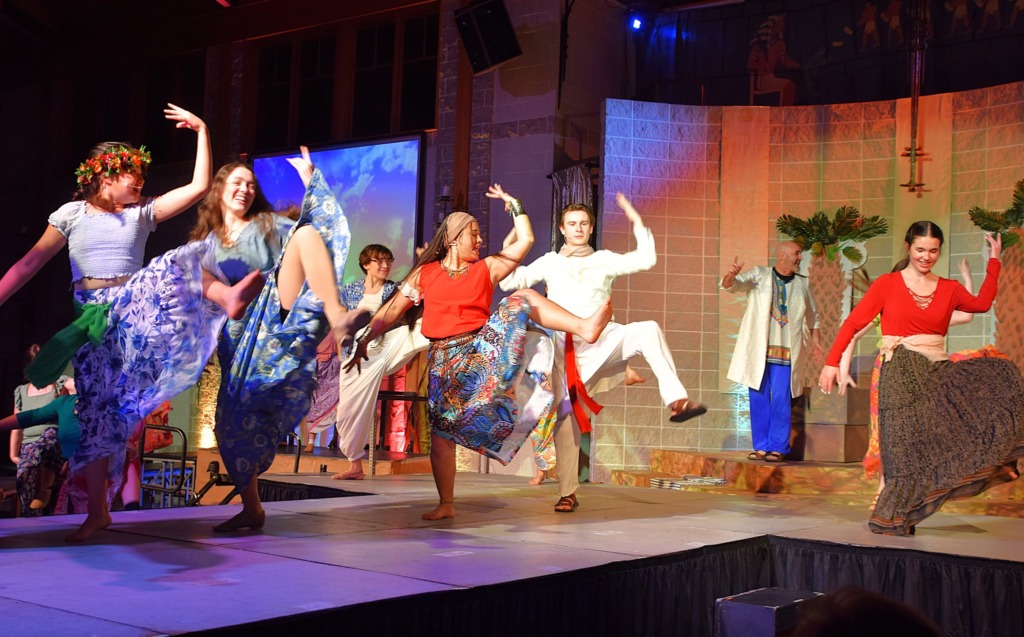
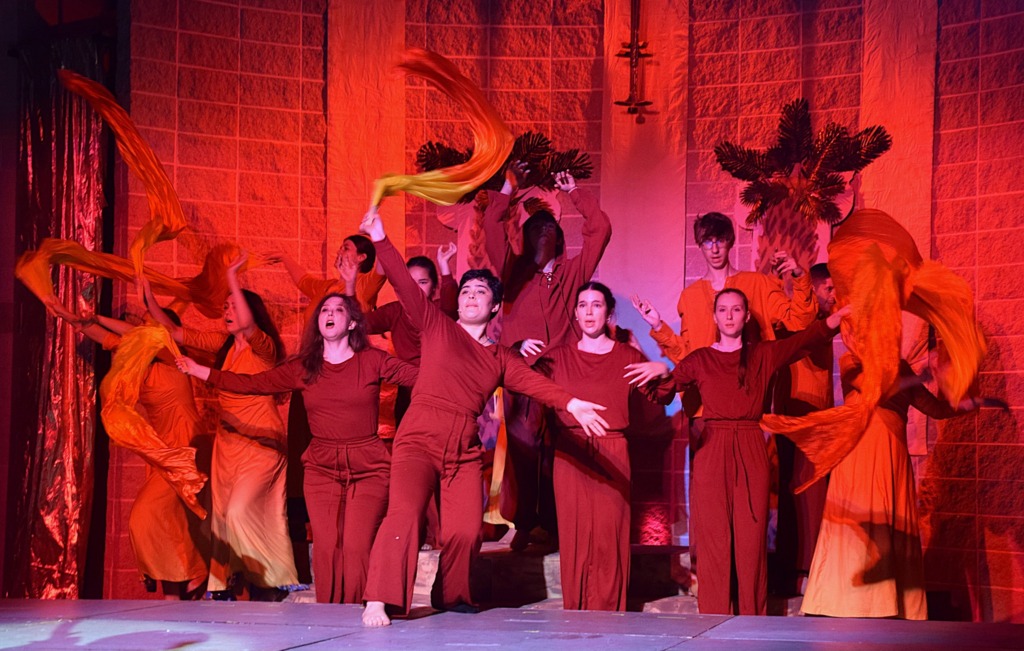
What enhances this experience tenfold is Elysia Merrill’s approach to the choreography. While there are two numbers— “Through Heaven’s Eyes” and “Simcha!” which are incomparably enthusiastic, vivaciously energetic and so engaging that I cannot understand how the audience isn’t leaping out of their seats to join these dancers up on the staging platform— it’s Merrill’s overall approach to utilizing her dance-corps as ‘the elements’ that is truly striking. I want to be clear, the work that the Dance Corps is doing both in “Through Heaven’s Eyes” and “Simcha!” is sprightly, wondrous, and so wholly evocative of elation and exulted joy that you will struggle to resist the urge to join them (and honestly with how well they move to the rhythm of those songs, it would be the highest compliment if the whole audience was up on their feet in an attempt at ‘imitation is the highest form of flattery.) But it’s watching this team of 16 becomes the waves of the Nile River that moves the basket of baby Moses during “Deliver Us” or as they transform into the desert sands that whips, bandy, buffet, and blind grown Moses about during “Moses in the Desert” that’s truly evocative and gasp-worthy. They serve also as the fires of the burning bush and the various incarnations of the plagues and even more impressively still as the Red Sea for that penultimate moment of striking visual intensity when Hotep cannot perform the miracle that Moses can; it’s astonishing to watch.
And there is infinite simplicity in Merrill’s approach to using her dancers in this way whilst infusing deep complexity of movement into the routines. It’s such a basic concept— “people as water” (or sand, or fiery bush limbs, etc.) but the way that Merrill and the dance corps commit wholeheartedly to it makes it beyond extraordinary. Lead by Dance Captain Cassia Lengbeyer (who is not only prominently featured in every routine because of her exquisite capability to move and her extraordinarily earnest smile, but serves as the Plague of the First Born in what can only be described as tragic-beauty-incarnate) this Dance Corps (Morgan Binnix, Maura Campbell, Robbie Dinsmore, Culley Fish, Jacob Hahn, Reid Johnson, Cassia Lengbeyer, Joelle Lengbeyer, Sabina Lengbeyer, Brayden McDowell, Michaela Shunk, Iz Taylor, Sydney Thompson, Violet Thompson, Shannon Vogel, Teagan Yokanovich) is a celebration of storytelling, and augmentation of theatrical exuberance, and a remarkably addition to the production as a whole. (Other performers dance in this production but the main labors of choreography fall to these 16 exceptionally talented individuals and praises are most certainly owed them, as well as their fearless leader, Elysia Merrill.)
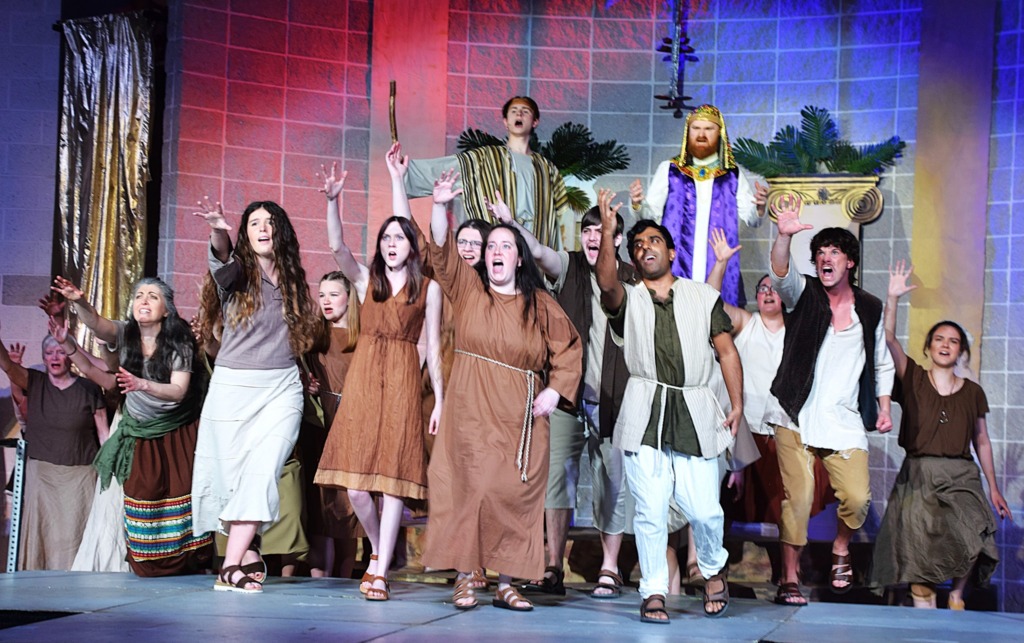
Rounding out the visual perfections of the production, Costume Designers Susan Bohlman, Alyssa Cripe, Kim Erickson, and Pery Swift create three very distinctive class groups in the show. There are the Egyptians— both of royalty with their headdresses and gold adornments (of particular note is that cerulean and silver sparkle dress worn on Nefetari when she first arrives to meet Ramses)— and the Midianites, who wear an array of brightly saturated, patterned skirts and pants which actively reflect their indefatigably hopeful spirits, and the Hebrews, whose earth-tone rags are befitting their labors. It’s a visual smorgasbord, with everything from high holy robes for Hotep and his priests to more peasant-appropriate garments for characters like Aaron and Miriam, and colorful threads for Jethro that give him status without making him pious or cocky. Bohlman and the Costume Crew outdo themselves (as there’s so many unique outfits that pop up throughout the performance) and it really gives that bonus edge to the production’s overall aesthetic.
Aesthetically speaking, in addition to everything I’ve already mentioned, you get divinity raining down from David Merrill’s lighting design (aided by board op Mary Calabrese and her SpotOp Team: Taylor Bailey, Tivy Binnix, Ronnie German, Mary Jo Greenly, Macy Toalepai.) Again, focusing on simplicity and really utilizing these ordinary styles of coloring to exacting effect and knowing when and how to aim a spotlight takes a great show and makes it a brilliant one. You get a lot of backwashes of colored light against the stone column-tower which aids in setting the emotional tone for a scene or a song. To speak of its simplicity is to praise its effectiveness, not overdone, not underdone, but perfectly executed in congruence with all the other moving components of this production. Sound Designer Alec Green has outdone himself; flawless sound design, mics balanced beyond measure, and held in extraordinary equilibrium with the musical recordings and with the live PoE choir.
The Choir (Dan Atkinson, Alyssa Barlis, Sue Becker, Callie Boone, Kevin Cleaver, Peter Cooper, Sue Cooper, Kim Erickson, Angela Germanos, Karen Grant, Mary Jo Greenely, Diane Heath, Rebecca Hope, Phil Hope, Doug Irminger, J.V. Livingston, Laura Mariah, Aliyah Miller, Jane Merrill, Jim Newman, Diane Schwartz, Sarah Thompson, Lucas White) adds stellar sounds throughout the performance (concealed as ‘unseen but sung’ heroes up in the choir loft of the sanctuary space) and gives this sonorous boost to the overall aural experience of the performance. What’s even more astonishing and truly magical is the Choir serves as the voice of God in the burning bush (and again whenever Moses is questioning his decisions and duties) and wafting down from aloft unseen, it’s an impeccably beautiful sound-bath-style experience to behold.
Musically the show is sublime. David Merrill’s musical direction is a gift from God, which feels wholly (and holy) appropriate, especially for this theatre and particularly for this production. The blends and the harmonies and the round-robins all come together flawlessly. It helps tremendously that he has an extraordinary bench of talented individuals to work with. The aforementioned PoE Choir, The Hebrews (Selene Athas, Sami Biggs, Azalea Daw, Gabrielle Dorney, Jack Guerre, Briella Hogue, Tonya Hogue, Madelyn Luebbers, Marguerite Norris, Mckinsey Norris, Rowen Olsen, Jaina Peveto, Emily Rivera, Keshav Swaminathan, Jack Swisher, Rachael Swisher, Yvanna Zoe Villaver, Abby Wilson) as well as three sectors of Egyptian High Courts: The Priests (Jennifer Augustine, Matt Gray, Chris Snipes, Jill Robinson), The Servants (Eliabeth Dorman, Emily Roberts, Cristina Rose, Thomas Shade, Erica Snipes), and the Guards (Jeff Maynard, Lindsey Miller, Joe Rose, John Rose.) All of these brilliantly talented individuals come together (along with the previously praised dancing Midianite corps) to form a powerhouse, unstoppable ensemble. (And that’s not even including the 14 principal performers who are a world of talent onto themselves.)
In the epitome of a Princess-Track, Emily Havnewitz’ Nefertari experiences a truly transformative character arch that happens in this pivoting moment; it’s gobsmacking. And awe-inspiring. The character is purposefully made of sharp edges and razor-like quips, which Havnewitz delivers divinely. And while her vocals are featured and utilized in a few of the larger numbers in Act I it isn’t until Act II that her true vocal prowess is given prominence and permission to shine. “Heartless”, a tune composed to be mournful and heartbreaking becomes this gut-wrenching agony with Havnewitz’ singing through it. Inconsolable torment, unrelenting grief, unimaginable heartbreak pours through her vocality as she traverses her way through the number. And after despising her character so thoroughly all through the first act, you’re left speechless at how suddenly Havnewitz can transform the character into one that deserves pity and empathy.
There’s felicity and bubbles bouncing about in the freely spirited Keturah (Sabina Lengbeyer) and Leah (Briella Hogue), the little Midianite girls that precede “The Well” with their jubilant child-like singing and dancing. You hear that same self-sung innocence though with a much more somber tone in Joelle Lengbeyer’s Young Miriam (appearing alongside Jack Swisher as young Aaron) during the opening “Deliver Us,” though the powerhouse vocalist that steals that number with her solo moment is Yocheved (Cristal Santiago Velez.) That cry of desperation, of teetering at the abysmal pit of hopelessness juxtaposes so strikingly against the optimism, albeit tempered by their naivete, of Lengbeyer and Swisher in that woven-together opening bid of the story. Velez (being one of four special individuals who gets to wear the holy angel lights during the performance and again, mad props to the costume team for making those glow lights— such a simple but effective way to segregate the living from the non-living) is staged perfectly alongside grown-up Miriam (Meridian Toalepai) and Tzipporah (Anya Lengbeyer) when Moses has that moment near the show’s conclusion and it’s such a strikingly beautiful moment, both visually and vocally as all those talented voices unite, that it’s emblazoned in your mind and your ears long after the final curtain call.
The aforementioned Miriam (Toalepai) jostles well alongside grown-up Aaron (Jacob Hahn) and they both deliver some intense dance moves, particularly during “Simcha!” Hahn and Toalepai are two sides of the same coin, with Toalepai serving as the ever-hopeful side and Hahn acting as the more grounded and pessimistic half of the sibling duo. They’re both featured frequently, both vocally and physically, throughout the performance once Moses returns to his roots, and their characterizations and overall character growth feel natural.
Appearing for the first time late in the first act, the character of Jethro (David Thompson) may be introduced as a supporting-style-cameo feature player, but Thompson leaves a wonderful and lasting impression on the audience, both with his lovely vocality when singing “Through Heaven’s Eyes” and with the way he engages with the dance. You don’t often expect a character track like this to have to dance or to dance so heartily and impressively as Thompson does; it’s quite the boon! While his paternal guiding instincts are not presented as prominently as the Pharoah, you get this tenderness and this sincerity in his interactions, especially when becalming his hot-tempered daughter Tzipporah by welcoming Moses, the stranger in a foreign land into their fold.
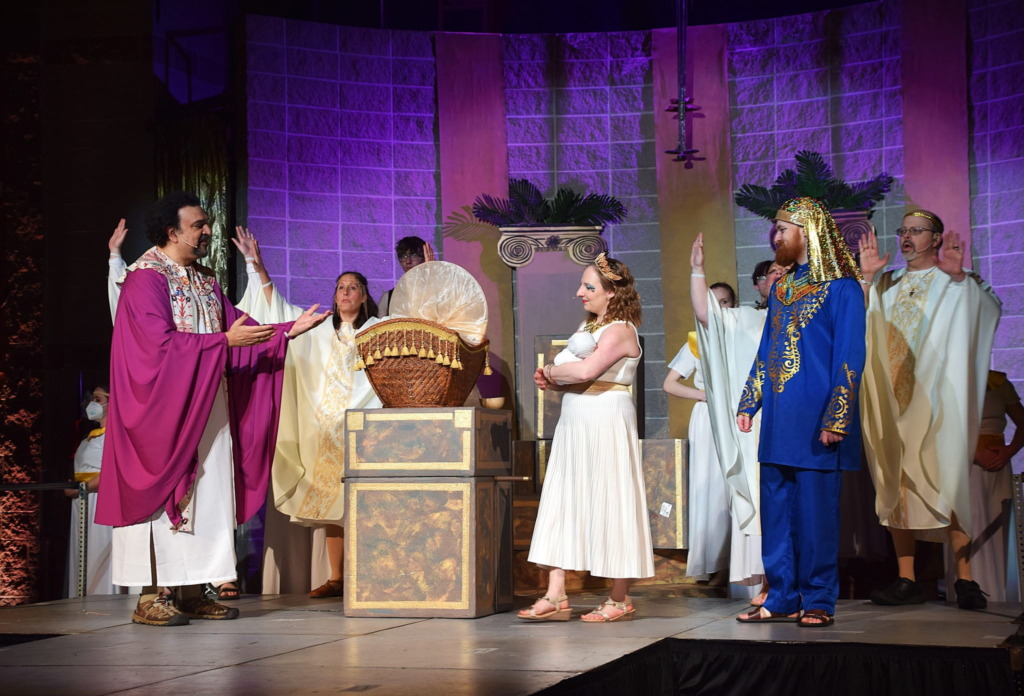
Queen Tuya (Sarah Kent) and Pharoah Seti (Scott Benedict) are featured heavily in the earlier scenes of the production and fit their respective bills sublimely. When Moses and Ramses find themselves cheekily mouthing off at Hotep (and it’s worth more than the pyramids themselves to watch the hilarious banter between these sophomoric princes and the haughty high priest) Sarah Kent’s character delivers that exacting duality of keeping the peace with Hotep, whilst shooting daggers that could kill with her eyes at her boys though all with maternal care. She’s also gifted with felicitous vocals which wend their way mellifluously through a plethora of musical numbers (in featured bits) throughout the first act. (Shout-out to makeup artist Perry Swift for caking years of time onto Kent’s face late in the second act to fully show the passage of time.) As the Pharoah, Benedict’s voice is superb, particularly with the emotional fortitude he brings to “One Weak Link.” Watching the transition of when he folds himself down at the end of his character’s scene work in the first act to that noble walk down the apron is striking. And seeing him, again meticulously placed on high in the tower in those penultimate moments, creates quite the effect.
If there’s a radiant jewel of the Nile standing out in the production, beyond our two male leads, it’s Shouvik Mondle as our pious Hotep, high priest and sole advisor to the Pharoah. His voice is liquid gold, shiny and heavy in that true, glorious range of a real bass. It’s breathtaking. And Mondle’s capability to strike balance in the character is exquisite. There’s villainy but it’s subtle, shades of corruption guised as wisdom, and there’s a dark humor that finely toes the line between being funny and being caricature-over-the-top without falling to heavily into being something cartoonish. You’ll find your whole body paralyzed when he sings, drinking in that sound that feels immaterial of this earth and when you set that against the way he commands his presence on stage, best of luck paying attention to anything or anyone else. (Except maybe when our two petulant princes are politely poking fun at him, which is epic.) And there’s a bonus praise owed to Mondle for that moment when Tzipporah and Nefetari are busy getting their squabbling verbal cat-fight on and he shouts the room to silence in this unyielding, unending note. It’s unhinged and totally epic, almost like a perfectly-pitched human foghorn.
If Mondle’s Hotep is the attention command center when it comes to stage presence, then Anya Lengbeyer is the firecracker that shakes up the world every time she bursts onto stage. She’s presented as a spoil of war, a present to Ramses, literally wheeled in on this 12”x12” postage stamp cage but she dances and sings during “Dance to the Day” as if her entire body owns the space of the sanctuary and her voice far transcends the physical occupancy of her confines. It’s stellar. There’s a fiery intensity that’s ever-present in Lengbeyer’s portrayal of Tzipporah, even when she’s mellow and flirty and falling in love with Moses (spoiler, this story rolls pretty much verbatim with— at least the who’s who of the bible story.) Her initial duet with Moses, “Never in a Million Years” is both powerful and beautiful, burbling up from a place of sincere reciprocal pathos. With glorious sound, she alights throughout various songs in the second act and is a part of that heavenly quartet of three women plus Moses in “When You Believe,” lending her sensational sound to that moment of utter theatrical perfection.
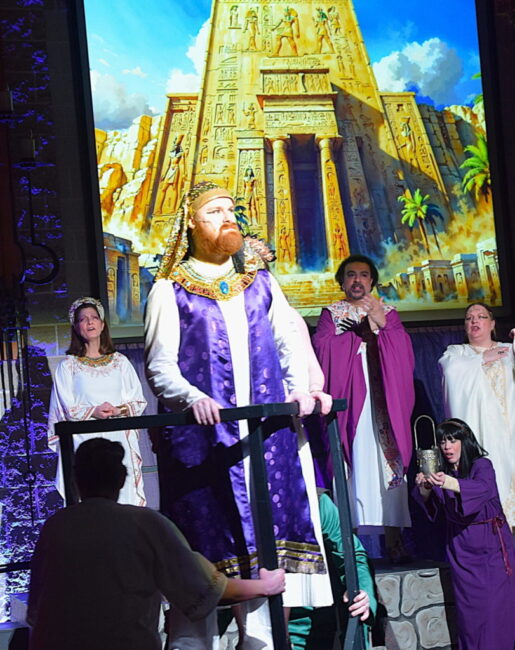
Brothers. Brotherly love shared even in times of solid disagreement and strife. Ramses (Matthew Monaghan) and Moses (Ian Cripe.) Their bond, stronger than diamond, brighter than Ra, even when stretched thin with the holes of their true origins; and the interplay between Monaghan and Cripe reads with that express dynamic at all stages of the journey. There’s this really wonderful moment early on, shortly after Tzipporah makes her escape where they’re play wrestling (shout-out to fight choreographer Mel Gabel) and both Monaghan and Cripe look as if they could be really at blows, but then they gently tap out when one takes the upper hand, showing that true fraternal affection and bond in live time. From their early, playful duet of “Faster” to its more harrowing reprise, you get this sense of how they operate together and it’s brilliant. It resurfaces in their duet “Always On Your Side” but with maturity and tensions that really radiate from the pair of them wholeheartedly. And that stunning, evocative moment when Cripe says, very sternly, very intentionally but very calmly, to Monaghan, “…let my people go…” it sends shivers up the spine.
Monaghan, as the more prim and polished, more refined ‘prince of Egypt’, affects a slight accent that gives him a sense of aristocracy, but despite that performative component, you never lose sight of the fact that his character is deeply troubled by seeds of unshakeable doubt, imposter syndrome, a true fear that he isn’t the worthy son. Watching him wrestle and wrangle with that internalized struggle is sheer acting brilliance, particularly when he’s faced with more difficult decisions in the second act. And that empowering moment of taking over “One Weak Link (Reprise)” is vocal and acting divinity incarnate. His command of presence on stage is fully engaging, which is no easy task when the character is plagued by doubts (and also plagued by plagues.) He’s a remarkable performer and the perfect foil to Cripe’s Moses.
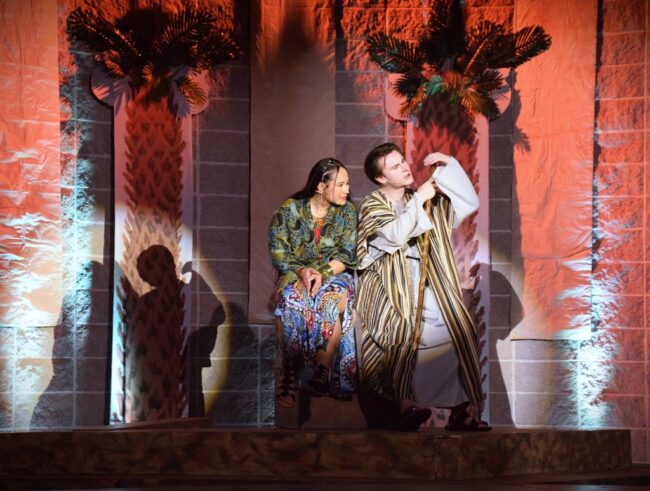
The expressivity and overall presence on Ian Cripe as Moses is sensationally stunning. You get this childish man-boy who very quickly unearths his destiny and becomes this prophet, this— Moses— and carries the burden of a true religious legend, whilst also maintaining the reality of the parameters of the show. It’s extraordinary to witness. That first moment in empty-stage solo, “Footprints on the Sand” sets the true tone of Cripe’s journey in this role; it’s perfection. There’s a romancing of his future in this number that carries through sublimely, and all the more so because of how clear and pure his vocal intonation and pitch remains. Vocally present, emotionally consistent, even with the turbulent maelstrom-coaster that Moses navigates in this musical, Cripe is wondrous. And when he calls down The Plagues, watching his facial expressions will inspire the {old testament} fear of God right into you. “For the Rest of My Life” is such a powerhouse expression of tormented heart, tortured soul, and yet agonizing truth that you feel Cripe’s pain as he sings his way through that number to a bitter victory. It’s extraordinary beyond measure.
When the gods send you a blessing, you don’t ask why it was sent; the gods of theatre, compassion, empathy and joy have sent Woods Memorial, David & Elysia Merrill and their production of The Prince of Egypt to delight the masses, lighten our hearts and minds and spirits, bring joy to our souls; it is a theatrical miracle unmatched in its talent, its experience, and its existence.
Running Time: Approximately 2 hours and 40 minutes with one intermission
The Prince of Egypt plays through March 21st 2026 with Woods Memorial Presbyterian Church— 611 Baltimore Annapolis Blvd in Severna Park, MD. Tickets are $20 and seating is LIMITED!! In order to register for seats, please visit this website or if registration is full and you’d like to be placed on the waiting list, please call Pam Ward at 443-261-3263 or email her at pward@woodschurch.org