Caption: Live theatre production on stage for month of March.
No.
Caption: Emotionally evocative musical theatre show happening in heart of Columbia.
Or—
Caption: Fun Home making area community theatre debut with Silhouette Stages at Slayton House Theatre under direction of Stephen Foreman and musical direction of Dave Foley.
That’s the one.
This expressive and emotionally visceral musical (Lisa Kron- book & lyrics, Jeanine Tesori- music, based on the graphic novel by Alison Bechdel) explores the family past of Alison Bechdel and how that shaped her existence in the present day. Though unlike other ‘reflective-nostalgia’ based narratives, this show takes some unique twists and turns by way of formatting and keeps the audience watching from start to finish, even though you know how it ends right from the beginning. It’s a fascinating libretto with beautiful music that’s exceptionally well-staged at Silhouette as the start of their 2026 calendar season.

Director Stephen Foreman fabricates his vision of the show to life by serving as the production’s Scenic Designer (aided by Head Carpenters Neal Townsend, Chris Mobley, and Alex Porter and a half-dozen construction hands and scenic decorative-duo Debbie Mobley and Ange Townsend.) The beauty of the set itself is twofold; there is an artistic aesthetic— literally the cartoon sketches of childhood memory from Alison’s mind captured in these frames— like windows or portals to Alison’s past— that stretch upward (and are accordingly augmented at times by the work of Lighting Designer Collin Griese)— and then there’s an artful fluidity as pieces of the set pop-roll-slide in and out of the structural framework, almost like a dollhouse from childhood. There’s nostalgia threading its way through both components of the set. And the devil’s in the detail (double-props again to the scenic decorating duo of Mobley & Townsend) like the paint on the piano or all the things on Alison’s roll-top desk. Foreman’s set also uses tiers and stairs to create depth, which plays well on the layered depth built into the libretto with the three versions of Allison.
Griese’s lightwork is most definitely praiseworthy here— not least of which for the special effect lighting for the ‘event’ near the end— because of it subtly and ease. The way different sketches are highlighted in colors at various moments really draws the eye to important details contained therein. There’s a use of blues and reds throughout, servings as emotional cue-cards for the audience, which in this case feels gentle rather than overhanded. Sound Designer Val Smith also keeps the balance of the performance in check, overall. You have a live pit orchestra (tucked up away behind the set somewhere, led by Musical Director Dave Foley on piano, with Mari Hill on reeds, Rich Barnes on guitar, Billy Georg on drums/percussion, David Zajic [sub-Andrew Nixon] on violin/viola, Jen Retterer on cello, and Joe Gretz on bass) that adds an intrinsic pathos to the musical theatre experience and their sounds are blended brilliantly against the singing. With a cast of just nine— and very few moments where all nine are singing at once— overbearing levels from the orchestra could be a concern, but not with Smith’s capable skillset at play.
I want to wax poetic further on Costumes (Debbie Mobley) and Hair & Makeup (AnnaBelle Auguste) but there isn’t much to say beyond ‘they flawlessly fit the time-stamp.’ Mobley and Auguste (aided by Dramaturg Julia Arbutus) do their research for fashion appropriate pieces for when the Alison character was growing up, verses when she was in college, verses her present-day motif and outfit the cast accordingly. And each look appears to be handcrafted for each person and character, blending so seamlessly into the action that you forget you aren’t in the past whilst watching it, but feel rather more like you’re living those moments frozen in time all over again.
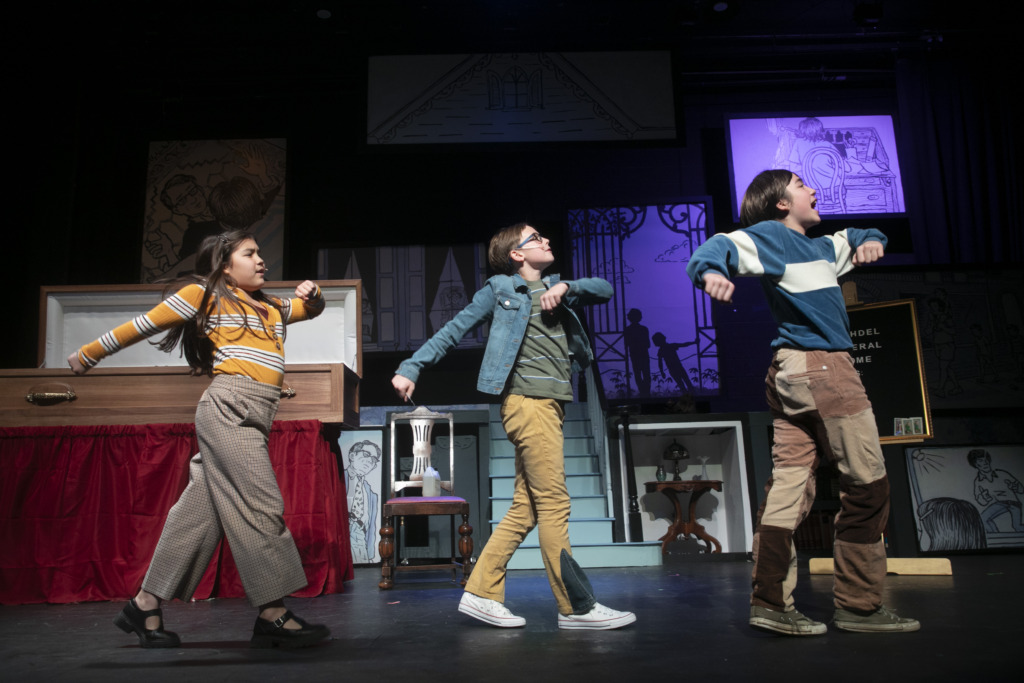
While Fun Home isn’t a ‘dance-show’ there is a number that steals the show with its up-tempo movements, deliberate hilarity, and overall impressive energy. Foreman (wearing the third hat of show’s choreographer) puts spunk and zest into this show, a much-needed component of levity, by way of the number “Come to the Fun Home” which is a fabricated advertisement for the family funeral home performed by Young Alison, and her two brothers, John and Christian. There’s an outrageous effervescence in this number, with the three children bouncing all around— including up in a casket and leaping down to the stage floor out of it— and they’re just living their best lives in this moment and it’s a refreshing blast of enthusiastic joy.
Outside of that dance routine, Foreman (as the director) has the audience ever-aware of the fact that these moments are being replayed. Alison, as her full-grown, present-day self, never truly leaves the stage. She’s tucked away on the stairs or off in a dark corner, watching, observing, remembering. There are more direct moments, like when she’s in the college dorm room with Middle Alison and the pair pitch-back all twitterpated and swooning, in tandem and it earns a well-deserved laugh from the audience. Those moments showcase Alison actively reliving memory and it makes the show itself more nuanced, creating depth whilst never letting the audience forget that this has all already happened, even if the reminder is tucked right in our periphery rather than front and center. It’s a masterful use of blocking, conceptual transference (taking what’s in his mind and laying it out in a clear and concise fashion on stage that makes sense), and the result is a remarkably invested, emotionally cathartic production.
Performances across the board from the cast of nine are sensational. Ryan Kieft serves as the multi-purpose man, playing Roy, Mark, Pete, Bobby, and Jeremy. Kieft has subtle shifts in his character every time he’s on stage (with a costume-flip to help further differentiate) and when his vocals are featured in various numbers, they’re warm and welcoming. The two other Bechdel siblings— Christian (Noah Anderson) and John (Cooper Johnsen)— add to the family dynamic in an intriguing fashion. Their aforementioned rock-fun number “Come to the Fun Home” showcases both Anderson and Johnsen’s ability to really live it up and sing zany lyrics whilst bouncing all around with indefatigable energy. And they’re featured in numbers like “Welcome to Our House on Maple Avenue” where the scene itself is chaos and they aid to it divinely.
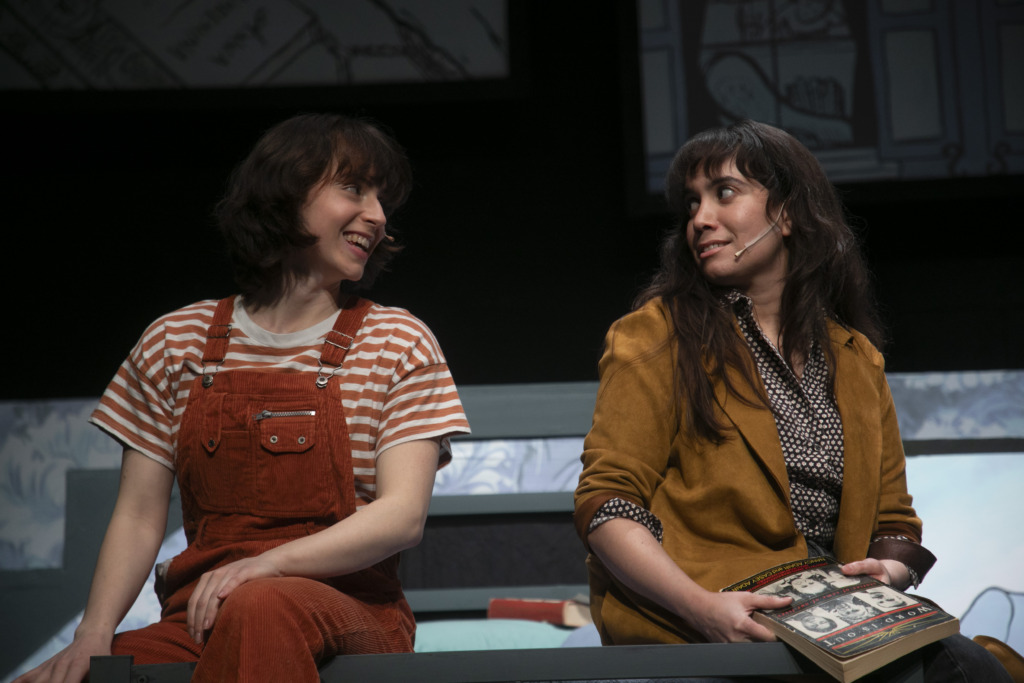
Joan (Maria Maclay) shows up once Medium Alison (Kaylee McDonald) goes off to college. The stark contrast between the bright but uncertain Medium Alison and the very stoic, grounded, sarcastic, wryly-humored Joan is fun and fascinating to observe, particularly as their relationship dynamic develops and grows. While Maclay’s character isn’t given a feature song per say, her acting chops and character development are spot-on (both she and Medium Alison are aided in that 100% perfection of ‘character in a time stamp’ by Mobley & Auguste) and her arch of interactions with Medium Alison is a real treat to explore. As Medium Alison, McDonald gets a lot of the middling pathos for the Alison-roller-coaster— like the lift hill or the hairpin turn just before something devastating (much of which gets left to be reflected upon and expressed by Alison.) When she erupts into her big solo “Changing My Major” there is this myriad of explosive feelings, all of which are supercharged in giddy glee and passion. You can’t take your eyes off of her in this song and it’s one of the more joyfully expressed numbers where you’ll find yourself chuckling along (the side-challenge here is that poor Maclay has to stay bundled under the blankets in bed, ‘asleep’, a remarkable feat as all the exuberance and movement raining forth from McDonald is extremely hard to ignore.) There are also some really intense interconnective moments between McDonald’s version of Alison and Bruce which define the sharper edges of the drama as a whole.
Situated in the thick of it and yet simultaneously outside of it, Helen Bechdel (Ellen Quay) is an unusual lynchpin in the mix. Of course the family dysfunction wouldn’t be as dysfunctional without the mother-wife archetype, though in this libretto it feels almost like she’s intentional ornament rather than functional household member— a dichotomy which Quay plays up remarkably well. It’s Alison’s story, Alison’s memory, largely focused around what happened to her father and why it happened and how she recollects it, so naturally her mother was there, but never really a focal point. Quay has a subtle but commanding stage presence, blending into the background— particularly when she’s at the piano— in a way that you almost lose track of her, but just as she’s about to drift from your mind’s eye, she reappears (this staging is also utilized to a grander-scale effect with Alison but works exceedingly well for the Helen character too.) It’s the jaded bitterness that percolates through Quay’s speaking voice, percolating just under the surface, never truly arising to a full expression of ire, disgusting, or anger. Though there is that astonishing moment when her character confronts Medium Alison about all what she’s known regarding Bruce and that dynamic share is harrowing. Her haunting solo, “Days and Days” gives you that much deserved release of pent-up emotional frustrations, with her fights with Bruce serving as those little preparatory and post-explosion pressure-valve releases. Quay’s vocals are beautiful and perfectly suited for the role.
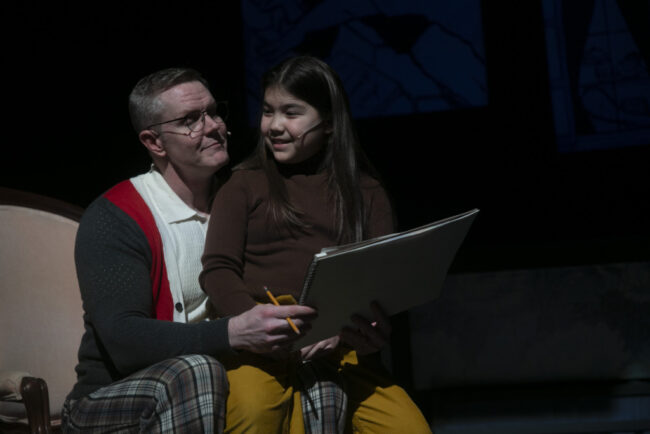
The man of the hour— the patriarch of the Bechdel Family— Bruce (Michael McGovern) is quite the complex character. With an angelic voice that is both haunting, deeply and emotionally disturbing, and ultimately vexing, he spins your head around and around with every note he sings, every line he delivers, and every move he makes on the stage. McGovern does a phenomenal job of humanizing this character, who for all intents and purposes is not portrayed in the best light. Even in moments where you absolutely should not be on his side— the car-ride with one of Ryan Kieft’s characters, the way he talks to Small Allison about wearing the dress, the criticism about Small Allison’s drawings— McGovern is bringing this dizzying sense of sympathy to the forefront of his portrayal and you feel for him, even and especially in those moments where you should be angry, disgusted, and revolted. The vocals on McGovern are pure musical theatre ecstasy, particularly when he’s singing “Edges of the World.” It’s evocative and visceral, raw and real. And you get all of that raw realness as a smoldering build-up every step of the journey with Bruce; it’s a powerful performance.
It’s difficult to say who’s giving the ‘final-bow’ style performance in this production— Small Alison (at this production Caroline Anderson) or Alison (Katin Cashin.) Because while Cashin’s Alison never truly leaves the stage, which is a challenge in and of itself, it feels almost like Anderson’s Small Alison has more ‘to do.’ They work together sublimely even though they have virtually no ‘direct’ interaction. As Small Alison, there is an undeniable gumption that Caroline Anderson is bringing to the role. It’s not precocious in a bratty way but rather in an educated, mature-beyond-her-years fashion. There is a playfulness to Anderson’s Small Alison that cannot be denied and it’s strikingly tempered with this earnest sincerity that is both refreshing and astonishing from such a young performer. In her opening bid, “It All Comes Back (Opening)”, where she’s singing and running around about wanting to ‘play airplane’ you get the first experience of her talents, which are many. Anderson’s responsive reactions, primarily to Bruce as most of her encounters are with him, generate from a place of authenticity; she’s living them, not just acting through them. And when she sings, she’s got powerful vocals. When she hits “Ring of Keys”, Anderson delivers this sensational sound: innocent and pure, yet confident and self-assured; it’s striking, glorious, and beautiful.
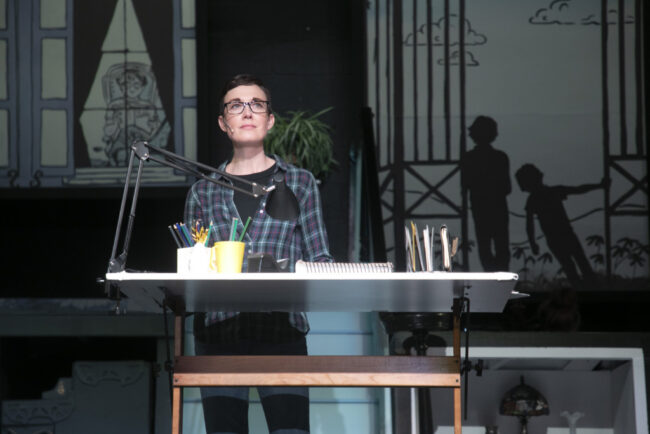
Cashin, as the ever-present almost ghoulish-phantom in her own mind, has vocal superbness for the two solo features that her character is given. “Telephone Wire” is this evocative time-bomb that feels as if it could erupt at any moment and that there’s some internalized struggle to keep a lid on it. And when she sings “Maps”, the sense of vested interest in her own recollections— this one featuring drawing with Small Alison on Bruce’s lap— is stunning. There is this perpetually frenetic sense of being lost that Cashin portrays at all times, though it mutates from time to time, expressing joy and confusion, sorrow and frustration, particularly when she’s trying to figure out how to caption her sketches and animations. One of the subtler, but by far most impressive, things that Cashin does on stage is engages wholly with that note-sketchbook. Often times when a character has a prop, it’s easy to forget its there, but you get this sense of Cashin’s Alison not being able to move or exist without it being in full use and full activation. She’s wholly invested in observing these particles of her memory that conglomerate into the bigger picture of her past and her emotional expressions are extraordinary. The moment in the car, in the middle of “Telephone Wire” is really, really striking, showcasing the further versatility and capabilities of Cashin’s acting skills.
Everything in this show is balanced and serene, like chaos never happens if it’s never seen. A remarkable, truly evocative theatrical experience, Fun Home is a must-see for the start of “Season 21: Coming of Age” at Silhouette Stages in 2026.
Running Time: Approximately 100 minutes with no intermission
Fun Home plays through March 22nd 2026 with 2025 with Silhouette Stages at Slayton House Theatre in the Village of Wilde Lake Columbia— 10400 Cross Fox Lane in Columbia, MD. For tickets please call the box office at (410) 216-4499 or purchase them in advance online