
author: Chris Pence
Fate Works Her Own Dread Work: Antigone at Spotlighters Theatre
“Grief teaches the steadiest minds to waver” – Sophocles, Antigone
Man versus woman, government versus people, morality versus legality. These themes have forever been debated on the theatrical stage, though no discussion has been more powerful than Sophocles’ Antigone, currently in production at Spotlighters Theatre. One of Sophocles’ most cherished works, the tragedy of Antigone brings to light themes of civil disobedience, morality, and equity, through the eyes of a young woman who wants only to honor her brother’s sacrifice amidst the flames of civil war.
Written in the 5th Century BC, Sophocles’ Antigone drops the audience into the middle of Thebes during civil war. Brothers Eteocles and Polynices have killed each other in search of the throne, leaving Creon as Thebes’ new ruler. Creon declares Eteocles a hero, to be honored and praised, while labeling Polynices a traitor, demanding that he be left unburied on the battlefield, carrion for the animals. Antigone, sister to the feuding brothers, defies Creon’s order, attempting to bury Polynices so that he may be shown the same dignity as his fallen brother. This sparks an argument for the centuries, pitting the rule of government against common compassion in a story that has withstood over two millennia. The third in Sophocles’ three Theban plays, following Oedipus Rex and Oedipus at Colonus, Antigone remains a staple of classic drama and literature, with readings and productions worldwide even 2400 years after its premiere.
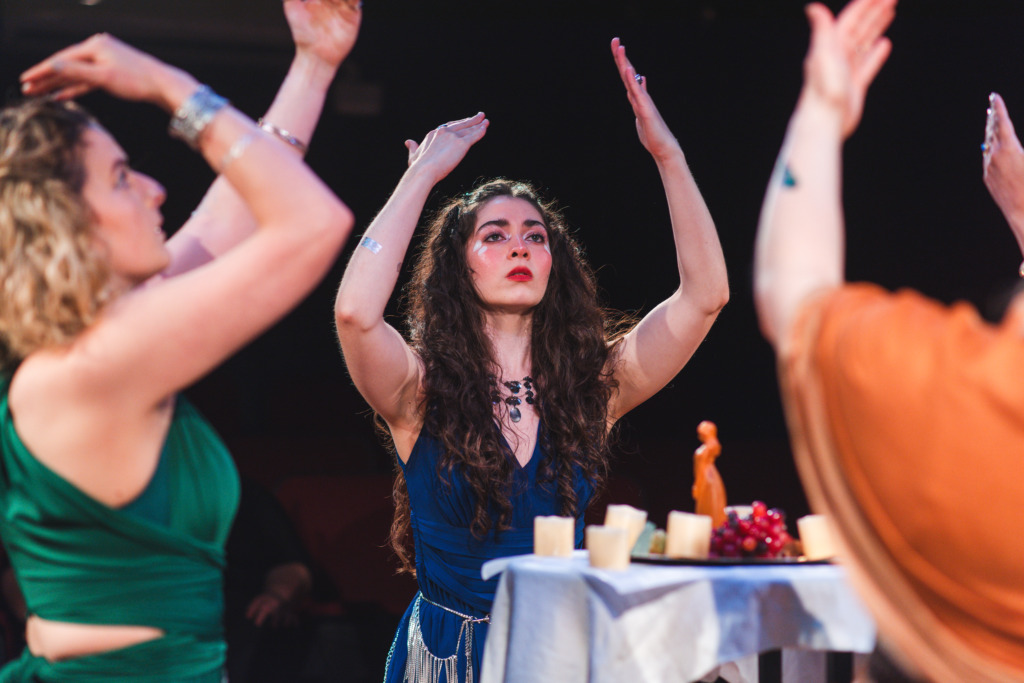
Directing a tragedy with two millennia under its belt is no simple feat, yet Director Emma Hook is up to the challenge. Performing in Spotlighters’ signature “theatre in the square,” Hook orchestrates her cast with authenticity and profundity rivaled by few other than Sophocles himself. Scenic Designer Justin Nepomuceno sets the scene with auditorium walls painted to represent the burning of Thebes. At center, an altar to the gods, with a small statue of Antigone herself, sitting atop a tray of grapes and surrounded by candles. Except for a few stools, Hook and Nepomuceno embrace minimalism to keep the focus on Sophocles’ script.
Lighting, Sound Designer & Board Operator McKinley Nance brings movement to each scene with lighting and sound cues that immerse the audience in the tragedy. At open, the cast engages in a mimed tableau of the events of the war, from the prayers of the ladies at the altar, to Creon assuming the role of leader, to the battlefield itself, lit by frantic lightning and the fires of war and set against a modern bluesy song bemoaning the struggles of war. Later, as the stubborn leader denounces a prophecy that spells his city’s end, the cast takes turns echoing the prophet, as Nance surrounds the audience in a sickly Disney villain green, signaling the mystical heartbreak that is soon to befall. At climax, red lights envelop the fallen, as the dead turn from their leader because of his betrayal.

Costume Designer Gracie Sciannella is the filigree on the Grecian urn that is Antigone, with practical, period appropriate attire. Antigone and Ismene join Eurydice and a chorus member in prayer in the opening scene, wearing identical gowns that differ only in color, signifying their common place as women in Theban culture. Each of the cast also sports some small but regal silver jewelry, enough to define the characters without blinding the audience to the characters’ personalities. A few of the actors would have done well to wear shorts under their costumes, so as to prevent their undergarments from showing, but in-all, Sciannella serves the production well.
Leading the show, Kaitlyn Fowler, as the eponymous Antigone, is a view of strength, courage, and woe. Her delivery exudes dedication for her brother, but also fear and apprehension for her leader, Creon. During her most powerful scene, Fowler cries real tears as Antigone laments loneliness during her imprisonment, knowing that her willingness to die for her cause is unseen by her fellow Thebans.
Standing at Antigone’s side through the fire and the flame is Ismene (Frankie Marsh). Marsh’s Ismene is a dedicated sister to Antigone, willing to bear her sister’s punishment, despite having qualms of her own about Antigone’s actions. During a particularly heated scene, Ismene stands up to Creon to defend Antigone, giving the ruler pause for just a second to debate whether his devotion to the law is worth its moral downfalls.
As new ruler of Thebes, Jae Jones’ Creon is a man in search of a path. Straightlaced and strong, Jones commands the stage with an iron fist, though his concern for his struggling country is constantly at the forefront of his mind. Creon values war over family, and man over woman, as Jones bellows orders and spits sarcasm back at the women who dare question him.
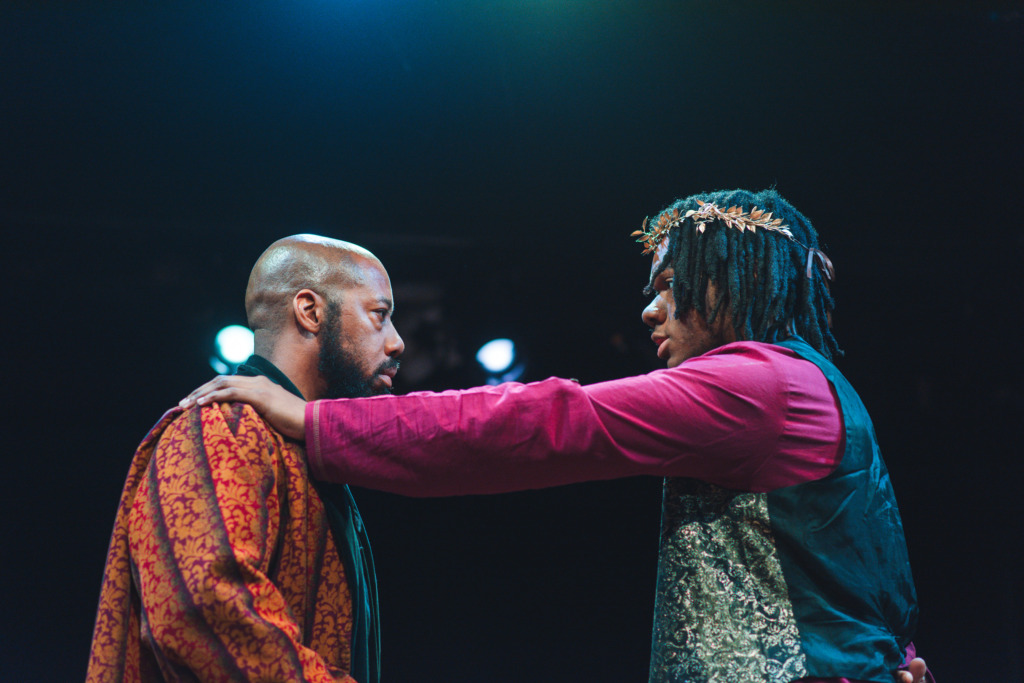
As Creon’s son, Haemon, Shamar Martin seems to bow to his father’s every demand, but quickly begins to question his father’s values, due to concern for his wife, Antigone. Martin is all the unrestrained lover that Antigone needs, forsaking his relationship with his father, and much more, in order to defend Antigone’s march toward morality.
Presenting the story through verse and debate are chorus members Sal Seely, Sofia Sandoval, Gaya Mundlye, and Rachel Arling Samson. The quartet shares an open dialogue throughout the show, imparting wisdom while also arguing amongst themselves whether Antigone’s cause is just. This chorus is much more than a group of all-seeing narrators, but also active members in the story. Sandoval doubles as a lowly Watchman, who enters to tell Creon the news of Antigone’s betrayal. This creates some comic relief early on, with Sandoval crawling, skittering, and gliding across the stage in fear as Creon shouts his dismay. Mundlye’s Eurydice enters late to find her family and her city in pieces, suffering in silence as she knows her husband Creon will not hear her cries because of her gender. Samson shines like a wicked little diamond as Tiresias, the blind prophet who warns Creon of Thebes’ fall, only to be ignored. Tiresias, not one to be overlooked, flies into a devilish fit of rage, screaming his prophesies unto Creon, bringing the terrified ruler to his knees.
While this production does well, no production is spotless, which is the beauty of live theatre. There were some uncomfortable pauses during the show as actors gathered their lines, though most of these were covered well, as though they were dramatic pauses. Some actors could also add a bit more focus on their diction and talking speed. Though emotions were high during the climax and the few scenes leading up to it, some of the narration was nearly lost in the fold, victim to rapid fire delivery and overwhelming emotion. Likewise, some of the emotion during these scenes came off as rather melodramatic, with a few actors taking their emotions a step too far, making the delivery feel more comical than dramatic.
While Antigone certainly doesn’t have a happy ending, the real tragedy of the Spotlighters Theatre production is that the show only runs until March 29th! The cast and crew give reality and modernity to Sophocles’ most enduring work, making it a production that is not to be missed!
Running Time: Approximately 90 minutes no intermission
Antigone plays through March 29th 2026 at The Audrey Herman Spotlighters Theatre— 817 Saint Paul Street, Baltimore MD. For tickets call the box office at (410) 752-1225 or purchase them online.