If you say something, you know it. If you don’t say something, you don’t know it. So many people keeping their sayings to themselves so that they— what? Get to remain unknown? Anonymous? Ignorant? Blood may be thicker than water but betrayal— that can cut deeper than any bond. Arthur Miller and his seemingly ageless drama A View From The Bridge is painting a bloody and brutal— and tragically still relevant— picture of the American condition. And it’s live at the Greenbelt Arts Center for the next three weekends under the direction of Stephen Cox. One would have hoped that over 70-years on from when the play was set that conditions for immigrants and the way we treat those coming to our country would have changed, making this work a ‘piece of its time’ but unfortunately the similarities to the plot’s through-line are all too relevant to today’s current climate.
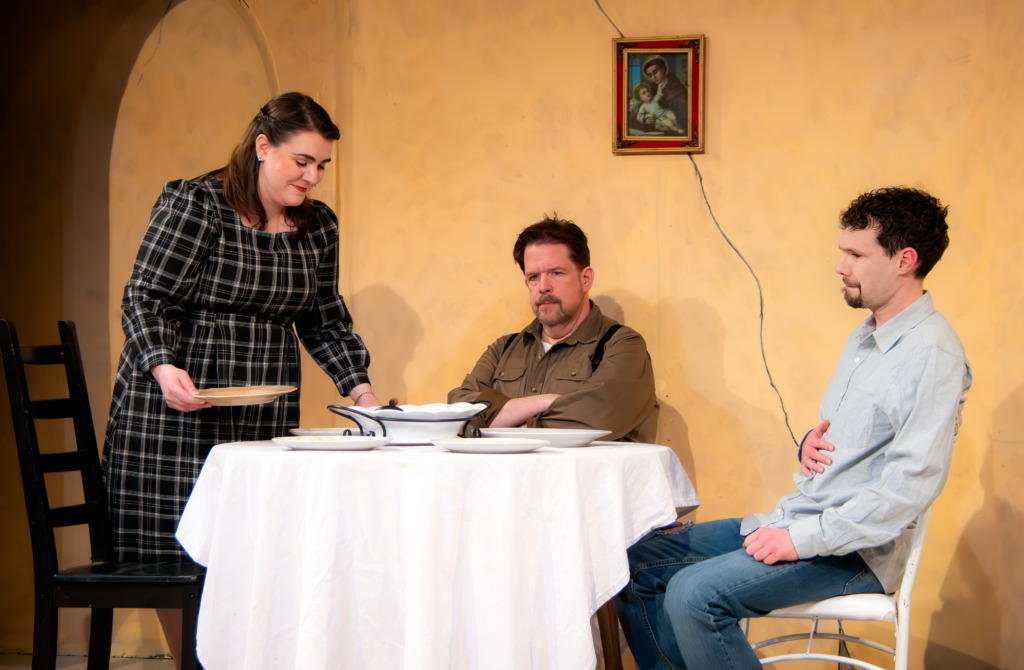
The stage (designed by Stephen Cox, assembled by the cast, crew, with assists from The Rude Mechanicals, and painted by Anne Hull and John Cholod) sets the scene sublimely, except for a few anachronistic décor choices that seem to be a bit more for Cox’ conceptualization of the piece rather than the internalized existence of the characters. That crumbling, derelict interior of the tenement slum for the Carbone home paints a glorious picture of their working-class poverty. Hull and Cholod paint cracked stucco and exposed brick right into the walled structure. The furniture is mismatched and simplistic, there’s even a cross hanging above the door to the bedroom. The scenic disconnect comes from the two, hyper-modern glossy posters that Cox has laminated onto the walls. The one— a picture of (we’ll graciously pretend it’s) The Brooklyn Bridge, can easily be forgiven as the ‘window/view’ that’s referenced in Alfieri’s opening monologue; hell, you could even stretch so far as to say that Cox was intentionally attempting to give you a modern look at ‘The Brooklyn Bridge’ with this shiny poster to reflect the fact that the situation in 1955 is no different from what we see right now in 2026 when it comes to the immigrant connection. (A window frame around said poster would have actualized this concept more believably.) But the modern-ish map of Red Hook feels awkwardly out of place on the walls of the Carbone home. It’s clear that Cox wanted to show you Red Hook, but it breaks through the fourth wall in a way that doesn’t gel with the rest of the happening of the production. Sticking it on a lamppost or street pole— or even on the load-bearing support column where the telephone is mounted would have been a stronger, more visionary choice. Cox’s use of the space, however, works well for the production, demarcating what’s interior and exterior (and props to Alan Duda on the ‘stair-block’ foley assist from backstage to further the illusion that the set goes up to a second story that the audience cannot see.)
Jeff Poretsky’s lighting design is intensely effective. The subdued blue-light that bathes the stage whenever Alfieri (Brett Fishburne) is narrating the play’s events, is mesmeric. And the red-bath on that ‘front and side alley’ when Eddie goes for the payphone is harrowing. Even if you aren’t familiar with the play, when that light cue hits, a rock just drops in the pit of your stomach, enhancing the effect of the scene tenfold. Poretsky is consistent with interior lighting, making it noticeably different when the characters enter the home verses when they’re out in the street or the alley. The use (and more specifically the absence) of Penny Martin’s sound design generates questions. Martin has this really lovely sound cue at the very beginning of the show— dock sounds with seagulls and clatter— and then (Kisara Garalde’s original musical composition for the record-scene notwithstanding, and it’s delightful though could stand to be a bit louder so the audience can fully appreciate it!) there is no more utilization of sound. While this may come across as an intentional choice to ‘prime the audience’ for the location, it feels oddly unnecessary. The silences and lack of underscoring enhance the drama. But by the same token, Martin’s work with that opening sound effect is quite impressive it makes you want more of it in other places; it’s a strange conundrum and I can’t recall being so vexed over the lack of sound and wanting even less whilst simultaneously wanting more.
Spencer Dye deserves a nod for period appropriate-appearing costumes. They accurately represent the socio-economic status of the characters, they suit the performers in ways that match both stature and the characters that they are playing and appear to align well with the Brooklyn, New York 1955 timestamp. The pacing of the show overall (Cox’ drive, Stage Manager Alan Duda’s shifts between scenes, etc.) was just a teeny bit off but given that it was an invited preview-style performance, one suspects that given the overall momentum of the performance that this should and will be tighter by the official opening.
The show’s primary hanging point for me is that the two leading women outplay the men ten to one in this performance. And that isn’t for a lack of effort on the men’s parts; the women are just the stronger performers, which makes for a fascinating on-stage dynamic when the show’s leading characters are men. Jim Adams as Eddie Carbone delivered a slightly uneven performance during the first act, struggling to find his footing in the existence of the character, but by the second act was fully wound up into that over-the-top explosiveness that one expects with this man. Those final scenes— the shouting, the bombacity, the intensity— it’s extraordinary and wholly praiseworthy, creating these evocative moments and really intense and brutal gut-punches. Even his opening bid in the cheeky exchanges with Beatrice, you get this sense of maybe he’s just this worked-to-death guy who has to put-up with certain nonsense from his family just to keep the peace in his house.
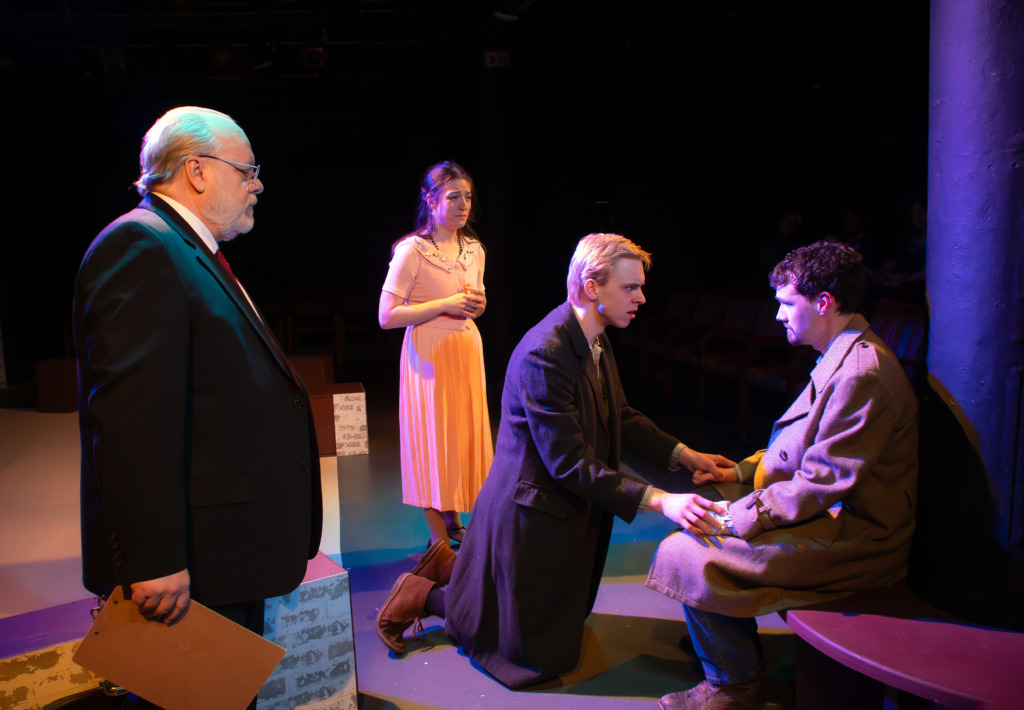
I think the disconnect with Adams’ Eddie is in attempting to humanize him too early and too often. It’s not that Eddie Carbone isn’t human (of course, according to Arthur Miller, most people ain’t people) but rather the way Adams finds his human faults; it reads whiny. And yes, there’s a certain level of whininess that lends itself to both that Brooklyn accent and the wording and phrasing of the time, but it feels one-level and shallow whiny. This is really confusing because Adams gives such a strength to the character in the more affecting moments almost like there’s a confusion on how to be vulnerable but not a clear way. It was a fascinating performance to watch because you have these astonishing moments where Adams is living it up in these larger-than-life explosions but then in the quieter moments, he just falls flat. I think the intent was to have him create a juxtaposition between the two sides of Eddie Carbone but what’s happening is dynamism and banal static clashing together instead. When he goes for Catherine and Rodolpho— you feel it. You connect with Adams’ Eddie at the end too— crying out for respect with that same unabashed, unchecked intensity as Brando’s Kowalski screaming for ‘Stella’ in Streetcar. But then when he’s fussing at Alfieri it just feels off and not intentionally so. It’s a wild ride with Adams’ Eddie— mostly an impressive one, but buckle up all the same.
You get scenery-chewing goodness out of Aref Dajani and Kisara Garalde (Louis and Mike, respectively) for the moments that they’re on stage. Garalde feels extremely under-utilized in this role; her handle on the cadence, patois, and overall delivery of her character’s speech patterns is remarkable and she really engages in that scene where she’s talking about how funny Rudolpho is. Garalde’s facial expressions, much like Dajani’s, are equally enticing, particularly when they’re reactionary when it comes to what Eddie does once it’s revealed. Straddling the questionable existence of ‘in-the-story’ verses ‘telling-the-story’, Brett Fishburne’s Alfieri spends a lot of time being highlighted by Jeff Poretsky’s ominous blue-light, which creates a curious depth for that character.
On the whole, accents in this production are particularly impressive. I’m always hesitant to make comments on accents, particularly at the community theatre level as there often isn’t a budget (or in this case, even a program credit) for a dialect coach, however, the 50’s Brooklyn accent was really delivered soundly and consistently. (Shout-out to Peter Orvetti and Alan Duda who appear as ‘Charlie & Dominick’ late in the second act with their smattering of lines but flawlessly laid down in that vocalization.) And the broken-English Italian accents on Marco and Rudolpho are quite consistent too. Whether it’s the cast or assistance from the director, they should be proud of this particular theatrical achievement as it really does make the play feel that much more realistic.
As Marco, Daniel Dausman delivers a really beautiful, albeit tragic, portrayal of this earnest, innocent man. The character doesn’t say much and Dausman does a sublime job of making what limited lines the character has land superbly in every moment. His facial expressions are rich, particularly when he’s observing and absorbing confusions. There’s a practicality and a reservedness to Dausman’s portrayal, which makes for a fantastical switch come the end of the production. There’s this hysterical moment— almost one of those nothing moments, really, but Dausman delivers it so well that it will now live rent-free in my brain for the rest of the season— when he says something to the effects of “No, in Italy the oranges are orange.” And it’s just the way that he says it, the exact timing of his delivery and the expression his face; it’s brilliant and totally hilarious.
Rudolpho (Ephraim Robinson) is vivacious and has a liveliness to him that cannot be tamped down. Robinson embraces this element of his character and allows it to dominate most of his scene work. You can feel the frenetic energy rolling through him, whether he’s interacting with Catherine or Eddie; both of which are very, very different styles of on-stage engagement, but both are met with a heightened sense of emotional urgency, even if the former is twitterpation and affection and the latter is trepidation and disdain. The top of the second act gives a real glimpse into the earnest passion in the chemistry between Robinson’s Rudolpho and Gillian Van Dita’s chemistry.
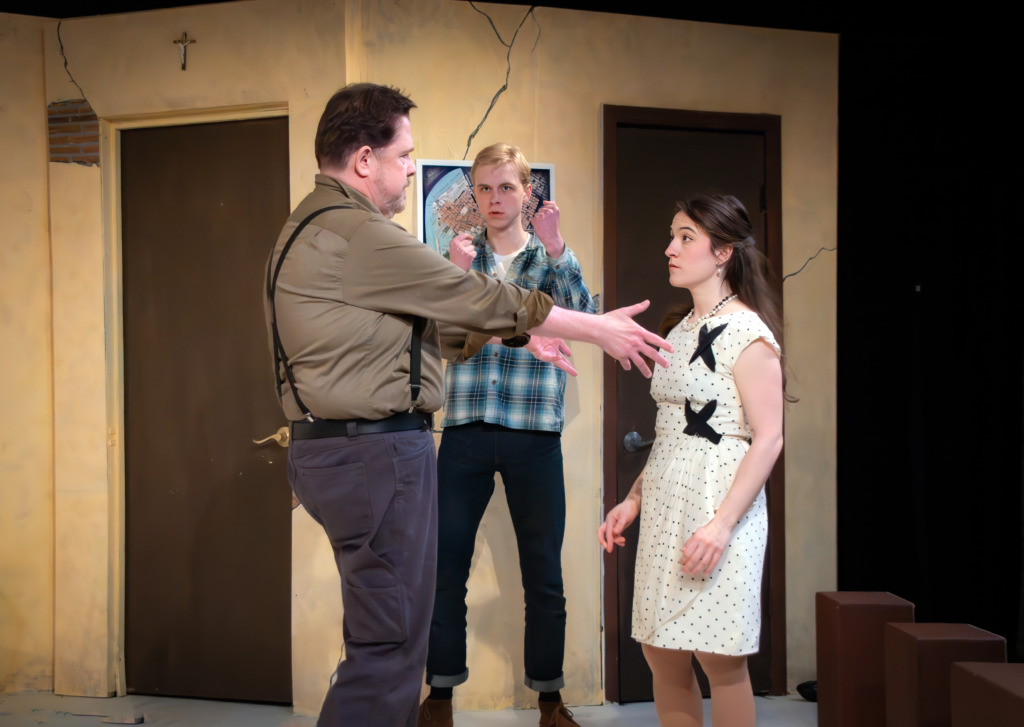
As mentioned, Gillian Van Ditta and Adriana Ganci (Catherine and Beatrice, respectively) are running the show, though I’m certain that’s not what or how Arthur Miller intended it to be. Van Ditta is just this exuberant bubble of giddy glee that cannot be popped no matter how awful things seem to get. There’s a balance in her childishness; she’s naïve but not stupid, she’s juvenile but not unaware. So watching the ‘sweet-on’ dynamic with Eddie shift into that playfully coy romantic attraction with Rudolpho is an exquisite display of character comprehension. The scene that Van Ditta shares with Ganci’s Beatrice, where they discuss appropriate behaviors, not being a baby, and growing up, is extremely meaty and lands beautiful between these two talented performers. Their emotional breakdown at the end is equally impressive. Ganci, as Beatrice, has my favorite reactionary moment in the show. When Eddie comes back into the house before ‘Charlie & Dominick’ make their respective entrances, watch Ganci’s face. She’s seated house left and the shock and of discovery that paints over her features is harrowing. And it’s several moments before her character is even able to speak, even allowed to articulate what she’s just learned. It’s glorious. Her desperation in trying to have conversations with Eddie is remarkable as well, particularly the ‘when am I going to be a wife again,” moment. And her emotional versatility is heightened, with a growth-trajectory, much like Van Ditta’s Catherine.
It’s a fine production, if a little shaky in places, but certainly worth enjoying and definitely worth investigating. It runs a firm two hours with an intermission and may tighten slightly as it comes into its full opening. Overlook the fact that the bridge picture isn’t actually The Brooklyn Bridge and you’ll be golden with this production of A View From The Bridge at Greenbelt Arts Center this March.
Running Time: Approximately 2 hours and 15 minutes with one intermission
A View From the Bridge plays through March 21st 2026 at Greenbelt Arts Center— 123 Centerway in downtown Greenbelt, MD. For tickets call the box office at 301-441-8770 or purchase them online.