Where’s the party? Can you take me there? Why, of course, Old Sport! It’s roarin’ on over at Baltimore’s Hippodrome Theatre! Come celebrate the glamour, glitz, opulence, and decadence— J. Gatsby himself is sending you a personal invitation! The party never ends at The France-Merrick Performing Arts Center as the national tour of The Great Gatsby launches itself right here in Charm City. Based on the iconic classic American novel by F. Scott Fitzgerald, this splashy new musical is a visual sensation with book by Kait Kerrigan, music by Jason Howland, and lyrics by Nathan Tysen. Partying only through February 7th 2026 here in Baltimore, it’s a razzle-dazzle of choreography (Dominique Kelley) and direction (Marc Bruni) that will spin you dizzy from start to finish.
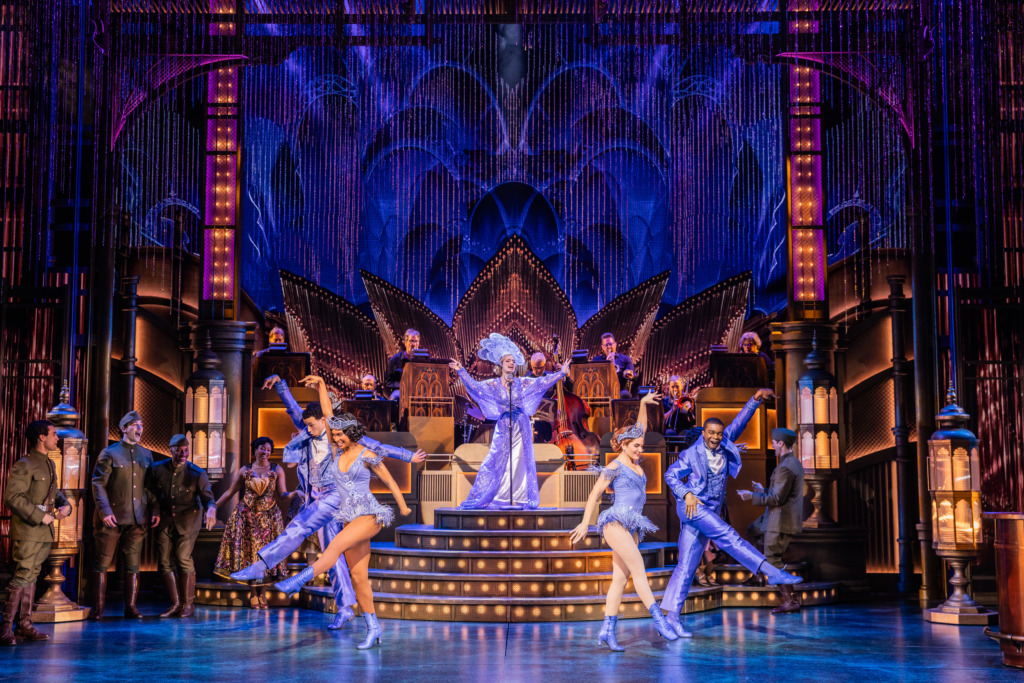
Live theatre is such an important entity, such a harbinger of hope, such a beacon of light in this seemingly unending darkened world in which we presently live— not unlike the symbolic green light (which both scenic & projections designer Paul Tate DePoo III and lighting designer Cory Pattak do a phenomenal job of incorporating into the background and overall visual setup of the production) that keeps Gatsby’s hope alive— that it’s painful to say anything less than positive about a production for fear that even the slightest neutral or negative commentary will give patrons pause and cause to perhaps pass-by the box office. The extremely hardworking talent that’s come together for this show— both on and off-stage— deserves the support. The show itself, however, is somewhat of a mismatched hodgepodge that feels like two or three different projects still in the making.
Librettist Kait Kerrigan, Composer Jason Howland, and Lyricist Nathan Tysen feel as if they’re in two different productions and their efforts never quite seem to gel with one another in a way that makes for a cohesive, fluid experience. While it’s understandable that a drastic tonal shift needs to occur between the first act and the second (not only because of the natural progression of the source material’s dramatic shift but because of the symbolic shift in perspective from the ‘eyes of God’ so to speak) but the shift doesn’t feel natural, to the point where it feels like these were two different shows composed at two different points in time and pushed together because they shared the same characters.
No one can deny that Howland’s music is gorgeous, truly glorious and even evocatively striking in places— particularly “Valley of Ashes”, “For Better or Worse”, and “God Sees Everything”— but nothing from the score is memorable or catchy in a way that sticks in the brain. And Tysen’s lyrics often feel contrived, as if they were trying too hard in places to be clever, but then in others feel so sweepingly banal that it feels like there was no effort at all. “Only Tea” drives home the point that The Great Gatsby could have been better severed as a non-musical stage show; the emotions are there, the drama, the gripping situations— it’s all in Kerrigan’s book (by way of Fitzgerald’s source material) but it didn’t necessarily need to be a musical in this golden age of ‘everything is a musical.’
There are other disconnects with the show as well— particularly in the way certain characters are presented and utilized (or in the case of the ensemble, severely underutilized)— that continue to beg the question of ‘was this necessary’ in becoming a musical stage show. Tom Buchanan (Will Branner) ends up being portrayed a bit too much like a caricature of a brute rather than a brute. If you’re going to go to the trouble to make ‘Tom being a brute’ such a hard-hitting plot point, embrace it and go wholly into the darkness of it, don’t dial it back and make it a send-up as it’s a direct mismatch with the rest of the grounded characters in the play. It’s impossible to tell what the intention of this was (directorial misstep, actor misinterpretation, etc.) because none of the other characters- even the ‘outrageous’ party-goers or the McKees (Alli Sutton as Mrs. and D’Marreon Alexander as Mr. at the party in the Harlem apartment)- read as anything outside the bounds of reality.
Both “Only Tea” and “The Met” follow in this weird vein of ‘we might be in a spoof/send-up’ and match the Tom Buchanan caricature presentation, again feeling out of joint with the rest of the show. (It’s like someone in the trifecta of creators or perhaps on high from the producers thought there needed to be comedic levity, the way “Master of the House” breaks up the rest of the heaviness in Les Miserables but they didn’t insert it into Gatsby in a way that didn’t disrupt everything else in the process.) Having these two numbers stacked atop one another in the first act made it even more of a separate entity than the more naturally progressive flow of the second act, which on the whole felt more fully fleshed out both with characters, song structure, and general emotional alignment.
The ensemble (at this performance D’Marreon Alexander, Justin Scott Brown, Kyle Caress, Valeria Ceballos, Anna Gassett, Rosie Granito, Joann Gilliam, Josiah Hicks, Nina Michael Howland, Tyler Johnson-Campion, Kurt Kemper, Joi D. McCoy, Charlotte McKinley, Macy McKown, Tim Quartier, Alli Sutton, Ryan Vogt, Shai Yammanee) appears less than one might expect in a show that’s built around massive parties of nouveau riche decadence. That’s not to say that when they’re onstage they aren’t active, though Dominique Kelley’s choreography, where many of the ensemble end up being featured, feels underwhelming for the most part, particularly during “Roaring On” and “New Money.”
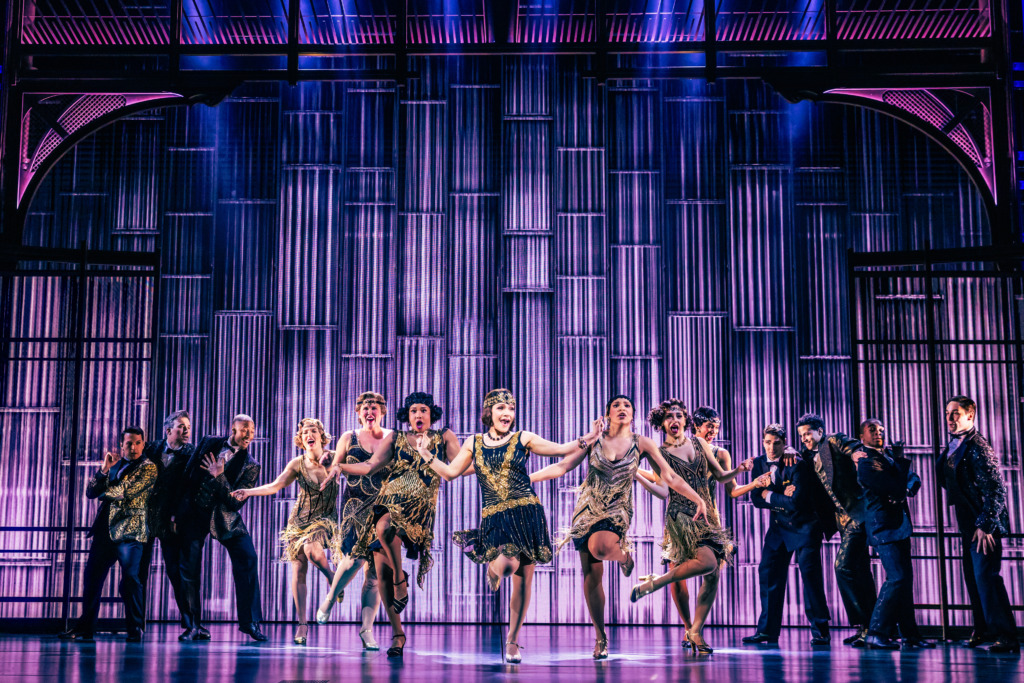
Where Kelley’s choreography does radiate with the opulence one expects from a show taking place as and when The Great Gatsby does is in the second act (again, harkening back to this disjointed verve of two separate shows being threaded together by an intermission.) “Shady” is some of the most elegantly slick dance work featured in the production and it’s a number without a single sequin, sparkle, tassel, or bead. “La Dee Dah With You” is the pièce de ré·sis·tance featuring The Sugars (Anna Gassett, Josiah Hicks, Macy McKown, Tyler Johnson-Campion) and their sensational tap and flapper-flip work. The number goes on to incorporate a larger tap routine with many of the named players but watching Gassett, Hicks, McKown, and Johnson-Campion build up this number with a proper splashy dance-break, as well as the little tap-off between Hicks and Johnson-Campion, is revitalizing and well-deserving of the ovation received from the audience.
It’s difficult to pinpoint where exactly one could more readily infuse and activate the ensemble because there are so many moments in this show that stand alone with just a single character or single couple on stage, and perhaps that’s part of the problem: wanting/needing more activation and overall use of background players but not being able to do so because of how the show’s presently written/constructed/conceived.
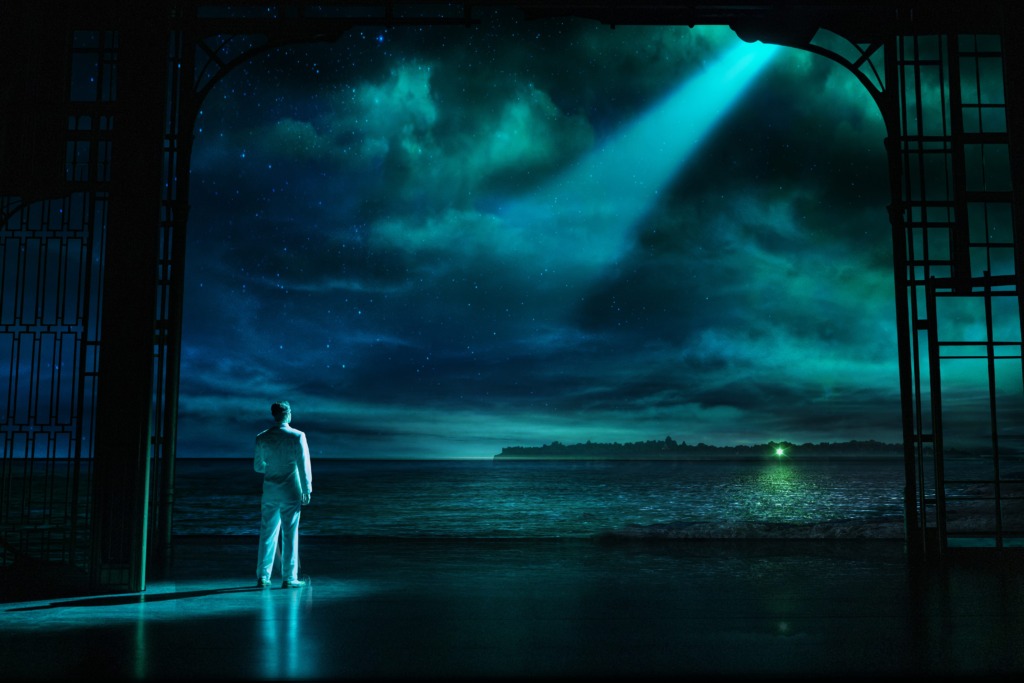
The story isn’t thin by any stretch of the imagination but the marvels of the show are clearly being presented in Paul Tate DePoo III’s set, Linda Cho’s costumes, and the illuminating light work of Cory Pattak. There’s certainly something to be said when the costumes and set outperform the libretto. This seems to be the case for The Great Gatsby. You get all the mesmerizing shimmer and signature sequins of the era in Cho’s sartorial selection. And the way that DePoo’s set slides in and out, gracefully, effortlessly transitioning from that verdantly charming cottage to the grandeur of Gatsby’s mansion to the decrepit decomposition of the gas station out in Queens is nothing short of breathtaking. The two most stunning visuals in the show are DePoo III & Pattak’s work creating the green light of Daisy’s dock as seen through Gatsby’s balcony and the hallmark of Gatsby, in literary terms, the ‘Eyes of God’ billboard. DePoo III’s fabrications of these moments into actuality, augmented by Pattak’s stellar light work are alone worth the price of admission.
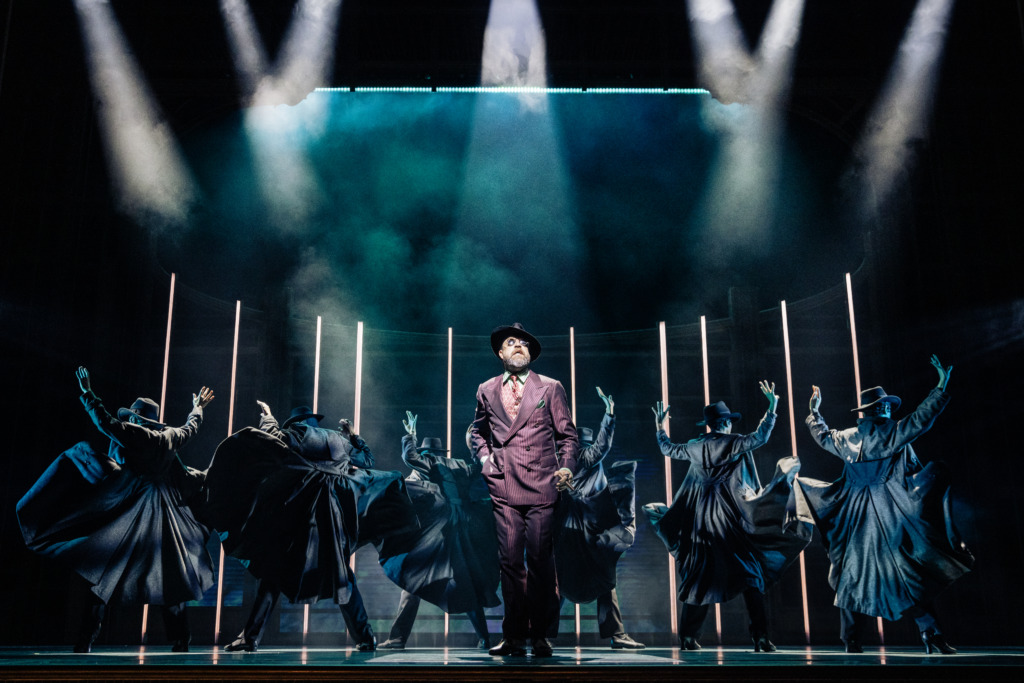
Marc Bruni’s direction feels muddled in places— falling into the quagmire of the show as a whole, yet there are moments where he knows exactly what he’s doing. The staging, tone, and placement of Wolfsheim’s (Edward Staudenmayer) big number to kickstart the second act is brilliant; same with the way Tally Sessions’ George Wilson gets positioned and placed for both “Valley of Ashes” and “God Sees Everything.” Bruni could have really driven the stake of the ending home in the “New Money (Reprise)” by asking for more ghoulish lighting (the choreography for that moment was appropriately staccato and sharp) and pausing just a beat for the audience to fully comprehend what they were seeing, but it was blitzed through. There were other moments like that one that felt rushed or glossed over. But then there were moments that lingered effectively— that final visual of Gatsby standing with his arm outstretched to the green light (the thing Nick had been describing since the beginning) or the fog effects and overall blocking from the end of “One-Way Road” through to the aftermath that follows it. This mismatched level of direction felt like a letdown for this particular production.
As Gatsby, Jake David Smith’s dialect (coach Deborah Hecht) was spot-on! And his singing voice was technically beautiful, but as an emotional vessel, Smith felt hollow. And not in the intentionally detached fashion. The essential juxtapositional difference of ‘pre-Daisy’ and ‘post-Daisy’ wasn’t displayed as a strong enough or palpable enough character shift; the energies and dynamic stayed at the same level and felt flat. Smith has a beautiful voice, well-suited for the range and sustains built into numbers like “For Her” and the duet shared with Daisy, “My Green Light” though it lacks emotional connection, even in that pivotal desperation number in the second act “For Her (Reprise)”.
As Daisy, Senzel Ahmady was delivering a myriad of emotional experiences, everything from flighty and flirty upon the first introduction of her and Nick through to the devastating number “Beautiful Little Fool” (which felt like it belonged in a different musical entirely; every other number felt staked in the show’s time stamp except for this one; it just smacked modern though that had noting to do with Ahmady’s performance of it.) Presenting versatility in her portrayal of the character, Ahmady was the closest at earning sympathy for her plight from the audience, particularly as her character’s story arch unfolded. And her half of “My Green Light” was truly evocative, though some of her vocal phrasing felt overly breathy and at times there were some vocal acrobatics happening in various songs that made it unclear if she was struggling in the range where the numbers were set or making choices to push the emotions forward over singing technique. Her rendition of “For Better or Worse” hits hard and really brings the tears to the eyes of the audience.
Jordan (Leanne Robinson) and Nick Carraway (Joshua Grosso) fit into the narrative in a curious configuration, though both performers are solid in what they’re giving to their characters and the show as a whole. Robinson, who’s sassy attitude often serves as little breaths of comedic relief, is both cheeky and charming, and she has zesty vocals that help alight “New Money.” Her sound gets somewhat lost in that dizzying quintet “Made To Last” (but this was an orchestration/sound balance issue as everyone was a bit muddled in that number and the number itself felt like a failed attempt at the formulaic second-act quartet that so often appears itself in musical theatre.) Robinson and Grosso have a simple yet earnest chemistry that really sparked the dynamic of their characters’ paths, respectively. As the narrative figure, Grosso’s Nick Carraway was engaging. You buy into his story and his experience right from jump street when he starts off with “Roaring On.” And while “The Met” feels as ridiculous as the number “Only Tea”, Grosso’s involvement in both of those songs is well-executed and his comedic timing, particularly in the former, is magical. Grosso has a strong, well-balanced, well-toned voice that is perfectly suited for the range and expressions of the Nick Carraway character.
The seedy zest and gritty texture of gilded gold is superbly represented in Meyer Wolfsheim (Edward Staudenmayer.) Just a ‘cameo-style’ character— one might even say ‘princess track’ (as he waltzes in, dramatically changes the show’s course of action, albeit midway through the second act, and watches the mayhem implode all around him)— Staudenmayer gives a most memorable portrayal in this nefarious role. He dominates the opening of the second act and it’s almost like watching a reverse-God with eyes from below looking up at the world burning (a direct opposition to the billboard eyes of God watching from above.) His voice is striking and really carries divinely through “Shady.” Staudenmayer has such an impressive command of his own stage presence that you almost wish his character had more to do.
Myrtle Wilson (Lila Coogan) and George Wilson (Tally Sessions)— two of the most compelling performers in the production (with Joann Gilliam as a close second in her cameo pop as ‘Gilda Gray’ belting her heart out for “La Dee Dah With You” and appearing earlier as Catherine, sister to Myrtle.) The accent on Coogan’s Myrtle is sublime. She’s this agitated little pop of incendiary necessity that acts like a roman candle amidst all the chandeliers in East and West Egg. “Second-Hand Suit” is her fun and frisky number but she switches on a hard dime by the time she hits “One-Way Road.” The versatility that Coogan manages to encapsulate in this secondary character is astonishing and wholly praiseworthy. Tally Sessions is the unsung hero of The Great Gatsby (the irony being that he has two of the most-moving and gripping songs in the show.) His voice is a raw, broken velvet— rich but visceral— and carries the weight of the working class, the oppressed, the desperate, the broken-eyed-dreamers in both “Valley of Ashes” and “God Sees Everything.” Both numbers are brutal, deeply moving, and exquisite to witness both aurally and visually in the capable, talented presentation that Sessions is giving to this role.
“Reserving judgements is a matter of infinite hope.” one of, if not the, opening quote from Nick Carraway and in this case, it is the necessary advice to approaching The Great Gatsby. There are stunning performances contained within, even if the libretto, music, and lyrics pose as an untangled quandary. There is visual beauty beyond compare in the scenery, the costumes, and even some of the dancing. It’s a spectacle for sure, but the heart and soul of so many of these individuals— again both on and off the stage— make it so very worth investigating.
Running Time: Approximately 2 hours and 20 minutes with one intermission
The Great Gatsby plays through February 7th 2026 at The Hippodrome inside The France-Merrick Performing Arts Center— 12 N. Eutaw Street in Baltimore’s Bromo Arts District. Tickets are available by calling the box office at 410-837-7400 or purchasing them in advance online.