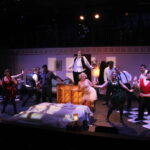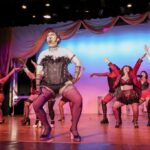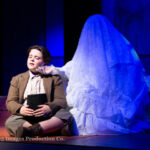
Phone rings, door chimes, in walks— Company. Damascus Theatre Company (in partnership with the city of Gaithersburg) is presenting this Sondheim classic for three weekends during February and it’s a heartfelt joy with a lot of beautifully humorous moments that really bring the show to life. Directed by Rachelle A. Horn, with Musical Direction by Keith Edward (live orchestra conducted by Stuart Y. Weich), and Choreography by Karen Kushner Creel, this charming and exceptionally well produced (Mario Font & Elli Swink) show will take you on the dizzying journey of birthday after birthday for our boy Bobby, where nothing ever changes except perhaps the persistent intensity of his married friends trying to marry him off.
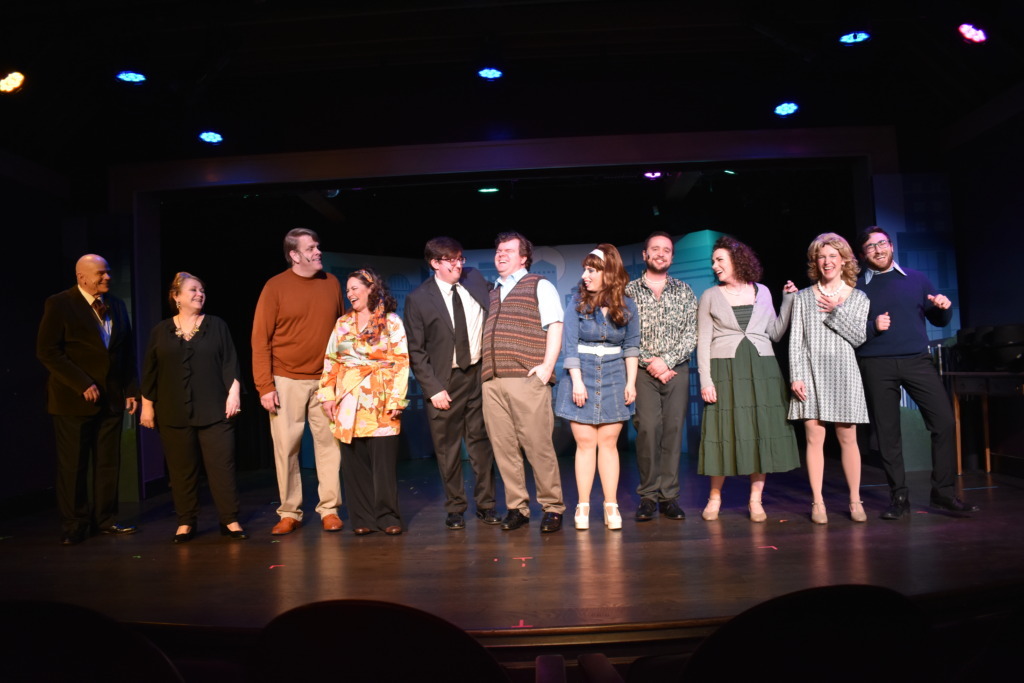
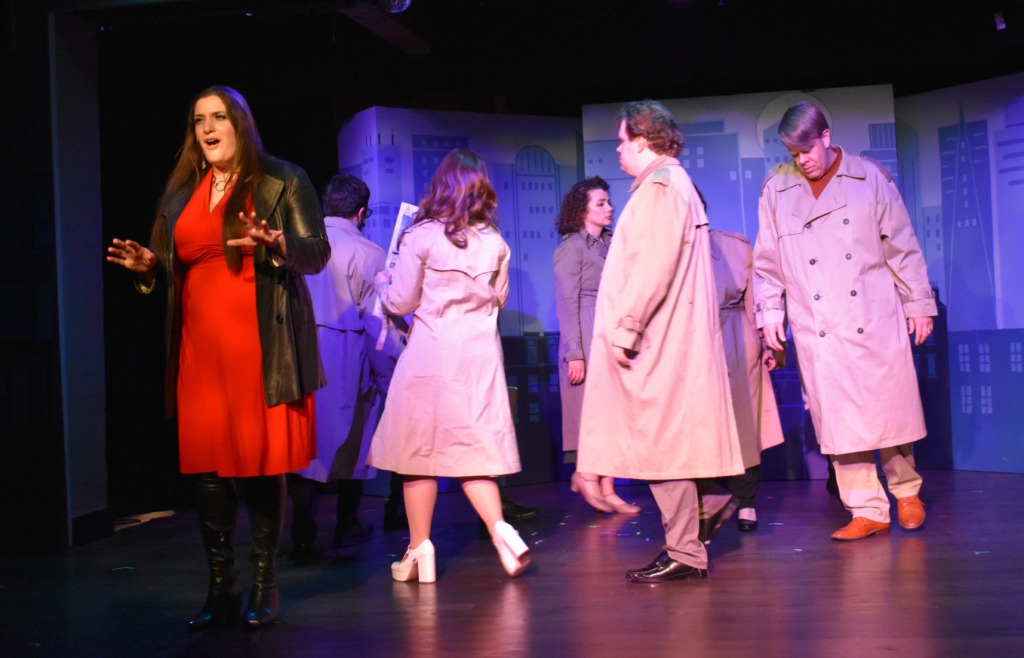
It’s a simple show about friends and Director Rachelle A. Horn keeps the scenery grounded in that vein of simplicity. With a New York City skyline and buildings painted across the back of the scenic uprights (by way of talented scenic painter Maria Littlefield and her crew of more than a half dozen construction and painting persons) we know immediately we’re in the heart of the Big Apple. Littlefield also serves as the show’s properties designer (with Elli Swink) and they both deserve great praises for the multi-functionality of that birthday cake and its candles. Ginger Ager on Costume Design brings the audience right into the 70’s with the various fashion choices, most notable on the female characters (and major shoutout to Hair & Makeup Designer Ava Silberman, particularly for the wigs and makeup featured on the Amy character), and allows the vignettes and music to do the lion’s share of the work. Horn, Littlefield, and Ager utilize scenery and costumes as subtle accents to this glorious performance rather than as the main attraction to draw you in and the balance is perfect for the intimate black-box-style theatre space at The Arts Barn.
One of the most successful components of this production is its fluidity and scenic expedience. While the scenery itself is kept simple, there are still furnishings— bed, sofa, bar-room table and stools, etc.— that have to find their way on and off stage at the appropriate moments. Stage Manager Michael Loebach (and crew Chris Spahn & Jen Willard) work deftly to ensure smooth, swift transactions. There’s only one moment (and this could have just been a Sunday matinee hiccup) where you have a pause of lingering darkness between scenes (and it was only noticeable because every other transition moved so flawlessly.) Loebach, Spahn, and Willard get the various furnishings and uprights shifted and moved as one scene is ending, into the darkness, in a deft and subtle fashion so that you almost don’t notice them, never disrupting the action or the overall flow of the show; Horn, and her SM & Run Crew understand the assignment of how to keep a show rolling along and it’s brilliant. Add to the mélange Rick Swink’s lighting design and overall technical direction and you’ve got a performance that feels real, authentically professional, and truly heartfelt. (Swink doubles alongside Michael Steimer as the show’s sound designer and all that can be said about it is that it felt perfectly balanced, and nary an issue to be heard on the mics, which feels unheard of these days in any theatre, let alone the community scene.)
The other thing that really speaks volumes on behalf of this sensational production is Horn’s understanding. Intentional blocking that not only services the scene and song-work whilst simultaneously creating the best vantage points for the audience but also feels charged with deliberate emotions. Horn embraces the repetitive nature of Sondheim’s structure in this show, meticulously blocking the birthday-cake scenes in an almost identical fashion with only minute differences to allow for the illusion that time has passed. She stokes the flames of comedy with intensity for the moments that are meant to be hysterical, she eases the more subdued moments that are loaded with heavier pathos onto the stage rather than forcing them there; Horn creates a balanced production and its utterly astonishing. Horn keeps Bobby active, not just observant (and she doesn’t ‘park-and-bark’ him when he gets those solo moments, he feels as if he’s present every step of the journey and honestly that’s what it feels like, a journey of vague discontentment through his wishy-washy existence of being mostly single.) There’s nuance to Horn’s direction and it elevates the overall theatrical experience tenfold.
One can tend to enter the theatre— especially community theatre— with certain preconceived notions or expectations of how a group of 14 singers* are going to handle the bombacity, diversity, and otherwise swirling insanity of a Sondheim show. Musical Director Keith Edward knows his Sondheim. And he’s found 14 talented performers who sound stellar when they’re singing, whether it’s together, solo, or racing round the ridiculousness of the score all at once. Sondheim’s score are notoriously insane— let’s call a Sondheim a Sondheim, shall we?— that’s what we love about them, after all, isn’t it? Edward and his cast are delivering professional quality sounds, extraordinary harmonies, blends, and balances, and above all, they appear to have mastered the art of articulation. I heard more lyrics— particularly in songs like “Getting Married” and “Company” (both its renditions)— that one might expect to catch from these whirling lyrical dervishes. “Side By Side By Side” is such a fulsome-sounding, wholly sweeping number that you could close your eyes and easily be transported to any theatre on The Great White Way by aural experience alone. Edward and the cast have put tremendous effort into the music of this show (while Director Horn and the cast make extraordinary moves in the scene work) to deliver a sensational musical theatre experience that is heartfelt, exquisitely articulate, and blended into something truly sublime to listen to, a rare feat to achieve with any Sondheim, particularly at the community level.
And all of that miraculous musical work is aided and augmented by the live orchestra (disguised somewhere in the TARDIS-esque bowels of that stage…it’s got to be bigger on the inside!) Conducted by Stuart Y. Weich and featuring— Matthew Dohm & Andrew Mauer on keyboards, Scott Luxenberg on percussion, Rachel Daudelin on violin, Tom Zebovitz on Cello, Sam Weich on French horn, Julie Pangelinan on reed1, Rose Weich on reed2— this orchestra brings that extra sparkle to the production, really becomes an uplifting gift to the singers on stage, and creates honest, beautiful music, deftly handling the Sondheim score from opening to finale.
Company isn’t known for its big, splashy dance-routines (I’m not sure that I can name a Sondheim that is) but that doesn’t stop Choreographer Karen Kushner Creel from slipping one in there. And it’s done so with precision and intention. “Side By Side By Side.” It’s not overly grandiose but tasteful and effectively executed; Creel not only has them swinging cans and donning top-hats (and ultimately coming to a kick-line because I think it might actually say so in the script) but she manages to work the rigid mechanics of ‘A Chorus Line’ into her routine ever so slightly and it’s a brilliant choice. The choreo feels fun at first, because you haven’t really had much fancy-dancing movement in the show up to that point but as you watch them all fall in line, racing through the windows of each other, moving and stepping and shuffling, you see the plastic-monotony sweep into their bodies and onto the faces— just like that final moment in A Chorus Line and it’s wild. The show has other little moments where Creel dips her choreographic toe into the mix and again strikes that exacting balance of ‘where to move with music’ and never once does the show feel ‘overchoreographed.’ There’s also a shout of praise deserved to Fight Choreographer Daniel Amaguaña for the pin-tackle work during the first couple scene between Sarah and Harry; it reeds with both humor and sophisticated authenticity.
No one feels like a minor-role in this production, in fact, with the exception of Bobby, they all feel truly equally weighted; 13 characters each radiant and resplendent in their own light, presented as five couples, and three love-interests for Bobby, all bonding, blending, working together with a palpable connection that makes the production feel not only lively but true. And at this performance the unique addition of Ally Harnsberger only added to the theatrical magic. (Listen performer Alexis Levien, for the role of April, had suffered a case of vocal loss but was able to physically perform the role. The unique and extremely successful decision to have Levien ‘go through the motions’ with Harnsberger on mic off-stage was made to ensure that the nearly sold-out Sunday matinee could go on as scheduled and it was absolutely the right call.) Harnsberger has a dulcet voice which was perfect for “Barcelona”, a duet shared with Bobby and the April character, and the way she vocally delivers the scene work surrounding that number is ‘picturesque’ (insane thing to say about a person’s voice you can only hear but there’s no better word for it!) What’s really wild is that Levien moves almost immaculately in time with the verbal delivery, and it actually works exceedingly well with the ‘vacant-quaintness’ of the April character.
Kathy (Mary Efimetz) who is another of the trio of love-interests, has a simplicity about her character, though very different from the April character, that just makes you tilt your head to the side and say ‘huh.’ If there’s one character that Sondheim left wholly underdeveloped it’s the Kathy character but Efimentz gives this love-interest a vivacious sense of importance, but not in an arrogant fashion, and when she has her spoken moments with Bobby, explaining her situation as it’s evolved, you can’t help but simultaneously hang on her every word while watching Bobby try to hide his emotional decomposition in that scene. Efimetz’ vocals blend perfectly into the trio of “You Could Drive a Person Crazy”, which features the trio of love-interests and she bounces alongside the other two like a 70’s version of The Andrews Sisters.
In the trio, everybody plays the game of “one of these gals is not like the others” and that gal is Marta (Leah Chiaverini.) Brash and brassy and wholly unapologetic for her existence as it is, Chiaverini is the gritty character who you feel like was birthed in an alley of New York City somewhere and grew-up street wise with chutzpah for miles. The robust rigor of her character follows directly into “Another Hundred People” and that number is stunning. There’s something meaningful and soulful about the way Chiaverini sings this song, letting it settle comfortably in her vocal wheelhouse while pushing the emotional monotony of the lyrics to the forefront of the experience. There’s this sweeping smile that just wraps both the song and Chiaverini’s face in this number and you’re fascinated beyond compare; it’s her moment in the limelight and she does not waste one second of it.
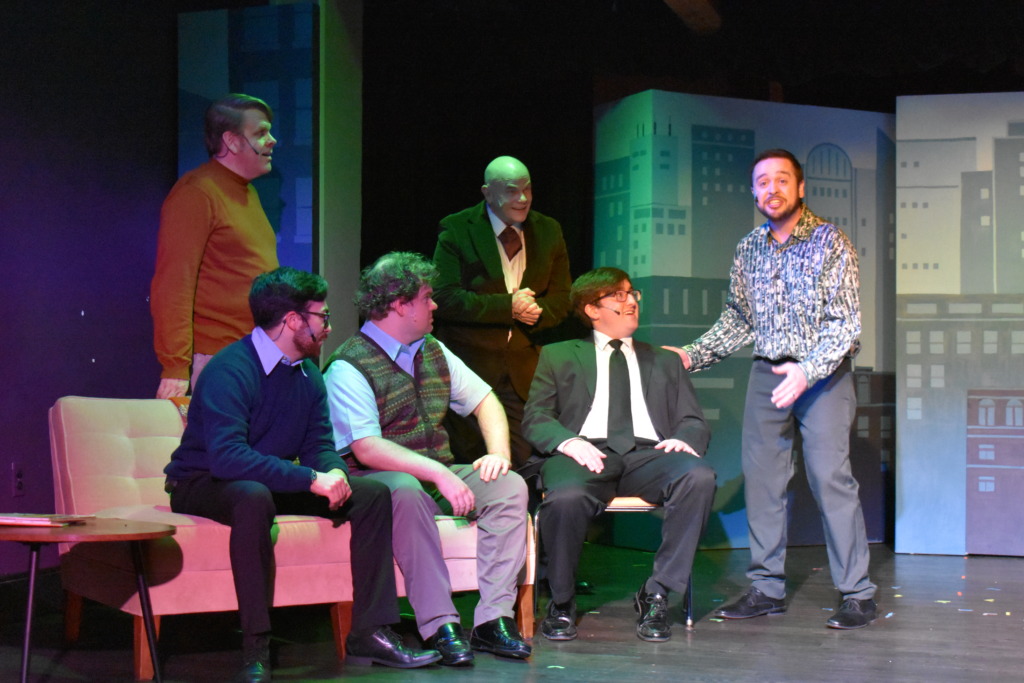
You’ve got The Husbands— Harry (Michael Rudmann), Peter (Nicholas Eden), David (Adam Esrig), Paul (Drew Looney), and Larry (Bob Bryant.) And the Wives— Sarah (Chrissy Barnett Miller), Susan (Katherine Eden), Jenny (Julia Donato), Amy (Melanie Kurstin), Joanne (Lee Michele Rosenthal.) Together they’re Bobby’s ‘friends’ and with friends like those? Honestly? Get new friends! At least in the vein of how they constantly try to partner him off, pair him up, square him away, and give him fathomless buckets of unsolicited life advice in the exclusive channel of ‘partnership.’ These ten performers are an excellent sampling of the areas finest vocal talents, fitted superbly into their respective roles, really making for a tremendously impressive production. They play well with each other and the group as a whole when singing and working through the birthday scenes; it’s a fine, fantastic showcase of community theatre at its best.
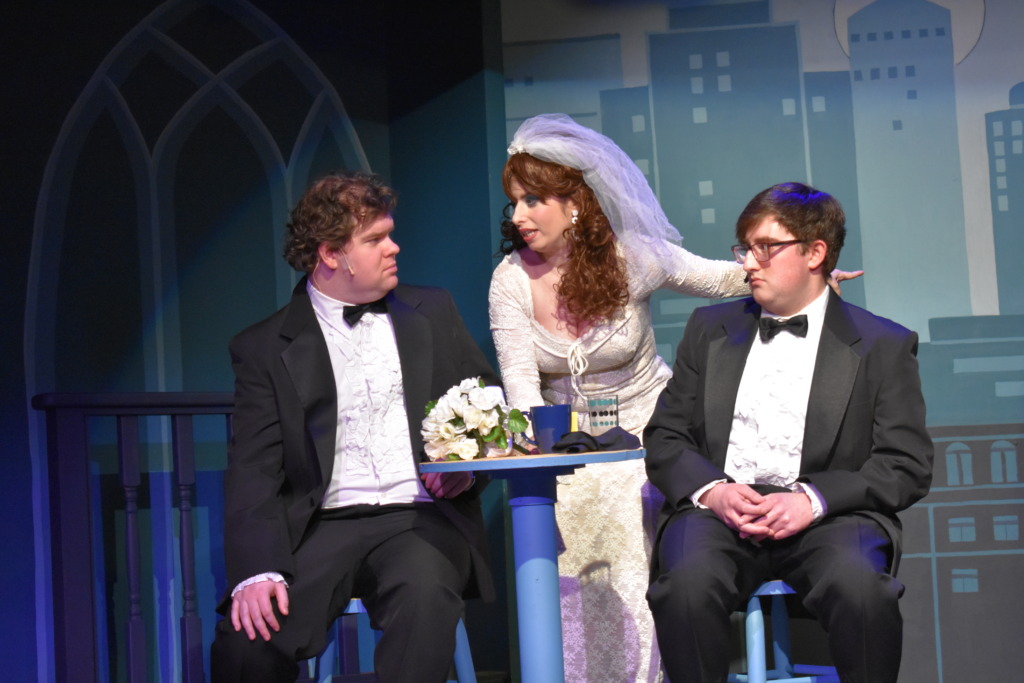
Possibly stealing the show with her high-octane comedic antics, Melanie Kurstin as Amy has the audience in stitches during “Getting Married Today.” Kurstin has exacting precision with the patter of this number, it’s done at full-speed and you never miss a single word, even as she’s throttling her body onto the floor and flinging herself all around the stage. Kurstin has bombastic facial expressions that fully portray her panic and meltdown over the situation and she possesses the epitome of comedic timing, allowing that half-breath beat to drop before engaging her face and body language for maximum laugh factor whilst being simultaneously steeped in the severity of the experience for the character. The audience sees hysterical nonsense, Amy’s on the verge of an utter, collapsible, panic-induced, terror-fueled nightmare. And the emotional fortitude she brings to the close of the scene, playing opposite Paul (Drew Looney) is striking. Looney, who is featured in that epic scene and as a part of the various husband numbers is engaging and present and his voice blends perfectly into the harmonies of “Have I Got a Girl for You” and its reprise.
Susan (Katherine Eden) and Peter (Nicholas Eden) create that divine sense of quirky awkwardness— always out on the terrace in their scene work. Katherine Eden delivers that easy, gracious southern charm, while Nicholas Eden has a slightly endearing approach to his character’s subtle aloofness. As Peter, N. Eden is a featured member of the trio for “Sorry-Grateful” and his voice strikes a beautiful balance against David and Harry in that number. K. Eden’s voice is tucked snugly away in the group numbers like “Poor Baby” and the impressive Act II opener, “Side By Side By Side.” The thing that’s most notable about Eden and Eden’s performance is the earnest affection that passes between the two of them. Even when they reveal their situation to Bobby, it feels sincere and heartfelt, like it’s coming from a place of true love, dedication, and commitment.
It’s a show set in the 70’s so there’s bound to be a stoner-scene and Jenny (Julia Donato) and David (Adam Esrig) are charged with delivering that scene (and Bobby of course; he’s omnipresent as Company is an introspective reflection on the dynamic of this single man amongst his married friends.) Their comedic antics in that scene, particularly with Donato babbling on about not believing it’s taking any effect, which juxtaposes superbly against the resonate chill that’s radiating off of Esrig’s David has the audience giggling (it’s actually a perfect primer for the laugh-palooza that the Amy and Paul character have coming a few short scene-songs later.) Donato also lends her voice as the ‘choir angel’ (who hysterically attempts to drag Amy’s butt down the aisle) to “Getting Married Today” while Esrig’s easy, smooth sound can be heard in “Sorry-Grateful” as a well-blended third of that number.
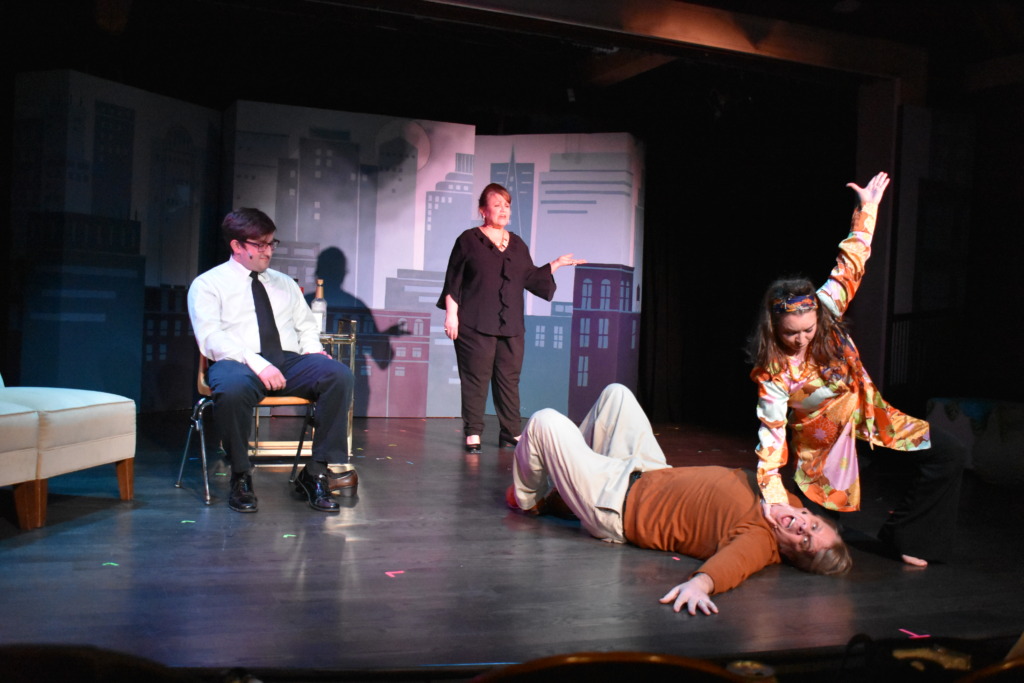
The comedic tone of the show is set early on with Sarah (Chrissy Barnett Miller) and Harry (Michael Rudmann.) The way they snipe at one another, with loving affection and dangerous verbal barbs, really lays the groundwork for the more humorous nature of the show that often gets glossed over. (Again, praises to Horn for understanding how to keep the humor alive in this production without overdoing it and balancing it exceptionally well against the emotional gravity of the performance.) While the Joanne character may do the bulk of the narrative singing for “The Little Things You Do Together” (creeping in like some romance-overlord to observe the fight choreography between Sarah and Harry) you get the first taste of Miller and Rudmann’s vocal chemistry here. Rudmann takes the vocal lead on “Sorry-Grateful” and serves as the beacon of fortitude that guides David (Esrig) and Peter (Eden) through that song. Miller lends her glorious voice to “Poor Baby” (also featuring Donato’s Jenny and the other ‘wives’) with that ever-present maternal sensation infused into each of her moments in stage, in regards to her relationship with Bobby. The character work between Miller and Rudmann has an undeniable authenticity to it, truly each of the couples connect in this fashion (to their respective partner, whether its loving or spiteful and biting) and they all find honesty in their connections to Bobby, even if their well-meant intentions are often expressed as condescension.
While Larry (Bob Bryant) is always going to take a backseat to Joanne (Lee Michele Rosenthal) if the production is done properly— and this one most certainly is— Bryant doesn’t just dissolve into the background like some supporting player. When he delivers his speech at the end of the “Ladies Who Lunch” scene, it’s powerful. It’s simple, earnest, heartfelt, and resonates so soundly with raw affection that you can’t help but shed a little tear for both his character and the dynamic between Larry and Joanne. Bryant can also be heard opposite Eden’s Peter in “Have I Got a Girl For You”, where his voice fits perfectly into that number. Elaine Stritch may have originated the role, and Patti LuPone may be the ‘more recent’ favorite, Lee Michele Rosenthal will be the DMV’s preferred Joanne after they see her performance in Company. The grit is there, the sass is there, the rough-around-the-edges rawness is more than present. And she’s still vocally stunning. It’s an impressive feat, no question. There’s an edginess in Rosenthal’s portrayal of Joanne that you get early on, even in the go-round discussion of ‘birthday surprise’ at the opening that carries consistently through the performance in even doses. She’s jaded but present, she’s bitter but alive, it’s a fascinating dichotomy. There’s a smoky smoothness to Rosenthal’s voice when she presents her opening bid of “The Little Things We Do Together”— it’s not channeling Stritch, LuPone, and the Broadway greats before her, but paying subtle homage, nodding to the path they’ve paved for her to shine in her own radiant resplendence. Vivacious and racy, sour and unfettered, when Rosenthal delivers “The Ladies Who Lunch” the audience is there for it, hands down. She’s delivering this huge vocal prowess with a commanding stage presence that has all eyes on her as if the entire set, stage, and everything around her dissolves away in a cinematic fashion and it’s just her and the song, with her belting her embittered heart out; it’s sensational.
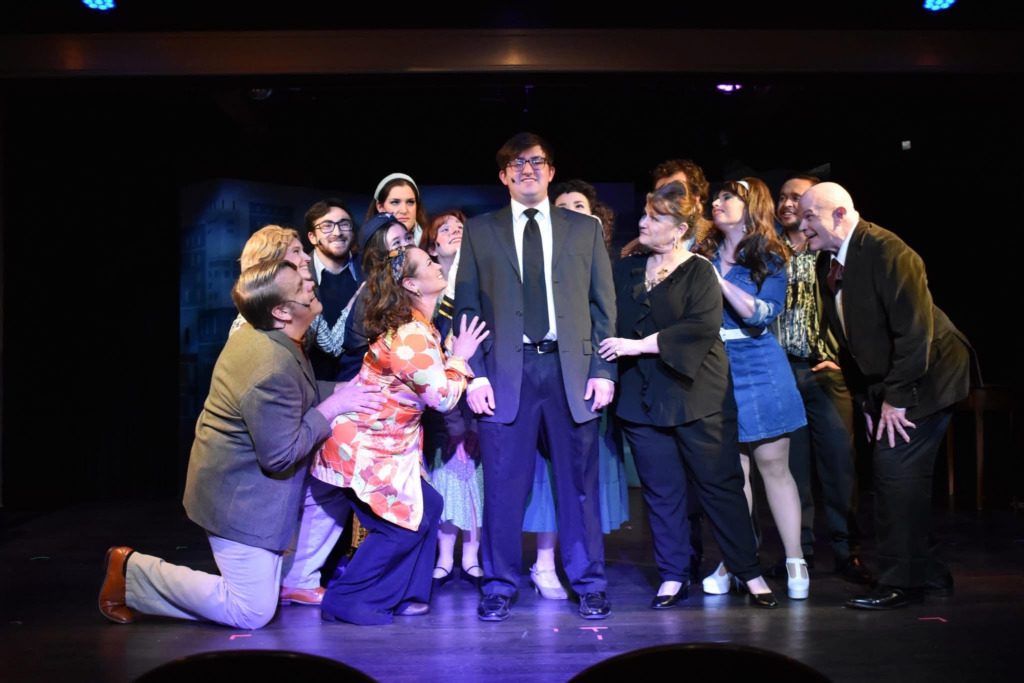
A more heartfelt, deeply dynamic, and overwhelmed Bobby, you’d be hard-pressed to find. Ethan Kahwaty takes the role to heart and delivers divinely everything Sondheim intended this character to be. His facial expressions are simply priceless, particularly when he’s slapping those “eek” ‘quick-look-happy’ grins onto his face, or the more plastic ‘I’m fine, it’s fine, everything is fine’ looks onto his overall countenance. It’s like watching those old-school anti-depressant commercials where the person holds the happy-face sign over their actual sad face and it works brilliantly to the character’s experience. The thing that sets Kahwaty’s Bobby apart is his mindfulness and overall sense of presence. He’s not phoning it in, his living in the moments, depressive though they often are. Watching him exhaust himself in “Side By Side By Side” is wildly engaging and is just one of many, many unique and powerful moments that define the depth of Bobby. There’s an emotional throughline in Kahwaty’s portrayal that never waivers; it ebbs and flows with intensity but it’s always palpable, always present. His voice is spectacular, mature and polished, reverent and emotionally connected, and perfectly suited for the range in which the character is written. “Someone is Waiting” lets Kahwaty showcase this glorious character-driven introspection and it’s not sad but rather humbling. The emotional exploration that Kahwaty successfully achieves in this role feels infinitely profound, as if he’s plumbing the emotional depths of the character’s soul, which is bottomless. The gentle earnestness in his connective duet with April feels tender and warm, his dialogue exchanges— particularly when he shuts down Joanne at the end— feels raw and real. But it’s “Being Alive” that takes the cake, steals the crown, wins the game. Kahwaty stays vocally pure during this number whilst bringing this heady emotional tidal wave crashing right out over the audience, which makes the final scene land with such profundity you’ll be in misty-eyes from the midway point of that number through to the curtain call. He’s a sensation; he gets the role; he is Bobby.
Damascus Theatre Company— have they got a show for you. Company was (and probably still is) at the bottom of my ‘most enjoyed Sondheims’ list. I say still because I doubt that a production as impressive, as emotionally engaging, and as fully heartfelt with humor and pathos, such as the one being produced here at DTC will come along in the future— but this one, this one is truly special. It’s an extraordinary, rare win for this particular title. There are two weekends remaining and it’s absolutely worth the trek to the Arts Barn; Company is inviting, it’s evocative, it’s a production that should not be missed this February.
Running Time: Approximately 2 hours and 30 minutes with one intermission
Company plays through February 22nd 2026 with Damascus Theatre Company at The Gaithersburg Arts Barn— 311 Kent Square Road in Gaithersburg, MD. For tickets please call the box office at 301-258-6394 or purchase them in advance online.
*at this performance there were still 14 singers and one body-double on stage (a truly commendable effort as the performer who had suffered temporary vocal loss was able to move expertly through the blocking and scene-work and her vocal double spoke and sang from backstage making for an excellent combination of persons wholly embracing ‘the show must go on’ mantra, in a safe and stupendous fashion.)