author: Rick Bergmann
By the Way, Meet Vera Stark Balances Screwball Comedy and Sharp Cultural Reckoning
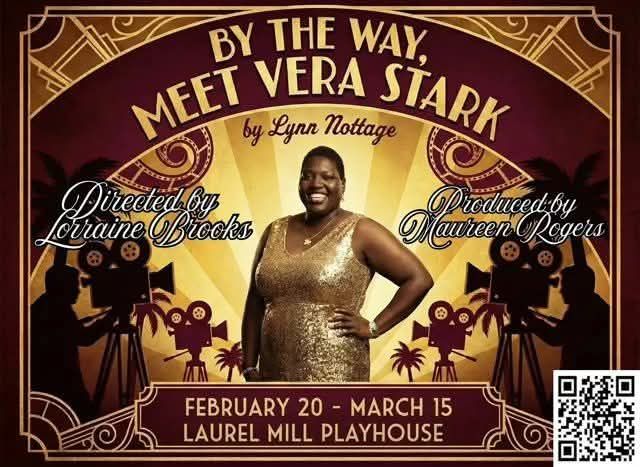
By the Way, Meet Vera Stark by Lynn Nottage, now showing at Laurel Mill Playhouse, sets out to do a lot—and nearly pulls it off. First produced in 2011, the play examines the legacy of African Americans in Hollywood, skewering racial stereotypes while reveling in the conventions of classic cinema and theater. Inspired in part by the life of actress Theresa Harris, the piece moves between sharp comedy and sobering commentary, resulting in a show that is compelling, uneven, and often very funny.
The first act, set in 1933, unfolds as a screwball comedy. We meet Vera Stark, a maid to “America’s Little Sweetie Pie,” Gloria Mitchell, who is auditioning for the lead in a new film, The Belle of New Orleans. Vera, meanwhile, has her eye on the role of Tilly, the maid in the same picture. The second act leaps forward to 1973 and 2003 and centers on a retrospective examination of Vera’s career and legacy. The contrast between these two theatrical styles creates an intriguing dichotomy—and one that almost fully clicks.
As the show opens, we are introduced to Vera and Millie, played by Jacqueline Youm and Terri Laurino, rehearsing a scene for an upcoming audition. Their banter is often sharp, funny, and true to life. Throughout the first act, we meet the rest of the ensemble, each actor taking on dual roles—one in each time period. Vera’s roommates, Lottie (Dionne Belk) and Anna Mae (Shiesha McNeil), provide much of the comic fuel. Lottie insists she’s finished with acting while still clearly chasing the next role, and Anna Mae uses her performance skills to pursue a wealthy suitor by posing as a Brazilian woman. Belk and McNeil play beautifully off one another, delivering impeccable comic timing and consistently landing laughs.
Later in the act, as Vera waits outside the studio gates for Gloria to finish her audition, she meets Leroy, a musician played by Derick John-King. King is another standout, bringing warmth and charm to a character who is immediately smitten with Vera. Always hustling, Leroy nonetheless keeps music at the center of his dreams. Alan Barnett and Paul Norfolk appear briefly as the studio head and the director of The Belle of New Orleans—the latter also being the man Anna Mae hopes to ensnare.
On opening night, the screwball energy of the first act felt slightly off. The pacing lagged at times, and scene changes lacked the snap the style demands. There were plenty of genuinely funny moments, and the audience frequently howled with laughter, but the act never quite found its full rhythm. Youm’s performance occasionally felt stiff and overly rehearsed, though at other moments she was big, bold, and genuinely hilarious. Her opening scene with Laurino crackled with sharp dialogue and a lively back-and-forth that convincingly suggested a long-shared history.
The chemistry between Dionne Belk and Shiesha McNeil, however, was electric. These two are fearless comic actresses who delighted every time they stepped onstage. In one particular scene where Vera attempts to secure the role she wants by pretending to be someone she isn’t, Youm may be the focus, but Belk steals laughs with the smallest gestures and glances in the background—a masterclass in comic support.
The second act of the play is an entirely different ball game, shifting both format and tone. The supporting cast reemerges in completely new roles, and the act opens with projected clips from The Belle of New Orleans on the back wall of the stage. As the footage fades, the audience learns that we are attending an academic panel examining the lost legacy of Vera Stark. The panel is moderated by Herb, played by Derick John-King (who portrayed Leroy in the first act), with scholars Carmen and Afua portrayed by Dionne Belk and Shiesha McNeil.
This structural shift allows these performers to showcase impressive versatility, inhabiting characters vastly different from those they played earlier. During the panel, we also see Vera’s final interview on The Brad Donovan Show, hosted by Brad Donovan (Alan Barnett). This sequence captures the feel of a stereotypical 1970s talk show, complete with a British blues artist (Paul Norfolk) and a surprise appearance by Vera’s old friend, Gloria Mitchell. It is in these scenes that Jacqueline Youm and Terri Laurino truly shine. Their chemistry is excellent, and the emotional weight of their exchanges provides a striking contrast to the lighter, farcical tone of the first act.
The second act leans more heavily into drama and reflection, thoughtfully exploring whether African Americans who accepted stereotypical roles in film ultimately helped or harmed the broader community. While many audience members may find the first act’s comedy more immediately entertaining, the deeper questions posed in the second act proved more compelling. For my money, it is here that the play truly captivated me.
Director Lorraine Brooks pulls double duty as set designer, and her work is both effective and economical. She gives her actors space to create fully realized characters while employing a smart, simple set enhanced by projections that establish location without requiring extensive scene changes. With subtle shifts in lighting and furniture, Brooks convincingly transforms the stage into Gloria’s home, the movie studio gates, and Vera’s apartment. Patrick Pase’s lighting design is particularly strong, clearly highlighting areas of action without bleeding into other parts of the set—a challenge in smaller theaters. The second act is divided into three distinct visual spaces—the academic panel, the talk show set, and the projected film clips—which allows the action to flow seamlessly without interruption. Marge McGugan’s costumes effectively evoke each time period and further ground the production in its shifting eras.
Overall, I thoroughly enjoyed By the Way, Meet Vera Stark. It is a thoughtful and engaging play that encourages reflection without hammering its message home. It is always refreshing when a community theater takes a risk on material outside the usual rotation, offering audiences something they may not have seen countless times before.
Running Time: 2 hours and 20 minutes with one intermission
By The Way, Meet Vera Stark plays through March 15th 2026 at Laurel Mill Playhouse— in the heart of historic Laurel at 508 Main Street in Laurel, MD. Tickets should be purchased in advance (though walk-ins are welcome!) and are available by calling the box office at 301-617-9906 or in advance online.
Tickets are general admission: $20; $15 for children 18 and under, seniors 65 and over, active and retired military, and American Legion Post 60 members. Showtimes are Fridays & Saturdays at 8:00pm and Sundays at 2:00pm with a post-show talkback on Sunday March 8th 2026.